AI基础设施

Search documents
关于谷歌TPU性能大涨、Meta算力投资、光模块、以太网推动Scale Up...,一文读懂Hot Chips 2025大会要点
硬AI· 2025-09-04 08:42
Core Insights - The demand for AI infrastructure is experiencing strong growth, driven by advancements in computing, memory, and networking technologies [2][5][6] - Key trends include significant performance improvements in Google's Ironwood TPU, Meta's expansion of GPU clusters, and the rise of networking technologies as critical growth points for AI infrastructure [2][4][8] Group 1: Google Ironwood TPU - Google's Ironwood TPU (TPU v6) shows a remarkable performance leap, with peak FLOPS performance increasing by approximately 10 times compared to TPU v5p, and efficiency improving by 5.6 times [5] - Ironwood features 192GB HBM3E memory and a bandwidth of 7.3TB/s, significantly up from the previous 96GB HBM2 and 2.8TB/s bandwidth [5] - The Ironwood supercluster can scale up to 9,216 chips, providing a total of 1.77PB of directly addressable HBM memory and 42.5 exaflops of FP8 computing power [5][6] Group 2: Meta's Custom Deployment - Meta's custom NVL72 system, Catalina, features a unique architecture that doubles the number of Grace CPUs to 72, enhancing memory and cache consistency [7] - The design is tailored to meet the demands of large language models and other computationally intensive applications, while also considering physical infrastructure constraints [7] Group 3: Networking Technology - Networking technology emerged as a focal point, with significant growth opportunities in both Scale Up and Scale Out domains [10] - Broadcom introduced the 51.2TB/s Tomahawk Ultra switch, designed for low-latency HPC and AI applications, marking an important opportunity for expanding their Total Addressable Market (TAM) [10][11] Group 4: Optical Technology Integration - Optical technology is becoming increasingly important, with discussions on integrating optical solutions to address power and cost challenges in AI infrastructure [14] - Lightmatter showcased its Passage M1000 AI 3D photonic interconnect, which aims to enhance connectivity and performance in AI systems [14] Group 5: AMD Product Line Expansion - AMD presented details on its MI350 GPU series, with the MI355X designed for liquid-cooled data centers and the MI350X for traditional air-cooled setups [16][17] - The MI400 series is expected to launch in 2026, with strong positioning in the inference computing market, which is growing faster than the training market [18]




摩根大通:关于谷歌TPU性能大涨、Meta算力投资、光模块、以太网推动Scale Up...,一文读懂Hot Chips 大会
美股IPO· 2025-09-04 04:24
Core Insights - The demand for AI infrastructure is experiencing strong growth, driven by advancements in computing, memory, and networking technologies [3] - Key trends include significant performance improvements in Google's Ironwood TPU, Meta's expansion of GPU clusters, and the rise of networking technologies as critical growth points [3][4][6] Group 1: AI Infrastructure Demand - AI is the primary driver of technological advancement and product demand, with a strong growth momentum in AI infrastructure [3] - The competition is expanding from pure computing power to comprehensive upgrades in networking and optical technologies [3] Group 2: Google's Ironwood TPU - Google's Ironwood TPU (TPU v6) shows a performance leap with a peak FLOPS performance increase of approximately 10 times compared to TPU v5p, and a 5.6 times improvement in efficiency [4] - Ironwood features 192GB HBM3E memory and a bandwidth of 7.3TB/s, significantly enhancing storage capacity and bandwidth [4] - The Ironwood supercluster can scale up to 9,216 chips, providing a total of 1.77PB of directly addressable HBM memory and 42.5 exaflops of FP8 computing power [4] Group 3: Meta's Custom Deployment - Meta's NVL72 system, Catalina, is designed with a unique architecture that doubles the number of Grace CPUs to 72, enhancing memory and cache consistency [6] - The custom design is based on model requirements and physical infrastructure considerations, accommodating both large language models and recommendation engines [6] Group 4: Networking Technologies - Networking technology is a focal point, with significant growth opportunities in both Scale Up and Scale Out domains [8] - Broadcom introduced the 51.2TB/s Tomahawk Ultra switch, designed for low-latency HPC and AI applications [9] - Nvidia's Spectrum-XGS Ethernet technology aims to address distributed cluster challenges across multiple data centers, offering advantages over existing Ethernet solutions [11] Group 5: Optical Technology Integration - Optical technology is highlighted as a key area, with a focus on deep integration into AI infrastructure to address power and cost challenges [12] - Lightmatter's Passage M1000 aims to solve connectivity issues with a large active photonic interconnect [12] - Ayar Labs presented its TeraPHY optical I/O chip, supporting up to 8.192TB/s bidirectional bandwidth with significantly improved power efficiency [13] Group 6: AMD Product Line Expansion - AMD detailed its MI350 GPU series, with the MI355X designed for liquid-cooled data centers and the MI350X for traditional air-cooled infrastructures [14][15] - The MI355X offers a 9% performance increase over the MI350X while maintaining the same memory capacity and bandwidth [16] - AMD's MI400 series is expected to launch in 2026, with strong positioning in the inference computing market, which is growing faster than the training market [16]

港股异动 | 芯片股集体回落 中芯国际收购中芯北方有助增厚利润 亦可满足部分股东退出需求
智通财经网· 2025-09-02 05:54
Group 1: Semiconductor Sector Performance - Semiconductor stocks collectively declined, with Shanghai Fudan down 6.03% to HKD 33.64, Hua Hong Semiconductor down 5.07% to HKD 49.46, SMIC down 4.71% to HKD 60.65, and Jingmen Semiconductor down 3.92% to HKD 0.49 [1] Group 2: SMIC Acquisition Plans - SMIC announced plans to issue additional A-shares to acquire a 49% minority stake in SMIC North, with specific details yet to be determined [1] - Minsheng Securities believes that the acquisition could significantly enhance the parent company's net profit, addressing the exit demands of major shareholders like the Big Fund Phase I, which holds a 32% stake and is nearing its recovery period [1][1] - The acquisition is expected to be completed through a combination of share issuance and cash, creating a closed loop for financing the expansion of semiconductor wafer manufacturing projects [1] Group 3: Alibaba's AI and Cloud Investment - Alibaba's capital expenditure for AI and cloud in a single quarter reached CNY 38.6 billion, with a three-year plan to invest CNY 380 billion in AI infrastructure, driving demand for computing power [2] - Under the backdrop of US-China tech tensions and risks in Nvidia's supply chain, domestic cloud providers like Alibaba may shift their demand towards domestic computing power, which could serve as a significant catalyst for the domestic computing power sector [2] - The IDC and computing power leasing segments of the industry chain are expected to benefit from this trend [2]

新股消息 | 传澜起科技(688008.SH)将于9月10日启动香港上市NDR
智通财经网· 2025-09-01 07:22
Core Viewpoint - 澜起科技 is set to launch a non-deal roadshow for its Hong Kong listing on September 10, with an expected transaction size of approximately $1 billion, aiming to list on the Hong Kong Stock Exchange in Q4 of this year [1] Company Overview - 澜起科技 is a leading fabless integrated circuit design company focused on providing innovative, reliable, and high-efficiency interconnect solutions for cloud computing and AI infrastructure [1] - According to Frost & Sullivan, 澜起科技 has become the largest supplier of memory interconnect chips globally, holding a market share of 36.8% in 2024 based on revenue [1] Financial Performance - In 2024, 澜起科技 achieved a revenue of 3.639 billion yuan, representing a year-on-year growth of 59.2%, with a net profit of 1.412 billion yuan, up 213.1% year-on-year [1] - For Q1 2025, 澜起科技 reported a revenue of 1.222 billion yuan, reflecting a year-on-year increase of 65.78%, and a net profit of 525 million yuan, which is a 135.14% year-on-year growth [1]

AI基础设施投资持续增长,英伟达展望显示需求依然强劲
Zhao Yin Guo Ji· 2025-08-29 08:48
Investment Rating - The report maintains a "Buy" rating for companies benefiting from the AI supply chain, specifically for 中际旭创 (300308 CH) and 生益科技 (600183 CH) [2][4]. Core Insights - AI infrastructure investment continues to grow, with NVIDIA's strong performance indicating sustained demand. NVIDIA's revenue for Q2 FY26 reached $46.7 billion, a 56% year-over-year increase and a 6% quarter-over-quarter increase, exceeding Bloomberg consensus estimates [2][4]. - The management expects Q3 revenue to be $54 billion, indicating a 16% quarter-over-quarter growth, which is significantly higher than previous quarters [2][4]. - The report highlights the robust growth in NVIDIA's data center revenue, which increased by 17% quarter-over-quarter, driven by high sales of Blackwell chips and strong network business growth [4]. Summary by Sections NVIDIA Performance - NVIDIA's Q2 FY26 revenue was $46.7 billion, with a Non-GAAP gross margin of 72.7%, expected to rise to around 75% by year-end [2][4]. - The net profit for Q2 was $25.8 billion, reflecting a 52% year-over-year increase and a 30% quarter-over-quarter increase [2][4]. Market Outlook - Management anticipates that the capital expenditure of the four major cloud providers will reach $600 billion by 2025, with market opportunities potentially expanding to $3-4 trillion by 2030 [4]. - The report emphasizes the improving return on investment for AI infrastructure, with GB200's ROI projected to be 10 times [4]. Geopolitical Considerations - NVIDIA's sales outlook in China remains uncertain due to geopolitical tensions, with potential revenue from H20 products estimated between $2 billion to $5 billion if conditions improve [4].
大行评级|花旗:上调英伟达目标价至210美元 上调今明财年每股盈利预测
Ge Long Hui· 2025-08-29 02:27
Core Viewpoint - Citigroup's report indicates that NVIDIA's Q2 sales of $46.5 billion and Q3 sales forecast of $54 billion meet investor expectations, with a notable gross margin guidance of 73.5%, exceeding market expectations by 70 basis points [1] Group 1: Financial Performance - NVIDIA's gross margin guidance of 73.5% aligns with Citigroup's expectations and is higher than market forecasts [1] - The company anticipates maintaining a gross margin of approximately 75% by the end of the year [1] Group 2: Market Outlook - NVIDIA projects that AI infrastructure spending will reach $3 to $4 trillion by the end of 2030, significantly higher than Citigroup and market's 2029 forecast of $2.3 trillion [1] - There is potential for data center sales to increase, particularly as NVIDIA has secured some export licenses for Chinese customers, which could yield an additional $2 to $5 billion per quarter [1] Group 3: Earnings Forecast - Citigroup has raised NVIDIA's earnings per share forecasts for fiscal years 2025 and 2026 by 2% and 10% respectively, reflecting an increase in weekly GB300 cabinet capacity by 10,000 units and improved network equipment compatibility [1] - The target price for NVIDIA has been increased from $190 to $210, maintaining a "buy" rating [1]
新莱应材(300260):Q2业绩环比改善,看好公司持续受益于半导体、液冷双增长极勘误版
Soochow Securities· 2025-08-28 08:32
Investment Rating - The report maintains an "Accumulate" rating for the company [1] Core Views - The company is expected to benefit from dual growth in the semiconductor and liquid cooling sectors [1] - The company's revenue for H1 2025 was 1.409 billion, a slight year-on-year decrease of 0.6%, with the food business showing a 5.4% increase [7] - The company has made significant progress in domestic substitution and is optimizing its customer structure in the semiconductor field [7] - The report has adjusted the net profit forecast for 2025-2027 to 255 million, 314 million, and 415 million respectively, reflecting a dynamic PE of 62, 50, and 38 times [1][7] Financial Performance Summary - Total revenue for 2023 is projected at 2.711 billion, with a year-on-year growth of 3.49% [1] - The net profit attributable to the parent company for 2023 is estimated at 235.9 million, down 31.58% year-on-year [1] - The company's gross margin for H1 2025 was 24.5%, a decrease of 1.1 percentage points year-on-year [7] - The operating cash flow for H1 2025 improved significantly, reaching 130 million, a year-on-year increase of 41.8% [7] Market Data - The closing price of the stock is 38.73 yuan, with a market capitalization of 15.794 billion [5] - The price-to-earnings ratio (P/E) is currently at 66.95 [5] - The company has a total asset-liability ratio of 60.01% [6]

英伟达财报未超预期,最强AI芯片要推中国特供版?
Hu Xiu· 2025-08-28 08:19
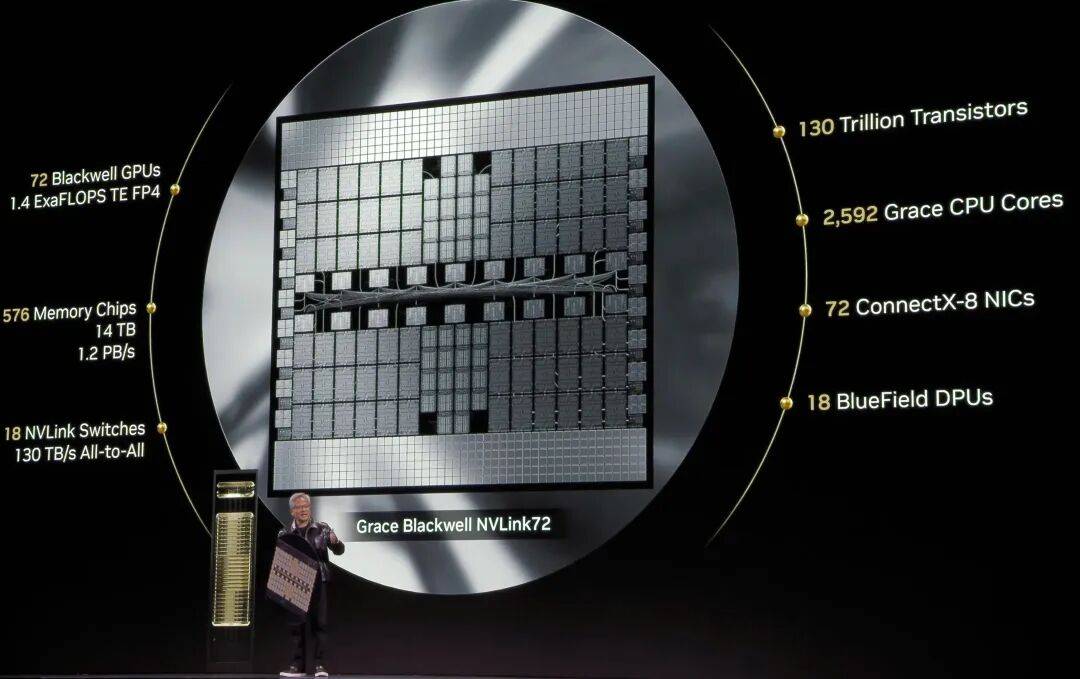
Core Insights - The article highlights the rapid rise of Cambrian Technology, surpassing Kweichow Moutai to become the highest-priced stock in A-shares, driven by the booming AI market [1] - NVIDIA's stock price fell despite impressive Q2 2026 financial results, with revenue reaching $46.7 billion, a 6% increase from Q1 and a 56% year-over-year growth [2][4] - NVIDIA's CEO Jensen Huang emphasizes the company's transformation into an AI infrastructure provider, with expectations of AI infrastructure investments reaching $3 to $4 trillion by the end of the decade [18][19] Financial Performance - NVIDIA's data center revenue was $41.1 billion, a 5% increase from Q1 and a 56% year-over-year growth [8] - The company has consistently exceeded revenue expectations, leading to heightened market expectations for future performance [4][5] - NVIDIA's revenue from the Chinese market decreased to $2.769 billion, down nearly $900 million from the previous year, with its contribution to total data center revenue dropping to a "low single-digit percentage" [24][25] Product Development - NVIDIA has developed the Blackwell NVLink 72 system, which significantly enhances performance and energy efficiency [10][11] - The new Blackwell architecture's B100/B200 series offers a 2.5x performance improvement over the H100 [11] - NVIDIA is transitioning to producing compliant chips for the Chinese market, including a reduced-performance version of the Blackwell architecture [26][27] Market Trends - The demand for AI computing power is expected to grow exponentially, driven by the proliferation of inference and intelligent AI applications [21] - NVIDIA's CUDA platform and AI model frameworks have become essential tools for AI developers, creating a strong ecosystem that is difficult for customers to replace [22][23] - The Chinese market presents a significant opportunity for NVIDIA, estimated at around $50 billion this year, with a projected annual growth rate of 50% [29] Competitive Landscape - Domestic competitors are emerging, with companies like DeepSeek developing models tailored to local chip architectures [32][33] - The introduction of new parameter formats, such as UE8M0 FP8 by DeepSeek and NVFP4 by NVIDIA, indicates a competitive push in the AI training space [36][38] - As local chip manufacturers collaborate to create compatible software stacks, confidence in domestic solutions is expected to rise [43]
美信科技:上半年公司信号类产品营收增长8.71%
Zhong Zheng Wang· 2025-08-28 03:11
Core Viewpoint - The company reported a slight revenue increase in the first half of 2025, driven by strong performance in signal products despite challenges in power magnetic components [1][2]. Group 1: Financial Performance - The company achieved a revenue of 205 million yuan, representing a year-on-year growth of 2.98% [1]. - Net profit attributable to shareholders was 10.51 million yuan [1]. - Revenue from signal magnetic components reached 148 million yuan, accounting for 72.05% of total revenue, with an 8.71% growth [1]. Group 2: Product Performance - Signal products, including network transformers and BMS transformers, continued to perform well in the 5G communication and automotive Ethernet sectors, maintaining a high gross margin [1][2]. - Revenue from power magnetic components decreased by 7.99% to 54.15 million yuan due to increased customization demands and pricing pressures from clients [1]. Group 3: Research and Development - The company focused on production automation and improving yield rates, with R&D expenses reaching an industry-leading level [2]. - The R&D team expanded to 18% of total employees, an increase of 3 percentage points from the end of 2024 [2]. - New patents were granted for Ethernet interface modules and electronic devices, with core product yield rates improving by 2.3 percentage points [2]. Group 4: Market Outlook - The global magnetic components market is projected to reach 28.6 billion USD by 2025, with significant growth in the electric vehicle and AI infrastructure sectors exceeding 20% [2]. - The company is adjusting its production capacity, positioning its Shenzhen subsidiary as a research center for automotive products and focusing its Shanghai branch on communication device customer service [2]. Group 5: Strategic Initiatives - The company aims to strengthen its position in signal products while accelerating breakthroughs in power products for emerging applications, such as the 800V high-voltage platform [3]. - Management anticipates a performance trend of lower results in the first half of the year followed by improvement in the second half, supported by seasonal demand and favorable new energy policies [3].
要有光!高盛上调“光模块双巨头”中际旭创和新易盛目标价,“暴涨后估值依然合理”
硬AI· 2025-08-27 15:37
Core Viewpoint - Goldman Sachs expresses unprecedented optimism for the leading optical module companies, Zhongji Xuchuang and Xinyi Sheng, despite their recent significant stock price increases [3][4]. Group 1: Valuation and Price Targets - Goldman Sachs has raised the 12-month target prices for Zhongji Xuchuang to RMB 392 and Xinyi Sheng to RMB 398, based on their reasonable valuations despite recent stock price surges [9][24]. - The expected price-to-earnings (P/E) ratios for 2026 are 19x for Xinyi Sheng and 23x for Zhongji Xuchuang, which align closely with their historical averages since 2021 [4][24]. Group 2: Market Drivers - Three main drivers are identified for the upward revision of target prices: ongoing supply tightness, elimination of tariff risks, and a slowdown in the rate of price declines [5][9]. - The industry is facing a tight supply of upstream components, such as 200G EML lasers, which benefits leading companies like Zhongji Xuchuang due to their scale and silicon photonics technology advantages [11]. - The recent U.S. tariff policy has exempted optical modules shipped from Thailand and Malaysia, alleviating concerns about market share loss due to trade tensions [7][14]. Group 3: Price Trends and Earnings Projections - The average selling price (ASP) decline is expected to slow from a previous forecast of 20% to 15% annually from 2025 to 2027, driven by supply constraints and increased demand for higher-end products [8][14]. - Goldman Sachs has raised its earnings per share (EPS) forecasts for Zhongji Xuchuang and Xinyi Sheng by 3% to 38% for the years 2025-2027 [9][16]. Group 4: Long-term Growth Potential - The value of optical modules in AI infrastructure is continuously increasing, with a rising "binding rate" between optical modules and GPUs [17]. - The expected spending on optical modules per dollar of GPU expenditure is projected to increase from $0.07 in the H100 GPU era to $0.12 in the next-generation Rubin Ultra GPU era [18][20]. - This trend, along with product upgrades from 800G to 1.6T and eventually to 3.2T, is expected to provide strong and sustainable revenue growth for Zhongji Xuchuang and Xinyi Sheng, mitigating concerns about cyclical risks in the industry [21]. Group 5: Reasonable Valuation Post-Price Surge - Despite significant stock price increases, Goldman Sachs believes the valuations of both companies still do not fully reflect their growth potential [23][24]. - Long-term profit forecasts suggest that peak net profits for Zhongji Xuchuang and Xinyi Sheng could reach approximately RMB 400 billion and RMB 360 billion, respectively, by 2029 [25].