
红利策略

Search documents
牛市纠结买啥
Xin Lang Ji Jin· 2025-08-21 09:43
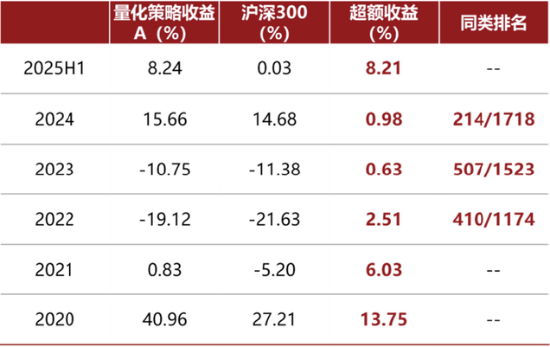
Market Overview - The Shanghai Composite Index has reached 3700 points, leading to increased market divergence among investors regarding whether to take profits or chase high-growth stocks [1] - Short-term fluctuations and pullbacks after reaching new highs are normal, and investors are advised to set stop-loss and take-profit points based on technical indicators [1] Investment Strategy - Full allocation to high-growth stocks at this market level carries significant risk due to previous substantial gains and potential valuation deviations [1] - It is recommended to allocate part of the portfolio to defensive and stable dividend-paying stocks, which provide a safety net during market volatility [1] Fund Introduction - Guotai Dividend Smart Selection (A: 024354 C: 024355) is launched in this context, combining traditional dividend strategies with a dynamic, adaptive style rotation framework [3] - The fund aims to enhance dividend strategies, allowing investors to experience better performance by adjusting the portfolio between "value dividends" and "growth dividends" based on market conditions [4] Performance Metrics - The fund manager, Dr. Gao Chongnan, has a strong background in quantitative strategies, with a successful track record in managing similar products [4] - The fund is expected to maintain a balanced approach between growth and value dividend stocks, including some holdings in high-dividend Hong Kong stocks to capture cross-market opportunities [4] Historical Performance - The Guotai Quantitative Strategy has shown strong performance since its transformation into a quantitative long-only product, with a recent two-year return of 14.40%, outperforming the benchmark and the CSI 300 index [5] - The fund has consistently outperformed the CSI 300 index over the last five complete calendar years [5] Conclusion - Guotai Dividend Smart Selection is positioned as a quality dividend product suitable for various market conditions, providing both growth potential and risk mitigation [7]

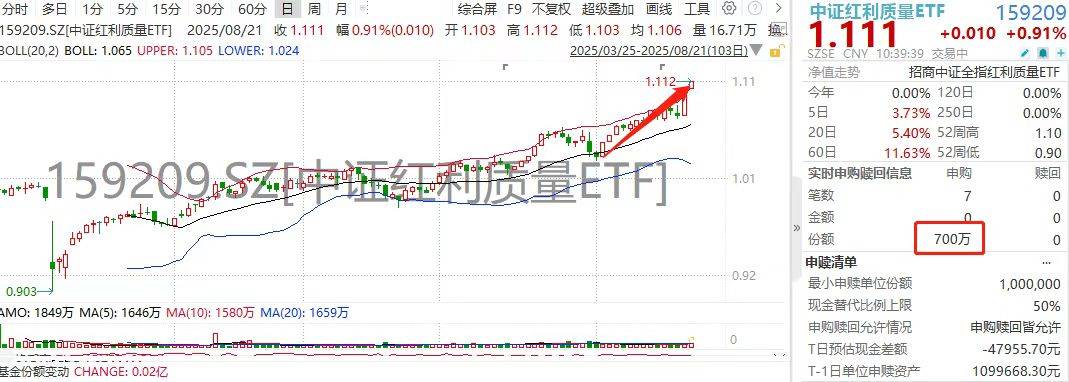
“进攻型红利”中证红利质量ETF(159209)年内第29次新高!吉比特、福耀玻璃持续走强
Sou Hu Cai Jing· 2025-08-21 03:05
风险提示:文中提及的指数成份股仅作展示,个股描述不作为任何形式的投资建议。任何在本文出现的信息(包括但不限于个股、评论、预测、图表、 指标、理论、任何形式的表述等)均只作为参考,投资人须对任何自主决定的投资行为负责。基金投资有风险,基金的过往业绩并不代表其未来表现, 基金管理人管理的其他基金的业绩并不构成基金业绩表现的保证,基金投资须谨慎。 来源:金融界 8月21日,两市持续走强。截至10时46分,中证红利质量ETF(159209)放量涨0.82%,盘中创年内第29次新高;吉比特、福耀玻璃持续拉升,资金热度不 减,据Wind Level2实时行情结合均价预估,盘中净流入约800万,截至发稿,该基金获资金连续9日净流入。 分析指出,中证红利质量指数作为传统红利策略的升级版,凭借"高ROE+稳定现金流+合理股息"的独特选股逻辑,正在成为价值投资者关注的新焦点。 该指数从沪深市场中筛选盈利能力强、分红可持续的优质企业,最新数据显示其成分股平均滚动ROE高达22%,一季度净利润增速接近50%,远超主流 宽基指数,而4%的股息率不仅跑赢十年期国债收益率两倍有余,也显著高于沪深300等大盘指数。低费率与月度分红机制的设计 ...

摩根红利优选基金投资价值分析:红利资产仍具配置价值
Shenwan Hongyuan Securities· 2025-08-20 13:44
Group 1: Report's Industry Investment Rating - Not provided in the report Group 2: Core Views of the Report - The CSI Dividend Index has long - term investment value, with a better Sharpe ratio and smaller maximum drawdown compared to other broad - based indices, and it shows both defensive and offensive characteristics [1] - Dividend assets still have medium - to - long - term allocation value due to policy promotion of corporate dividends and the low - valuation and high - dividend features of the CSI Dividend Index [22][29] - Morgan Dividend Select Fund has investment value, achieving excess returns since its establishment, and its sector selection can contribute to excess returns [1][38] Group 3: Summary by Directory 1. CSI Dividend Index: Focus on High Dividend Yield, with Dual Advantages of Return and Safety Cushion - **Index Composition and Features**: Composed of 100 stocks with high cash dividend yields, stable dividends, and good scale and liquidity in the Shanghai and Shenzhen stock markets, it is an important representative index of the dividend strategy. The index uses dividend - yield weighting, with a relatively dispersed portfolio. As of July 31, 2025, the combined weight of the top ten stocks was 16.43% [6][7][9] - **Industry and Market - Value Distribution**: The industry distribution shows "high - dividend + traditional cycle" characteristics, with the top three weighted industries being banking, coal, and transportation. The market - value distribution of the 100 constituent stocks is wide, including large - cap leading companies and small - and medium - cap companies, presenting a combination feature of "stable returns from core leaders + elastic supplementation from small - and medium - cap stocks" [11] - **Long - and Medium - Term Performance**: In the nearly 15 - year back - testing period from January 1, 2011, to August 15, 2025, the annualized return of the CSI Dividend Total Return Index was 8.34%, the Sharpe ratio was 0.41, and the maximum drawdown was - 45.66%. It outperformed other indices in terms of Sharpe ratio and maximum drawdown. It has defensive properties in falling markets and can also keep up with the market in some rising years [14][15] 2. Dividend Assets Still Have Medium - to - Long - Term Allocation Value at the Current Time - **Policy - Driven Corporate Dividends**: Since the end of 2022, regulatory authorities have continuously strengthened policies related to listed - company cash dividends. The dividend - policy system has entered a stage of rigid implementation, increasing the attractiveness of high - dividend assets and creating a medium - to - long - term allocation window for high - dividend strategies [22][23] - **Low Valuation and High Dividend**: The current price - to - book ratio (PB_LF) of the CSI Dividend Index is still below the historical average, and the price - to - earnings ratio (PE_TTM) has rebounded to near the long - term average, showing a pattern of "low PB + stabilizing and rising PE". The current dividend yield remains high, with an average of 4.67% over the past ten years, which is significantly higher than the overall level of the A - share market [29][33] 3. Analysis of the Investment Value of Morgan Dividend Select - **Fund Overview**: It is an active quantitative product under Morgan Fund, established on July 30, 2024, with a performance benchmark of 90% of the CSI Dividend Index return + 10% of the after - tax bank current deposit interest rate. The fund aims to achieve excess returns through a quantitative stock - selection model [35][38] - **Performance**: As of August 8, 2025, the cumulative return of Morgan Dividend Select A since its establishment was 17.37%, and the excess return compared to the performance benchmark was 7.47%. The maximum drawdown was comparable to the benchmark. Through sector selection, it can contribute to excess returns [38][40][41] 4. Information on the Fund Manager and Fund Managers - **Fund Manager**: Morgan Asset Management is affiliated with JPMorgan Chase & Co. It offers a diverse and complete fund product line. Its China Index and Quantitative Business provides diversified solutions for both Beta and Alpha investments [45] - **Investment Team**: The China Index and Quantitative Investment Team at Morgan Asset Management has an average of nearly 10 years of work experience. They are currently managing 6 active quantitative products, with a total scale of 1.869 billion yuan [50]
外资纷纷看好A股后市,现金流ETF嘉实(159221)早盘涨近1%,近10日合计“吸金”3.30亿元
Xin Lang Cai Jing· 2025-08-20 05:15
Group 1 - The National Index of Free Cash Flow increased by 0.75% as of August 20, 2025, with notable stock performances including Moulding Technology up 10.04% and SAIC Motor up 6.94% [1] - The cash flow ETF, Jia Shi (159221), saw a trading volume turnover of 3.55% and a transaction value of 42.57 million yuan, with an average daily transaction of 55.94 million yuan over the past month [1] - The cash flow ETF, Jia Shi, experienced a significant growth of 352 million yuan in scale over the past two weeks, ranking first among comparable funds, and has attracted a total of 330 million yuan over the last ten trading days [1] Group 2 - Morgan Stanley's latest report indicates that Chinese bank stocks are expected to rise further, benefiting from stabilized net interest margins and increased fee income, with potential gains of 15% in A-shares and 8% in Hong Kong shares [2] - UBS analysts express an optimistic outlook for foreign investment in the Chinese stock market, predicting that the liquidity-driven bull market rebound will last at least until September [2] - Shenwan Hongyuan Securities highlights that the free cash flow strategy is resilient during market volatility and is suitable for stable growth phases, while dividend strategies provide short-term cash returns during economic downturns, suggesting a complementary effect when combined [2]
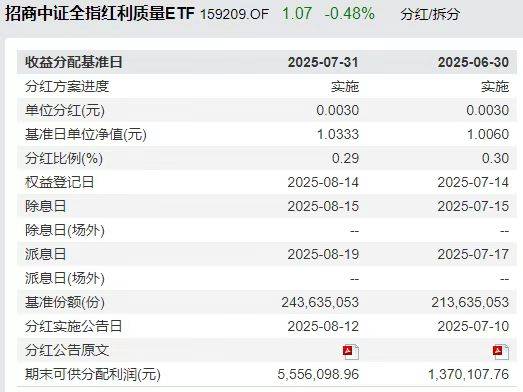
分红到账!中证红利质量ETF(159209)上市以来连续2个月分红
Sou Hu Cai Jing· 2025-08-20 01:12
Core Insights - Two dividend ETF products under China Merchants Fund have recently completed their dividend distribution, with the CSI Dividend Quality ETF (159209) distributing 0.003 yuan per share for the second consecutive month since its listing [1] - The CSI Dividend Quality ETF employs a "high dividend + high quality" dual strategy, focusing on high-quality stocks in the consumer and pharmaceutical sectors, maintaining a dividend yield of 3%-5% while outperforming mainstream broad-based indices in the long term [1] - The Hong Kong Dividend Low Volatility ETF (520550) tracks the Hang Seng Hong Kong Stock Connect High Dividend Low Volatility Index, emphasizing defensive sectors like finance and utilities, currently offering a dividend yield exceeding 5% [1] - Both products represent complementary investment strategies of "defensive stability" and "growth value," providing investors with diversified allocation tools [1] - The low management fee rate of 0.2% per year and monthly dividend assessment design enhance the long-term investment experience [1] Summary by Category Dividend Distribution - The CSI Dividend Quality ETF has a unit dividend of 0.0030 yuan, with a distribution ratio of 0.29% based on a net asset value of 1.0333 yuan [2] - The dividend distribution for the Hong Kong Dividend Low Volatility ETF also follows a similar structure, with a unit dividend of 0.0030 yuan and a distribution ratio of 0.30% based on a net asset value of 1.0060 yuan [2] Performance Metrics - The CSI Dividend Quality ETF has a historical performance that leads the market, maintaining a dividend yield of 3%-5% [1] - The Hong Kong Dividend Low Volatility ETF currently exhibits a dividend yield exceeding 5%, benefiting from the overall low valuation of the Hong Kong market [1] Investor Considerations - The two ETFs provide distinct investment paths, catering to different risk appetites and investment goals, thus offering a balanced approach for investors [1] - The management fee structure and dividend distribution frequency are designed to improve the overall investment experience for long-term holders [1]
A股两融余额重回2.1万亿元 融资余额单日暴增近400亿元
Shen Zhen Shang Bao· 2025-08-19 16:44
Core Insights - The overall financing balance in Shanghai, Shenzhen, and Beijing has been rising, with a net purchase of 92.563 billion yuan in the last six trading days as of August 18, marking a significant increase in market activity [1][2] - The margin financing balance has surpassed 2.1 trillion yuan for the first time in ten years, reaching 2.102309 trillion yuan [1][3] - The electronics, computer, and machinery sectors have seen the highest net purchases, with amounts of 8.094 billion yuan, 4.071 billion yuan, and 2.852 billion yuan respectively [1] Financing Net Purchases by Sector - On August 18, 28 out of 31 sectors recorded net purchases, with significant contributions from electronics, computer, and machinery sectors [1] - Over the past month, 29 sectors experienced net purchases, with electronics, biomedicine, and machinery leading the way with net purchases of 37.986 billion yuan, 22.105 billion yuan, and 16.634 billion yuan respectively [2][3] - The only sectors with net sales were petroleum and coal, with net sales of 0.783 billion yuan and 0.525 billion yuan respectively [2] Individual Stock Performance - On August 18, 2,325 stocks had net purchases, with 965 exceeding 10 million yuan and 97 exceeding 100 million yuan [2] - The top three stocks by net purchase on August 18 were Northern Rare Earth at 736 million yuan, followed by SMIC at 661 million yuan and ZTE at 614 million yuan [2] - Over the past month, 2,474 stocks had net purchases, with 171 exceeding 200 million yuan and 81 exceeding 500 million yuan [3] Market Sentiment and Policy Impact - The increase in margin financing balance is attributed to improved policy expectations and a rebound in market risk appetite, as indicated by the chief strategist of China Galaxy Securities [3] - Regulatory signals aimed at stabilizing the capital market have bolstered investor confidence in the medium to long-term market environment [3]
华安基金:险资再度密集举牌,红利资金面仍向好
Xin Lang Ji Jin· 2025-08-19 09:25
Market Overview and Key Insights - The Hong Kong stock market's dividend sector continued to rise last week, with the Hang Seng China Central State-Owned Enterprises Dividend Total Return Index increasing by 1.08%, the Hang Seng Index by 1.73%, and the Hang Seng Tech Index by 1.52% [1] - All sectors within the Hang Seng Index experienced gains, with healthcare leading and utilities lagging [1] - Foreign capital inflow into Hong Kong stocks remained strong, with a net inflow of HKD 38.1 billion from southbound funds last week [1] Dividend Strategy and Performance - The Hang Seng China Central State-Owned Enterprises Dividend Index offers a higher dividend yield of 5.83% compared to the CSI Dividend Index at 4.45%, with a price-to-book (PB) ratio of 0.64 and a price-to-earnings (PE) ratio of 6.99 [2] - Since the beginning of 2021, the total return index has accumulated a return of 134%, outperforming the Hang Seng Total Return Index by 124% [2] - The current low interest rate environment and weak economic recovery are favorable for dividend strategies, with strong dividend willingness and capability from central state-owned enterprises [2] ETF Overview - The Huaan Hong Kong Stock Connect Central State-Owned Enterprises Dividend ETF (code: 513920) tracks the Hang Seng China Central State-Owned Enterprises Dividend Index, reflecting the performance of high-dividend securities listed in Hong Kong with major shareholders being mainland central enterprises [3] - This ETF is the first in the market to combine the attributes of Hong Kong stocks, central enterprises, and dividends [3] ETF Performance - The Huaan Hong Kong Stock Connect Central State-Owned Enterprises Dividend ETF (513920) had a net asset value of 1.5848 billion and a trading volume of 7.81 billion last week [4] - The top ten weighted stocks in the index showed varied performance, with notable dividend yields and weekly price changes [4]

红利低波ETF(512890)逆势而动:红利策略转向个股驱动 银行调整不改长期逻辑
Xin Lang Ji Jin· 2025-08-19 04:06
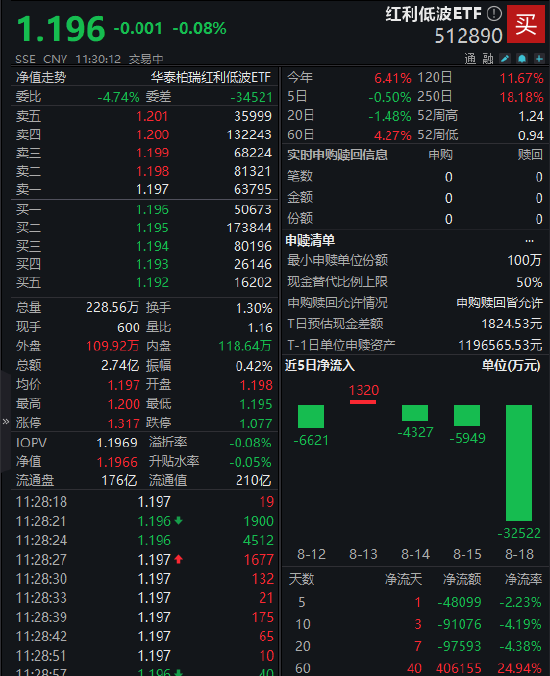
Group 1 - The core viewpoint of the news is that the market is experiencing fluctuations, with the dividend low volatility ETF (512890) showing a slight decline, while the overall market indices are rising [1][2] - The dividend low volatility ETF has seen a net outflow of 9.76 billion CNY over the past 20 trading days and 4.8 billion CNY over the last 5 days, indicating a trend of capital withdrawal [1][2] - As of August 18, 2025, the circulating scale of the dividend low volatility ETF is 210.27 billion CNY, reflecting its size in the market [1][2] Group 2 - Analysts suggest that the short-term adjustment in bank stocks is primarily a result of marginal capital pricing, but they still hold long-term investment value due to reasonable valuations and attractive dividend yields [1][3] - The dividend low volatility ETF (512890) was established on December 19, 2018, and has achieved a total return of 139.32% since its inception, indicating strong performance [3][4] - The ETF's top holdings have shown mixed performance, with some banks experiencing slight declines while others have seen minor gains, reflecting the volatility in the banking sector [4][5] Group 3 - The investment logic for the dividend sector is shifting from style-driven to stock-driven, with high-quality stocks attracting specific style capital inflows [3][5] - There is a clear asset allocation demand for high dividend stocks, as evidenced by frequent acquisitions by insurance companies and asset management companies [3][5] - Investors seeking stable returns and low-risk volatility can participate in the dividend low volatility ETF through its linked funds, even without a stock account [5]
股债冰火两重天,银行热推含权产品近1个月年化收益率超6%
2 1 Shi Ji Jing Ji Bao Dao· 2025-08-18 11:03
Core Viewpoint - The recent performance of the stock market has been strong, surpassing 3700 points, while the bond market has shown increased volatility, indicating a clear stock-bond seesaw effect. Investors are shifting their focus towards the stock market, benefiting certain "fixed income + equity" products, which have shown impressive returns due to the stock market's rise [2][7]. Group 1: Product Performance - The "Yangguang Jin Zengli Le Xiang Ri Kai 1 Hao" product has recently achieved an annualized return of 6.39% over the past month, benefiting from the stock market's upward trend [7]. - The product's equity investment ratio was reported at 4.65% as of June 30, indicating a low exposure to equities, which helps in controlling risk [7][25]. - In the first half of the year, this product outperformed many of its peers, with an average net value growth rate of 1.43%, translating to an annualized return of 2.86% [9][23]. Group 2: Risk and Return Metrics - The product received a score of 73 for performance and 90 for risk control, ranking 29th out of 968 similar products, indicating strong risk management and performance metrics [9][11]. - The product's maximum drawdown since inception was only 0.25%, showcasing its risk control capabilities [17]. - The product's Sharpe ratio stands at 6.40, reflecting a favorable risk-return profile [17]. Group 3: Investment Strategy - The product primarily invests in fixed income assets (80%-100%), with a maximum equity investment of 20%, and a focus on low-volatility preferred stocks and dividend strategies [13][25]. - The use of derivatives, such as government bond futures, is employed for risk hedging, indicating a proactive approach to managing market risks [21][22]. - The product is designed for investors with a moderate risk tolerance seeking slightly higher returns, with a minimum holding period of 30 days [25].


公募基金权益指数跟踪周报(2025.08.11-2025.08.15):沪指突破前高,科技延续强势-20250818
HWABAO SECURITIES· 2025-08-18 10:31
Group 1: Report Summary - The report is a weekly report on public - offering funds from August 11 to August 15, 2025, focusing on the performance of the equity market and public - offering funds [1][2] Group 2: Industry Investment Rating - No industry investment rating is provided in the report Group 3: Core Viewpoints - Global markets rose last week, with A - shares remaining strong, and investors' risk appetite increasing. The trading volume and margin trading balance in the two markets both exceeded 2 trillion yuan. The market has shifted from a focus on banks and micro - cap stocks to pricing based on fundamental trends, mainly in the growth - style sectors driven by industry trends [2][10] - The technology sector continued its strong performance, with growth sectors such as AI, semiconductors, and robots surging. The ChiNext Index and the STAR 50 Index rose by 8.58% and 5.53% respectively [10] - When the market pricing driver shifts from low - volatility focus to improved fundamental expectations, trading - type funds may sell the dividend sector. As anti - involution policies deepen and major infrastructure projects start, the style market may change [11] - As the Fed's interest - rate cuts approach, the pressure on the Hong Kong dollar exchange rate may ease, and Hong Kong technology and consumer assets may attract more south - bound capital inflows [4][12] - The details of the "Action Plan for Promoting the High - Quality Development of Public - Offering Funds" are being gradually implemented, including new product launches, performance comparison benchmarks, fee reforms, and information disclosure regulations [4][13] Group 4: Equity Market Review and Observation - Global markets rose last week, A - shares were strong, and investors' risk appetite increased. The trading volume and margin trading balance in the two markets exceeded 2 trillion yuan. The Shanghai Composite Index reached a four - year high, and the technology sector was strong. The ChiNext Index and the STAR 50 Index rose significantly [10] - Market hotspots were around AI PCB, CPO, non - ferrous metals, medicine, and military industries. The market has shifted to pricing fundamental trends, mainly in growth - style sectors. Institutional investors show trend - following behavior, and the clustering of funds creates a liquidity premium [10] - When the market focuses on fundamental improvements, trading - type funds may leave the dividend sector. Policy changes and project progress may lead to a turning point in the style market [11] - As the Fed's interest - rate cuts approach, the pressure on the Hong Kong dollar may ease, and Hong Kong technology and consumer assets may attract more south - bound capital due to their scarcity [12] Group 5: Public - Offering Fund Market Dynamics - In May 2025, the CSRC issued the "Action Plan for Promoting the High - Quality Development of Public - Offering Funds". Details are being implemented, including new product launches, performance comparison benchmarks, fee reforms, and information disclosure regulations [4][13] Group 6: Active Equity Fund Index Performance Tracking 6.1 Active Stock Fund Preferred Index - It rose 2.84% last week and has an accumulated excess return of 11.32% since its establishment. It selects 15 funds equally weighted, with core positions selected based on performance and style stability, and the style distribution is balanced according to the CSI Active Stock - type Fund Index [5][14][15] 6.2 Value Stock Fund Preferred Index - It rose 1.79% last week and has an accumulated excess return of - 1.75% since its establishment. It includes deep - value and quality - value styles, and selects 10 funds based on multi - period style classification, with the CSI 800 Value Index as the benchmark [5][14][17] 6.3 Balanced Stock Fund Preferred Index - It rose 3.33% last week and has an accumulated excess return of 8.41% since its establishment. It selects 10 relatively balanced and value - growth style funds, with the CSI 800 as the benchmark [5][14][20] 6.4 Growth Stock Fund Preferred Index - It rose 4.06% last week and has an accumulated excess return of 19.51% since its establishment. It selects 10 active - growth, quality - growth, and balanced - growth style funds, with the 800 Growth Index as the benchmark [5][14][23] 6.5 Pharmaceutical Stock Fund Preferred Index - It rose 5.17% last week and has an accumulated excess return of 23.51% since its establishment. It selects 15 funds based on the intersection market value of fund equity holdings and the pharmaceutical index, with a self - fitted pharmaceutical theme fund index as the benchmark [5][14][25] 6.6 Consumption Stock Fund Preferred Index - It rose 1.34% last week and has an accumulated excess return of 17.00% since its establishment. It selects 10 funds based on the intersection market value of fund equity holdings and consumption - related indices, with a self - fitted consumption theme fund index as the benchmark [5][14][31] 6.7 Technology Stock Fund Preferred Index - It rose 5.29% last week and has an accumulated excess return of 19.30% since its establishment. It selects 10 funds based on the intersection market value of fund equity holdings and technology - related indices, with a self - fitted technology theme fund index as the benchmark [5][14][34] 6.8 High - end Manufacturing Stock Fund Preferred Index - It rose 3.82% last week and has an accumulated excess return of - 2.27% since its establishment. It selects 10 funds based on the intersection market value of fund equity holdings and high - end manufacturing - related indices, with a self - fitted high - end manufacturing theme fund index as the benchmark [5][14][35] 6.9 Cyclical Stock Fund Preferred Index - It rose 1.84% last week and has an accumulated excess return of - 1.36% since its establishment. It selects 5 funds based on the intersection market value of fund equity holdings and cyclical - related indices, with a self - fitted cyclical theme fund index as the benchmark [5][14][37]