
长钱长投

Search documents
引导“长钱长投” 财政部发布险企长周期考核新规
Shang Hai Zheng Quan Bao· 2025-07-11 18:02
Core Points - The Ministry of Finance has issued a notice to guide state-owned commercial insurance companies towards long-term stable investments and to enhance the assessment of their operational efficiency over longer periods [1][2] - The notice adjusts the evaluation metrics for return on equity (ROE) and capital preservation and appreciation rates, incorporating a five-year assessment alongside annual and three-year metrics [1][2] Group 1: Adjustments in Assessment Metrics - The return on equity (ROE) assessment will now include annual, three-year, and five-year metrics with respective weights of 30%, 50%, and 20% [1] - The capital preservation and appreciation rate will also shift to include annual, three-year, and five-year metrics, maintaining the same weight distribution [1] Group 2: Investment Management and Strategy - State-owned commercial insurance companies are required to enhance asset-liability management, focusing on matching the structure, cost-benefit, and cash flow of assets and liabilities [2] - The companies should prioritize stable operations, long-term investments, and value investments while improving internal assessment mechanisms and investment portfolio management [2] - There is an emphasis on identifying high-quality investment targets that offer stable returns and potential for appreciation, thereby supporting the high-quality development of the real economy [2] Group 3: Policy Context and Trends - Recent policies have been aimed at addressing the "long money short investment" phenomenon, with a focus on long-term performance assessments for state-owned insurance companies [3] - The implementation plan from various financial authorities emphasizes a long-cycle assessment of at least three years for the performance of state-owned insurance companies, with a significant weight on longer-term metrics [3]
国有商业保险公司长周期考核机制迎重磅更新,如何影响A股市场
Bei Jing Shang Bao· 2025-07-11 15:14
Core Viewpoint - The Ministry of Finance has issued a notification to enhance the long-cycle assessment mechanism for state-owned commercial insurance companies, emphasizing the establishment of a three-year assessment framework to promote stable long-term investments [1][10][11]. Group 1: Long-Cycle Assessment Mechanism - The new assessment mechanism increases the weight of long-cycle evaluations for net asset return rate and capital preservation and appreciation rate to 70% over three and five years [1][11]. - The assessment will now include a combination of annual, three-year, and five-year indicators for net asset return rate, with respective weights of 30%, 50%, and 20% [11][12]. - The adjustment aims to reduce the impact of market volatility on annual performance evaluations, encouraging long-term, value-oriented, and stable investments [11][12]. Group 2: Impact on Investment Behavior - The long-cycle assessment is expected to shift investment decisions from short-term profit-seeking to long-term stable layouts, enhancing rationality and coherence in investment behavior [13]. - It is anticipated that the new mechanism will increase the proportion of equity investments by insurance funds, optimizing the structure of capital market investors and reducing speculative behavior [13][14]. - The focus on long-term investments will direct insurance funds towards industries aligned with national strategies, providing stable funding for technological innovation and industrial upgrades [13][14]. Group 3: Industry Response and Future Outlook - Major state-owned insurance companies have expressed support for the notification, indicating it will help them leverage their long-term capital advantages and increase equity investment ratios [14][18]. - The insurance sector is expected to see a significant increase in A-share investment ratios, with predictions suggesting it could rise to over 15% by 2025, potentially injecting substantial liquidity into the market [16][17]. - The notification encourages insurance companies to adopt a long-term perspective in asset appreciation and return, aligning with the industry's high-quality development trends [17][18].


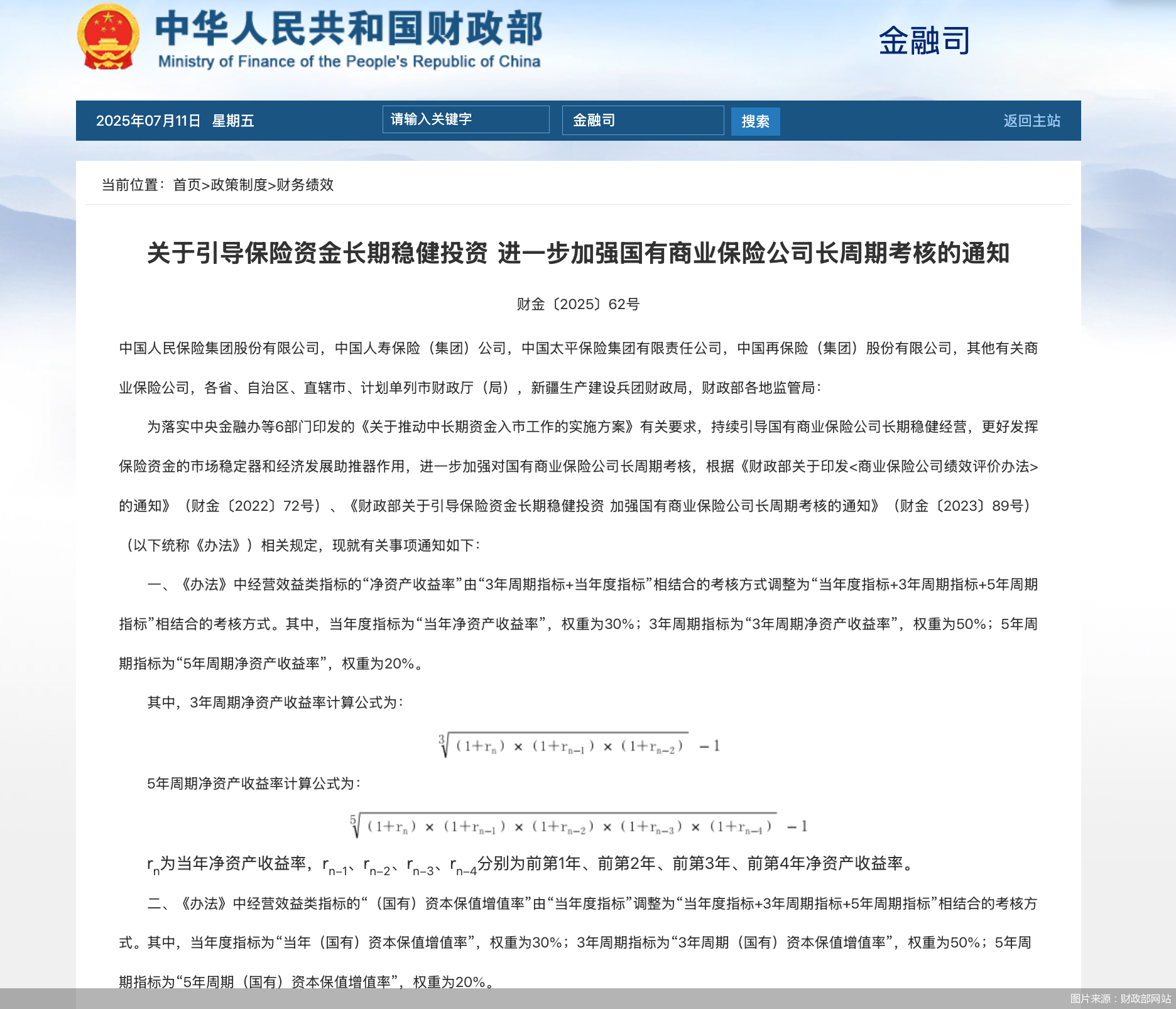
长钱长投新规出台,创业板综编制优化
Soochow Securities· 2025-07-11 13:52
Capital Market News - The Ministry of Finance has adjusted the assessment method for state-owned commercial insurance companies, changing the evaluation from a combination of "3-year cycle + current year" to "current year + 3-year cycle + 5-year cycle" for net asset return and capital preservation rates[6] - The Shenzhen Stock Exchange has revised the compilation plan for the ChiNext Composite Index, introducing a monthly removal mechanism for stocks under risk warning and an ESG negative removal mechanism for stocks rated C or below[7] Industry News - The IEA has lowered its 2025 average oil demand growth forecast from 720,000 barrels/day to 704,000 barrels/day, and for 2026 from 740,000 barrels/day to 722,000 barrels/day[8] - The adjustment of the national basic medical insurance and commercial health insurance drug directories has officially started, with the application period from July 11 to July 20, 2025[9] Market Performance - As of July 11, 2025, the STAR 50 Index rose by 1.48%, the North Exchange 50 Index by 0.90%, and the ChiNext by 0.80%[11] - The North Exchange A-share component stocks totaled 268, with an average market capitalization of 3.104 billion, and the trading volume reached 24.766 billion, up 17.20% from the previous trading day[11] Company Announcements - Jiao Da Tie Fa announced a passive dilution of shareholding for a shareholder holding over 5%, reducing their stake from 17.19% to 16.57%[21] - Qiu Guan Electric Cable won a bid for projects from the Southern Power Grid totaling 509.3263 million yuan[21] - Greeer announced plans for shareholders to reduce their holdings, with three shareholders planning to sell up to 1.4 million shares in total[21] Risk Warning - Risks include individual stock earnings falling short of expectations, intensified industry competition, increased trade friction, and policy changes not meeting expectations[23]
长钱长投新规出台,险企全面实施“当年+三年+五年”周期考核
财联社· 2025-07-11 08:19
Core Viewpoint - The recent issuance of the "Notice" by the Ministry of Finance marks a significant institutional breakthrough for long-term investment by insurance funds, enhancing the performance evaluation system for state-owned insurance companies and promoting stable and sustainable long-term investments in the capital market [1][2]. Group 1: Long-term Assessment Mechanism - The "Notice" emphasizes the establishment of a long-term assessment mechanism for state-owned insurance funds, adjusting the evaluation of net asset return and capital preservation and appreciation rates to include annual, three-year, and five-year indicators, with respective weights of 30%, 50%, and 20% [2][3]. - This adjustment aims to reduce the impact of short-term market fluctuations on performance evaluations, encouraging insurance companies to focus on long-term and value investments [2][3][4]. Group 2: Asset-Liability Management and Investment Capability - The "Notice" outlines new requirements for state-owned insurance companies regarding asset-liability management, emphasizing the need for better matching of asset and liability structures, cost-benefit analysis, and cash flow management [5]. - It also stresses the importance of stable operations and enhanced investment management capabilities, including strict adherence to internal investment management systems and improved decision-making processes [5][6]. Group 3: Increased A-share Investment - The new long-term assessment mechanism is expected to encourage insurance funds to increase their allocation to A-shares, as it allows for greater tolerance of short-term market volatility [8][9]. - If insurance funds increase their equity allocation by just 1%, it could inject approximately 350 billion yuan into the market, further enhancing the long-term investment characteristics of insurance capital [9][10]. Group 4: Potential for Growth in Specific Sectors - There is significant potential for insurance capital to increase its allocation in A-shares, with current investments being relatively low compared to the total assets under management [10][11]. - The focus on long-term assessments may lead to increased investments in blue-chip stocks and high-dividend assets, as well as in strategic emerging industries such as integrated circuits and artificial intelligence [12][13]. Group 5: Fund Companies' Role - Fund companies are expected to enhance their investment services to support insurance funds in achieving good long-term returns, developing more stable products, and improving their investment capabilities [13]. - The ongoing reforms and improvements in the capital market environment are seen as favorable for insurance funds to increase their equity investments [13].

财政部:国有险企要发挥长期资本、耐心资本的“压舱石”作用
news flash· 2025-07-11 08:07
Group 1 - The Ministry of Finance has issued a notice to guide insurance funds towards long-term and stable investments, emphasizing the principle of "long money, long investment" [1] - State-owned commercial insurance companies are required to enhance their operational management capabilities [1] - Key areas of focus include improving asset-liability management, emphasizing prudent operations, and enhancing investment management capabilities [1] Group 2 - The notice outlines specific measures such as optimizing asset allocation and balancing returns and risks [1] - It calls for the establishment of a robust internal medium to long-term assessment mechanism and better investment portfolio management [1] - The document stresses the importance of strict adherence to internal investment management systems and improving decision-making and risk assessment processes [1]
破局权益投资银行理财入市恰逢其时
Shang Hai Zheng Quan Bao· 2025-07-09 18:22
Core Viewpoint - The article emphasizes the timely entry of bank wealth management products into equity investments, highlighting their potential as "patient capital" to support the long-term development of capital markets [4][5]. Group 1: Bank Wealth Management Transformation - Bank wealth management is transitioning from a "deposit-like" manager to a long-term institutional investor, supported by new policies such as the "National Nine Articles" and the "Implementation Plan for Promoting Medium and Long-term Funds into the Market" [4]. - The current scale of bank wealth management has returned to over 30 trillion yuan, comparable to public funds, indicating a significant capacity to provide continuous capital to the market [4]. Group 2: Advantages of Long-term Capital - The long-term advantages of bank wealth management are characterized by three aspects: extended product operation periods, diversified asset allocation strategies, and an increasingly favorable policy environment [5]. - Bank wealth management funds are now positioned alongside insurance and pension funds as key players in long-term capital, with more direct investment channels in areas like REITs and private placements [5]. Group 3: Challenges in Equity Investment - Despite the potential, bank wealth management faces challenges in aligning client risk preferences, as most clients prefer low-risk products, making it difficult to sell equity products [6]. - There is a mismatch between the short duration of bank wealth management products and the long lock-in periods required for investments in projects like public REITs and private placements [7]. - The industry lacks a mature equity research system, which hinders the ability of bank wealth management to transition from fixed income to diversified investment strategies [8]. Group 4: Mechanisms for Improvement - To enhance the role of bank wealth management as long-term investors, it is essential to improve the sales channels and exit mechanisms for investment products [9]. - Recommendations include allowing internet platforms and brokerages to participate in product sales, simplifying the purchase process for higher-risk products, and establishing a share transfer platform for better liquidity [9][10]. - A shift in performance evaluation metrics is necessary, focusing on long-term returns and risk-adjusted performance rather than short-term net asset value fluctuations [10].

★A股主要股指"含科量"提升 更有效表征企业转型升级
Shang Hai Zheng Quan Bao· 2025-07-03 01:56
Group 1 - The core viewpoint of the news is the recent adjustments in index sample stocks by major exchanges, which aim to enhance the representation and investment value of indices, particularly in the context of increasing long-term capital inflows into the market [1][2] - The adjustments have led to a significant increase in the scale of ETFs linked to major indices, with an estimated total scale of approximately 1.7 trillion yuan by April 2025, representing a nearly fourfold increase since the end of 2021 [1] - The adjustments are expected to optimize index representation, trigger structural capital flows, and potentially have a positive impact on the stock prices of newly included stocks, especially those in mainstream indices [1][3] Group 2 - The recent index adjustments have increased the weight of technology stocks, reflecting a trend towards high-tech and advanced manufacturing in listed companies [2] - The adjustments in the CSI 300 index included an increase of 2 technology stocks, raising its weight by 0.18%, while the CSI 500 index saw an increase of 12 technology stocks, raising its weight by 1.82% [2] - The adjustments are likely to enhance the investment value of the North Exchange's indices, aligning with its focus on specialized and innovative companies [2][3] Group 3 - The selection criteria for index adjustments typically emphasize market capitalization and liquidity, with newly included stocks often experiencing increased buying pressure post-adjustment [3] - The recent adjustment of the CSI 300 index involved the removal of stocks from sectors like power equipment and construction materials, while adding stocks from banking, artificial intelligence, and military sectors, consistent with the current market style [3] - Historical data indicates that index adjustments lead to positive price impacts for included stocks, particularly in larger indices where passive trading can significantly influence stock prices [3][4] Group 4 - The adjustments by international index providers like MSCI are also noteworthy, with recent changes including the addition of five A-shares to the MSCI China Index, which saw immediate price increases for the newly included stocks [4]



★在更深层次打通中长期资金入市卡点堵点 促进"长钱长投"机制进一步优化
Zhong Guo Zheng Quan Bao· 2025-07-03 01:56
Core Insights - China Pacific Insurance launched a private equity fund with a target size of 20 billion yuan, emphasizing long-term investment strategies [1][2] - China Chengtong's investment in three ETFs signals confidence in the long-term value of state-owned enterprises [1][2] - The approval of the first batch of new floating fee rate funds indicates a shift towards performance-based fee structures [3][4] Group 1: Long-term Capital Inflow - There is an increasing trend of long-term capital inflow into the capital market, with social security funds, enterprise annuities, and insurance funds showing significant investment activity [1][2] - The total net purchase of A-shares by long-term funds has exceeded 200 billion yuan this year, indicating a positive cycle of capital inflow and market stability [2][5] Group 2: Policy and Regulatory Developments - The China Securities Regulatory Commission (CSRC) has introduced a floating management fee mechanism linked to fund performance, encouraging long-term investment behavior [3][4] - Recent regulatory changes allow private equity funds to shorten lock-up periods for shares, enhancing liquidity and investment efficiency [4][5] Group 3: Future Outlook - The ongoing implementation of policies aimed at promoting long-term capital participation is expected to optimize the investment environment for insurance and pension funds [5] - There is potential for further increases in the equity investment ratio of insurance funds, as regulatory limits remain significantly below current levels [5]

规模居首的中证A500ETF将更名:A500ETF华泰柏瑞
Xin Lang Ji Jin· 2025-07-02 01:09
Core Viewpoint - Huatai-PB Fund announced a name change for its A500 ETF to "A500ETF Huatai-PB," enhancing product recognition and aligning with long-term investment strategies in the A-share market [1][2]. Group 1: Product Overview - The Huatai-PB CSI A500 ETF (563360) has a scale of 20.256 billion yuan, making it the largest in its category and the only A-share ETF tracking the CSI A500 index to exceed 20 billion yuan [1]. - The new naming format aims to improve investor decision-making efficiency by clearly indicating the index and fund manager [2]. Group 2: Market Context - The A-share market has over 1,200 listed ETFs with a total scale exceeding 4.2 trillion yuan, highlighting the rapid growth of the ETF market [1]. - The number of ETFs tracking the CSI A500 index has reached 38, indicating a crowded market where standardization of product names is becoming essential [1][2]. Group 3: Long-term Investment Strategy - The A500 ETF is positioned as a key product for long-term investors, catering to the growing demand for quality A-share assets [1][2]. - The fund's management fee is set at 0.15% per year, which is among the lowest in the A-share market, enhancing the investment experience for holders [3]. Group 4: Performance and Dividends - The Huatai-PB CSI A500 ETF has a strong track record of dividends, with the Huatai-PB CSI 300 ETF (510300) achieving a record single dividend of nearly 8.4 billion yuan [3]. - The Huatai-PB Dividend ETF (510880) has distributed dividends 18 times since its inception, totaling 4.298 billion yuan, making it a leader in the dividend theme ETF category [4]. Group 5: Market Trends - The shift towards equity assets is driven by increasing wealth management needs and declining long-term interest rates, with index-based investments gaining popularity [5][6]. - The CSI A500 index focuses on 500 leading companies across various sectors, which are expected to benefit from China's modernization efforts and increased market concentration [6].
A500ETF人气单品将更名 华泰柏瑞多路并进打造“长钱长投”生态
2 1 Shi Ji Jing Ji Bao Dao· 2025-07-01 14:07
Core Viewpoint - The transformation of ETF naming conventions in the Chinese market aims to enhance product recognition and investor decision-making efficiency, reflecting a shift towards high-quality development in the public fund industry [1][2][4]. ETF Naming Standardization - The new naming format for ETFs, which includes the index name, ETF designation, and fund manager's name, is being adopted to improve product identification and appeal [2][5]. - Major fund companies like E Fund, Huaxia, and GF Fund have also initiated similar renaming efforts, indicating a broader industry trend towards standardization [2][5]. Market Context - The domestic ETF market has seen rapid growth, with over 1,200 ETFs listed and a total asset scale exceeding 4.2 trillion yuan [3]. - The proliferation of ETFs tracking the same index has led to a homogenization of product names, complicating investor choices [3]. Impact of Name Change - The renaming of Huatai-PB CSI A500 ETF to "A500ETF Huatai-PB" is expected to enhance clarity for investors regarding the fund's index and management [5]. - This change aligns with the increasing trend of long-term capital, such as insurance and pension funds, entering the market through ETFs, emphasizing the need for transparency and recognizability [5]. Long-term Investment Ecosystem - The shift towards a "long money, long investment" ecosystem is becoming a central theme in the industry, with the renaming of the ETF serving as a strategic move to strengthen index investment offerings [7]. - Huatai-PB has been focusing on providing a better investment experience through low fees and regular dividends, which is crucial for attracting long-term investors [8]. Performance and Innovation - Huatai-PB CSI A500 ETF has the largest asset scale in its category, reaching 20.256 billion yuan as of June 27, 2023, and is the only A500 ETF to surpass 20 billion yuan [2][5]. - The fund has maintained a competitive fee structure, with management fees at 0.15% per year and a custody fee of 0.05% per year, which is among the lowest in the A-share market [8]. - Huatai-PB has also launched innovative products to meet long-term investment needs, including dividend-themed ETFs [8][9].