
高股息

Search documents
今天,A股“股王”反弹,四大行集体上涨
Zhong Guo Zheng Quan Bao· 2025-10-14 04:55
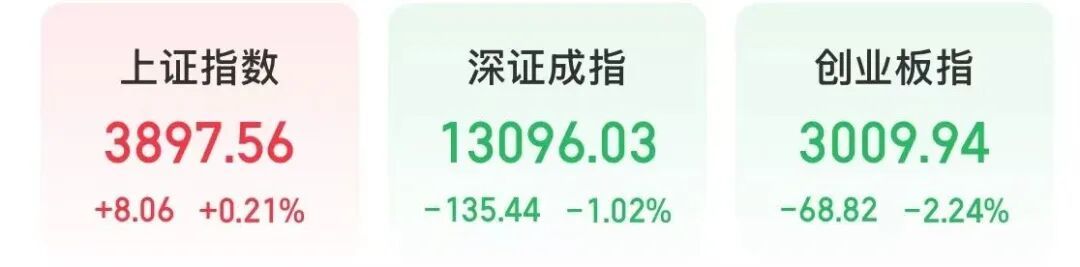
今天上午,市场风格发生明显变化,科技股大幅调整,中际旭创、中芯国际、寒武纪、华虹公司等龙头股下跌。顺周期、高股息板块迎来反弹,白酒、煤 炭、银行、保险等板块涨幅居前。四大行——工商银行、农业银行、建设银行、中国银行集体上涨,"股王"贵州茅台上涨2.35%。 截至午间收盘,上证指数上涨0.21%,深证成指下跌1.02%,创业板指下跌2.24%。 顺周期主线走强 今天上午,顺周期主线走强,白酒、工程机械、房地产等板块上涨。 具体看,白酒板块中,酒鬼酒、舍得酒业等个股涨幅居前。 | | | 白酒 | | | | --- | --- | --- | --- | --- | | | | 3053.91 2.97% | | | | 成分股 | 基金 | 简况(F10) | 资金 | 板块分析 | | 名称代码 | | 最新 | 涨幅 ◆ | 流通市值 | | 酒鬼酒 融 000799 | | 63.75 | 7.02% | 207亿 | | 王得漫业 融 600702 | | 62.23 | 6.92% | 207亿 | | 泸州老窖 ■ 000568 | | 132.76 | 4.29% | 1951亿 | | 金徽酒 ...

红利低波ETF(512890)逆势走强!60个交易日吸金近13亿 机构:短期盯高股息 中期看TMT
Xin Lang Ji Jin· 2025-10-13 09:21
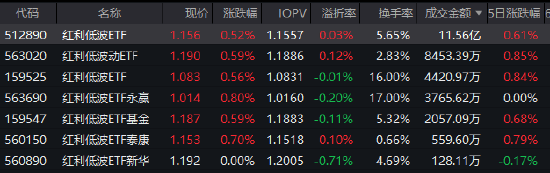
Core Viewpoint - The market experienced a collective decline in the three major stock indices on October 13, while the Science and Technology Innovation 50 index rose by over 1%. The Dividend Low Volatility ETF (512890) showed resilience, increasing by 0.52% despite the overall market downturn [1]. Fund Performance - The Dividend Low Volatility ETF (512890) had a closing price of 1.156, with a 5-day increase of 0.61% and a total trading volume of 1.156 billion CNY [2]. - Over the past five trading days, the ETF saw a net inflow of 158 million CNY, which increased to 346 million CNY over the last ten days, and reached a total net inflow of 1.299 billion CNY over the last sixty days, indicating strong investor interest [2][3]. Market Outlook - Huaxi Securities suggests that the market impact this month will be less severe than the "April 7 incident," with "turning points and opportunities" being key themes for October [4]. - The industry allocation is expected to favor sectors such as dividends, agriculture, military, and rare earths, while Everbright Securities indicates that the market may enter a phase of wide fluctuations due to multiple factors [4]. Investment Strategy - The Dividend Low Volatility ETF (512890) has achieved a cumulative return of 129.76% since its inception in December 2018, outperforming its benchmark and ranking 82nd among 502 similar products [4]. - The fund has consistently delivered positive returns for six consecutive years from 2019 to 2024, making it one of the few A-share market ETFs to achieve "annual positive returns" [4]. - Experts recommend that investors consider the Dividend Low Volatility ETF as a core component for stable returns in their asset allocation, suggesting a dollar-cost averaging approach to mitigate short-term volatility risks [4].
财信证券宏观策略周报(10.13-10.17):冷静应对海外冲击,A股市场具备较强韧性-20251012
Caixin Securities· 2025-10-12 09:49
Group 1 - The report emphasizes the resilience of the A-share market in response to overseas shocks, suggesting that the market will maintain a "slow bull" trend in the medium to long term despite short-term volatility [4][7][13] - It highlights the ongoing challenges and complexities of the US-China tariff negotiations, indicating that the market's reaction to these negotiations is expected to weaken over time [4][7][13] - The report suggests that investors should remain calm during market fluctuations and consider accumulating high-quality leading stocks during adjustments, particularly in sectors such as rare earths, military industry, domestic semiconductors, and agriculture [4][7][13] Group 2 - The A-share market's performance is reviewed, noting that the Shanghai Composite Index rose by 0.37% to close at 3,897.03 points, while the Shenzhen Component Index fell by 1.26% [16][17] - The report indicates that resource sectors, such as non-ferrous metals and coal, performed well, while high-risk technology sectors lagged behind [16][17] - It mentions that the average daily trading volume in the A-share market increased by 19.02% compared to the previous week, indicating heightened market activity [16][17] Group 3 - The report discusses the adjustment mechanism for margin financing and securities lending, stating that it will not significantly impact the long-term positive trend of technology stocks [8][12] - It notes that the recent adjustments in margin financing ratios for certain high-valuation technology stocks are aimed at mitigating leverage risks [8][12] - The report also highlights the ongoing efforts by regulatory bodies to address price competition issues in various industries, which may lead to improved pricing strategies for affected sectors [10][12] Group 4 - The report identifies structural highlights in consumer behavior during the recent National Day and Mid-Autumn Festival holiday, with a significant increase in domestic travel and spending [11] - It points out that while core cities like Beijing and Shanghai saw a rise in new home sales, the overall real estate market remains under pressure, indicating a need for continued policy support [11] - The report emphasizes the importance of monitoring the implementation of policies aimed at expanding domestic demand in light of ongoing external risks [11]
基金研究周报:双创板块迎调整,价值风格显韧性(10.6-10.10)
Wind万得· 2025-10-11 22:33
Market Overview - The A-share market showed resilience despite a divergence between growth and value styles, with the ChiNext index falling by 3.86% and the CSI 300 index rising by 0.37% [2] - The value style, represented by the CSI Dividend Index, performed well, increasing by 1.79%, indicating a preference for high dividend and low valuation stocks amid rising overseas uncertainties [2] - The average weekly increase for Wind's first-level industry was 0.15%, with 55% of sectors yielding positive returns, particularly in non-ferrous metals, coal, and steel, which rose by 4.44%, 4.41%, and 4.18% respectively [2] Fund Issuance and Performance - A total of 4 funds were issued last week, including 2 equity funds, 1 bond fund, and 1 FOF fund, with total issuance of 1.13 billion units [3][4] - The Wind All Fund Index decreased by 0.62%, with the ordinary equity fund index down by 1.58% and the mixed equity fund index down by 1.52% [3][7] Global Asset Review - Global equity markets experienced significant divergence, with major U.S. indices declining due to supply chain issues and government shutdowns, while Asian markets showed mixed results [4] - Gold prices reached a historical high, surpassing $4000 per ounce, while energy commodities showed weaker performance [4][5] Domestic Fund Market Review - The average weekly increase for Wind's first-level industry was 0.15%, with the public utility sector leading with a 3.69% increase, reflecting demand for stable cash flow and low valuation amid uncertainty [13] - The healthcare sector saw a decline of 1.21% for the week and 3.22% over the past month, attributed to internal sector differentiation and short-term sentiment [13] Bond Market Review - The bond market showed mixed performance, with long-term government bonds underperforming while mid-term bonds remained stable [15] - The 10-year government bond yield was recorded at 1.846%, reflecting a slight decrease of 1 basis point from the previous week [17]

策略周专题(2025年10月第1期):市场短期内或进入宽幅震荡阶段
EBSCN· 2025-10-11 12:44
Group 1 - The A-share market is experiencing differentiation, with most major indices declining, while the Shanghai Composite Index saw a slight increase. Mid-cap and small-cap value stocks outperformed, while large-cap growth stocks lagged behind [1][3][16] - The current valuation of the ChiNext 50 and the Wind All A indices is relatively high, with their PE (TTM) percentile exceeding 90% as of October 10, 2025 [1][13][29] Group 2 - Recent policy measures include export controls on key materials, adjustments to the technical requirements for new energy vehicle purchase tax, and the establishment of cloud computing standards [2][20][22] - Economic data from the recent National Day holiday indicates a significant increase in domestic travel, with 888 million trips taken, up 123 million from the previous year, and total spending reaching 809 billion yuan [2][23] Group 3 - The market is expected to enter a phase of wide fluctuations due to high valuations and cautious capital, compounded by uncertainties in Sino-US relations. However, upcoming policy expectations and potential interest rate cuts by the Federal Reserve may provide support [3][28][29] - Mid-term prospects for listed companies' profitability are improving, with signs of stabilization in industrial profits and a potential recovery in Q4 supported by policy measures [3][30] Group 4 - Short-term investment focus should be on high-dividend and consumer sectors, while mid-term attention should shift to TMT (Technology, Media, and Telecommunications) and advanced manufacturing sectors [4][35][36] - Historical trends suggest that during market fluctuations, sectors that previously underperformed may become more attractive, particularly high-dividend and consumer sectors such as banking and utilities [4][36]
假期经济谨慎乐观
Zhao Yin Guo Ji· 2025-10-10 10:57
Macro Overview - The report indicates a cautious optimism regarding China's holiday economy, with moderate growth in consumption during the National Day holiday. Key trends include strong performance in green, smart, and experiential consumption [2][4] - Despite recent relaxations in real estate policies in first-tier cities, the real estate market remains weak, with a significant year-on-year decline in new and second-hand housing sales [3][6] - The report anticipates that core CPI and PPI growth will rebound, alleviating deflationary pressures, with liquidity conditions expected to remain loose for at least the next two quarters [2][7][8] Internet Sector - The online travel agency (OTA) sector shows resilience, with keywords "quality" and "long-distance travel" indicating strong demand. Long-distance travel bookings on Ctrip increased by 3 percentage points year-on-year [28][30] - During the holiday, Alibaba's Fliggy reported a 14.6% year-on-year increase in average transaction value, while Tongcheng Travel noted nearly 100% growth in outbound group travel bookings [28][31] - The report maintains a "buy" rating for Ctrip (TCOM US) and Tongcheng Travel (780 HK) based on these positive trends [28] Consumer Discretionary - The report expresses a cautious outlook for retail sales growth during the 2025 National Day holiday, attributing potential risks to high base effects from 2024, lack of government subsidies, and ongoing macroeconomic pressures [32][35] - The report highlights a preference for consumer downgrade themes and high-dividend stocks, with concerns over profit margin pressures due to increased competition and discounting [32][35] Automotive Sector - The report notes a significant divergence in sales during the National Day holiday, with new energy vehicles (NEVs) outperforming traditional fuel vehicles. The introduction of popular NEV models is expected to drive order growth [6][32] - The forecast for national passenger vehicle retail and wholesale sales in 2025 has been slightly raised, reflecting better-than-expected sales in Q3 and potential pre-purchase demand for NEVs [6][32] Real Estate Sector - The report indicates that the effectiveness of real estate policies is diminishing, with a notable decline in sales volume for new and second-hand homes during the holiday period [3][6] - The report anticipates that further easing measures may be necessary to stimulate housing demand, as sales data remains weak despite policy support [3][6] Selected Stocks - The report identifies several preferred stocks, including Luckin Coffee (LKNCY US), Guoquan (2517 HK), Green Tea Group (6831 HK), Jiumaojiu (9922 HK), Li Ning (2331 HK), Bosideng (3998 HK), and JS Global Life (1691 HK) [33][41]



跨境投资洞察系列之二:中国香港股票市场特征与投资者结构分析
Ping An Securities· 2025-10-10 10:33
Market Overview - Hong Kong's stock market has become deeply "localized" and "new economy-oriented," characterized by "low valuation" and "high dividend" features[3] - As of July 2025, mainland enterprises account for 57% of the total number of listed companies and 81% of the total market capitalization in Hong Kong[11] Market Structure - The main board of the Hong Kong Stock Exchange dominates with 2,337 listed companies and a total market capitalization of 44.82 trillion HKD, while the growth enterprise market has 314 companies with a market cap of 0.07 trillion HKD[10] - The market is highly concentrated, with 69.43% of companies having a market cap between 0-20 billion HKD, contributing only 1.80% to total market capitalization[42] Valuation Characteristics - As of August 15, 2025, the Hang Seng Index has a price-to-earnings (P/E) ratio of 11.52 and a price-to-book (P/B) ratio of 1.20, both lower than major global indices[49] - The average valuation premium of A-shares over H-shares is approximately 55%, with most dual-listed companies showing significant price differences[52] Shareholder Returns - The dividend yield of the Hang Seng Index has remained stable between 3%-5% since 2020, outperforming major markets like the US and Japan[64] - Annual cash dividends in the Hong Kong market have steadily increased from under 700 billion HKD in 2015 to over 1.2 trillion HKD in 2024[68] Investor Structure - The investor base in Hong Kong is highly internationalized, with foreign investors contributing 41% of total trading volume, and institutional investors accounting for 57%[79] - The market has seen a significant shift, with the market share of mainland funds through the Stock Connect program rising to 12.29% by July 2025[81] Southbound Capital - Cumulative net inflows from southbound funds have reached 4.60 trillion HKD as of August 2025, significantly impacting market liquidity and asset pricing[94] - The proportion of southbound funds in the Hong Kong market has increased, with their trading volume accounting for nearly 50% of total market transactions in 2025[96]
2025年国庆假期出行创新高,交通运输ETF(159666)逆势走强
Mei Ri Jing Ji Xin Wen· 2025-10-10 02:40
Core Viewpoint - The A-share market experienced a collective decline on October 10, 2025, with over 2,300 stocks falling, while the transportation sector showed resilience with a notable increase in passenger flow during the National Day holiday [1] Market Performance - A-share indices opened lower, with significant declines across various sectors, particularly in electronics, power equipment, and computing, while coal, textiles, building materials, and non-bank financials led the gains [1] - The Transportation ETF (159666) was the only fund tracking the CSI Transportation Index, rising by 0.6%, with key holdings such as Dongguan Holdings increasing over 5% [1] Passenger Flow Data - The National Day and Mid-Autumn Festival holiday saw a record high in cross-regional passenger flow, totaling 2.433 billion trips over eight days, averaging a year-on-year increase of 6.3% and a 30.8% increase compared to 2019 [1] - Breakdown of passenger transport volume included: - Rail: 154 million trips (+2.6% YoY) - Road: 2.248 billion trips (+6.6% YoY) - Civil Aviation: 19.14 million trips (+3.3% YoY) - Water Transport: 11.66 million trips (+4.1% YoY) [1] Sector Characteristics - Companies within the transportation sector are characterized by high dividends, low valuations, and stable performance, encompassing logistics, railways, highways, shipping ports, and airports, reflecting the overall performance of listed companies in the A-share transportation industry [1]
华泰证券:关注“反内卷”相关周期型高股息及部分潜力型高股息品种
Di Yi Cai Jing· 2025-10-10 00:14
Core Viewpoint - The market risk appetite continued to recover in September, with the current All A ERP below the rolling 5-year average, indicating a potential for further market improvement [1] Group 1: Market Performance - The overall performance of high dividend sectors weakened, with internal valuation differentiation increasing due to the influence of the banking sector [1] - "Anti-involution" related cyclical high dividend stocks performed relatively well this month, while banks and non-bank financials showed weakness [1] Group 2: Outlook for October - The trend of market risk appetite recovery is expected to continue into October, with TMT and high-end manufacturing sectors likely to outperform high dividend sectors due to favorable fundamental factors [1] - It is recommended to focus on "anti-involution" related cyclical high dividend stocks and some potential high dividend stocks in the investment strategy [1]

长盛基金杨衡:结构性行情关注“守”与“攻”两大主线
Zhong Zheng Wang· 2025-10-09 13:29
Core Viewpoint - The future A-share market is expected to experience a systematic and steady upward trend characterized by oscillation and structural differentiation rather than a rapid and comprehensive surge [1] Market Outlook - The market is likely to face pressure from previous trapped positions at key points, leading to normal and healthy fluctuations and corrections [1] - Each quality correction is seen as a consolidation of the bottom, accumulating energy for the next phase of growth [1] Investment Strategy - Stock selection will be more important than market timing, with future opportunities becoming highly differentiated rather than a broad market rally [1] - Funds are expected to continue flowing towards assets that align with national strategies, trends of the times, and high-quality development requirements [1] Key Investment Themes - Two main themes to focus on: - Defensive: High dividend and "China Special Valuation" assets serve as market stabilizers, providing stable cash flow returns suitable for conservative allocation [1] - Offensive: Technology growth sectors represented by AI and new productive forces are seen as the hope for China's economic transformation and future growth, particularly in segments with technological breakthroughs and realizable applications [1]