信心牛

Search documents
声明:任泽平博士观点
泽平宏观· 2026-01-19 16:24
任泽平博士的观点,网上传来传去,多有谬误,本文一并更正,正本清源。 需要声明,任泽平博士新媒体矩阵号过往所写公司,仅为研究,并非投资建议,公开场合不荐 股。 做有温度、有情怀、有专业的研究,用知识推动社会进步。正心正念,坚持做长期正确的事。 感谢各界以及媒体朋友的关心,一起带着梦想去旅行。 基建"写入2020年政府工作报 - 2 - 1 12 在2020年国内最早倡导新基建,看好新能源和人工 智能。专著《新基建》荣获中组部第五届全国党员培 训创新教材奖。 任泽平 马家讲 连 你们著的《新基建》在第五届全国党员教育培训 教材展示交流活动中被评为创新教材。 中共中央组织部 2021年1月 在2021年12月常州金坛区举办的新能源产业峰会上,提出"当下不投新能源,就像20年前没买 房"。只是在2022年中期新能源大热时被媒体借势炒作上热搜,并非部分网上解读的是2022年 提出的观点。 021年12月,中国汽车工业协会、常州市金坛区人民政府、 法模如十篇安十量店照过留学生经 新能源相关的产业是未来中国经济最有希望的,最具爆发力的领域 下不给新能源 就像20年前沿理服 这是我个人的看法,这是时代的力量,我们每个人不过是 ...


声明:任泽平博士观点
泽平宏观· 2026-01-18 16:05
任泽平博士的观点,网上传来传去,多有谬误,本文一并更正,正本清源。 需要声明,任泽平博士新媒体矩阵号过往所写公司,仅为研究,并非投资建议,公开场合不荐 股。 基建"写入2020年政府工作报 - 2 - 1 12 在2020年国内最早倡导新基建,看好新能源和人工 智能。专著《新基建》荣获中组部第五届全国党员培 训创新教材奖。 做有温度、有情怀、有专业的研究,用知识推动社会进步。正心正念,坚持做长期正确的事。 感谢各界以及媒体朋友的关心,一起带着梦想去旅行。 任泽平 马家讲 连 你们著的《新基建》在第五届全国党员教育培训 教材展示交流活动中被评为创新教材。 中共中央组织部 2021年1月 在2021年12月常州金坛区举办的新能源产业峰会上,提出"当下不投新能源,就像20年前没买 房"。只是在2022年中期新能源大热时被媒体借势炒作上热搜,并非部分网上解读的是2022年 提出的观点。 021年12月,中国汽车工业协会、常州市金坛区人民政府、 法模如十篇安十量店照过留学生经 新能源相关的产业是未来中国经济最有希望的,最具爆发力的领域 下不给新能源 就像20年前沿理服 这是我个人的看法,这是时代的力量,我们每个人不过是 ...

任泽平:解析牛市成因及后续市场震动分化趋势
Sou Hu Cai Jing· 2026-01-15 12:36
Core Viewpoint - The current bull market is characterized as a "confidence bull," driven by a combination of policy support, technological advancements, and ample liquidity, leading to a market that is experiencing a short squeeze [1] Group 1: Market Dynamics - The bull market is supported by macro policy easing, a new wave of technological revolution, asset scarcity, and abundant liquidity [1] - The market is expected to experience increased volatility, oscillation, and differentiation in performance among sectors [1] Group 2: Market Behavior - Historically, bull markets often "re-emerge in despair, rise amid controversy, and collapse in euphoria," suggesting that the end of the current bull market may exceed expectations [1] - The coexistence of structural recession in traditional industries and prosperity in new technologies indicates a stark contrast in sector performance, with some sectors thriving while others struggle [1]
任泽平:A股此轮大牛市十年一遇
Xin Lang Cai Jing· 2026-01-12 23:31
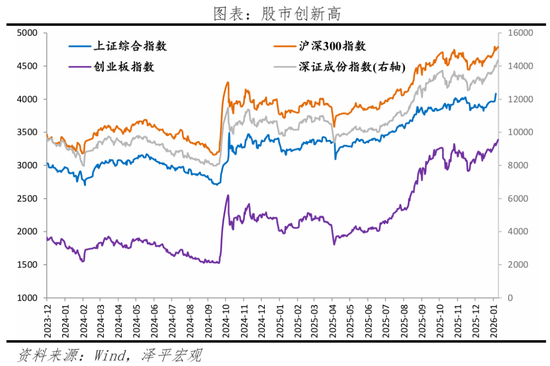
Core Viewpoint - A new bull market has begun since September 24, 2024, driven by significant policy easing, abundant liquidity, and a new wave of technological revolution, termed the "Confidence Bull" [2][31][34]. Group 1: Characteristics of the Bull Market - This bull market is described as a once-in-a-decade event, comparable to previous major bull markets in 2004-2007 and 2014-2015, with the current market driven by policy easing and technological advancements [4][34]. - The bull market has already seen substantial gains, with the Shanghai Composite Index rising by 45.5% and the ChiNext Index by 109.8% from September 24, 2024, to January 12, 2026 [7][35]. - Trading volume has surged from a few hundred billion before September 2024 to over 3 trillion recently, indicating a significant increase in market activity [9][37]. Group 2: Drivers of the Bull Market - The bull market is supported by three main drivers: continuous policy easing, a new technological revolution, and abundant liquidity, creating a combination of policy, technology, and liquidity-driven confidence [11][37]. - Policy easing has included interest rate cuts, relaxed housing market restrictions, and substantial fiscal measures, which have significantly boosted market risk appetite [38]. - The technological revolution is characterized by advancements in artificial intelligence, semiconductors, robotics, and innovative pharmaceuticals, leading to a strong performance in high-risk growth sectors [12][38]. Group 3: Historical Missions of the Bull Market - The bull market is expected to support the development of new productive forces, assist in major power competition, and repair household balance sheets, highlighting its strategic importance [15][41]. - It aims to provide capital market support for new economy sectors, which often struggle to secure financing through traditional banking systems [41]. - The bull market is also seen as a means to counteract the negative wealth effects from the real estate market downturn, with the A-share market's value increasing from under 70 trillion to over 100 trillion, creating a wealth effect of over 30 trillion [16][42]. Group 4: Future Outlook - The sustainability of the bull market will depend on continued macroeconomic policy easing, including further interest rate cuts and fiscal measures to stimulate demand [44]. - There is a need for effective regulation of leverage in the market to ensure healthy development, given the characteristics of the A-share market, which is primarily retail investor-driven [45][46]. - The potential for a long-term bull market could significantly impact the recovery of consumer spending and the real estate market, particularly in major cities [42][44].
任泽平:此轮牛市十年一遇
Sou Hu Cai Jing· 2025-12-22 23:36
Core Viewpoint - The current bull market in China is characterized as a once-in-a-decade event driven by strong policy support, a new technological revolution, and abundant liquidity, marking a significant shift in market dynamics since September 2024 [2][3][10]. Group 1: Market Characteristics - This bull market is described as epic, with historical comparisons to previous major bull markets in 2004-2007 and 2014-2015, indicating a cyclical pattern aligned with economic cycles [4][5]. - The Shanghai Composite Index has risen by 45% and the ChiNext Index by 108.6% since their respective lows last year, showcasing unprecedented growth [6]. - Trading volume has surged from a few hundred billion to over 3 trillion, and market capitalization has increased from 70 trillion to over 100 trillion, creating a wealth effect exceeding 30 trillion [7]. Group 2: Driving Forces - The bull market is propelled by three main drivers: continuous policy easing, a new technological revolution, and ample liquidity, collectively termed as "confidence bull" [8][10]. - Policy easing began with a significant shift in September 2024, leading to lower interest rates and increased support for the private sector, which has significantly boosted market risk appetite [8]. - The technological revolution, particularly in AI, semiconductors, and robotics, is driving growth in high-risk, high-reward sectors, contributing to the market's upward momentum [9]. Group 3: Historical Missions - This bull market is seen as fulfilling three historical missions: supporting the development of new productive forces, aiding in major power competition, and repairing household balance sheets [11]. - The capital market's growth is crucial for financing new economy sectors, which struggle to secure funding through traditional banking systems [11]. - The recovery of household balance sheets is vital, as the stock market's rise has countered significant wealth losses from the real estate market, potentially stimulating consumer spending [12][14]. Group 4: Future Prospects - The outlook for the bull market hinges on whether it can sustain a "slow bull" trend, which would significantly benefit hard technology development and economic recovery [16]. - Continued macroeconomic policy easing, including interest rate cuts and fiscal stimulus, is essential for maintaining market momentum [16]. - The unique characteristics of the A-share market, dominated by retail investors, necessitate careful regulation to manage volatility and leverage [17].
2025科技与资本报告|4000点,“喜芯厌酒”
Bei Jing Shang Bao· 2025-12-14 08:26
Group 1 - The core viewpoint is that the technology sector is pivotal for economic growth, with the capital market increasingly supporting innovation, leading to a bullish trend in the stock market by 2025 [1][17][21] - The A-share market returned to 4000 points in October 2025, with the information technology sector experiencing a 50% increase year-to-date, making it the top-performing industry [4][12] - The number of listed companies in the electronics sector has grown from 299 at the end of 2020 to 489 by November 2025, with the total market capitalization share rising from 7.45% to 11.76% [5][6] Group 2 - The average price-to-earnings (P/E) ratio for the Shanghai Composite Index and the ChiNext Index is 16.36 and 49.18, respectively, indicating a favorable environment for medium to long-term investments [7] - The capital market is witnessing a surge in technology IPOs, with over 90% of new listings being technology-related or high-tech companies [10][11] - The introduction of policies supporting unprofitable technology companies to access the capital market has opened new avenues for funding and growth [14][15][16] Group 3 - The Hong Kong stock market is also becoming a hotspot for hard technology companies, with a significant number of tech firms applying for listings [12] - The growth of technology companies is supported by a series of government policies aimed at fostering innovation and financial support for the tech sector [16][18] - The capital market's role in facilitating the transition from innovation to commercialization is crucial, as it provides necessary funding for high-risk, high-reward tech startups [20]


任泽平:牛市终结有四大关键信号
水皮More· 2025-11-25 09:35
Core Viewpoint - The article discusses the recent bullish trend in A-shares and Hong Kong stocks, termed as the "confidence bull market," driven by unprecedented macro policies since late September 2024. It analyzes historical bull markets to identify patterns and potential future trends. Summary by Sections Historical Bull Market Analysis - A-shares bull markets require three conditions: policy shift, capital inflow, and low valuations, often starting amid controversy and despair, with subsequent valuation recovery igniting investor enthusiasm [6] - Bull markets typically go through three phases: policy-driven, capital-driven, and fundamental-driven, with initial phases less correlated to economic fundamentals [6] - A-shares exhibit characteristics of short bull markets and long bear markets, with average bull market duration of 17 months compared to 27 months for bear markets [8] - The first half of bull markets is primarily driven by policy, emotion, and capital, averaging 6.3 months with a 59% increase, led by technology, finance, and cyclical sectors [8] - Adjustments occur during bull markets due to various factors, but these adjustments can lead to stronger subsequent performance if sufficiently deep [8] - The second half of bull markets relies on economic fundamentals and corporate profit recovery, often resulting in a "Davis double play" where both valuation and profit growth occur [8] - Bull markets typically end due to high valuations, policy shifts, lack of new capital inflow, or economic recovery failures, often culminating in panic selling [8] Signals of Bull Market End - Key signals indicating the end of a bull market include: 1. Overvaluation, where high market valuations cannot be supported by corporate earnings [10] 2. Policy shifts that historically have marked the end of previous bull markets [13] 3. Absence of new capital inflow, which is crucial for sustaining market growth [15] 4. Economic recovery failures, where declining economic indicators lead to market downturns [15] Future Outlook - The current "confidence bull market" mirrors past bull markets, initiated during economic downturns with policy shifts and low valuations. Continued macro policy easing, interest rate cuts, and support for private sector investment are essential for sustaining this bull market [17] - The article emphasizes the need for careful monitoring of market signals, particularly regarding high valuations and potential policy changes, to avoid pitfalls associated with previous market cycles [18]
A股“924”行情一周年:总市值增长36万亿元,逾1400只个股涨超100%,你翻倍了吗?
Hua Xia Shi Bao· 2025-09-22 00:16
Core Viewpoint - The A-share market has experienced a significant bull market since September 24, 2024, with major indices showing substantial increases, driven by policy support and improved investor confidence [2][3][8]. Market Performance - As of September 19, 2025, the Shanghai Composite Index has risen approximately 39%, the Shenzhen Component Index has increased by 61.7%, and the ChiNext Index has surged by about 102% since the "924" market [2][3][4]. - The total market capitalization of A-shares reached approximately 104 trillion yuan, an increase of about 36 trillion yuan over the past year [4][5]. Policy Impact - A series of financial policies announced by the central government aimed at supporting economic growth have been pivotal in boosting market confidence [2][3]. - The Central Political Bureau's meeting emphasized the need to enhance capital market support and facilitate the entry of long-term funds [3][8]. Sector Performance - All 30 sectors tracked by Citic have seen gains, with the top five sectors being Communication, Electronics, Computer, Media, and Machinery, which have risen approximately 120%, 108%, 99%, 88%, and 76% respectively [5][6]. - Conversely, sectors such as Coal, Oil & Gas, and Utilities have shown minimal growth, with increases ranging from 6% to 24% [5]. Individual Stock Performance - Over 5200 stocks have risen since the "924" market, with 3089 stocks increasing by more than 50% and 424 stocks rising over 200% [5][6]. - The top three performing stocks have seen increases exceeding 1000%, with the highest being 1710% [7]. Future Outlook - Analysts suggest that the current bull market has further potential, despite recent adjustments due to external factors like the Federal Reserve's interest rate changes [8][9]. - The market is expected to undergo structural shifts, with a potential focus on cyclical sectors and technology branches in the upcoming quarters [9].

任泽平:这一轮牛市将是十年一遇,有三大驱动力、三大使命和两大前景
Sou Hu Cai Jing· 2025-08-26 01:11
Group 1 - The current bull market is characterized as a "confidence bull" driven by significant policy easing, abundant liquidity, and a new wave of technological revolution, marking it as a once-in-a-decade opportunity [4][8][13] - Since September 2024, the bull market has seen substantial gains, with the Shanghai Composite Index rising 45% from its low of 2690, and the ChiNext Index increasing by 79%, indicating a strong market recovery [5][7] - The market capitalization has surged from 70 trillion to 100 trillion, creating a wealth effect of 30 trillion, which is significant for the overall economy [7][8] Group 2 - Three main drivers of the current bull market include continuous policy easing, a new technological revolution, and ample liquidity, which together create a robust "confidence bull" [8][13] - The policy shift since September 2024 has led to a historic turning point, with measures such as interest rate cuts, relaxed housing market restrictions, and significant infrastructure investments boosting market sentiment [8][11] - The technological revolution, particularly in sectors like artificial intelligence and semiconductors, is expected to lead the market, reflecting a shift towards new economic drivers [11][14] Group 3 - The bull market is expected to fulfill three historical missions: supporting the development of new productive forces, aiding in major power competition, and repairing household balance sheets [13][15] - The capital market's prosperity is crucial for financing new economy sectors, which are often unable to secure funding through traditional banking systems due to their high-tech and asset-light nature [15][18] - The recovery of household balance sheets is vital, as the stock market's growth can offset the wealth loss from the real estate market, potentially leading to increased consumer spending [15][18] Group 4 - The outlook for the bull market includes the potential for a prolonged "slow bull" phase, which would significantly benefit hard technology development and economic recovery [17][19] - Continuous macroeconomic policy easing is essential for sustaining the bull market, with expectations for further interest rate cuts and fiscal stimulus to support demand [17][19] - The unique characteristics of the A-share market, dominated by retail investors, necessitate careful regulation of leverage to ensure healthy market development [18][19]

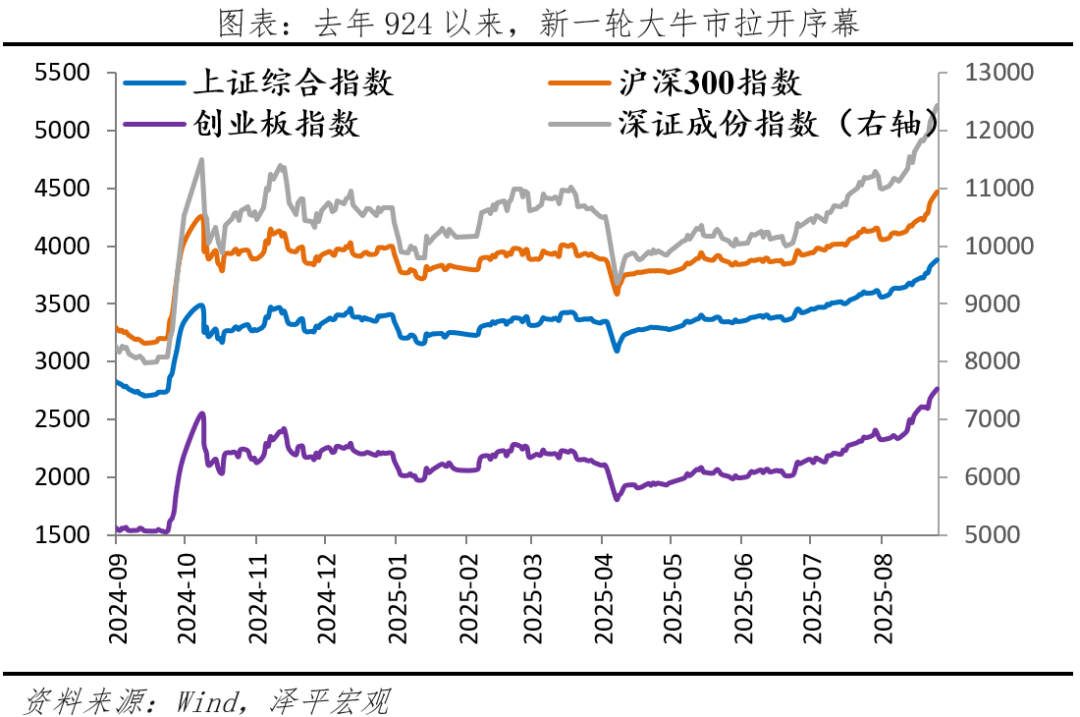
“信心牛”再创新高,未来向何处去?
水皮More· 2025-08-19 10:00
Core Viewpoint - The article presents a bullish outlook on Chinese assets, emphasizing a "confidence bull market" driven by significant policy easing and a shift in market sentiment towards optimism regarding China's economic prospects [5][7]. Group 1: Market Trends and Economic Outlook - Recent performance of A-shares and Hong Kong stocks indicates a new high for RMB assets, coinciding with a weakening US dollar and strengthening RMB exchange rate [6]. - The "confidence bull market" is characterized by a historical turning point in macroeconomic policy, marked by substantial fiscal measures and ongoing monetary easing [7]. - The concept of "East rises, West falls" suggests that while the US economy may face a downturn, China's economy is poised for recovery and renewed interest from global investors [7]. Group 2: Historical Analysis of A-share Bull Markets - A-share bull markets require three conditions for initiation: policy shift, capital inflow, and low valuations, often emerging from periods of despair [9]. - Bull markets typically progress through three phases: policy-driven, capital-driven, and fundamental-driven, with initial phases less correlated to economic fundamentals [9][10]. - The average duration of A-share bull markets is 17.35 months, significantly shorter than the average bear market duration of 27.12 months [10]. Group 3: Economic Trends for the Second Half of 2025 - The global economic landscape is marked by rising populism and de-globalization, with Chinese companies increasingly seeking opportunities abroad [12]. - The ongoing US-China tariff conflict is expected to persist, with potential escalations in trade tensions [12]. - Key factors for economic recovery include restoring confidence in the private sector, stabilizing the real estate market, and fostering new productive forces [12][13]. Group 4: Strategies for Economic Recovery - The concept of "debt migration" is proposed as a strategy to revitalize the economy, emphasizing the need for government and central bank intervention to alleviate debt burdens on households and businesses [14][15]. - Three main strategies for implementing "debt migration" include aggressive economic policies, establishing a housing reserve bank, and investing in new infrastructure [16][17]. - The focus on new infrastructure aims to support long-term economic growth and technological advancement, positioning China for future economic prosperity [16][17].