
化工行业反内卷

Search documents
化工行业“反内卷”势在必行,关注化工龙头ETF(516220)
Mei Ri Jing Ji Xin Wen· 2025-09-29 05:30
Core Viewpoint - The chemical industry is facing significant capacity issues, necessitating a "de-involution" approach, as highlighted by the recent policy announcement from the Ministry of Industry and Information Technology and six other departments regarding the "Petrochemical and Chemical Industry Stabilization Growth Work Plan (2025-2026)" [1] Group 1: Policy and Industry Response - The new policy emphasizes the inclusion of the petrochemical and chemical industry in key support areas for new manufacturing technology transformation pilot cities [1] - It aims to strengthen the planning and layout guidance for major petrochemical and modern coal chemical projects while strictly controlling new refining capacity [1] - The policy encourages the expansion of applications for new energy battery materials, carbon fibers and their composites, and special engineering plastics [1] Group 2: Global Industry Trends - The global chemical industry is currently facing challenges such as weak downstream demand and supply-demand imbalances, leading to a wave of capacity reduction initiatives [1] - Major overseas companies, including Shell and Dow, have proactively adjusted their production lines in response to these challenges [1] Group 3: Market Outlook - Chemical prices are highly correlated with the Producer Price Index (PPI) and are expected to benefit significantly from the implementation of "de-involution" policies [1] - Recent trends indicate a recovery in the prices of certain chemical products, enhancing expectations for fundamental improvements in the industry [1] - The high-end transformation of the chemical industry is anticipated to open up valuation space, with leading chemical companies likely to benefit more during market clearing processes [1] - Continued attention is recommended for leading chemical ETFs (516220) to seize investment opportunities [1]
百合花(603823):国产颜料龙头受益“反内卷”,光刻胶业务开启第二增长曲线
Shanghai Securities· 2025-09-27 11:34
Group 1 - The company is rated as "Buy" for the first time [1][8] - The report highlights that the company is a leading domestic organic pigment manufacturer with a comprehensive product range covering various application fields [6][15] - The company achieved a revenue of 1.125 billion yuan in the first half of 2025, a year-on-year decrease of 7.83%, and a net profit of 100 million yuan, a decrease of 0.67% [6][28] Group 2 - The report emphasizes that the "anti-involution" policies introduced in 2025 will benefit the chemical industry by eliminating outdated production capacity, which will enhance the company's profitability [6][36] - The company is expanding into the photoresist pigment business, which is expected to open a second growth curve, with significant market potential in the LCD and semiconductor sectors [7][49] - The company plans to invest 1 billion yuan in a project to produce high-performance organic pigments and related materials, with an expected annual output value of approximately 1.7 billion yuan upon completion [7][58] Group 3 - The company forecasts net profits for 2025, 2026, and 2027 to be 207 million, 275 million, and 427 million yuan respectively, representing year-on-year growth rates of 17.64%, 32.96%, and 55.04% [8][60] - The projected revenue for 2025, 2026, and 2027 is 25.20 billion, 27.13 billion, and 30.92 billion yuan, with corresponding year-on-year growth rates of 4.86%, 7.67%, and 13.96% [8][61] - The company maintains a competitive edge with a gross margin of 21.34% in 2025, which is expected to increase to 25.85% by 2027 [33][61]

002513 5连板!化工股逆势爆发!
Zheng Quan Shi Bao Wang· 2025-09-26 04:58
Market Overview - A-shares opened lower and experienced fluctuations, with the ChiNext Index dropping over 1% and falling below 3200 points, while the Shanghai Composite Index and Shenzhen Component Index also showed slight declines [1] - The number of rising stocks slightly exceeded that of falling stocks, with trading volume showing a slight contraction trend [1] Wind Power Industry - Wind power concept stocks surged in the morning, with the sector index increasing over 5%, reaching a two-and-a-half-year high, and half-day trading volume exceeding the previous day's total [3] - Morgan Stanley reported a positive outlook for China's wind power industry, expecting an average annual new installed capacity of over 110GW during the 14th Five-Year Plan period, with potential to reach about 120GW between 2028 and 2030 [6] - The establishment of a self-regulatory agreement among 12 major wind turbine manufacturers has contributed to a more stable development of the wind power industry [6] - Wood Mackenzie forecasts unprecedented growth in the global wind power market over the next decade, with an expected new installed capacity of 170GW in 2025 [7] Chemical Industry - The chemical sector saw a collective rise, particularly in the chemical fiber segment, with the index increasing over 4% and half-day trading volume surpassing the previous day's total [8] - After a "de-involution" inventory cycle in 2024, signs of profit recovery are evident in some chemical sub-industries [9] - Prices of refrigerants have significantly increased, with R32, R134a, and R125 prices rising by 44.19%, 22.35%, and 8.33% respectively [11] - The demand for modified plastics is surging due to the growth in humanoid robots and lightweight requirements for new energy vehicles, leading to rapid earnings growth for related companies [11] - The potassium fertilizer market has seen substantial revenue growth due to reduced overseas supply and strong global demand, with four listed potassium fertilizer companies reporting a combined revenue increase of 3.57% [11][12]

大化工- 反内卷专题汇报
2025-09-26 02:28
Summary of the Chemical Industry Conference Call Industry Overview - The conference call focuses on the chemical industry and its current challenges and strategies in response to overcapacity and profitability issues [1][2][3]. Key Points and Arguments - **Profitability Improvement**: Industry associations are implementing collaborative mechanisms to bring poorly performing products back to cost levels, allowing leading companies to stabilize their profit margins [1][2]. - **Unified Market Policy**: The aim is to eliminate underperforming companies and standardize new entrants to prevent regional capacity transfer, promoting orderly industry development and enhancing product price elasticity [1][2]. - **Investment Growth**: From 2020 to 2024, the chemical industry is expected to see a compound annual growth rate (CAGR) of 13.6% in fixed asset investment, significantly higher than previous cycles. However, demand decline has led to a notable reduction in capacity utilization and profitability [1][3]. - **Export Limitations**: Relying solely on exports is insufficient to alleviate domestic overcapacity. Anti-dumping measures from various countries restrict export capabilities, making it unrealistic to rely on international markets to absorb excess supply [4]. - **Dual Strategy for Overcapacity**: The industry will adopt a dual approach of strong regulation and soft constraints to manage capacity and achieve supply-demand balance. This includes policy support and collaborative mechanisms to control production and pricing [5]. - **Complexity of the Chemical Sector**: The chemical industry is complex, with various sub-sectors and products, making supply-side reforms challenging. The need for extensive data collection contributes to the slow pace of reform [6][9]. - **Historical Context**: The current phase of supply-side reform differs from 2016 due to technological barriers, diminishing returns on new investments, and increased project approval difficulties under a unified market policy [9]. Important but Overlooked Content - **Environmental and Safety Regulations**: Historical regulatory measures, such as environmental inspections and energy consumption controls, have significantly impacted supply dynamics in the chemical sector [8]. - **Investment Selection Criteria**: When selecting investment targets, focus on industries with historical collaboration, moderate scale, high concentration, low new capacity ratio, and advantageous production pathways to enhance investment returns [10].
两股涨停,化工板块强势反攻!供需双侧利好叠加,机构高呼行业正步入长景气周期
Xin Lang Ji Jin· 2025-09-24 12:15
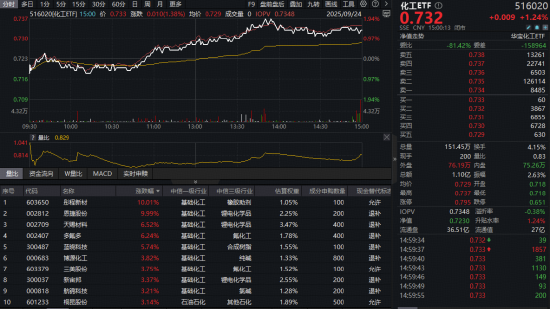
Group 1 - The chemical sector has regained momentum, with the Chemical ETF (516020) experiencing a rise of 1.24% by the end of trading on September 24, following a brief period of low-level fluctuations [1][2] - Key stocks in the sector include rubber additives, lithium batteries, and fluorochemicals, with notable gains from Tongcheng New Materials and Enjie Co., both hitting the daily limit, and Tianqi Materials and Duofluoride rising over 6% [1][2] - Recent government policies aim to promote high-quality development in energy equipment, which is expected to improve supply and demand dynamics in the chemical industry [1][3] Group 2 - Guojin Securities indicates that the current policy direction provides a phase-specific industry tone, with many chemical sectors at price profit bottoms and low inventory levels, making them sensitive to marginal changes [3] - The Chemical ETF (516020) has a price-to-book ratio of 2.21, which is at a low point historically, suggesting a favorable long-term investment opportunity [3] - Future measures are expected to lead to a significant slowdown in global chemical industry capacity expansion, potentially transforming the Chinese chemical industry into a high dividend yield sector [4] Group 3 - The chemical sector is anticipated to enter a new long-term prosperity cycle, driven by recent policy initiatives aimed at improving supply-demand dynamics [4] - The Chemical ETF (516020) tracks the CSI segmented chemical industry index, with nearly 50% of its holdings in large-cap leading stocks, providing a robust investment opportunity in the sector [5] - Investors can also consider the Chemical ETF linked funds for efficient exposure to the chemical sector [5]



化工板块飘红!政策+估值双轮驱动,板块配置性价比凸显!
Xin Lang Ji Jin· 2025-09-19 06:41
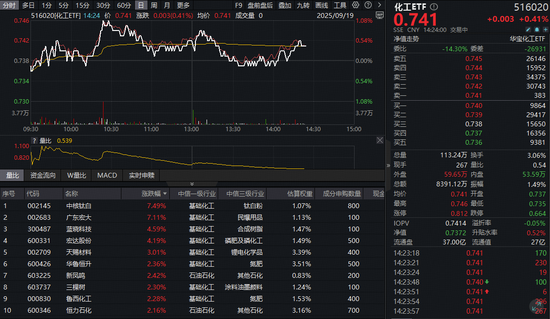
Core Viewpoint - The chemical sector is experiencing a rebound, with the chemical ETF (516020) showing positive performance, indicating potential investment opportunities in the industry [1][2]. Group 1: Market Performance - The chemical ETF (516020) rose by 0.41% during the trading session, reflecting a positive trend in the chemical sector [1][2]. - Key stocks such as Zhongke Titanium, Guangdong Hongda, and others saw significant gains, with Zhongke Titanium and Guangdong Hongda both increasing over 7% [1]. Group 2: Industry Dynamics - The chemical industry is currently at a low point, necessitating the elimination of outdated production capacity to optimize supply-demand dynamics and promote high-quality development [1][4]. - There is a notable decline in new construction projects in the basic chemical sector, with the ratio of construction projects to fixed assets dropping to 24% in Q2 2025, down from 37% in Q2 2023, indicating a slowdown in capacity expansion [4]. Group 3: Future Outlook - The "anti-involution" movement within the chemical industry is expected to lead to a re-evaluation of the sector, with potential measures to slow global capacity expansion [5]. - The chemical sector is characterized by strong cash flow, and a slowdown in expansion could significantly enhance potential dividend yields, transforming the sector from a cash drain to a cash generator [5]. - The chemical ETF (516020) provides a diversified investment opportunity across various sub-sectors, with nearly 50% of its holdings in large-cap stocks, allowing investors to capitalize on strong market leaders [6].


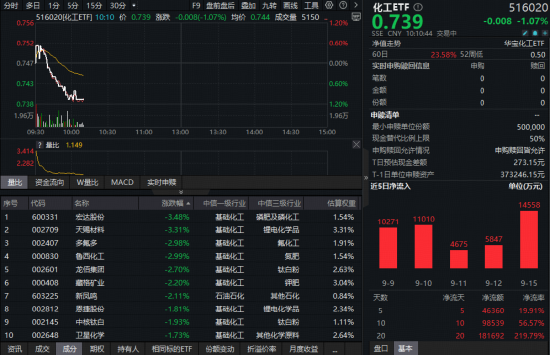
掘金低位!化工板块又陷回调,化工ETF(516020)跌超1%,资金大举加码!
Xin Lang Ji Jin· 2025-09-16 02:24
Group 1 - The chemical sector experienced a pullback on September 16, with the chemical ETF (516020) briefly rising before quickly declining, closing down 1.07% [1][2] - Key stocks in the sector, including Hongda Co. and Tianci Materials, saw significant declines, with both dropping over 3%, while several others fell more than 2%, negatively impacting the sector's performance [1][2] - The chemical ETF (516020) has seen substantial capital inflows recently, with a single-day inflow of 140 million yuan and cumulative inflows exceeding 980 million yuan over the last 10 trading days [1][2] Group 2 - As of the last closing, the chemical ETF (516020) had a price-to-book ratio of 2.29, which is at a low point within the last decade, indicating a favorable long-term investment opportunity [3] - Analysts suggest that the "anti-involution" measures in China may lead to a re-evaluation of the chemical industry, potentially slowing global capacity expansion and enhancing dividend yields for companies in the sector [4] - The Chinese chemical industry is expected to leverage its competitive advantages in cost and technology to fill gaps in the international supply chain, reshaping the global chemical industry landscape [4] Group 3 - The chemical ETF (516020) tracks the CSI segmented chemical industry index, covering various sub-sectors, with nearly 50% of its holdings in large-cap leading stocks, providing investors with opportunities to capitalize on strong performers [5] - Investors can also access the chemical sector through the chemical ETF linked funds (Class A 012537/Class C 012538) for broader exposure [5]
化工行业“反内卷”加速,供需结构有望修复,石化ETF(159731)处于较好布局时点
Mei Ri Jing Ji Xin Wen· 2025-09-05 04:45
Group 1 - The A-share market experienced an upward trend on September 5, with the China Securities Petrochemical Industry Index rising over 1.1%, led by stocks such as Bluestar Technology, Lianhong New Science, and Salt Lake Co. [1] - The Petrochemical ETF (159731) followed the index's upward movement, indicating a favorable investment timing. [1] - The Yulong Petrochemical Refining and Chemical Integration Project (Phase I), constructed by CIMC Group's CIMC Tianda, has completed its automated vertical warehouse, with a total investment of nearly 350 million yuan, marking a significant advancement in high-end logistics equipment manufacturing and intelligent system integration in China. [1] Group 2 - Guosen Securities anticipates that the chemical industry will see a recovery in profitability as state-owned enterprises actively control capacity and regulatory bodies manage the approval of new backward capacity, leading to an accelerated clearance of inefficient capacity and an improved supply-demand structure. [1] - By September 2025, a recovery in overseas demand for certain chemical products and further domestic demand growth is expected, indicating a potential improvement in the medium to long-term supply-demand landscape. [1] - The top three industries in the China Securities Petrochemical Industry Index, according to Shenwan's secondary industry classification, are refining and trading (27.12%), chemical products (23.87%), and agricultural chemical products (19.75%), which are likely to benefit from policies aimed at reducing competition, structural adjustments, and eliminating backward capacity. [1]
石化化工行业“反内卷”相关政策措施有望出台 | 投研报告
Zhong Guo Neng Yuan Wang· 2025-09-02 02:40
Core Viewpoint - The petrochemical industry is facing significant "involution" competition, leading to a decline in profit margins, with the industry's operating income profit margin dropping from 8.03% in 2021 to 4.85% in 2024, and remaining low in the first half of 2025 [2] Oil Price Trends - In August, international crude oil prices showed volatility, with Brent crude settling from $69.7 per barrel at the beginning of the month to $68.1 per barrel at the end, and WTI crude dropping from $67.3 per barrel to $64.2 per barrel [4] - The supply side is influenced by OPEC+ production increases and a decline in U.S. shale oil rig counts, while weak global economic recovery suppresses long-term demand expectations [4] - Short-term support comes from seasonal fuel consumption and a temporary decrease in U.S. crude oil inventories [4] Industry Competition and Policy - The petrochemical industry is experiencing severe competition characterized by low-quality and homogeneous products, resulting in a profit squeeze due to over-investment and capacity oversupply [2][3] - The central government has initiated comprehensive rectification measures to address these issues, including promoting self-discipline, enhancing innovation, and eliminating non-compliant capacities based on energy efficiency and environmental standards [2][3] Chemical Industry Performance - As of August 29, the China Chemical Products Price Index (CCPI) reported 4009 points, a 7.48% decrease from January 2's 4333 points, indicating a slight decline in major chemical product prices [5] - The manufacturing PMI for July was 49.3%, down 0.4 percentage points from the previous month, indicating a slowdown in market demand [5] Sector-Specific Insights - **Refining and Petrochemicals**: China's refining capacity exceeds 1 billion tons/year, but utilization rates have dropped to around 70%, indicating structural oversupply [6] - **Ethylene**: The domestic ethylene market faces a supply gap, with a projected net import of 214.5 million tons in 2024, highlighting the competitive advantage of low-cost production methods [7] - **Potash Fertilizer**: Recommended investment in YK International, which has significant potash resources and is expanding production capacity [8] - **Fluorochemicals**: The market for refrigerants is expected to see price increases due to structural changes and demand growth in liquid cooling technologies [9] Investment Recommendations - The investment portfolio includes YK International, China Petroleum, Baofeng Energy, Juhua Co., and Satellite Chemical, focusing on sectors with improving supply-demand dynamics and unique resource attributes [10]
招商化工行业周报2025年8月第4周:正丁醇、氢氟酸价格涨幅居前,建议关注化工龙头白马-20250901
CMS· 2025-09-01 08:05
Investment Rating - The report maintains a recommendation for the chemical industry, indicating a positive outlook for the sector [6]. Core Viewpoints - The report highlights the significant price increases in n-butanol (+4.92%) and hydrofluoric acid (+4.7%), suggesting a focus on leading chemical companies [4][5]. - It emphasizes the performance of the chemical sector, which outperformed the broader market, with a weekly increase of 1.11% compared to the Shanghai Composite Index's 0.83% [2][13]. - The report identifies key sub-industries that have shown strong performance, including fluorochemicals and refrigerants (+15.56%) and fiberglass (+14.2%) [3][17]. Summary by Sections Industry Performance - In the fourth week of August, the chemical sector saw 21 sub-industries rise while 10 declined, with notable gains in fluorochemicals and refrigerants [3][17]. - The dynamic PE ratio for the chemical sector is reported at 28.83, significantly above the average PE of 5.81 since 2015 [2][13]. Chemical Prices and Spreads - The report lists the top five products with the highest price increases, including n-butanol (+4.92%) and hydrofluoric acid (+4.7%), while liquid chlorine saw the largest drop (-37.78%) [4][20]. - It also details the price spreads, with PX (naphtha-based) showing a remarkable increase of 406.83% [4][40]. Inventory Changes - Significant inventory increases were noted for key products, with epoxy propane rising by 31.15% and ethylene glycol by 18.56% [5][62]. Recommendations - The report suggests focusing on industry leaders such as Wanhua Chemical, which is expected to benefit from the chemical industry's recovery, and Dawn Co., which has made critical advancements in DVA products [5].