双碳政策

Search documents
为苏南新能源企业搭起风险“防护网”
Qi Huo Ri Bao Wang· 2026-02-11 16:21
Core Insights - The global photovoltaic (PV) installation capacity has grown at an average annual rate of over 24% in the past five years, while the prices of PV products have continued to decline, leading to intensified price competition and volatility in raw material prices [1] - A leading photovoltaic welding strip company in Jiangsu has managed to maintain stable operations despite significant increases in copper and tin prices in 2024, thanks to a risk management strategy involving financial derivatives [1] - The collaboration between the company and Nanhua Futures has sparked a trend in risk management within the Suzhou industrial cluster, highlighting the importance of financial tools in mitigating raw material price risks [2][3] Company Overview - The photovoltaic welding strip company, recognized as a high-tech enterprise in Jiangsu, has established itself as an industry benchmark due to its high market share [1] - The company faced challenges related to raw material price fluctuations, particularly for copper and tin, which could lead to increased costs and inventory management difficulties [1] - Following a year of risk management service from Nanhua Futures, the company signed a contract for investment consulting, indicating a deepening partnership [1] Risk Management Strategy - Nanhua Futures provided a tailored hedging solution focusing on futures and options to address the company's concerns about rising raw material prices and inventory management [1] - The company successfully locked in sufficient quantities of copper and tin ahead of price surges in 2024, demonstrating effective risk mitigation [2] - The introduction of new risk hedging tools, such as options, has further strengthened the company's risk management capabilities [2] Industry Impact - The successful collaboration between the company and Nanhua Futures has influenced other enterprises in the Suzhou industrial cluster, leading to increased interest in financial derivatives for risk management [2][3] - Local banks and securities firms have facilitated the connection between industries and futures institutions, accelerating the adoption of risk management practices [2] - The ongoing "dual carbon" policy and the transition in the photovoltaic sector underscore the necessity for robust risk management as a core competency for companies in the renewable energy industry [3]

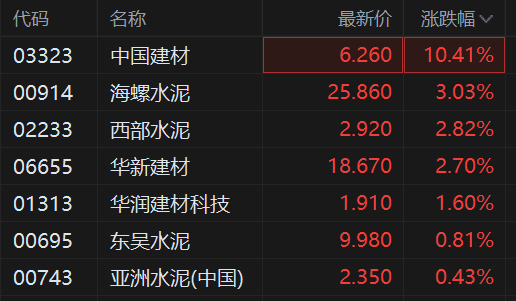
建材水泥股拉升,中国建材大涨超10%领衔,刷新阶段新高
Ge Long Hui· 2026-02-11 03:45
Group 1 - The core viewpoint of the article highlights a significant rise in Hong Kong's cement stocks, particularly China National Building Material, which surged over 10%, reaching a new high since April 2023 [1] - Longjiang Securities' research report recommends the cement sector due to policy-driven opportunities, indicating clear signals of an industry bottom after four consecutive years of demand decline and price competition [1] - The report suggests that the industry's profitability bottom is evident for the second half of 2025, with many mid-tier and lower-tier companies potentially facing substantial losses [1] Group 2 - The report mentions that overproduction management has led to a decrease in capacity, with production starting according to registered capacity from 2026, which may improve industry capacity utilization by 10-15 percentage points [1] - The dual carbon policy may see intensified implementation starting in 2026, which could lead to a steeper cost curve, benefiting leading companies with lower energy consumption [1] - Recently, China National Building Material secured four consecutive overseas contracts, including a project for the renovation of a cement raw material warehouse in France, showcasing the company's comprehensive service capabilities in cement engineering asset renovation and upgrades [1]

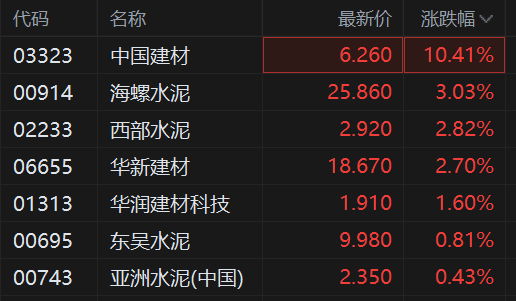
港股异动丨建材水泥股拉升,中国建材大涨超10%领衔,刷新阶段新高
Ge Long Hui A P P· 2026-02-11 03:03
Group 1 - The core viewpoint of the article highlights a significant rise in Hong Kong's cement and building materials stocks, particularly China National Building Material, which surged over 10%, reaching a new high since April 2023 [1] - Longjiang Securities' research report recommends the cement sector due to policy-driven opportunities, indicating clear signals of industry bottoming after four consecutive years of demand decline and price competition [1] - The report suggests that the industry's profitability bottom is evident for the second half of 2025, with many mid-tier and lower-tier companies potentially facing substantial losses [1] Group 2 - The article notes that production overcapacity management has led to a decrease in capacity, with a projected increase in industry capacity utilization rates by 10-15 percentage points starting in 2026, based on registered production capacity [1] - The dual carbon policy may see intensified implementation in 2026, which could lead to a steeper cost curve, benefiting leading companies with lower energy consumption [1] - Recently, China National Building Material secured four consecutive overseas contracts, including a project for the renovation of a cement raw material depot in France, showcasing the company's comprehensive service capabilities in cement engineering asset renovation and upgrades [1]
建材周专题2026W6:电子布上涨加速,关注水泥板块政策催化
Changjiang Securities· 2026-02-11 00:27
Investment Rating - The industry investment rating is "Positive" and maintained [7] Core Views - The report highlights the accelerating price increase of electronic fabrics and emphasizes the policy-driven opportunities in the cement sector [2][3] - The cement sector is showing clear signs of bottoming out after four consecutive years of demand decline and price competition, with significant losses reported among mid-tier and lower-tier companies [4] - The report identifies three main lines for 2026: the stock chain, the African chain, and the AI chain, suggesting a shift in demand dynamics and growth opportunities [6] Summary by Sections Cement Sector - Cement shipments have decreased month-on-month, with an average shipment rate of approximately 24% in key regions, down about 8 percentage points [5][18] - The average price of cement is reported at 346.61 yuan/ton, reflecting a month-on-month decrease of 3.23 yuan/ton and a year-on-year decrease of 53.06 yuan/ton [19] - The report anticipates a potential increase in industry capacity utilization by 10-15 percentage points starting in 2026 due to production constraints and policy enforcement [4] Glass Sector - The domestic float glass market is experiencing a slowdown in demand, with overall inventory pressure remaining significant, and production capacity is reported at 208 lines with a daily melting capacity of 148,935 tons [27] - The average price of glass is 63.18 yuan/weight box, with a slight month-on-month increase of 0.06 yuan/weight box, but a year-on-year decrease of 12.01 yuan/weight box [30] Electronic Fabrics - The report notes a dual prosperity in electronic fabrics, with AI electronic fabrics benefiting from high demand and price increases due to supply shortages [3] - Ordinary electronic fabrics are also expected to see continued price increases due to weaving machine bottlenecks, with significant price hikes noted in February [3] Future Outlook - The report suggests focusing on the stock chain, which is expected to drive demand back to historical highs, particularly in the renovation market, which currently accounts for about 50% of demand [6] - The African chain is highlighted as an undervalued growth opportunity, with companies like Keda Manufacturing and Huaxin Cement positioned for growth in the African market [6]
涤纶长丝价差快速提升,化工产业右侧布局窗口期,化工行业ETF易方达(516570)低费率投资工具备受关注
Xin Lang Cai Jing· 2026-02-10 03:34
Fundamental Analysis - The polyester fiber industry chain is experiencing a rapid increase in price differentials between upstream and downstream [1] - Upstream costs are providing stronger support, boosting market sentiment and driving prices of PX, MEG, and PTA higher [1] - In the polyester filament sector, the number of maintenance shutdowns is increasing, leading to a decline in market supply; however, as the year-end approaches, terminal demand is weakening and the operating rate of downstream weaving machines is declining faster [1] - There is potential for price increases in the "golden March and silver April" period as the polyester filament industry is expected to resume operations and replenish inventory after the New Year [1] Industry Trends - The petrochemical industry is a core segment of China's resource-manufacturing re-inflation and is gradually entering a window for layout in the right phase of the industrial fundamentals [1] - Long-cycle fixed asset investment is turning negative, and the capacity cycle is expected to peak, potentially releasing profit space [1] - Policy measures are exceeding expectations; during the "14th Five-Year Plan" period, the implementation of dual control of carbon emissions is gradually revealing capacity ceilings for high-energy-consuming enterprises, benefiting the chemical supply side [1] - The upward trend in overseas demand, coupled with capacity exit, is expected to shift exports from quantity-driven to both quantity and price increases, leading to a revaluation of China's industrial strength [1] - The demand side is benefiting from the transformation of old and new driving forces, with new chemical materials expected to inject elasticity into industrial demand improvement [1] Related Products - The chemical industry ETF E Fund (516570, linked funds: 020104/020105) directly benefits from dual carbon policies and price increases in core segments such as PX-PTA-filament industry, with a latest scale of 1.7 billion [2] Packaging Leaders - A one-click package for leading companies in the petrochemical and basic chemical industries is available [3] Fee Advantages - The combined management and custody fee is only 0.20% per year, significantly lower than similar products, resulting in lower investment costs [4] Elasticity Advantages - The index composition focuses on sub-industries with clear supply-demand improvements, making it sensitive to price increase expectations [5]
PVC能否成为下一个电解铝?
Hua Er Jie Jian Wen· 2026-02-09 09:28
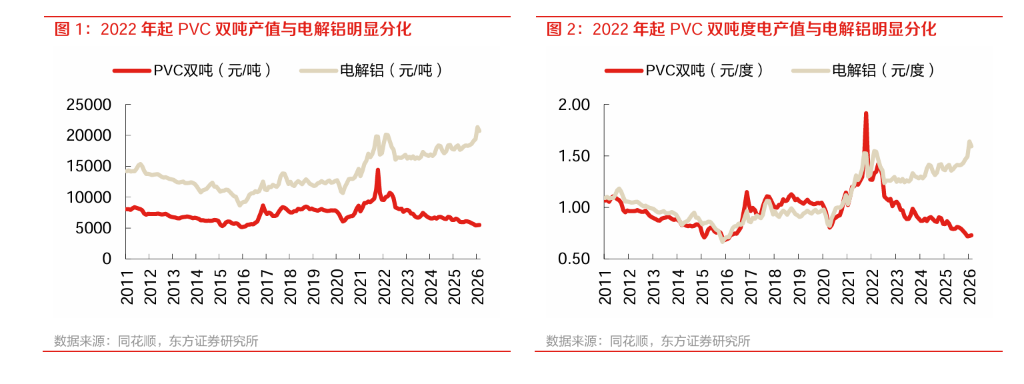
PVC行业正站在重估的临界点。 东方证券研究所分析师倪吉、万里扬于2月8日发布深度报告,自2025年底以来,PVC概念股集体异动引发市场关注,但商品价格涨幅有限,市场 普遍将其归因于4月出口退税取消前的抢出口行情。 报告以电解铝为对照,提出一个大胆判断:压制PVC景气度的因素已发生根本性转变,资产价值重估窗口正在打开。 分化的能耗经济学 报告指出,PVC与电解铝同为高耗能产品,电力占成本结构核心。2022年前两者度电产值基本一致,但此后急剧分化。到2026年初,生产电解铝 的度电产值已达电石法PVC的一倍以上。 "在2022年后导致电解铝和PVC产生明显分化的主要原因是需求端的变化。PVC需求出现下滑;电解铝则受到光伏产业拉动,需求快速 增长。" 报告以天山铝业和北元集团为样本,测算2024年电解铝度电净利达0.21元,而PVC几乎无利润。若PVC修复至相当水平,意味着双吨(1吨 PVC+0.7吨烧碱)净利将超过1500元。 风险提示及免责条款 分析师测算显示,2025年光伏用铝已占国内总需求的12%,而PVC需求则有所下降,依靠出口消化产能。 关键转折在于:PVC出口占比已达18%,报告认为这是"非常重要的 ...
扣非净利再陷亏损!吉华集团控制权生变
IPO日报· 2026-02-05 11:09
Core Viewpoint - Zhejiang Jihua Group Co., Ltd. is undergoing a potential change in its controlling shareholder, which may impact its strategic direction and financial stability [1][8]. Group 1: Company Background - Jihua Group, founded in 1990 and headquartered in Hangzhou, Zhejiang, was listed on the Shanghai Stock Exchange in June 2017 [9]. - The company specializes in the research, production, and sales of dyes, dye intermediates, and other chemical products, recognized as the third-largest dye production base globally [10]. Group 2: Financial Performance - For the first three quarters of 2025, Jihua Group reported total revenue of 1.056 billion yuan, a year-on-year decline of 8.87%, with a net profit attributable to shareholders of only 14.44 million yuan, down 88.74% [11]. - The company has faced recurring losses in its net profit excluding non-recurring items, with figures of -244 million yuan in 2022 and -243 million yuan in 2023, before a slight recovery to 30 million yuan in 2024 [11]. - Accounts receivable surged by 101.95% in the first half of 2025, attributed to a decline in sales collection rates amid intense market competition [13]. Group 3: Industry Challenges - The dye industry is characterized by fierce competition and declining product prices, leading to poor performance in recent years [11]. - The global demand for textiles has weakened, and competition from Southeast Asia, along with high raw material prices, has contributed to a slow recovery [14]. - The chemical industry faces increasing environmental pressures under the "dual carbon" policy, necessitating a transformation for traditional high-pollution and high-energy-consuming dye enterprises [15]. Group 4: Potential Changes in Control - The planned transfer of shares by the controlling shareholder, Jinhui Electromechanical, is interpreted as a strategic adjustment by the actual controller, Shao Bojin, possibly in response to long-term capital needs [8]. - Market speculation suggests that potential new controlling parties could include industrial capital with chemical industry integration capabilities or local state-owned platforms aiming to facilitate the company's green transformation [16][18].


电解铝行业观点更新
2026-02-05 02:21
Summary of Key Points from the Conference Call Industry Overview: Electrolytic Aluminum Industry - The dual carbon policy primarily impacts the electrolytic aluminum industry through long-term supply constraints rather than short-term cost increases. The carbon tax has a limited effect on profitability, but stricter environmental requirements will continue to enhance energy consumption control, limiting industry supply [1][2] - The downstream industries show a high acceptance of aluminum price increases, as aluminum constitutes a small percentage of total product costs, e.g., only 3%-4% in the automotive sector. Therefore, short-term price fluctuations have a limited impact on downstream demand [1][2][4] Core Insights and Arguments - The premium for green hydropower aluminum and recycled aluminum is expected to increase significantly in the future. Currently, green hydropower aluminum in overseas markets has a premium of $200-$300, while domestic premiums are not yet significant but are expected to rise with the implementation of carbon taxes [1][5] - The dual carbon policy is driving the retention of profits in high-value segments of China's manufacturing industry. Through capacity reduction and environmental restrictions, profits are increasingly retained in domestic smelting, changing the previous trend of exporting low-value products [1][6][7] - Global inventory replenishment and geopolitical tensions are constraining the supply of strategic metals. The expectation of economic recovery is leading to increased inventory accumulation, while geopolitical factors are limiting new production capacity [1][9][10] Additional Important Insights - The electrolytic aluminum industry is characterized by strong supply constraints, which support high prices and profitability. Even in high-price scenarios, domestic supply ceilings remain robust [2] - The anticipated energy crisis in North America by 2027 could push aluminum prices to around 30,000 RMB/ton, with historical precedents suggesting that such price levels are feasible [3][12] - Companies with high dividends and stable integration, such as Tianshan and Hongqiao, are expected to perform well, with potential valuation recovery from 10x to 13-15x [3][13] - The dual carbon policy is expected to lead to a more rigid supply side, enhancing the elasticity of demand due to strategic considerations and national resource policies [11]
纯苯:供需重构 震荡修复
Zhong Guo Hua Gong Bao· 2026-02-03 03:37
Core Insights - The chemical industry is expected to transition from price competition to value creation by 2025, leading to a systematic restructuring of the entire chemical supply chain [1] - The pure benzene market experienced a significant decline in 2025, with prices dropping from 7464 yuan per ton in January to 5318 yuan in December, a decrease of over 40% [1] - For 2026, industry experts anticipate a "supply-demand restructuring and oscillatory recovery" in the pure benzene market, with overall transaction levels expected to gradually improve [1] Supply Dynamics - The rapid expansion of pure benzene production capacity in China has led to a supply surplus, with 2025 production reaching approximately 23 million tons and imports at 5.6083 million tons, marking increases of 10% and 30.03% year-on-year, respectively [2] - In 2026, the supply of pure benzene is expected to show "limited growth and structural optimization," as capacity expansion slows down, with new capacity additions around 2.26 million tons [2] - The exit of outdated production capacity, driven by carbon reduction policies, is accelerating, with about 15% of existing old facilities facing elimination or upgrades [2] Demand Factors - Traditional demand for pure benzene remains stable, primarily driven by the styrene sector, which accounts for approximately 48% of demand [4] - Although traditional demand is steady, emerging market demand is weak, with high-end applications like electronic-grade solvents and pharmaceutical intermediates making up less than 5% of total demand [4] - The overall growth rate for pure benzene demand in Asia is projected to be only 1.6% in 2026 due to global economic uncertainties and trade barriers [4] Market Outlook - The pure benzene market is expected to experience a "bull-bear tug-of-war and oscillatory recovery" in 2026, with prices rising from 5300 yuan to 6200 yuan, a 17% increase driven by improved fundamentals and pre-holiday stockpiling [5] - The market may enter a phase of oscillatory consolidation due to high inventory levels and the acceptance of price increases by downstream enterprises [5] - Long-term, the chemical sector's new cycle narrative will dominate the market, with supply-side constraints and steady traditional demand providing support for price recovery [6]
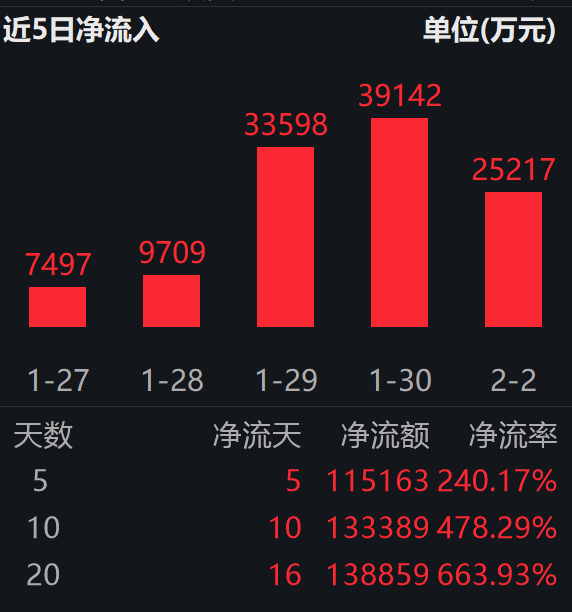
石油煤炭加工1月价格指数迎改善;化工行业ETF易方达(516570)连续10日“吸金”合超13亿
Sou Hu Cai Jing· 2026-02-03 02:48
相关产品: 化工行业ETF易方达(516570)一键打包石化产业龙头,管理费率+托管费率合计仅0.2%/年,助力投资 者低成本布局传统能源产业机会。 易方达中证石化产业ETF联接A(020104.OF) 易方达中证石化产业ETF联接C(020105.OF) 【免责声明】本文仅代表作者本人观点,与和讯网无关。和讯网站对文中陈述、观点判断保持中立,不 对所包含内容的准确性、可靠性或完整性提供任何明示或暗示的保证。请读者仅作参考,并请自行承担 全部责任。邮箱:news_center@staff.hexun.com 截至10:12,中证石化产业指数(H11057)涨1.63%,权重股中,万华化学、盐湖股份、藏格矿业、华 鲁恒升、云天化涨超2%。截至2月2日,该指数近一年上涨41.19%。 化工行业ETF易方达(516570)跟踪中证石化产业指数,备受资金青睐。数据显示,该基金连续10日获 资金净流入,合计超13亿;最新基金规模攀升至15.37亿元。 消息面上,国家统计局数据显示,1月份石油煤炭及其他燃料加工业的生产指数和新订单指数均低于临 界点,相关行业市场需求放缓,企业生产有所回落。同时,主要原材料购进价格指数和出 ...