
地方债务化解

Search documents
【深度】化债一周年启示:让债务更好支持经济发展才是核心目标
Sou Hu Cai Jing· 2025-10-20 01:46
Core Viewpoint - The central government has introduced a comprehensive debt reduction initiative, "6+4+2," aimed at resolving 12 trillion yuan of hidden local government debt over five years, with a focus on ensuring that debt management supports economic development rather than hindering it [1][9]. Debt Reduction Measures - The National People's Congress has approved significant debt reduction measures, including increasing the local government special debt limit by 6 trillion yuan for debt replacement, allocating 800 billion yuan annually for five years from new local government bonds specifically for debt reduction, and ensuring that 2 trillion yuan of hidden debt due after 2029 is repaid as per original contracts [2][4]. Impact on Local Government Debt - Following the implementation of the "6+4+2" policy, local hidden debt has significantly decreased from 14.3 trillion yuan at the end of the previous year to 10.5 trillion yuan by the end of 2024, marking a 27% reduction [4]. - As of September 28, 2025, nearly 3.2 trillion yuan in special refinancing bonds and new special bonds have been issued for debt reduction, exceeding the initial target of 2.8 trillion yuan [4][5]. Investment Efficiency Concerns - Some local governments have experienced a decline in investment efficiency during the debt reduction process, leading to economic contraction. The issuance of new special bonds for project construction has slowed, resulting in a decrease in funds available for infrastructure projects [6][7]. - For instance, from January to August this year, approximately 1.94 trillion yuan in new special bond funds were allocated to infrastructure projects, a reduction of nearly 200 billion yuan compared to the same period last year [6]. Structural Challenges - Analysts highlight structural contradictions in the debt reduction process, such as a scarcity of quality projects and declining investment returns, which hinder local governments from effectively utilizing available funds [7][8]. - The cautious approach of local governments, driven by stringent regulations and accountability measures, has led to delays in project approvals and a reluctance to initiate new projects, further exacerbating the issue of underutilized funds [8]. Long-term Strategies - To achieve sustainable local debt management, a shift from short-term crisis management to long-term structural reforms is necessary. This includes enhancing the fiscal system, clarifying responsibilities between central and local governments, and establishing a transparent municipal bond issuance mechanism [11][12]. - Emphasizing economic development over mere debt reduction is crucial for maintaining fiscal sustainability, with a focus on investing in high-return sectors such as technology innovation and green energy [12][13].

多地积极推进化债工作 打开新的投资空间
Shang Hai Zheng Quan Bao· 2025-08-07 01:53
Core Viewpoint - The ongoing efforts to resolve local government debt are showing positive results, with regions like Inner Mongolia successfully exiting the high-risk debt list, which is expected to stabilize the economy and growth [1][2]. Group 1: Debt Resolution Progress - Inner Mongolia has officially exited the high-risk debt region list, with other regions like Ningxia and Jilin also working towards similar exits [1][3]. - The government has emphasized a strategy of "developing while resolving debt," aiming to optimize debt management and support new investment opportunities [1][2]. - In the first half of the year, local governments issued approximately 22,607 billion yuan in bonds for debt resolution, accounting for about 81% of the total debt resolution quota of 28,000 billion yuan [1]. Group 2: Standards for Exiting High-Risk Debt - Exiting the high-risk debt list requires meeting specific standards, including reducing the number of local government financing platforms and the ratio of hidden debt to local GDP [2]. - Inner Mongolia's government plans to reduce financing platforms by 66.5% and eliminate hidden debt in eight counties, aiming for a downgrade in debt risk status [2]. Group 3: Future Expectations and Policy Directions - Analysts expect that other regions will gradually begin to exit the high-risk debt list, with the impact of these changes becoming clearer in the next fiscal year [3]. - The central government has reiterated the importance of preventing new hidden debts while effectively managing local financing platforms [4]. - The transition from government-enterprise integration to market autonomy is a key focus, with a deadline for financing platform exits set for June 2027 [4].
债市早报:七部门联合印发《关于金融支持新型工业化的指导意见》;资金面均衡偏松,债市表现分化
Sou Hu Cai Jing· 2025-08-06 03:23
Group 1: Domestic News - The People's Bank of China and six other departments issued guidelines to enhance financial support for new industrialization, focusing on manufacturing investment and differentiated credit policies for various sectors [2] - The guidelines encourage financial institutions to establish internal mechanisms to support manufacturing and to monitor credit risks effectively [2] - The guidelines also promote the establishment of a "green channel" for financing, mergers, and bond issuance for technology companies that break through key core technologies [2] Group 2: Debt Market Developments - The local government debt resolution efforts have accelerated, with Inner Mongolia successfully exiting the high-risk debt list, and Ningxia and Jilin also aiming to follow suit [3] - In July, the issuance of new special bonds reached a record high of 616.936 billion yuan, marking a 45% year-on-year increase in the first half of the year [3] Group 3: International News - The US ISM non-manufacturing PMI for July was reported at 50.1, below expectations, indicating a slowdown in the service sector and a decrease in employment [4] - The prices of raw materials and services in the US reached their highest level since October 2022, with the price index rising to 69.9 [4] Group 4: Commodity Market - International crude oil prices continued to decline, with WTI and Brent crude oil futures dropping by 1.70% and 1.63%, respectively [5] - Natural gas prices increased by 2.03% to $3.012 per million British thermal units [5] Group 5: Financial Market Dynamics - On August 5, the central bank conducted a 7-day reverse repurchase operation of 160.7 billion yuan, resulting in a net withdrawal of 288.5 billion yuan [7] - The money market showed a balanced and slightly loose condition, with DR001 and DR007 rates decreasing [8] Group 6: Bond Market Trends - The bond market showed mixed performance, with short-term rates slightly rising and medium to long-term rates slightly declining [9] - The secondary market for credit bonds experienced significant price deviations, with some bonds seeing drastic price changes [10] Group 7: Convertible Bonds - The convertible bond market saw collective gains, with major indices rising and a significant increase in trading volume [18] - Notable individual convertible bonds experienced substantial price increases, while a few faced significant declines [18]
化债提速!多地加快退出债务高风险名单
Mei Ri Jing Ji Xin Wen· 2025-08-05 13:36
Core Insights - The approval of a debt resolution plan totaling 12 trillion yuan has led to significant progress in local debt management, with regions like Inner Mongolia successfully exiting high-risk debt status [1][2] - The exit from high-risk debt lists is expected to improve local financing conditions, allowing for more investment and development opportunities [3][4] Debt Management Progress - Inner Mongolia has allocated 12.06 billion yuan to support grassroots debt resolution, achieving a 66.5% reduction in local government financing platforms and clearing hidden debts in eight counties [2][5] - Other regions, such as Ningxia and Jilin, are also on track to meet the criteria for exiting high-risk debt status, indicating a broader trend of debt resolution across the country [1][2] Financial Environment Improvement - Exiting the high-risk list allows local governments to focus on sustainable fiscal management, redirecting funds towards social welfare and development projects [3][4] - The removal of high-risk labels will ease regulatory constraints on local government bond issuance and financing, potentially lowering costs for financing platforms [3][4] Infrastructure and Investment - The easing of debt restrictions is expected to accelerate infrastructure projects, as financing channels become more accessible and project approvals more flexible [3][4] - The improved fiscal outlook is likely to enhance private investment confidence, encouraging more capital inflow into local economies [4] Future Challenges and Strategies - Continuous efforts are needed to optimize debt structures and prevent the re-emergence of hidden debts, with a focus on maintaining a balance between debt levels and economic capacity [6][7] - Strengthening local revenue sources and enhancing debt supervision are critical to ensuring long-term fiscal health and reducing reliance on government financing [7]
化债提速!多地加快退出债务高风险名单,专家解析对财政收支有何影响
Mei Ri Jing Ji Xin Wen· 2025-08-04 15:21
Core Viewpoint - The recent approval of a 12 trillion yuan debt resolution plan by the National People's Congress has led to significant progress in local debt resolution efforts, with regions like Inner Mongolia successfully exiting high-risk debt status [1][5]. Group 1: Debt Resolution Progress - Inner Mongolia has allocated 12.06 billion yuan to support grassroots debt resolution, achieving a 66.5% reduction in local government financing platforms and clearing hidden debts in eight counties [2][3]. - Other regions, such as Ningxia and Jilin, are also on track to exit high-risk debt status, indicating a broader trend of improving local fiscal health [1][2]. Group 2: Impacts of Exiting High-Risk Status - Exiting the high-risk list allows local governments to focus on sustainable fiscal management, enabling more funds to be directed towards public welfare and developmental expenditures [3][4]. - The removal from the high-risk list improves the financing environment, reducing regulatory constraints on local government bond issuance and lowering financing costs for platform companies [3][4]. - Infrastructure projects that were previously delayed due to funding and approval restrictions can now proceed more rapidly, enhancing urban infrastructure and economic growth [3][4]. Group 3: Future Considerations - Continuous efforts are needed to optimize debt structures and ensure that new debt levels align with local economic capabilities to prevent future debt crises [6][7]. - Strengthening local revenue generation capabilities is essential for sustainable debt resolution, alongside rigorous debt oversight to prevent the accumulation of hidden debts [7][8].
上半年城投债净融资为负,政府债券净融资大增至7.7万亿元
第一财经· 2025-07-15 09:30
Core Viewpoint - The article highlights the transformation of the government financing system in China, evidenced by the contrasting trends in local government bond (城投债) financing and government bond financing, indicating a tightening of local government debt issuance while increasing government bond financing to support economic growth [1][2]. Group 1: Local Government Bonds - In the first half of 2025, the net financing of local government bonds was -76.36 billion yuan, a year-on-year decrease of approximately 149% [1]. - The supply of local government bonds continues to tighten, reflecting the government's efforts to control new hidden debts and mitigate local debt risks [1][2]. - The transformation of local government financing platforms is progressing slowly, with over 7,000 local government financing companies announcing their exit from the government financing platform list last year [1]. Group 2: Government Bonds - In contrast, the net financing of government bonds reached 766 billion yuan in the first half of 2025, an increase of 432 billion yuan year-on-year, representing a growth of approximately 129% [1][2]. - The significant increase in government bond financing is a response to the need for increased debt funding for major projects amidst complex domestic and international conditions [2]. - The net financing of national bonds was 337 billion yuan, and local government bonds was 429 billion yuan in the first half of 2025, with both figures showing substantial year-on-year increases [2]. Group 3: Policy and Economic Impact - The article notes that the decline in local government bond issuance and the increase in government bond financing are indicative of proactive fiscal policies aimed at ensuring economic stability [2]. - Infrastructure investment grew by 4.6% year-on-year in the first half of 2025, outpacing overall investment growth by 1.8 percentage points, supported by the accelerated issuance of special local government bonds and long-term special treasury bonds [2]. - The ongoing efforts to resolve local government debt and the transformation of local financing platforms are expected to continue, although challenges remain regarding the quality of these transformations and the potential for increased debt burdens [3].

【国寿安保定盘星】系列之二:一季度经济迎来开门红
Zhong Guo Jing Ji Wang· 2025-04-28 08:18
Economic Performance Overview - In Q1 2025, China's GDP grew by 5.4% year-on-year, with production, consumption, and investment data exceeding market expectations [1] - The industrial added value for large-scale enterprises increased by 6.5% year-on-year, accelerating by 0.7 percentage points compared to the previous year [1] - Social retail sales rose by 4.6% year-on-year in Q1, with a notable increase of 5.9% in March [1] - Fixed asset investment grew by 4.2% year-on-year in Q1, with manufacturing investment up by 9.1% and infrastructure investment up by 11.5% [1] Export and Domestic Demand - Q1 exports remained resilient, with net export levels reaching new highs, supported by a "rush to export" factor [2] - The positive economic performance in Q1 was attributed to the release of domestic demand and the effects of previous policy measures [2] - The "old-for-new" consumption policy launched in early 2025 allocated 300 billion yuan to support consumer goods replacement, significantly up from 150 billion yuan in 2024 [2] Manufacturing and Investment Trends - Manufacturing investment saw a cumulative year-on-year growth of 9.1% in March, supported by equipment upgrading policies [3] - High-tech industry investments grew by 6.5%, with significant increases in information services, aerospace manufacturing, and computer equipment sectors [3] - Local government debt resolution efforts have positively impacted economic growth, particularly in major economic provinces [3] Overall Economic Outlook - Despite external uncertainties, China's large economic scale and domestic market provide significant resilience and flexibility [4] - The effectiveness of previous growth stabilization policies has contributed to a strong economic performance in Q1 2025 [4] - The focus on domestic stability in response to international uncertainties is seen as a unique advantage for China's economic growth [4]
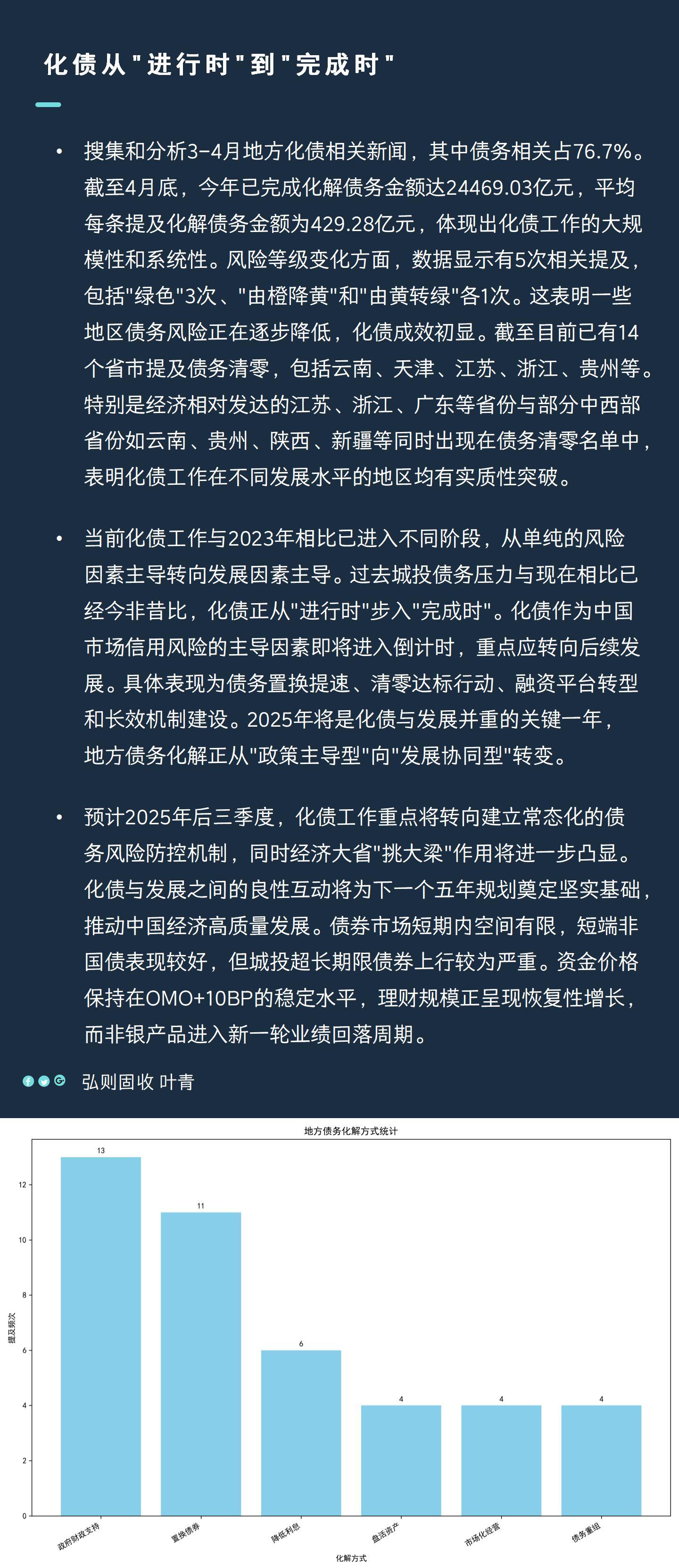
弘则固收叶青:化债从"进行时"到"完成时"
news flash· 2025-04-27 23:39
Group 1 - The core viewpoint of the report indicates that the debt resolution work in China has entered a new phase, shifting from a focus on risk factors to development factors, with significant progress in debt reduction across various regions [1][2][4] - As of the end of April, a total of 24,469.03 billion yuan has been resolved in debt, with an average of 429.28 million yuan per mention, highlighting the scale and systematic nature of the debt resolution efforts [1] - 14 provinces and cities have mentioned achieving debt clearance, including economically developed regions like Jiangsu, Zhejiang, and Guangdong, as well as some central and western provinces such as Yunnan and Guizhou, indicating substantial breakthroughs in debt resolution across different development levels [1] Group 2 - The focus of debt resolution work is expected to shift towards establishing a normalized debt risk prevention mechanism in the third quarter of 2025, with major economic provinces playing a crucial role [2][4] - The interaction between debt resolution and development is anticipated to lay a solid foundation for the next five-year plan, promoting high-quality economic development in China [2][4] - The bond market is expected to have limited short-term space, with better performance in short-term non-government bonds, while long-term urban investment bonds face significant upward pressure [2][4]
宏观专题研究:从预算报告看2025年的地方财政
Guoxin Securities· 2025-03-05 01:50
Group 1: Fiscal Performance Overview - In 2024, national general public budget revenue reached approximately CNY 22 trillion, a year-on-year growth of 1.3%[7] - Local fiscal revenue growth (1.7%) outpaced central fiscal revenue growth (0.9%), with local revenue accounting for 54.3% of total revenue[1] - Government fund revenue declined by 12.2%, with land transfer revenue dropping significantly by 16% to CNY 4.9 trillion[1] Group 2: 2025 Budget Projections - The weighted growth rate of local general public budget revenue for 2025 is projected at 2.8%, with some major economic provinces (e.g., Guangdong, Jiangsu) below 3%[1] - Total local government fund revenue budget for 2025 is estimated at CNY 5.7 trillion, reflecting a 1% decrease[1] - The expected issuance of land reserve special bonds in 2025 is projected to be between CNY 600 billion and CNY 1 trillion[2] Group 3: Economic Growth Targets - Among 31 provinces, only Tianjin raised its GDP growth target for 2025, while half of the provinces lowered their targets, with a weighted GDP growth target of approximately 5%[2] - Fixed asset investment targets are also weakening, with 10 out of 19 provinces reducing their growth targets[2] Group 4: Debt Management Strategies - Local governments are focusing on five key strategies for debt risk management: strict control of new hidden debts, reduction of existing debts, reform of financing platforms, strengthening special bond management, and ensuring basic financial security[2] - Specific measures include prohibiting projects beyond fiscal capacity and enhancing monitoring of hidden debts[2]