存储行业超级周期

Search documents
存储企业扎堆冲刺IPO,赛道火热再迎新动态
Sou Hu Cai Jing· 2025-12-29 06:54
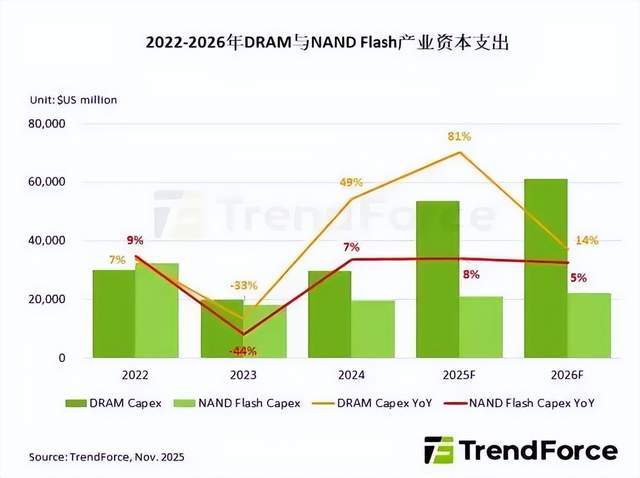
Core Viewpoint - The storage industry is experiencing a "super cycle" driven by explosive AI demand and supply-side contraction, leading to significant price increases and a surge in capital activities among major companies [1][2]. Group 1: Industry Trends - The storage industry has historically shown strong cyclical characteristics, with the current cycle, defined as a "super cycle," expected to last until at least the end of 2026, potentially extending into 2027 [2]. - AI's structural demand explosion is the core engine driving this super cycle, with AI servers requiring 8 times more DRAM and 3 times more NAND Flash compared to traditional servers [2]. - Major storage manufacturers, including Samsung, SK Hynix, and Micron, are adopting cautious expansion strategies, further exacerbating supply shortages [3]. Group 2: Price Trends - The average selling prices (ASP) of DRAM and NAND Flash are on the rise, with suppliers seeing increased profits, although capital expenditures for 2026 may not significantly boost output growth [3]. - The spot market reflects rising prices, with Kingston raising DRAM prices and NAND Flash showing bullish sentiment due to expected contract price increases [5]. Group 3: Capitalization Trends - The ongoing industry boom has ignited a wave of IPO activities among storage companies, with multiple firms accelerating their listing processes across various segments [7]. - Shenzhen Dapu Microelectronics has successfully passed the IPO review for the ChiNext board, marking a significant milestone in the current IPO wave [8]. - Dapu Micro focuses on enterprise-level SSDs and has developed a comprehensive technology stack, positioning itself uniquely in the market [10][13]. Group 4: Global Capitalization Efforts - Companies like Nanya Technology and Montage Technology are pursuing IPOs in Hong Kong to leverage global financing advantages [15]. - Nanya Technology is targeting the niche DRAM market and plans to achieve mass production of advanced DRAM products by Q3 2027 [19]. - Montage Technology aims to provide interconnect solutions for cloud computing and AI infrastructure, with plans for an overseas listing [22]. Group 5: A-Share Market Preparations - Several storage firms are preparing for A-share listings, focusing on governance and business structure to strengthen their capital foundation [23]. - Shenzhen Shichuangyi has initiated IPO counseling, marking a critical phase in its listing preparation [24][26]. - The company has developed a full-chain capability in storage products, covering various applications in consumer electronics and IoT [26]. Group 6: Future Outlook - The capital market is expected to see significant contributions from companies like Changxin Memory and Dapu Micro if they successfully list, addressing gaps in the market from storage media to enterprise-level solutions [30]. - The current capital wave in the storage industry is a result of cyclical benefits and accelerated domestic substitution, with a strong focus on long-term profitability [30].


存储迎史上最强涨价周期,两大牛股年内涨近400%
2 1 Shi Ji Jing Ji Bao Dao· 2025-12-18 11:22
Core Viewpoint - The storage industry is experiencing a significant price increase driven by AI demand, marking the beginning of a "super cycle" in the sector [2][5][10]. Group 1: Price Increases and Market Dynamics - Major companies like Samsung, SK Hynix, and Micron have raised product prices, with DDR contract prices expected to increase by 35% and NAND prices by 20% in Q4 2023 [2][5]. - UBS forecasts that DDR contract prices will rise by an additional 30% and NAND prices by 20% in Q1 2026 [2]. - The stock prices of several A-share companies in the storage sector have surged significantly, with Shannon Chip achieving a year-to-date increase of over 394% [2][8]. Group 2: Industry Trends and Future Outlook - The storage industry has entered a new cycle, with AI server demand increasing the shipment of storage chips, particularly DDR5 and HBM [5][6]. - The transition from DDR4 to DDR5 has been accelerated due to AI investments, leading to a supply-demand imbalance in the industry [6][11]. - Morgan Stanley predicts that the global storage market could reach $300 billion by 2027, driven by sustained demand [6][10]. Group 3: Company Performance and Financial Results - Micron reported a strong performance for Q1 FY2026, with adjusted revenue of $13.64 billion, a 57% year-over-year increase [7]. - Samsung's Q3 2025 operating profit reached 12.16 trillion KRW (approximately $85.6 billion), a 32.2% increase year-over-year [7]. - SK Hynix's Q3 2025 sales were 24.45 trillion KRW, with a year-over-year growth of 39% [7]. Group 4: Supply Chain and Production Strategies - Major players are cautious about expanding production capacity, focusing instead on optimizing capital expenditures to balance customer demand and market prices [10][11]. - SK Hynix plans to shift a significant portion of its DRAM capacity to the latest 10nm products, indicating a strategic pivot rather than aggressive expansion [10]. - The cautious approach stems from the fear of overproduction if AI demand does not sustain, as seen in previous downturns [11].

至少火到2026年底?AI需求引爆存储史上最强涨价周期
2 1 Shi Ji Jing Ji Bao Dao· 2025-12-18 09:24
Core Viewpoint - The storage industry is experiencing a significant price surge driven by AI demand, marking the beginning of a "super cycle" that is expected to last until at least the end of 2026 [1][2]. Group 1: Price Increases and Market Dynamics - Major companies like Samsung, SK Hynix, and Micron have raised product prices, with DDR contract prices expected to increase by 35% and NAND prices by 20% in Q4 2023 [1]. - The stock prices of companies in the storage sector have surged, with Shannon Chip, Dongxin Co., Jiangbolong, and Baiwei Storage seeing increases of 294.51%, 291.19%, 195.51%, and 67.17% respectively in the second half of this year [1]. - The current cycle is characterized by a supply-demand imbalance, exacerbated by AI's unexpected demand, leading to a significant rebound in prices after a prolonged down cycle [2][3]. Group 2: Financial Performance of Key Players - Micron reported a strong performance for Q1 FY2026, with adjusted revenue of $13.64 billion, a 57% year-over-year increase, and adjusted net profit of $5.48 billion, also up 58% [3][4]. - Samsung Electronics achieved an operating profit of 12.16 trillion KRW (approximately $8.56 billion) in Q3 2025, a 32.2% increase year-over-year, exceeding analyst expectations [4]. - SK Hynix reported Q3 2025 sales of 24.45 trillion KRW, with a year-over-year growth of 39% and an operating profit of 11.38 trillion KRW, reflecting a 62% increase [4]. Group 3: Future Outlook and Industry Trends - The global storage market is projected to reach $300 billion by 2027, driven by AI demand and the ongoing super cycle [3]. - Companies are cautious about expanding production capacity due to previous downturns, with Samsung and SK Hynix indicating a reluctance to rapidly increase production [7][8]. - Demand for DRAM is expected to outpace supply growth, with a projected 26% increase in demand for 2026 compared to a 20% increase in supply, leading to a potential price increase of 58% for DRAM [8].
需求被验证,美股存储龙头业绩大超预期,盘后股价大涨
Xuan Gu Bao· 2025-12-18 00:30
Group 1 - Micron reported strong Q1 FY2026 earnings with adjusted revenue of $13.64 billion, exceeding analyst expectations of $12.95 billion [1] - Non-GAAP operating profit reached $6.419 billion, accounting for 47.0% of revenue, also surpassing the expected $5.37 billion [1] - The company provided a robust Q2 guidance, forecasting revenue of $18.7 billion, significantly above the analyst estimate of $14.38 billion [1] Group 2 - Micron's Q1 revenue from cloud storage was $5.284 billion, showing substantial year-over-year growth, while data center revenue was $2.379 billion [2] - The company emphasized its critical role in the AI ecosystem and is continuously investing to meet the growing demand for storage and memory [2] - Analysts noted that Micron's strong performance and increased capital expenditure reflect a tightening supply-demand balance in the storage market [2] Group 3 - The storage industry supply chain consists of upstream semiconductor equipment and material suppliers, midstream storage chip design and manufacturing companies like Micron and Samsung, and downstream sectors including AI servers, smartphones, and PCs [3] - Increased end-user demand and technological upgrades are driving the demand for midstream storage chips, which in turn boosts the demand for upstream equipment and materials [3] Group 4 - Zhaoyi Innovation is a leading domestic storage chip company in China, with core businesses including NOR Flash, MCU, and DRAM, holding a significant global market share in NOR Flash products [4] Group 5 - China Electronics Port is one of Micron's authorized distributors in the domestic market [5]
大手笔扩产备战 国产存储芯片龙头抢滩超级周期风口
2 1 Shi Ji Jing Ji Bao Dao· 2025-12-12 23:14
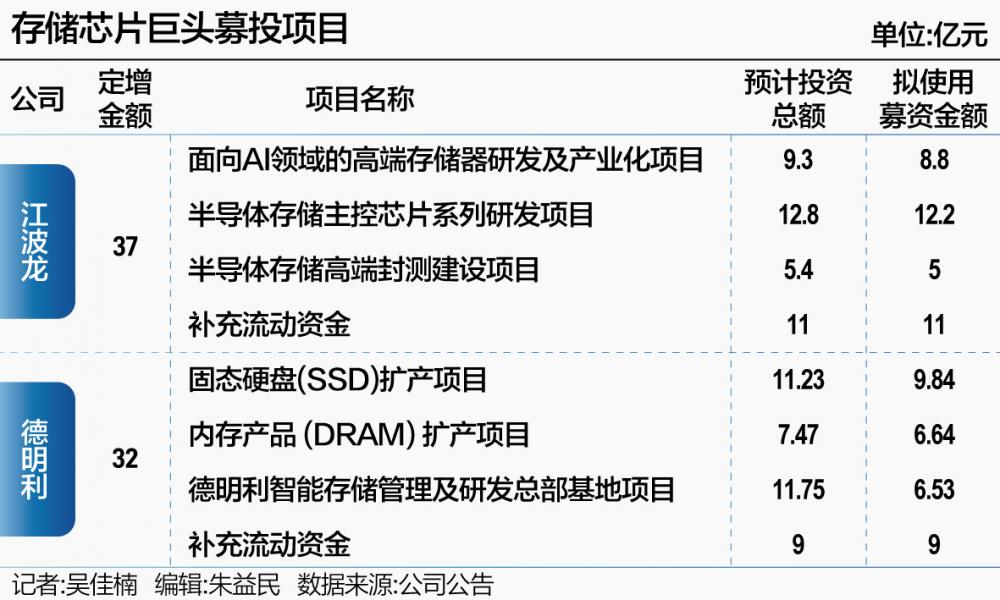
Core Viewpoint - The storage industry is experiencing a "super cycle" driven by AI demand, prompting major companies like Jiangbolong and Demingli to announce significant fundraising plans for expansion [2][10]. Group 1: Fundraising Plans - Jiangbolong plans to raise up to 3.7 billion yuan for projects focused on storage technology development, NAND Flash controller chip design, and packaging/testing of storage chips [5][6]. - Demingli aims to raise 3.2 billion yuan, with funds directed towards expanding SSD and DRAM production, as well as establishing a smart storage management headquarters [9][10]. Group 2: Market Dynamics - The storage industry is expected to see price increases continue into the first half of next year due to supply chain adjustments and urgent inventory preparations [2][12]. - AI servers require significantly more storage than traditional servers, with DRAM usage approximately eight times higher and NAND Flash usage three times higher, driving demand for high-performance storage [6][10]. Group 3: Investment Focus - Jiangbolong's investment will focus on high-end storage solutions for AI applications, including enterprise-level PCIe SSDs and RDIMM products [7][8]. - Demingli's expansion projects will emphasize high-capacity SSDs and reliable DRAM products to meet the growing needs of data centers and cloud computing [10][11]. Group 4: Industry Outlook - The global semiconductor storage market is projected to grow to $214.8 billion by 2026, presenting opportunities for domestic manufacturers [11]. - Both companies are optimistic about the market's future profitability, with expectations of a supply-demand imbalance in the coming years [12][15]. Group 5: Operational Strategies - Jiangbolong and Demingli are implementing strategies to ensure stable supply chains and inventory management amid market volatility [14][15]. - Companies are adopting a "quantity-based" procurement strategy to align production with current inventory levels, ensuring they can respond to supply shortages effectively [13][15].
存储芯片“超级周期”有多久 业内:还有四个季度会更明显
2 1 Shi Ji Jing Ji Bao Dao· 2025-12-11 09:15
Core Viewpoint - The storage industry is experiencing a significant expansion wave driven by increasing demand from AI applications, with major companies like Jiangbolong and Demingli announcing substantial fundraising plans to enhance production capacity and technology development [1][2][3]. Group 1: Fundraising and Expansion Plans - Jiangbolong plans to raise up to 3.7 billion yuan for investments in storage technology development, NAND Flash controller chip design, and packaging testing [1][3]. - Demingli has announced a fundraising plan of 3.2 billion yuan aimed at solidifying its full-chain technical capabilities from storage controller chip R&D to module delivery [1][3]. - Both companies are focusing on expanding production to capture market share amid a booming storage market driven by AI demand [2][3]. Group 2: AI Market Focus - Jiangbolong's fundraising will support high-end storage development projects targeting AI applications, including enterprise-level PCIe SSDs and RDIMM products [4][7]. - Demingli's fundraising is also directed towards high-capacity and high-performance SSDs and DRAM products, reflecting a strong alignment with AI market needs [8][9]. Group 3: Market Dynamics and Future Outlook - The storage market is expected to experience a prolonged upcycle due to surging demand from data centers and AI applications, with predictions of a 16.2% growth in the global semiconductor storage market by 2026 [10][11]. - Both companies are preparing for potential supply shortages in the coming years, with Jiangbolong and Demingli indicating that the supply-demand imbalance will become more pronounced in late 2026 and early 2027 [11][12]. - The companies are adopting strategies to manage inventory and pricing effectively to navigate the challenges posed by the industry's cyclical nature and technological advancements [12][13]. Group 4: Financial Health and Cash Flow - Jiangbolong and Demingli are facing cash flow challenges, with Demingli reporting negative operating cash flows over the past few years and a high debt ratio of 73.28% [12][13]. - Jiangbolong has also indicated a pressing need for funds, having proposed an H-share listing to address its financial requirements [12].

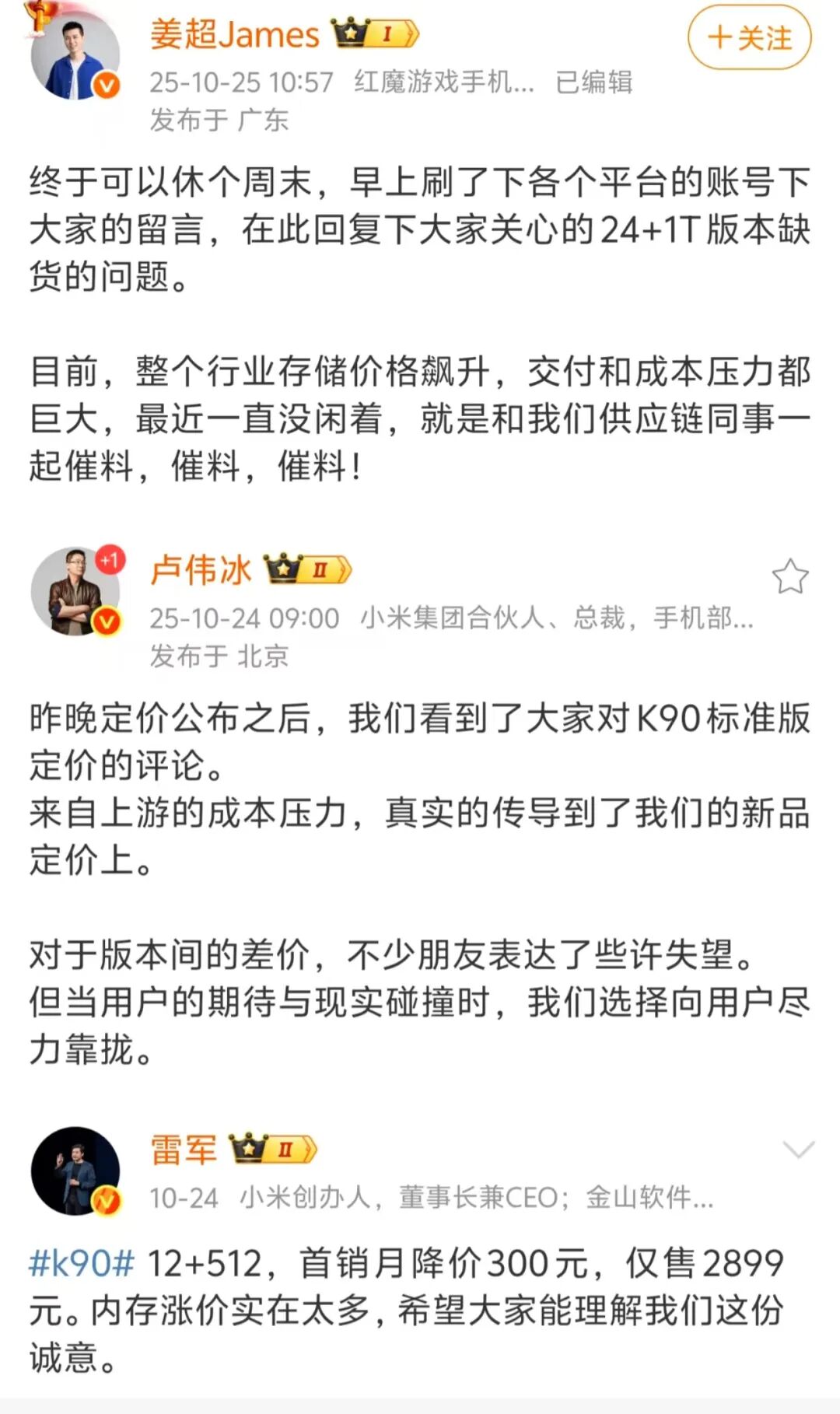
英伟达扇扇翅膀,2026年中国手机要涨价
36氪· 2025-11-17 08:59
Core Insights - The article discusses the anticipated challenges in the Chinese smartphone industry due to rising storage costs and supply chain disruptions, predicting price increases and reduced specifications for smartphones in 2026 [4][7][30]. Group 1: Industry Dynamics - Nvidia's founder Jensen Huang is strengthening ties with Samsung to secure HBM storage capacity, which is critical for AI applications [5][6]. - Samsung has suspended quotes for LPDDR5 due to capacity constraints, indicating a shift in focus towards HBM for AI model training [6][11]. - The storage industry is experiencing a significant price surge, with LPDDR4X prices increasing from $6 to $25, a rise of over 300% [11]. Group 2: Impact on Smartphone Manufacturers - Smartphone manufacturers are facing a "super cycle" in the storage market, leading to a shift in the supply chain dynamics where demand may not be fully met [22][30]. - Major smartphone brands are expected to increase prices or reduce specifications in response to rising storage costs, with predictions of flagship models seeing price hikes of several hundred yuan [26][30]. - The trend of high memory configurations is declining, with flagship models now typically featuring a maximum of 16GB of RAM [25]. Group 3: Market Predictions - The storage supply-demand gap is expected to persist until at least 2027, with manufacturers struggling to secure necessary components [19][30]. - The rising costs are likely to delay consumer upgrade cycles, particularly affecting mid-range and low-end products, which may see reduced product lines and shipment volumes [30]. - Consumers are advised to purchase smartphones sooner rather than later to avoid higher prices in the future [31].


英伟达扇扇翅膀,2026年中国手机要涨价
3 6 Ke· 2025-11-17 05:18
Core Insights - The meeting between Nvidia's founder Jensen Huang and Samsung's chairman Lee Jae-Yong in Seoul is expected to impact the smartphone industry significantly, leading to potential shortages and price increases in 2026 due to Nvidia's acquisition of HBM storage capacity [1][2][3] - The rising costs of storage components, particularly LPDDR and HBM, are anticipated to force smartphone manufacturers to either raise prices or reduce specifications in their products [2][4][10] Group 1: Nvidia and Samsung Collaboration - Jensen Huang's visit to Samsung aimed to strengthen ties and secure HBM storage capacity, which is crucial for AI applications [1] - Nvidia's aggressive procurement strategy, including prepayments to suppliers, has disrupted the traditional supply chain dynamics, favoring Nvidia over smartphone manufacturers [7][10] Group 2: Impact on Smartphone Manufacturers - The smartphone industry is facing a "super cycle" of storage shortages, with predictions that the supply-demand gap may persist until at least 2027 [10][11] - Major smartphone brands are experiencing significant pressure on storage availability, leading to reduced orders and potential product line adjustments [11][13] Group 3: Price Increases and Market Adjustments - The cost of LPDDR storage has surged dramatically, with prices increasing from $6 to $25, reflecting a threefold rise [4] - Predictions indicate that flagship smartphones will see price increases, while mid-range and low-end products may face reduced specifications or even discontinuation [14]
【财联社早知道】上调多达60%!三星电子11月提高内存芯片价格,机构称存储行业的“超级周期”或已经悄然启动
财联社· 2025-11-16 11:01
Group 1 - Samsung Electronics is raising memory chip prices by up to 60% in November, indicating a potential "super cycle" in the storage industry [1] - The State Council emphasizes the need to cultivate new consumption scenarios and business formats, with optimism for the recovery of the offline retail sector [1] - A company reports that its storage revenue is still largely driven by DDR3, but the proportion of new process products like DDR4 will gradually increase [1]

20cm速递|存储行业进入超级周期,创业板50ETF华夏(159367)上涨3.71%
Mei Ri Jing Ji Xin Wen· 2025-10-21 07:04
Group 1 - The core viewpoint of the article highlights a significant surge in memory prices in 2025, particularly DDR4 memory, which has more than doubled in price, with 16GB modules exceeding 500 yuan, making them a popular investment choice among industry professionals and gamers [1] - Morgan Stanley indicates that the "memory hunger" trend is driving the industry into a structural growth phase, with the DRAM market entering an unprecedented four-year pricing upcycle from 2024 to 2027, and the global storage market is expected to reach nearly $300 billion by 2027 [1] - The ChiNext 50 Index selects the top 50 stocks from the top 100 by market capitalization and liquidity on the ChiNext board, representing high-growth potential companies across various sectors, including batteries, securities, and communication equipment, reflecting innovation and new technologies [1] Group 2 - The ChiNext 50 ETF (159367) has two core advantages: a 20% price fluctuation limit, providing greater trading flexibility compared to traditional broad-based indices, and low management fees of 0.15% and custody fees of 0.05%, which effectively reduce investment costs [1]