
工业金属

Search documents
天风证券:市场正进入布局“春季躁动”的关键窗口
Di Yi Cai Jing· 2025-12-23 00:26
Group 1 - The core viewpoint of the report indicates that the external environment for A-shares is stabilizing as uncertainties related to overseas monetary policies are resolved, marking a critical window for the "spring rally" [1] - Key investment directions highlighted include technology growth sectors such as AI (computing power and applications), commercial aerospace, and robotics [1] - Other focus areas include cyclical/value stocks, particularly in industrial metals, chemicals, and non-bank financials [1] - High dividend stocks are noted for their short-term price advantages and potential for a rebound [1]

【国泰第一时间20251212】中央经济工作会议点评
Xin Lang Cai Jing· 2025-12-12 08:07
Core Viewpoint - The Central Economic Work Conference held on December 10-11 in Beijing emphasizes the need to fully tap economic potential, combining policy support with reform and innovation, and focusing on both material and human investment to address external challenges [1][4]. Macroeconomic Policy - The conference calls for a more proactive macroeconomic policy that enhances forward-looking, targeted, and coordinated measures, aiming to continuously expand domestic demand and optimize supply [1][8]. - It stresses the importance of maintaining a necessary fiscal deficit and total debt scale while optimizing fiscal expenditure structure and addressing local fiscal difficulties [2][8]. - A moderately loose monetary policy is advocated, with a focus on promoting stable economic growth and reasonable price recovery, utilizing various policy tools to maintain liquidity [2][8]. Key Tasks - The conference outlines several key tasks, including: 1. Prioritizing domestic demand and building a strong domestic market, with initiatives to boost consumption and increase central budget investment [3][9]. 2. Fostering innovation and enhancing new growth drivers, including improving intellectual property protection in emerging fields [3][9]. 3. Promoting coordinated development and urban-rural integration, while ensuring a stable real estate market and managing local government debt risks [3][9]. Overall Attitude - The conference reflects a more optimistic and determined attitude towards future economic challenges, shifting from a focus on recognizing difficulties to consolidating and expanding economic stability [4][10]. - There is a strong emphasis on structural adjustments and reforms, with a focus on quality and efficiency improvements in macroeconomic governance [4][10]. Future Outlook - The outlook for the A-share market suggests a favorable environment for investment as policy and liquidity converge positively, with expectations for a spring market rally [6][12]. - The bond market is also expected to benefit from the conference's outcomes, with a focus on maintaining fiscal policy stability and potential interest rate cuts in early 2024 [6][12].
加仓!连续加仓
中国基金报· 2025-12-05 03:54
Core Viewpoint - The stock ETF market in China experienced a significant net inflow of over 4.3 billion yuan on December 4, with a cumulative increase of 10.8 billion yuan over the past three days, indicating a strong interest in broad-based ETFs despite market volatility [2][5]. Group 1: Market Overview - On December 4, the A-share market showed mixed performance, with the Shanghai Composite Index down 0.06% and the ChiNext Index up over 1% [2]. - The stock ETF market saw a total increase of 1.789 billion shares, with a net inflow of 43.15 billion yuan, primarily driven by broad-based ETFs and Hong Kong market ETFs [5]. - The total scale of all stock ETFs in the market reached 4.56 trillion yuan as of December 4 [4]. Group 2: Fund Inflows - The net inflow for broad-based ETFs was 33.54 billion yuan, while Hong Kong market ETFs saw a net inflow of 12.2 billion yuan [5]. - The CSI A500 Index ETF led the inflows with 9.21 billion yuan, while the Shanghai market corporate bond index saw the largest outflow of 5.01 billion yuan [6]. - Recent inflows into the Hang Seng Technology Index exceeded 1.8 billion yuan, and the SGE Gold 9999 Index saw inflows of over 1.1 billion yuan [7]. Group 3: Top Performing ETFs - The top ETFs by net inflow included the Chinese Internet ETF with 5.33 billion yuan, the CSI A500 ETF with 4.56 billion yuan, and the SSE 50 ETF with 4.37 billion yuan [8]. - Notable inflows were also observed in the STAR Market ETF and the CSI 1000 ETF, with net inflows of 3.89 billion yuan and 2.99 billion yuan, respectively [8]. Group 4: Fund Outflows - The industry-themed ETFs experienced significant outflows, totaling 12.02 billion yuan, with the Bank ETF and Gold Stock ETF each seeing outflows exceeding 3 billion yuan [12][13]. - Other ETFs with notable outflows included the Chemical ETF and the Military Industry Leader ETF, both exceeding 2 billion yuan in outflows [13]. Group 5: Market Sentiment - Despite some industry-themed ETFs experiencing outflows, institutions remain optimistic about structural opportunities in the A-share market, anticipating clearer policy and fundamental expectations in December [15]. - Analysts suggest focusing on growth sectors such as AI, electric new energy, and industrial metals, while also considering potential policy-driven opportunities in sectors like hotels, logistics, and aviation as the year-end approaches [15].


多只绩优权益基金限购,释放什么信号?
Guo Ji Jin Rong Bao· 2025-12-04 00:41
Group 1 - Multiple public equity funds have announced the suspension of large subscriptions as the year-end approaches, including several high-performing funds that ranked well over the past year [1][2][3] - The suspension of large subscriptions is seen as a measure to prevent fund sizes from exceeding optimal investment strategies and market capacity, reflecting a shift from pursuing scale to focusing on high-quality development [4][5] - Notable funds that have implemented subscription limits include 中欧红利优享, 中欧价值回报, and 安信远见成长, with recent one-year net value increases of 44.47%, 41.62%, and 39.09% respectively [3][4] Group 2 - The market remains volatile, and the actions of fund companies to limit subscriptions indicate a strategy to manage growth and protect fund performance [4] - Investment firms are preparing for a "cross-year market" with expectations of a rebound in industry allocations and a focus on emerging technologies and undervalued sectors [5][6] - December is anticipated to be a period of resonance among policies, liquidity, and fundamentals, with a focus on growth sectors such as AI and electric vehicles, as well as potential policy-driven opportunities in hospitality and logistics [5][6]
公募基金看好跨年行情 明年继续看好AI产业
Sou Hu Cai Jing· 2025-12-03 01:37
Group 1 - Institutions are optimistic about the year-end market, with expectations for positive policy catalysts during this period [1] - The short-term signs of a cooling U.S. economy have led to increased expectations for Federal Reserve interest rate cuts, which may benefit the Hong Kong and A-share markets due to the outflow of U.S. dollar liquidity [1] - The "anti-involution" policy is expected to open up prospects for corporate profit recovery by 2026 [1] Group 2 - There is significant progress in various industries, particularly in the AI sector, which has substantial room for technological iteration [1] - Institutions are intensifying research efforts to identify investment opportunities, with over 19,000 institutional research visits recorded as of December 2 [1] - The advanced manufacturing sector is receiving high attention, with industries such as general equipment, semiconductors, automotive, electronic equipment manufacturing, and computer software each having over 1,000 research visits [1] Group 3 - Notable fund managers have participated in research visits to listed companies, focusing on industry prosperity, core business development, and performance expectations [1] - Companies are preparing for the year-end market, with a focus on growth sectors such as AI and industrial metals, as well as potential policy-driven opportunities in hotels, logistics, and aviation during the year-end to Spring Festival period [1]
三大指数齐收阳,下个爆点浮出水面?
Jiang Nan Shi Bao· 2025-12-01 13:51
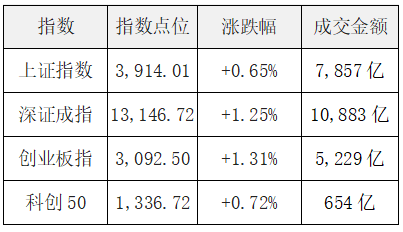
Market Overview - The A-share market exhibited a strong recovery with a "high opening, fluctuating, stabilizing in the afternoon, and increased volume at the close" [1] - By the end of trading on December 1, the Shanghai Composite Index rose by 0.65% to 3,914.01 points, the Shenzhen Component Index increased by 1.25% to 13,146.72 points, and the ChiNext Index gained 1.31% to 3,092.50 points [2] Technical Analysis - The Shanghai Composite Index successfully surpassed the 60-day moving average (3,885-3,890) and approached the 3,930 gap area; the ChiNext Index broke through the 3,050 resistance level, with a MACD golden cross about to be established [3] - The market's volume increased to over 1.8 trillion, indicating a shift from "low-position ambush" to "main line attack," with the potential to challenge the 3,930 gap [4] Industry and Hotspot Capture - AI hardware on the edge experienced a significant surge, driven by the launch of the "Doubao mobile assistant" and Huawei's "Hanhai" AI toy, with global smart glasses shipments increasing by 64% year-on-year [5] - Industrial metals saw strong gains, with copper prices breaking through $11,200 and silver reaching new highs, prompting a re-evaluation of resources [5] - Companies such as Jiangxi Copper, Yunnan Copper, and Zijin Mining saw substantial increases, as funds viewed metals as dual-attribute assets against inflation and new productive capacity [5] Forward Strategy - The Shanghai Composite Index's 3,930 gap is a critical point; if it breaks through with sustained volume, the market may accelerate; however, if it peaks and retreats, short-term profit-taking pressure may arise [6] - Maintaining a volume level above 1.8 trillion indicates strong recognition from incremental funds; a rapid decline could lead to structural rotation [6] - A short-term strategy of "main line rotation, high-low switching, and rhythm adjustment" is recommended to rationally respond to market fluctuations [7]
超175亿 跑了!
Zhong Guo Ji Jin Bao· 2025-11-26 06:08
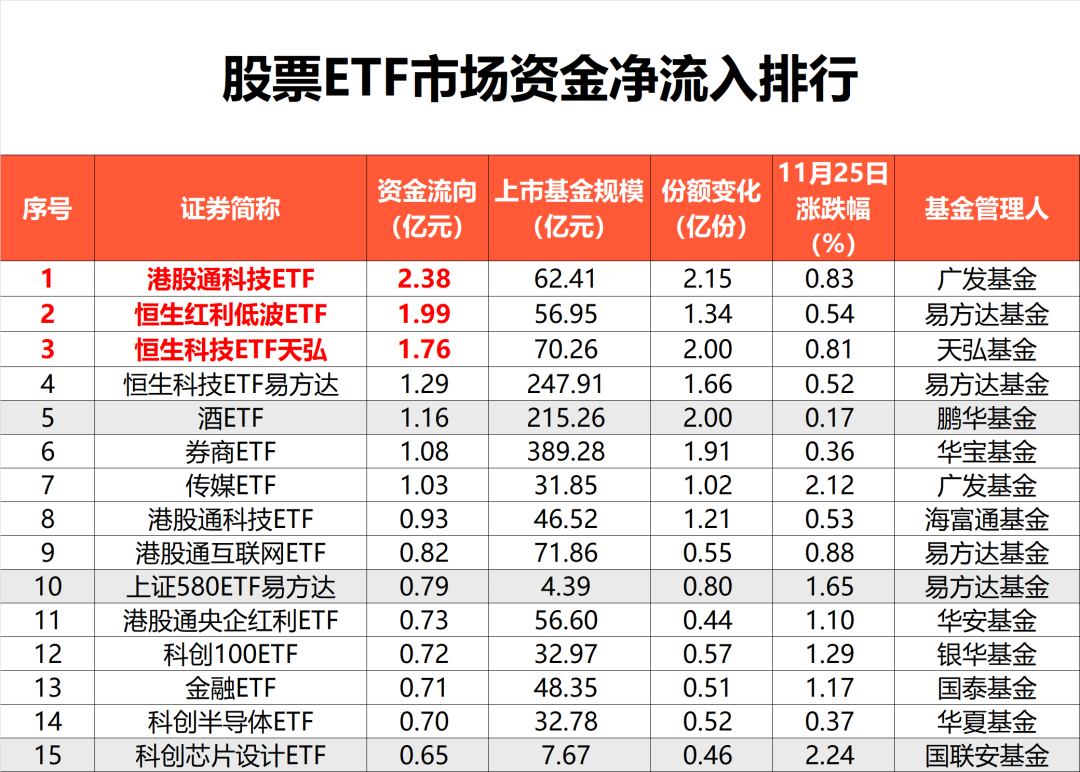
Group 1 - The core point of the article highlights a significant net outflow of over 17.5 billion yuan from the stock ETF market amid a collective rise in A-share indices, indicating a trend of "selling into strength" by investors [1][3][10] - The total scale of the stock ETF market reached 4.54 trillion yuan, with a reduction of 8.241 billion units in total shares, reflecting a net outflow of over 17.5 billion yuan on the day of the market surge [3][6] - The Hong Kong market ETFs and commodity ETFs saw notable net inflows of 1.214 billion yuan and 415 million yuan respectively, while the ChiNext ETF and CSI 500 ETF experienced significant net outflows [3][7] Group 2 - The CSI 500 ETF led the outflows with a net withdrawal of 3.332 billion yuan, followed by the ChiNext ETF and CSI 1000 ETF with outflows of 2.39 billion yuan and 1.534 billion yuan respectively [7][9] - Major fund companies like E Fund and Huaxia Fund reported substantial net inflows in their ETFs, with E Fund's Hang Seng Dividend Low Volatility ETF attracting nearly 200 million yuan [6][10] - Institutional investors remain optimistic about the A-share market's future, anticipating a potential spring rally driven by sectors such as AI, electric vehicles, and industrial metals, alongside policy expectations around the year-end and Spring Festival [10]
A500ETF基金(512050)强势翻红成交额超53亿元位居同类第一,机构:2026年中国牛市2.0有望启动
Mei Ri Jing Ji Xin Wen· 2025-11-19 07:32
Group 1 - A-shares experienced a strong afternoon rally, with the Shanghai Composite Index closing in the green, supported by sectors such as shipbuilding, deep-sea technology, lithium mining, gold and jewelry, insurance, and industrial metals [1] - The A500 ETF fund (512050) saw a notable increase of 0.17%, with a turnover rate of 27.61% and a trading volume exceeding 5.3 billion yuan, ranking first among comparable funds [1] - Key stocks such as Aerospace Development and Spring Breeze Power reached their daily limit up, while companies like Chengxin Lithium, Zhongjin Gold, Chifeng Jilong Gold, Tianqi Lithium, and Shandong Gold showed significant gains [1] Group 2 - UBS China’s 2026 outlook report predicts another prosperous year for the Chinese stock market, driven by favorable factors including developments in innovative sectors [1] - The MSCI China Index is projected to reach a target of 100 by the end of next year, indicating a potential upside of 14% from current levels [1] - Earnings per share for Chinese companies are expected to grow by 10% in 2026, with a positive outlook for sectors such as internet, hardware technology, and brokerage firms [1] Group 3 - Shenwan Hongyuan forecasts that the technology structural bull market in 2025 represents the "Bull Market 1.0" phase, with a potential peak in spring 2026 [2] - The second half of 2026 may initiate a comprehensive bull market, termed "Bull Market 2.0," driven by the sequential emergence of policy, market, and economic bottoms [2] - The upcoming bull market is anticipated to be characterized by a "technology bull" or "China influence enhancement bull," supported by cyclical improvements in fundamentals, strengthening trends in emerging industries, and a shift in resident asset allocation towards equities [2]
国泰基金胡松:做有安全边际的价值投资
Sou Hu Cai Jing· 2025-11-14 10:21
Core Viewpoint - The article emphasizes the importance of experienced fund managers who can navigate through bull and bear cycles to generate long-term returns for investors [1][2]. Group 1: Fund Manager Profile - Hu Song, a veteran fund manager with over 20 years in finance and 14 years of investment experience, is highlighted as a rare example of a value investor in the current A-share market [2]. - Under Hu Song's management, the Guotai Jinpeng Blue Chip Fund has achieved a return of 75.63% since September 25, 2020, with an annualized return of 11.87%, outperforming its benchmark and peer average [2][3]. - The Guotai Jinsheng Fund, launched at a market low in February 2024, has seen a performance increase of 50.73% this year, significantly surpassing the performance of the CSI 300 Index [2][3]. Group 2: Investment Philosophy - Hu Song's investment strategy focuses on "margin of safety" and emphasizes the importance of fundamental analysis over mere price observation [3][4]. - He employs a bottom-up stock selection approach while also considering macroeconomic factors, adjusting the investment portfolio based on fundamental changes [3][4]. - The selection criteria include a preference for stocks with sustainable competitive advantages and reasonable valuations, particularly those with high Return on Invested Capital (ROIC) [4]. Group 3: Risk Management and Performance - Hu Song prioritizes risk-return balance and actively manages drawdown control through diversified industry allocation and dynamic adjustments [5][6]. - The Guotai Jinpeng Blue Chip Fund has achieved nearly 60% positive returns over the past three years, with a maximum drawdown significantly lower than the peer average [6][7]. - The fund's top ten holdings are diversified across various sectors, with no single holding exceeding 8% of the total portfolio, reflecting a balanced investment style [7][8]. Group 4: Market Outlook - Hu Song remains optimistic about the market, citing structural transformations at the economic cycle's bottom and positive developments in the technology sector [9]. - He identifies potential growth areas in AI, new energy, industrial metals, and technology sectors, while also acknowledging the risks associated with trade and geopolitical uncertainties [9]. - The article suggests that investors may benefit from selecting experienced fund managers like Hu Song, who can navigate market fluctuations effectively [9].

价值投资老将,业绩确实能打
Xin Lang Ji Jin· 2025-11-14 09:45
Core Viewpoint - The article emphasizes the importance of experienced fund managers who can navigate through bull and bear cycles to create long-term returns for investors [1][2]. Group 1: Fund Manager Profile - Hu Song, a veteran fund manager with over 20 years in finance and 14 years of investment experience, is highlighted as a rare example of a value investor in the current A-share market [2]. - Under Hu Song's management, the Guotai Jinpeng Blue Chip Fund has achieved a return of 75.63% since September 25, 2020, with an annualized return of 11.87%, outperforming its benchmark and peer average [2][3]. Group 2: Fund Performance - The Guotai Jinsheng Fund, launched at a market low in February 2024, has seen a performance increase of 50.73% this year, surpassing the CSI 300 Index and its benchmark [2][3]. - The Guotai Jinpeng Blue Chip Fund has delivered nearly 60% positive returns over the past three years, ranking in the top 10% among peers, with a maximum drawdown significantly lower than the average [6][7]. Group 3: Investment Philosophy - Hu Song's investment strategy focuses on fundamental analysis, emphasizing the importance of a company's competitive advantages and reasonable valuations [4][5]. - The principle of "margin of safety" guides Hu Song's investment decisions, favoring growth stocks that can create long-term value [5][6]. Group 4: Risk Management - Hu Song employs a balanced approach to risk and return, actively managing drawdowns and diversifying across industries to mitigate market volatility [6][9]. - The investment portfolio is dynamically adjusted based on macroeconomic conditions and individual stock performance, ensuring a robust response to market changes [4][9]. Group 5: Market Outlook - Hu Song remains optimistic about sectors such as AI, new energy, industrial metals, and technology, citing favorable domestic and international economic conditions [8][9]. - The article notes that despite challenges in the real estate and consumer sectors, there are structural highlights in emerging industries that could present investment opportunities [8][9].
