房地产去库存

Search documents
一线城市房价环比跌幅率先收窄,2026年“稳预期”政策效力有望深化
Sou Hu Cai Jing· 2026-01-19 08:41
央广网北京1月19日消息(记者门庭婷)1月19日,国家统计局发布了2025年全年房地产市场相关数据, 涵盖房价、开发投资、销售等多个维度。数据显示,全年新建商品房销售面积为8.8亿平米,同比下降 8.7%;销售额8.4万亿元,同比下降12.6%;投资、新开工和竣工面积同比分别下降17.2%、20.4%、 18.1%。 开发投资与销售:各项指标深度调整,去库存取得积极进展 2025年,全国房地产开发投资与新开工大幅收缩,数据显示,2025年,全国房地产开发投资额为8.28万 亿元,同比下降17.2%;房屋新开工面积5.88亿平方米,同比下降20.4%。 多位业内专家结合数据指出,2025年房地产各项指标处于深度调整过程中。随着市场库存持续消化、政 策协同发力及社会预期逐步修复,市场有望逐步探明底部,迈向规模更稳、结构更优、品质驱动的高质 量发展阶段。 房价:整体仍处调整通道,一线城市跌幅收窄释放企稳信号 从房价数据看,2025年12月,全国70个大中城市商品住宅销售价格环比继续下跌,但部分指标跌幅呈现 收窄或趋稳态势,市场出现微妙变化。 新房价格环比跌幅趋稳,一线城市显现韧性。据国家统计局数据,2025年12月 ...
去年12月70城二手房价格均下跌
Di Yi Cai Jing· 2026-01-19 05:52
Core Viewpoint - The national real estate market in China is undergoing a deep adjustment, with a focus on institutional reforms and revitalizing idle properties to mitigate risks and boost consumption in 2025 [2][3]. Group 1: Sales and Market Trends - In 2025, the total sales area of new commercial housing reached 88.101 million square meters, a decrease of 8.7% from the previous year, with residential sales area down by 9.2% [2]. - The sales revenue for new commercial housing was 839.37 billion yuan, reflecting a decline of 12.6%, with residential sales revenue decreasing by 13.0% [2]. - The sales area and revenue for new commercial housing in 2024 were 97.385 million square meters and 967.5 billion yuan, respectively, marking a year-on-year decline of 12.9% and 17.1% [3]. Group 2: Investment and Development - National real estate development investment in 2025 was 827.88 billion yuan, down 17.2% year-on-year, with residential investment at 635.14 billion yuan, a decrease of 16.3% [3]. - The construction area and new starts for residential projects saw year-on-year declines exceeding 10% and 20%, respectively [3]. Group 3: Price Trends - In December 2025, the new housing prices in Shanghai increased by 0.2%, making it the only first-tier city with a month-on-month increase [4]. - The number of cities with stable new housing prices increased, indicating a phase of deep negotiation between supply and demand [4]. - In the second-hand housing market, prices continued to decline, with first-tier cities experiencing a reduced month-on-month decline of 0.9% [4]. Group 4: Inventory and Market Dynamics - As of the end of 2025, the nationwide unsold housing area was 76.632 million square meters, an increase of 1.6% from the previous year [5]. - The inventory pressure remains significant, with many cities still facing prolonged periods for sales to normalize [5]. - The article highlights that the overall stability of the real estate market is accompanied by fluctuations in certain cities due to high inventory levels [5]. Group 5: Future Outlook - Looking ahead to 2026, the trend of controlling new supply while addressing inventory issues is expected to continue, with a shift in demand towards second-hand and rental markets [6]. - The narrowing decline in housing prices in first-tier cities and increased transactions in affordable second-hand homes suggest a potential stabilization in the market [6].


环球房产周报:住建部鼓励原拆原建,居民换房退个税政策延续,央行下调商用房首付……
Huan Qiu Wang· 2026-01-19 01:29
Policy News - The Ministry of Housing and Urban-Rural Development emphasizes the need to create high-quality living spaces and encourages the renovation of old housing through self-renewal and original demolition [1] - The Financial Regulatory Bureau aims to establish a normalized urban real estate financing coordination mechanism to support a new model of real estate development [2] - The Ministry of Finance and the State Taxation Administration announced the extension of personal income tax policies supporting residents' housing purchases until December 31, 2027 [3] - The People's Bank of China has lowered the minimum down payment ratio for commercial property loans to 30% to support the real estate market [4] - The Ministry of Finance and the State Taxation Administration extended tax incentives for public rental housing until December 31, 2027 [5] - Hunan Province is promoting the use of special bonds to acquire existing commercial housing for affordable housing and other purposes [6] - Beijing plans to release its annual land supply plan by the end of January, aiming to supply quality land in the first quarter [7] Market News - In 2025, the top 30 real estate companies in Beijing achieved a total sales amount of 239.564 billion yuan, with China State Construction winning the top three categories [8] - A combination land plot in Tongzhou, Beijing, has been adjusted to increase residential land supply [9] - Beike's subsidiary, Beihome, is collaborating on a residential project in Changping, Beijing, utilizing a C2M model [10] - Chengdu successfully auctioned five land plots at a base price, totaling approximately 9.1 billion yuan [11] Company News - Vanke proposed a debt extension plan for two bonds totaling 57 billion yuan [12] - China State Construction reported a new contract amount of 45.458 billion yuan for 2025, with real estate sales reaching 39.48 billion yuan [12] - Yuexiu Property's total contract sales for 2025 reached approximately 106.21 billion yuan, a decrease of 7.3% year-on-year [14] - New City Holdings' major shareholder has pledged 13.83% of the company's shares [14] - R&F Properties reported that approximately 77% of planned creditors have agreed to a restructuring support agreement [15] - Sunac's subsidiary has had over 1 billion yuan in assets frozen due to legal actions [16] - Jin Ke Service's privatization offer has been accepted by over 95% of unrelated shares, with plans to delist by February 20, 2026 [16]
利好频出,2026年中国楼市开局“步稳”
Zhong Guo Xin Wen Wang· 2026-01-19 01:05
Group 1 - The Chinese real estate market has received multiple favorable policies at the beginning of 2026, including a reduction in the down payment for commercial properties and adjustments to mortgage rates, indicating a steady start for the market [1][4] - The People's Bank of China has lowered the minimum down payment ratio for commercial property loans to 30%, down from previous requirements of 50% or higher, aiming to stimulate the commercial real estate market [1][2] - The extension of the tax refund policy for home sales is expected to stabilize market expectations and reduce costs for families looking to upgrade their housing, thereby promoting demand for improved housing [2][3] Group 2 - The reduction in mortgage rates for existing housing and some commercial loans is set to lower borrowing costs for homeowners, contributing to a more favorable market environment [4] - Local governments are also implementing supportive policies, such as increasing loan limits for families with multiple children and veterans, which further enhances the accessibility of housing finance [4] - Recent data indicates a gradual recovery in housing transactions in major cities, with a notable increase in the average price index for second-hand residential properties, suggesting a positive market outlook [4]
最新调整!商业用房贷款最低首付比例不低于30%
Sou Hu Cai Jing· 2026-01-18 12:39
Core Viewpoint - The People's Bank of China has announced a reduction in the minimum down payment ratio for commercial property loans from 50% to 30%, aimed at adapting to changes in the real estate market and supporting a new development model in the sector [1][3]. Group 1: Policy Changes - The minimum down payment ratio for purchasing commercial properties, including "commercial-residential mixed-use properties," has been adjusted to no less than 30% [1]. - Local branches of the People's Bank of China and the National Financial Regulatory Administration are authorized to set lower minimum down payment ratios based on local government policies, following the principle of "differentiated measures for different cities" [1]. Group 2: Market Impact - The reduction in the down payment requirement is expected to lower the barriers for purchasing commercial properties, thereby enhancing the activity in the commercial real estate market [3]. - The move is seen as a significant step in supporting the de-inventory efforts for commercial properties, indicating an increased focus from central and regulatory authorities on reducing excess stock in commercial projects [3].
房地产去库存再加速!买商业用房最低首付降至30%
Di Yi Cai Jing· 2026-01-17 10:53
Core Viewpoint - The People's Bank of China and the National Financial Regulatory Administration have announced a policy to lower the minimum down payment ratio for commercial property loans to no less than 30%, aiming to adapt to changes in the real estate market and support a new development model [1][5] Group 1: Policy Implementation - The policy allows provincial branches of the People's Bank of China and local regulatory agencies to set their own minimum down payment ratios based on local government requirements, following the principle of "differentiated measures" [1] - Prior to this policy, most cities had a minimum down payment requirement of around 50%, with some banks setting it as high as 60% or more [1][2] Group 2: Market Conditions - The commercial property market is facing high inventory levels and slow absorption rates, with office buildings and commercial properties accounting for 25.7% of the total unsold residential properties in China as of November 2025 [2] - The average absorption period for commercial properties is reported to be around 30 months, with some areas experiencing periods of 50 to 70 months [2] Group 3: Demand Dynamics - There is a rising interest from institutional and individual investors in commercial properties, particularly in long-term rental products such as serviced apartments [3] - In Shenzhen, the proportion of non-residential new home transactions reached 31.4% in 2025, indicating a growing preference for rental-oriented products [3] Group 4: Local Measures - Various cities have implemented localized measures to stimulate the commercial property market, including allowing the conversion of commercial properties to rental housing and providing purchase subsidies [4] - For example, Shanghai permits business buildings to be used for various functions, while Wuhan offers a 50% subsidy on deed tax for new commercial property purchases [4] Group 5: Strategic Shift - The shift in policy reflects a broader trend of extending support from residential to commercial and industrial real estate, embodying a "precise drip irrigation" approach to regulation [5] - Lowering financial barriers for commercial real estate is seen as a targeted easing measure to invigorate the market and support a stable transition to a new development model in the real estate sector [5]
商业用房购房贷款,新政来了!
券商中国· 2026-01-17 10:43
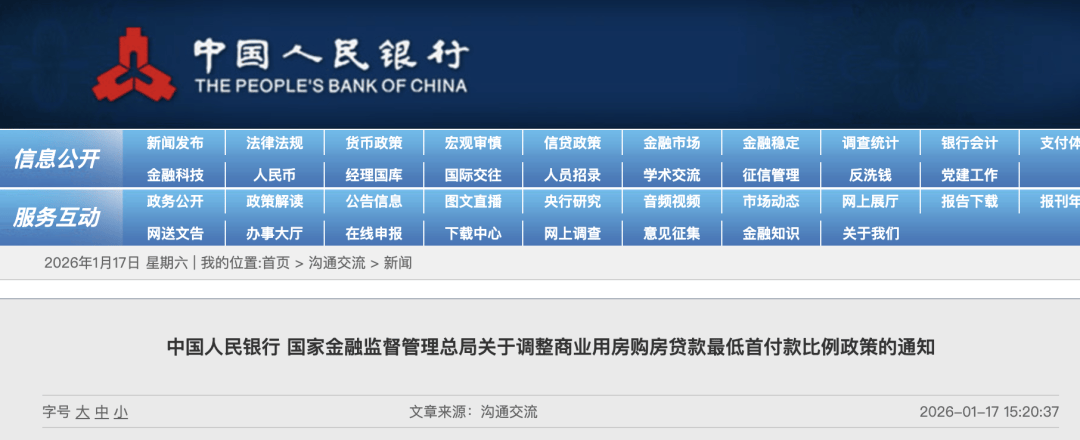
为贯彻落实党中央、国务院决策部署,适应我国房地产市场供求关系的新变化,支持构建房地产发展新模式,现就商业用房购房贷款政策有关事项通知如下: 商业用房(含"商住两用房")购房贷款最低首付款比例调整为不低于30%。 中国人民银行各省级分行、国家金融监督管理总局各省级派出机构根据辖区各城市政府调控要求,按照因城施策原则,在全国统一的最低首付款比例基础上,自 主确定辖区各城市最低首付款比例下限。 | | | 中国人民银行、国家金融监督管理总局发布《关于调整商业用房购房贷款最低首付款比例政策的通知》。 广东省住房政策研究中心首席研究员李宇嘉表示,目前各地普遍面临在售商业用房库存高企、去化周期高企的问题。另外,在售库存去化难度大,导致已供应土 地和在建项目开发难度大,二手商业用房价格跌幅也很大。"过去,考虑到商用性质为主,对商业用房贷款一直奉行低杠杆的金融财经纪律。现在来看,炒作已经 完全退去,从商业经营的角度看过剩已成定局。在居民加杠杆购房意愿下降的情况下,面对有结构性的贷款需求,放开是合理的。而且,考虑到银行评估价比较 谨慎,30%的首付也并不低,未来还有可能再次降低。" 责编:刘珺宇 校对:刘星莹 百万用户都在看 ...

周末重磅!商业用房购房贷款,新政公布
证券时报· 2026-01-17 08:05
为贯彻落实党中央、国务院决策部署,适应我国房地产市场供求关系的新变化,支持构建房地产发展新模式,现就商业用房购房贷款政策有关事项通知 如下: 商业用房(含"商住两用房")购房贷款最低首付款比例调整为不低于30%。 中国人民银行各省级分行、国家金融监督管理总局各省级派出机构根据辖区各城市政府调控要求,按照因城施策原则,在全国统一的最低首付款比例基 础上,自主确定辖区各城市最低首付款比例下限。 中国人民银行、国家金融监督管理总局发布《关于调整商业用房购房贷款最低首付款比例政策的通知》。 广东省住房政策研究中心首席研究员李宇嘉表示,目前各地普遍面临在售商业用房库存高企、去化周期高企的问题。另外,在售库存去化难度大,导致 已供应土地和在建项目开发难度大,二手商业用房价格跌幅也很大。"过去,考虑到商用性质为主,对商业用房贷款一直奉行低杠杆的金融财经纪律。 现在来看,炒作已经完全退去,从商业经营的角度看过剩已成定局。在居民加杠杆购房意愿下降的情况下,面对有结构性的贷款需求,放开是合理的。 而且,考虑到银行评估价比较谨慎,30%的首付也并不低,未来还有可能再次降低。" 综合自:央视新闻、证券时报此前报道 责编:李丹 校对: ...

(经济观察)利好频出 2026年中国楼市开局“步稳”
Zhong Guo Xin Wen Wang· 2026-01-16 13:03
Group 1 - The Chinese real estate market is experiencing a positive start in 2026 with multiple favorable policies aimed at stabilizing the market and promoting economic activity [1][2] - The People's Bank of China has lowered the minimum down payment for commercial property loans to 30%, down from previous requirements of 50% or higher, to support the commercial real estate market [1][2] - The extension of the tax refund policy for home sellers who purchase new homes within a year is expected to lower costs for families looking to upgrade their housing, thereby stimulating demand [2][3] Group 2 - The reduction in interest rates for existing housing provident fund loans and some commercial loans is set to lower borrowing costs for homeowners, effective from January 1, 2026 [4] - Local governments are also implementing supportive measures, such as increasing loan limits for families with multiple children and veterans, to further stimulate the real estate market [4] - Major cities like Beijing, Shanghai, and Shenzhen have seen a steady increase in real estate transactions, indicating a gradual recovery in the housing market [4]
央行:商业用房购房最低首付降至30%
Xin Lang Cai Jing· 2026-01-15 14:14
Core Viewpoint - The People's Bank of China (PBOC) is implementing two key policy measures to address the current economic and financial situation, including lowering interest rates on various structural monetary policy tools and enhancing support for economic structural transformation [2][4]. Group 1: Monetary Policy Adjustments - The PBOC will reduce the interest rates on various structural monetary policy tools by 0.25 percentage points, with the one-year relending rate decreasing from 1.5% to 1.25%, and other term rates adjusted accordingly [2][4]. - The minimum down payment ratio for commercial property loans will be lowered to 30% to support the de-inventory of commercial and real estate markets [2][4]. Group 2: Tax Policy for Housing - A joint announcement from the Ministry of Finance, State Taxation Administration, and Ministry of Housing and Urban-Rural Development states that from January 1, 2026, to December 31, 2027, taxpayers selling their own homes and purchasing new ones within one year will receive a tax refund on the personal income tax paid on the sale of their previous home [2][4].