
智能化汽车

Search documents
豪华信仰崩塌,BBA不再吸引年轻人
3 6 Ke· 2025-11-05 09:44
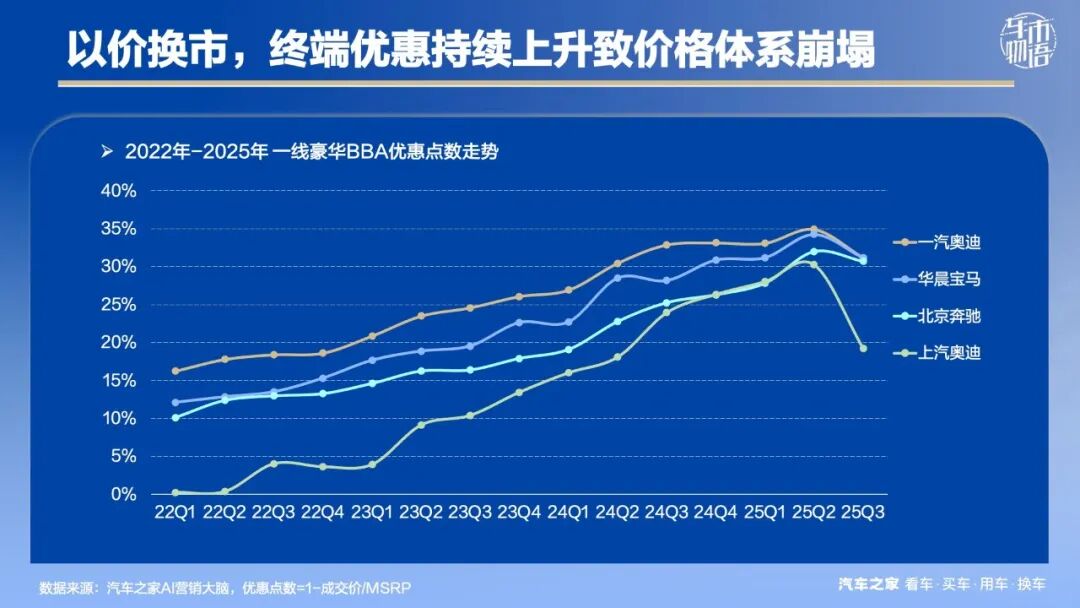
Core Insights - Mercedes-Benz is reportedly planning to lay off 30,000 employees, marking the largest layoff in the company's history, amid a significant decline in profits, with net profit dropping 50.3% year-on-year from €7.8 billion to €3.87 billion in the first nine months of 2025 [1] - The luxury automotive market is facing a transformation crisis, with traditional luxury brands struggling against rising Chinese brands and experiencing a collapse in their high-end pricing structure [1][2] - The market share of overseas luxury brands in the large vehicle segment has plummeted from 94% in 2016 to just 13% by 2025, indicating a significant loss of dominance [4] Group 1: Market Dynamics - Luxury vehicles are now being sold at discounts, with some models entering the price range of ¥250,000 to ¥300,000, and even below ¥200,000, which poses a threat to both foreign and domestic brands [2] - The high-end market share of luxury brands is rapidly declining, with a drop from 68% in 2016 to 22% by 2025 in the combined mid-large vehicle segment [4] - The shift in consumer preferences towards traditional fuel vehicles over luxury brands is evident, with only 41% of consumers with a budget over ¥300,000 considering overseas luxury brands [7] Group 2: Changing Consumer Preferences - In the new energy vehicle market, only 32% of potential buyers consider overseas luxury brands, highlighting a disconnect between luxury branding and consumer needs [9] - The perception of luxury is evolving, with 92% of high-budget new energy users recognizing at least one Chinese brand as a high-end brand, indicating a shift in the definition of luxury [13] - The importance of brand value is diminishing in the new energy sector, with only 25% of users considering brand as a key factor in their purchasing decision [9] Group 3: Technological Advancements - Chinese brands are increasingly recognized for their high-end features, with over 90% of new energy users acknowledging the high-end capabilities of Chinese brands [13][19] - The standardization of advanced features in Chinese high-end models is significantly higher than that of overseas luxury brands, particularly in areas like lane-keeping assistance and 360° panoramic imaging [19][21] - Collaborations between luxury brands and Chinese tech companies are expected to enhance their technological offerings, with several partnerships set to launch new models by 2025 [24][26]

广汽集团交出最差三季报,旗下昊铂9个月才卖1万辆
阿尔法工场研究院· 2025-11-03 00:05
Core Viewpoint - GAC Group is facing significant financial challenges, with a record net loss of 1.774 billion yuan in Q3 2025, indicating a critical state for the company as it struggles to find a way forward in a competitive automotive market [4][5][8]. Financial Performance - GAC Group reported a revenue of 66.272 billion yuan in Q3 2025, a year-on-year decline of 10.49% [8]. - The net profit attributable to shareholders was 4.312 billion yuan, a staggering year-on-year decrease of 3691.33%, marking a shift from profit to loss [8]. - Total vehicle sales from January to September 2025 were 1.1837 million units, down 11.34% compared to the previous year, with a sharp decline from the peak sales of approximately 2.505 million units in 2023 [8]. Brand Performance - GAC's main brands, including GAC Honda and GAC Toyota, have seen varying performance, with GAC Honda experiencing a year-on-year decline of 27.58%, while GAC Toyota grew by 4.89% [8]. - GAC's self-owned brands, such as GAC Trumpchi and GAC Aion, also faced declines of 15.84% and 19.99%, respectively [8]. - Despite the overall downturn, some brands showed sequential growth in Q3, with GAC Trumpchi, GAC Aion, and GAC Haobo collectively selling over 159,500 units, a quarter-on-quarter increase of 15.09% [8]. Strategic Challenges - GAC Group's reliance on joint ventures with Honda and Toyota has historically contributed to nearly 60% of its profits, but this dependency has hindered its transition to electric vehicles [12][14]. - The company has acknowledged strategic missteps, particularly in addressing user concerns about range anxiety and missing opportunities in the extended-range market [16][18]. Future Initiatives - GAC has initiated the "Panyu Action" to address its challenges, declaring a "wartime state" to revitalize the company [16][20]. - The introduction of the "Xingyuan Extended Range" technology aims to alleviate user concerns regarding vehicle range [18]. - GAC is collaborating with Huawei to develop the "Qijing" brand, which is expected to enhance GAC's technological capabilities and market positioning [21][22][24].


浩物股份连续四个季度实现盈利 拟使用公积金弥补亏损
Zheng Quan Ri Bao Wang· 2025-10-28 06:48
Core Viewpoint - The company has shown a significant improvement in net profit despite a decline in revenue, indicating a positive trend in profitability and operational efficiency [1][2]. Financial Performance - For the first three quarters of 2025, the company reported revenue of 2.183 billion, a year-on-year decrease of 16.98%, while net profit reached 42.7752 million, a year-on-year increase of 279.04% [1]. - In the third quarter alone, the company achieved revenue of 726 million, down 18.69% year-on-year, with net profit of 12.3436 million, up 324.27% year-on-year [1]. - The company has maintained positive net profit for four consecutive quarters since Q4 2024, indicating a continuous improvement in profitability [1]. Business Segments - The company operates primarily in two segments: automotive sales and services, and internal combustion engine crankshaft manufacturing [1]. - The automotive sales and services segment includes vehicle sales, maintenance services, and comprehensive services, with key brands including SAIC Volkswagen, FAW Volkswagen, FAW Toyota, Dongfeng Nissan, and various new energy vehicle brands [1]. Strategic Initiatives - The company is optimizing its revenue structure and cost management, which has led to a sustained increase in profitability [2]. - The focus on new energy vehicles and enhanced after-sales service is expected to drive further growth in revenue and market share [2][3]. - The company plans to use 679.482 million from surplus reserves and 876 million from capital reserves to offset cumulative losses, which will improve its financial stability and net asset quality [2][3]. Market Outlook - The demand for new energy and smart vehicles is expected to grow, providing opportunities for the company to expand its market presence and enhance brand partnerships [2]. - Improving financial conditions may attract more investors and support future growth initiatives, including potential green bond issuance [3].

长安汽车(000625):2025 年三季报点评:新能源转型成果显著,智能化、全球化加速
HUAXI Securities· 2025-10-26 05:47
Investment Rating - The investment rating for the company is "Accumulate" [1][7] Core Views - The company has shown significant results in its transition to new energy, with improvements in core profitability and accelerated efforts in smart technology and globalization [6] - The company reported a revenue of 42.236 billion yuan for Q3 2025, a year-on-year increase of 23.36%, and a net profit attributable to shareholders of 0.764 billion yuan, up 2.13% year-on-year [2] - The company’s sales volume reached 266,000 units in September 2025, a nearly 25% increase year-on-year, with new energy vehicle sales exceeding 100,000 units, marking an 87% increase [3] Summary by Sections Financial Performance - For the first three quarters of 2025, the company achieved a revenue of 114.927 billion yuan, a year-on-year increase of 3.58%, while the net profit attributable to shareholders was 3.055 billion yuan, down 14.66% year-on-year [2] - The company’s non-recurring net profit for the first three quarters was 2.018 billion yuan, reflecting a year-on-year growth of 20.08% [4] New Energy and Sales Growth - The company’s new energy vehicle segment has shown strong momentum, with September sales of 100,000 units, representing a year-on-year growth of 87% [3] - The company’s export volume in September reached 60,000 units, a year-on-year increase of 23% [4] Smart Technology Development - The company launched a new smart brand "Tianshu Intelligent" at its fifth technology ecosystem conference, introducing several leading technologies in smart driving, cabin, and chassis [5] - The company is advancing in the L3 autonomous driving sector and has been approved as one of the first pilot units for L3 intelligent connected vehicles in the country [5] Profit Forecast and Valuation - The revenue forecast for 2025-2027 is set at 190.274 billion, 213.849 billion, and 236.303 billion yuan, respectively, with net profits projected at 4.717 billion, 6.265 billion, and 7.695 billion yuan [6] - The expected earnings per share (EPS) for 2025-2027 are 0.48, 0.63, and 0.78 yuan, with corresponding price-to-earnings (PE) ratios of 26.73, 20.13, and 16.39 [7]

魏建军的MPV拼图完成了
Hua Er Jie Jian Wen· 2025-10-16 07:31
Core Insights - The launch of the Wei brand's Gaoshan 7 MPV targets the growing family MPV market, with a price of 285,800 yuan, filling a gap in the entry-level large MPV segment [1] - The Gaoshan series now includes three product lines: Gaoshan 7 for young families, Gaoshan 8 for larger families, and Gaoshan 9 for both business and family use [1][5] - The MPV market is shifting from a business-oriented focus to a family-first approach, with family MPVs expected to account for 58% of sales by 2025 [1][4] Product Strategy - Gaoshan 7 features a single SKU strategy, simplifying user choices and significantly reducing production costs and inventory pressure [2] - The vehicle is equipped with a Hi4 performance version intelligent four-wheel drive hybrid system, offering a combined power of 337 kW and a 0-100 km/h acceleration time of 5.7 seconds [2] - Gaoshan 7 is the only large MPV under 300,000 yuan to come standard with laser radar and rear entertainment screens, enhancing its competitive edge [2] Sales Performance - Wei brand's sales reached 11,000 units in September, maintaining a monthly sales figure above 10,000 units, with a cumulative sales of 63,600 units from January to September, reflecting a year-on-year increase of 96.35% [2] - The Gaoshan family has achieved over 40,000 orders since its launch in May, with more than 30,000 units delivered, leading the national MPV sales rankings [2] Market Dynamics - The MPV market is undergoing significant changes, with total sales reaching 500,000 units in the first half of 2025, a 13% year-on-year increase, and a 66.5% penetration rate for new energy MPVs [4] - Plug-in hybrid models dominate the new energy MPV market, accounting for 42.8% of sales, while pure electric models represent 22.8% [4] - The competition in the MPV market is intensifying, with some models priced below 200,000 yuan and large SUVs encroaching on the MPV market, indicating a shift from a blue ocean to a red ocean market [4] Brand Positioning - Wei brand has established dual flagship product lines: the Blue Mountain SUV series and the Gaoshan MPV series, aiming to enhance its presence in the luxury market [5] - The completion of the Gaoshan family product layout positions Wei brand to secure a strong foothold in the increasingly competitive new energy MPV market [5]

五菱汽车(00305.HK):业绩稳健增长 新能源及智能化布局开启新篇章
Ge Long Hui· 2025-10-15 20:54
Core Viewpoint - The company has demonstrated strong performance in its financial results for the first half of 2025, with significant increases in both revenue and net profit, driven by product structure optimization, cost control, and increased R&D investment [1][2]. Financial Performance - For the first half of 2025, the company achieved operating revenue of 4.03 billion yuan, a year-on-year increase of 2.0% [1]. - Net profit reached 85.81 million yuan, up 306.2% year-on-year, while net profit attributable to shareholders was 39.42 million yuan, a staggering increase of 2385.2% [1]. - The gross profit margin improved to 12.0%, an increase of 1.2 percentage points year-on-year, indicating enhanced product value and cost control capabilities [2]. Business Segments - The core business of automotive parts and other industrial services generated revenue of 2.84 billion yuan, a year-on-year increase of 5.2%, with 46 new customers and 125 project approvals in the first half of the year [1]. - The automotive power system business turned profitable with an adjusted EBIT of 6.61 million yuan, attributed to improved product structure and rapid growth in high-value-added products [1][2]. - The commercial vehicle business saw an adjusted EBIT increase of 6.2% to 27.97 million yuan, with successful performance in niche markets such as fire trucks and vending vehicles [2]. Strategic Initiatives - The joint venture "Ling Shi Automobile" experienced a 9% year-on-year sales growth in the first half of 2025 and established partnerships with leading companies like Huolala and SF Express, enhancing market recognition [2]. - The parent company, Guangxi Automobile Group, has launched the "Ling Shi Project" strategy, aiming to develop the "Ling Shi" vehicle brand and become a leader in hybrid systems, drive axles, and chassis [2]. - A new low-altitude economy division has been established to focus on low-altitude and related travel products [2]. Future Outlook - The company is expected to continue its revenue growth, with projected total revenues of 8.866 billion yuan, 9.724 billion yuan, and 10.672 billion yuan for 2025-2027, representing year-on-year growth of 12%, 10%, and 10% respectively [3]. - Net profit forecasts for 2025-2027 have been adjusted to 87 million yuan, 110 million yuan, and 144 million yuan, reflecting year-on-year growth of 72%, 27%, and 31% respectively [3].
汽车视点 | 上汽“九连涨”破局:9月销量同比猛增四成,“金九银十”或再现
Xin Hua Cai Jing· 2025-10-11 05:09
Core Insights - SAIC Motor Corporation has reported impressive sales figures for September, with total vehicle sales reaching 440,000 units, a year-on-year increase of 40.4% and a month-on-month increase of 21%, reclaiming the top position in the industry [1] - The company has achieved a cumulative wholesale volume of 3.193 million units in the first nine months of the year, reflecting a year-on-year growth of 20.5%, while retail sales reached 3.378 million units, indicating strong end-user demand [1] Group 1: Growth Drivers - The significant rise in sales is attributed to SAIC's strategic transformation focusing on self-owned brands, new energy vehicles, and overseas markets, which are referred to as the "new three driving forces" [1][2] - In September, SAIC's self-owned brand sales reached 294,000 units, marking a year-on-year increase of 50.4% and accounting for 67% of total sales [2] - The MG4 and Roewe M7 DMH models contributed to a remarkable 72.4% year-on-year increase in sales for SAIC passenger vehicles, with domestic sales soaring by 245.3% [2] Group 2: Technological Advancements - SAIC's proprietary technologies, including the DMH super hybrid system and the Magic Cube battery platform, have enabled rapid market success for models like MG4 and the new generation of Zhiji LS6 [3] - The new generation Zhiji LS6 achieved over 10,000 pre-orders within 27 minutes of its launch, indicating strong market interest [3] Group 3: New Energy Vehicle Performance - In September, SAIC's new energy vehicle sales reached 189,000 units, a historical high with a year-on-year growth of 46.5% and a penetration rate of 43.2% [6] - The cumulative sales of SAIC's new energy vehicles in the first nine months reached 1.083 million units, reflecting a year-on-year increase of 44.8% [6] Group 4: International Expansion - SAIC's overseas sales in September reached 101,000 units, a year-on-year increase of 12.2%, with cumulative sales of 765,000 units in the first nine months, up 3.5% [7] - The MG brand has shown strong performance in Europe and Southeast Asia, with the MG4 EV frequently ranking in the top 10 in sales [7][8] Group 5: Joint Venture Developments - SAIC's joint ventures, including SAIC Volkswagen and SAIC General Motors, are adapting to industry changes with distinct yet complementary strategies [10] - SAIC Volkswagen's sales in September reached 91,300 units, supported by the launch of six new models, while SAIC General Motors saw a doubling of sales to 47,700 units [11] Group 6: Future Outlook - The recent surge in new vehicle orders, including models like MG4 and Zhiji LS6, suggests sustainable growth for SAIC [13] - The company aims to solidify its leading position by balancing innovation, cost control, and brand enhancement amid increasing market competition [13]


乘用车“金九”销量稳步增长 上汽集团重回月销榜首
Zheng Quan Ri Bao Zhi Sheng· 2025-10-08 16:08
Core Viewpoint - The automotive market is experiencing significant growth driven by consumer demand for new energy vehicles (NEVs) and favorable policies, despite some regional challenges in vehicle replacement subsidies [2][5][8] Market Performance - During the National Day and Mid-Autumn Festival holiday, major auto shows in cities like Suzhou, Nanjing, and Guangzhou showcased thousands of models, leading to increased sales and transaction amounts [1][4] - In September, passenger car sales showed steady year-on-year growth, with NEVs becoming mainstream, while sales performance varied significantly among different automakers [5][6] Policy Impact - The upcoming restoration of the vehicle purchase tax for NEVs starting January 1, 2026, has prompted automakers like NIO, Zeekr, and Li Auto to introduce tax difference subsidy policies to encourage consumer purchases [2][3] - Some regions have seen a decline in customer traffic and sales due to the suspension of vehicle replacement subsidies, leading to a more cautious consumer sentiment [2][3] Sales Trends - In September, the overall passenger car market grew, but there was a notable divergence in sales among different brands, with domestic brands and new energy vehicle manufacturers showing varied performance [5][6][7] - Shanghai Automotive Group led with sales of 439,800 units, a 40.39% increase, while BYD's sales fell by 5.5% to 396,300 units, marking its first monthly decline since March 2024 [6][7] New Energy Vehicle Segment - New energy vehicle sales are becoming a focal point, with companies like Zhejiang Leapmotor achieving a 97% year-on-year increase in sales, while others like Li Auto faced a 36% decline [7][8] - The overall performance of joint venture brands in September showed stable sales for traditional fuel vehicles but struggled in the NEV segment, highlighting a slower transition to electric models [8] Future Outlook - Industry experts remain optimistic about the automotive market's trajectory, anticipating a moderate recovery in October sales due to holiday demand and year-end promotions [8] - Projections indicate that by 2025, China's NEV sales could reach 15.78 million units, with a penetration rate of 53.7% [8]



价格下探至6万区间 主流A级家轿市场再度“硝烟四起”
Xin Hua Cai Jing· 2025-09-26 03:30
Group 1 - BYD launched the second generation Qin PLUS series, including three new models with prices starting at 69,800 yuan, enhancing its presence in the compact sedan market [1][3] - The 60,000 to 100,000 yuan segment is defined as the "starting layer" for young consumers, showcasing significant changes in the automotive market over the years [2][3] - The new models are positioned as A-class sedans, equipped with advanced technology, marking a shift from the previous A0-class small cars [3][4] Group 2 - The first generation Qin DM was launched in 2013, marking BYD's initial exploration into the A-class sedan market, which was dominated by joint venture brands [4][5] - The launch of the Qin PLUS DM-i in 2021 was a pivotal moment, achieving a fuel consumption of 3.8L/100km and a comprehensive range of 1,245 km, surpassing traditional fuel vehicles [4][5] - In 2023, the Qin family achieved over 480,000 units sold, marking the first annual sedan sales championship for Chinese brands in 13 years [5][6] Group 3 - The Qin family has seen cumulative sales surpassing 2 million units by December 2024, establishing a significant presence in the core segment [6][7] - The introduction of the fifth-generation DM technology and the second generation Qin PLUS models reflects ongoing technological advancements and product updates [7][8] - The competitive landscape is intensifying with new entrants in the 100,000 yuan electric vehicle market, prompting BYD to strengthen its market position [8]
征战21年IPO,奇瑞能成为下一个比亚迪吗?
3 6 Ke· 2025-09-26 02:37
Core Viewpoint - Chery Automobile has officially entered the capital market, experiencing a significant opening day surge but facing challenges in market valuation despite strong revenue growth [1][2] Group 1: Company Performance - Chery's revenue is projected to grow from 92.618 billion to 269.897 billion, with a compound annual growth rate of 70.7% from 2022 to 2024 [1] - Despite its high revenue, Chery's market capitalization is comparable to newer competitors like NIO, Li Auto, and Xpeng, indicating a disparity between revenue and market valuation [1][2] - Chery's IPO journey has been lengthy, spanning 21 years with seven applications and six failures, marking it as one of the longest IPO processes in China's automotive history [1][2] Group 2: Industry Context - Traditional automakers like BYD and Geely have successfully entered the capital market and leveraged capital for growth, while Chery has missed several opportunities [2] - The shift in the automotive market from fuel vehicles to new energy vehicles has created a challenging environment for Chery, which must now navigate intense competition in the new energy sector [2] Group 3: Strategic Challenges - Chery's early entry into the new energy vehicle market has not translated into significant market presence, with a low penetration rate compared to industry leaders [5][6] - The company faces high debt levels, with an asset-liability ratio exceeding 85%, raising concerns about its financial stability and ability to invest in new energy initiatives [7][8] - Chery's reliance on fuel vehicles for revenue hampers its ability to invest in new energy development, with R&D expenditure rates lower than many leading competitors [8][9] Group 4: Market Dynamics - The competitive landscape is intensifying, with price wars affecting profitability; Chery has responded with aggressive pricing strategies to maintain market share [10][11] - The company has launched a "100 billion factory subsidy" plan to reduce prices across multiple models, indicating a struggle to establish a strong market presence with flagship products [11][12] - Chery's transition to a public company will subject it to greater scrutiny from investors, necessitating a balance between growth and profitability in a rapidly changing market [10][12]