
白酒价格调整

Search documents
飞天茅台批价回涨 零售均价超1800元 动销也在提升
Nan Fang Du Shi Bao· 2025-12-14 13:31
Core Viewpoint - The price of Feitian Moutai has experienced significant fluctuations as year-end demand for liquor increases, with recent reports indicating a rise in wholesale prices due to a new supply control policy from Guizhou Moutai [2][3]. Price Fluctuations - On December 13 and 14, the wholesale price of Feitian Moutai saw a notable increase, with prices ranging from 1570 RMB to 1600 RMB per bottle, and some areas reaching up to 1630 RMB per bottle, indicating a substantial recovery compared to previous periods [2][3]. - Retail prices have also adjusted in response to the rising wholesale prices, with platforms and stores increasing prices by tens to hundreds of RMB. For instance, a retail store in Guangzhou raised its price from 1650 RMB to 1715 RMB per bottle [3]. Retail Price Stability - Despite the volatility in wholesale prices, the average retail price of Feitian Moutai in major consumption cities remains stable, with an average of 1884.1 RMB per bottle across cities like Guangzhou, Shenzhen, Foshan, and Dongguan [4]. - Specific retail prices in these cities include Guangzhou at 1904.39 RMB, Shenzhen at 1874.25 RMB, Foshan at 1928.21 RMB, and Dongguan at 1849.83 RMB, indicating a concentration of prices between 1800 RMB and 2000 RMB [4]. Market Demand and Consumption Trends - The market is witnessing a shift in consumption behavior, with a decline in speculative buying and an increase in genuine consumption needs. Retailers report that sales have been strong since May, driven by more attractive pricing [4][6]. - The willingness to purchase and open bottles has increased, particularly for high-end events such as weddings and birthdays, indicating a growing acceptance of Feitian Moutai for everyday consumption [5][6]. Industry Outlook - The demand for white liquor is currently in a "bottoming" phase, but there is a gradual increase in demand as the year-end approaches, influenced by promotional events like "Double 11" and "Double 12" [6]. - Guizhou Moutai is adapting to market changes by implementing a supply control policy and focusing on maintaining brand value and market stability, which includes a combination of short-term and long-term measures [3][6].


茅台酒价单日4次上调,经销商拿货价1580元
3 6 Ke· 2025-12-14 03:26
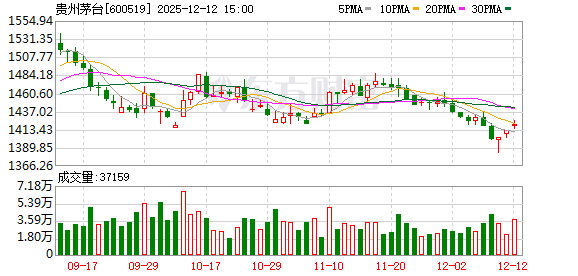
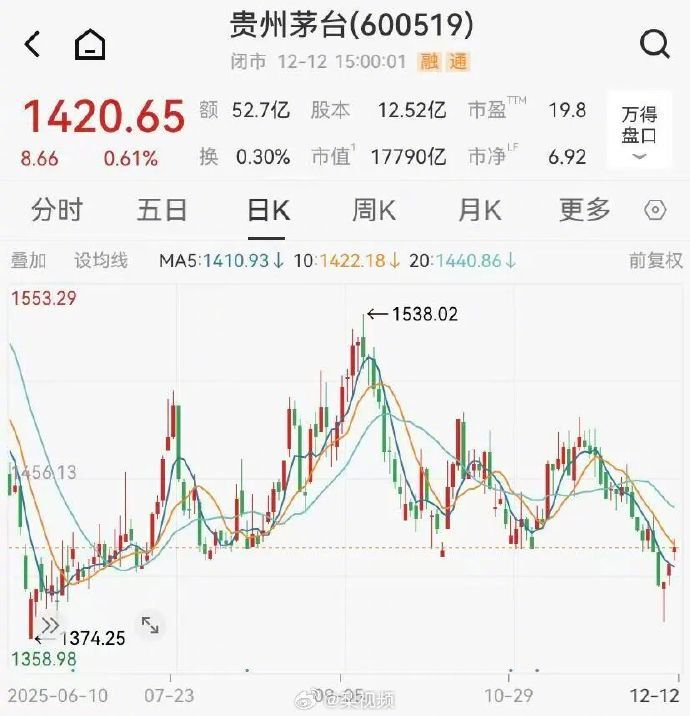
Group 1 - The core point of the news is that the price of Moutai liquor has experienced significant fluctuations, with a reported increase of four price adjustments in one day, reaching a purchase price of 1580 yuan per bottle as of December 13 [1] - Since June 2025, the retail price of Moutai has shown a downward trend, with the wholesale price falling below 2000 yuan for the first time on June 11, and continuing to decline to below 1600 yuan by the end of November [1] - Moutai management has been actively working with major e-commerce platforms like JD and Alibaba to integrate their channels into the Moutai ecosystem and combat unfair competition [1] Group 2 - A recent meeting of Moutai's provincial distributors discussed the strategic focus for 2026, which will center on three core products: Moutai 1935, Flying Moutai, and Premium Moutai, targeting price segments of over 600 yuan, over 1500 yuan, and over 2000 yuan respectively [2] - Non-standard Moutai products, such as Zodiac and kilogram Moutai, may see a reduction in supply, with specific amounts yet to be determined, and these products will be operated on a market-driven basis [2] - The company plans to halt the distribution of unfulfilled quotas for 2025 to stabilize the market [2] Group 3 - As of December 12, the stock price of Guizhou Moutai (600519.SH) closed at 1420.65 yuan per share, with a total market capitalization of 1779 billion yuan [3] - The company's earnings per share (EPS) is reported at 19.8, with a price-to-earnings (P/E) ratio of 19.8 [3] - The stock has shown a slight increase of 0.61% on the day, with a trading volume of 52.7 billion yuan [3]
五粮液出招“调价” 国窖们跟不跟?
2 1 Shi Ji Jing Ji Bao Dao· 2025-12-13 01:47
Core Viewpoint - The article discusses the potential price adjustment strategies of high-end liquor brands, particularly focusing on Wuliangye and Guojiao 1573, in response to market dynamics and competition, especially following Wuliangye's recent price changes [1][2]. Group 1: Market Dynamics - Wuliangye has initiated a price adjustment strategy, leading to speculation about whether Guojiao 1573 will follow suit [1]. - The competitive landscape has shifted, with Guojiao 1573's price gap with Wuliangye narrowing, and it even surpassed Wuliangye temporarily [2]. - The current market environment shows a trend of price adjustments among high-end liquor brands, with both Wuliangye and Guojiao 1573 historically following each other's pricing strategies [3][4]. Group 2: Pricing Strategies - Wuliangye's pricing strategy has included initial price increases followed by indirect price reductions through channel subsidies, ultimately leading to formal price cuts [5]. - Guojiao 1573 has historically adopted a follow-the-leader approach in pricing, often adjusting its prices in response to Wuliangye's moves [6][9]. - The article highlights that Guojiao 1573 may not need to follow Wuliangye's price adjustments directly due to its diverse product offerings, which provide it with more flexibility [14]. Group 3: Historical Context - The current pricing adjustments reflect patterns seen in previous cycles, where both brands engaged in back-and-forth pricing strategies [3][10]. - Guojiao 1573's past experiences with pricing strategies have led to significant market share fluctuations, emphasizing the importance of timely adjustments [6][11]. - The article notes that the competitive landscape has evolved, with new players entering the market, making pricing strategies more complex [14][15]. Group 4: Future Outlook - The article suggests that both brands will need to navigate the ongoing challenges in the market, with a focus on maintaining brand value while managing pricing [17]. - The need for a balanced approach between pricing and volume is emphasized, as companies face the dilemma of sacrificing one for the other [11][12]. - The future strategies of both Wuliangye and Guojiao 1573 will likely continue to evolve in response to market conditions and competitive pressures [13][16].


酒价内参12月13日价格发布 市场整体下挫水晶剑南春领跌
Xin Lang Cai Jing· 2025-12-13 01:07
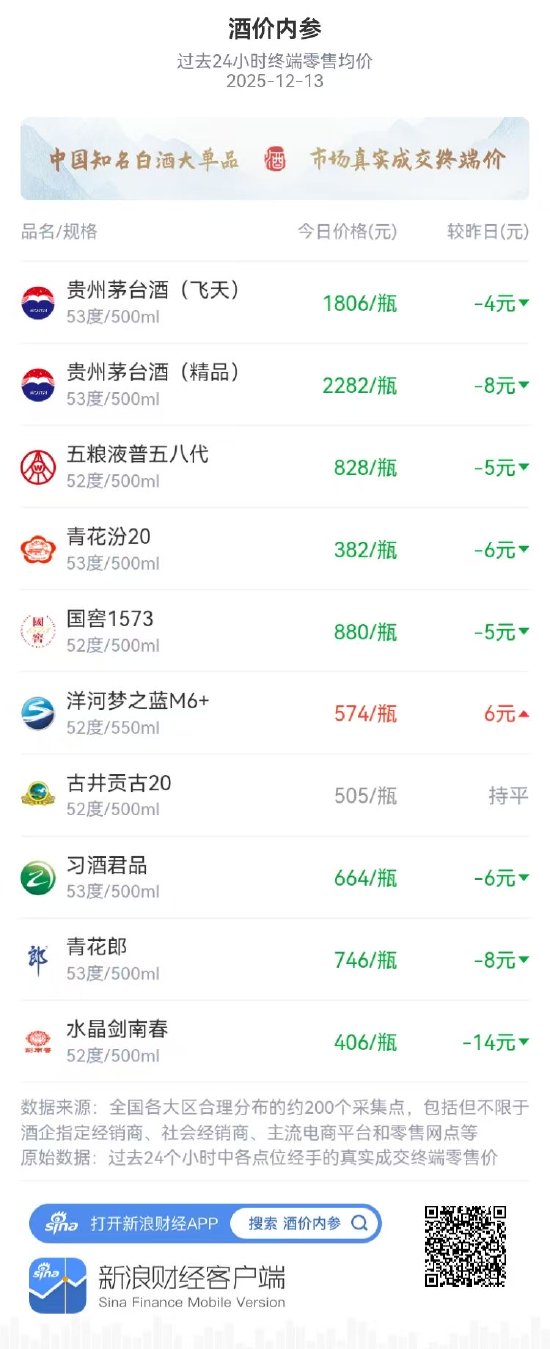
Core Viewpoint - The white liquor market is experiencing a significant price decline, with the average retail price of the top ten products dropping, indicating a continued weak downward trend in the market [1]. Group 1: Market Price Trends - The average retail price of the top ten white liquor products has decreased by 50 yuan, with a total price of 9073 yuan for a bundled sale [1]. - Specific products such as Shuijingjiu and Qinghualang have seen price drops of 14 yuan and 8 yuan per bottle, respectively, leading the market decline [3]. Group 2: Market Analysis - The white liquor industry is facing pressures from high inventory levels and weak demand, with distributors experiencing significant financial strain and low willingness to stock new products [3]. - Despite the current market challenges, the stock prices of the sector have adjusted significantly, reflecting pessimistic expectations, and valuations are now at historically low levels, suggesting potential long-term investment value [3].



茅台价格跌破1499元,昔日“液体黄金”为何突然不香了?
Sou Hu Cai Jing· 2025-12-12 14:00
Core Viewpoint - The price of Moutai, once considered "liquid gold," has fallen below the official guidance price of 1499 yuan, marking a significant shift in the Chinese consumer market and reflecting deeper changes in the industry [1][4]. Price Decline - Moutai's wholesale price for 53-degree 500ml bottles dropped to 1485 yuan, with box prices at 1495 yuan, both breaking the long-held 1499 yuan threshold [1]. - Compared to the peak price of over 2200 yuan at the beginning of 2025, the decline exceeds 30%, with some e-commerce platforms offering promotional prices as low as 1399 yuan [1][3]. Market Dynamics - The price drop is a result of a prolonged decline, starting with the first breach of the 2000 yuan psychological barrier in June 2025, followed by continuous decreases throughout the year [3]. - Retail prices in offline stores have decreased from over 2000 yuan to around 1580 yuan, allowing consumers to purchase Moutai at more accessible prices [4]. Supply and Demand Factors - The reversal in supply-demand dynamics is the fundamental reason for the price drop, with Moutai's production capacity expected to reach 48,000 tons in 2025 and social inventory estimated between 120 million to 220 million bottles [6]. - Demand has weakened significantly, with government consumption dropping to 0.8% and business banquet demand reduced by 30%, while younger consumers show less interest in high-proof liquor [6]. Channel Changes - The transformation of distribution channels has disrupted the traditional pricing system, with direct sales from Moutai increasing from 13.5% in 2020 to 46.8% [6]. - E-commerce platforms are using Moutai as a "traffic tool," leading to a vicious cycle of price cuts and inventory issues [6]. Financial Implications - The financial appeal of Moutai has diminished, with annualized returns dropping below 5%, prompting speculative funds to withdraw [6]. - Prices for previously inflated products, such as the "scattered Moutai," have plummeted over 70%, now below 3000 yuan [6]. Industry Impact - The collapse of Moutai's price has triggered a domino effect across the high-end liquor sector, with other brands like Wuliangye and Luzhou Laojiao experiencing significant price drops [9]. - Among 18 listed liquor companies, only Moutai and Shanxi Fenjiu have shown slight growth, while others face substantial declines in revenue and profit [9]. Future Outlook - The decline in Moutai's price signifies the end of an era reliant on government consumption and speculative investment [11]. - Moutai is adapting by introducing smaller packaging and new products aimed at younger consumers, while industry analysts suggest that 2026 may mark a turning point as inventory levels normalize [11].
五粮液,曲线降价
21世纪经济报道· 2025-12-12 06:46
Core Viewpoint - The article discusses the recent price adjustment strategies of high-end liquor brands, particularly focusing on Wuliangye and Guojiao 1573, and the competitive dynamics in the premium liquor market following Wuliangye's price changes [1][3][5]. Group 1: Market Dynamics - Wuliangye has been leading the high-end liquor market, with Guojiao 1573 closely following, and both brands often adjust their prices in tandem [1][3]. - The competition has intensified, with Guojiao 1573 expected to adopt a follow-up strategy similar to Wuliangye, potentially using channel subsidies to effectively lower prices without officially changing the factory price [1][3][9]. - The price gap between Guojiao 1573 and Wuliangye has been narrowing, with Guojiao 1573's price sometimes exceeding Wuliangye's [3][9]. Group 2: Pricing Strategies - Wuliangye's pricing strategy has included initial price increases followed by indirect price reductions through channel incentives, leading to a complex pricing environment [7][9]. - Guojiao 1573 has historically followed Wuliangye's pricing moves, but its management has indicated a more cautious approach this time, reflecting on past experiences where aggressive pricing led to market share losses [8][10]. - The current market environment is characterized by a need for strategic pricing adjustments, as both brands face declining demand and the challenge of maintaining market share [10][12]. Group 3: Product Focus and Revenue Contribution - Wuliangye's revenue is heavily reliant on its flagship product, contributing 50%-60% to its overall income, while Guojiao 1573 has diversified its offerings, with significant contributions from both high and low alcohol content products [13][14]. - Guojiao 1573's revenue contribution from high-end products has increased significantly, indicating a successful strategy in expanding its market presence [13][14]. - The competitive landscape has evolved, with new players entering the market, making pricing strategies more critical for maintaining brand positioning [14][15].

酒价内参12月12日价格发布,水晶剑南春上涨4元
Sou Hu Cai Jing· 2025-12-12 03:44
Group 1 - The core viewpoint of the articles indicates a continued decline in the retail prices of major Chinese liquor brands, with the average price of the top ten products dropping to 9123 yuan, a decrease of 15 yuan from the previous day, reflecting a weak market overall but with notable internal structural differentiation [1][2] - The data collected from approximately 200 sampling points across various regions ensures an objective and traceable representation of the market prices for well-known liquors [1] - Specific brands show significant price variations, with Qinghua Lang leading the decline at 20 yuan per bottle, while Xijiu Junpin and Guojiao 1573 saw increases of 7 yuan and 6 yuan respectively, indicating a mixed performance among brands [1][2] Group 2 - On December 10, a meeting took place between the Vice President of the Central Radio and Television Station and the Chairman of Moutai Group, where the Chairman emphasized the need to consolidate market advantages amidst ongoing industry adjustments [2] - The strategic focus of Moutai has shifted from merely pursuing price benchmarks to actively competing for market share in a contracting market, marking a new phase in their approach to industry challenges [2]
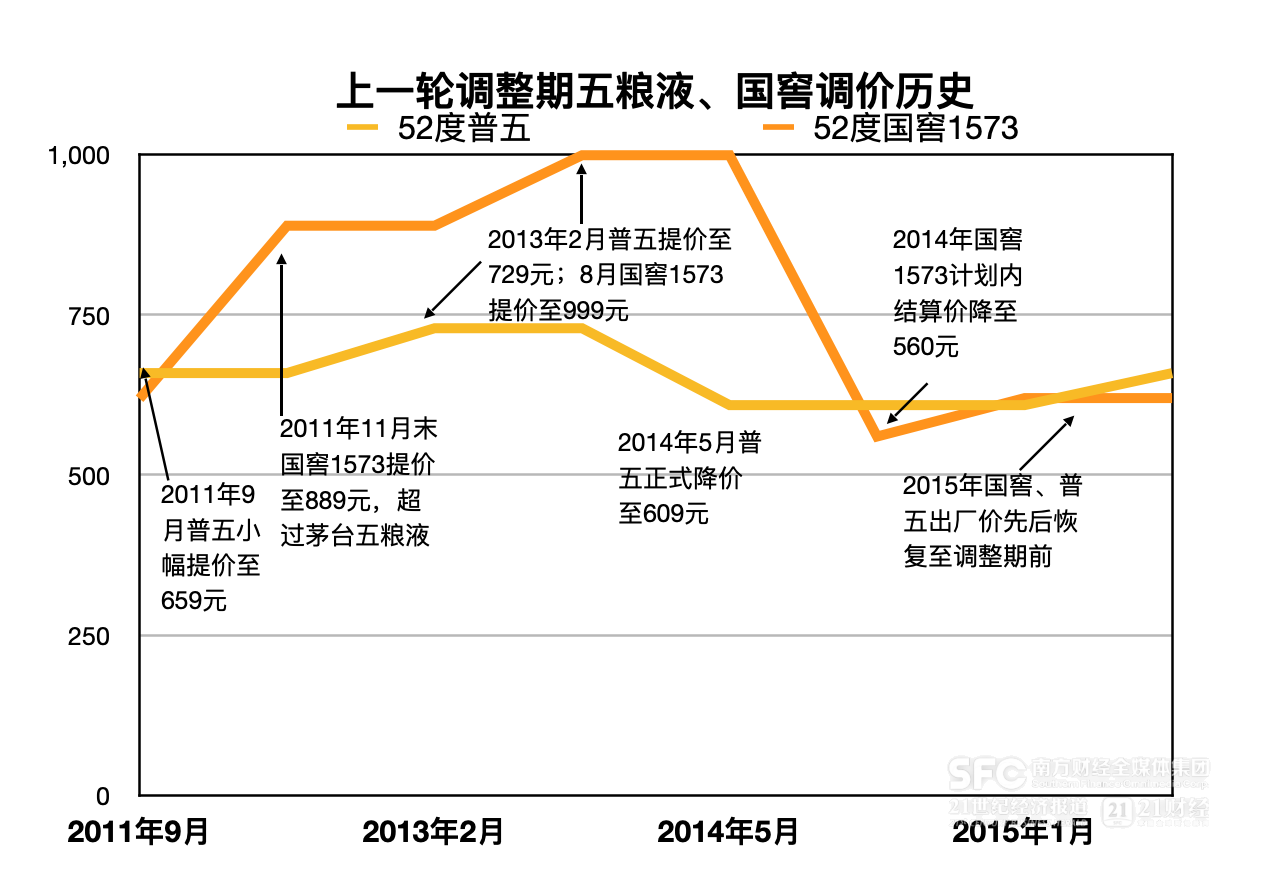
五粮液出招“调价”,国窖们跟不跟?
2 1 Shi Ji Jing Ji Bao Dao· 2025-12-12 03:29
Core Viewpoint - The recent price adjustment news from Wuliangye has sparked industry speculation about whether other high-end liquor brands will follow suit, particularly focusing on the competitive dynamics between Wuliangye, Guojiao 1573, and other brands in the premium liquor market [1][3][4]. Group 1: Market Dynamics - Wuliangye, Guojiao 1573, and Moutai are the top three players in the high-end liquor market, with Wuliangye and Guojiao 1573 often adjusting their strategies in tandem due to their similar pricing and market positioning [2][4]. - The competition has intensified, with Guojiao 1573's pricing strategy closely mirroring that of Wuliangye, often resulting in a price difference of only a few dozen yuan between the two brands [4][11]. - The current market environment shows a trend of price adjustments, with Wuliangye leading the way by increasing channel subsidies to effectively lower the cost for distributors without officially changing the factory price [13][15]. Group 2: Historical Context - The current price adjustment cycle resembles previous cycles, where both Wuliangye and Guojiao 1573 have engaged in back-and-forth pricing strategies, including price increases followed by temporary reductions [9][10][12]. - Historical data indicates that Guojiao 1573 has previously faced challenges when maintaining higher prices than Wuliangye, leading to a significant drop in market share during past adjustment periods [10][11]. Group 3: Strategic Responses - Guojiao 1573 is expected to adopt a follow-up strategy similar to Wuliangye's, potentially using indirect methods such as increased subsidies to maintain competitiveness without directly lowering factory prices [4][15]. - The strategic focus of both companies has diverged, with Wuliangye prioritizing volume sales while Guojiao 1573 has the flexibility to leverage both high and low alcohol content products to enhance market presence [18][20]. - The competitive landscape has evolved, with new entrants like Langjiu and Moutai 1935 gaining market share, complicating the pricing strategies for established brands [22][23].
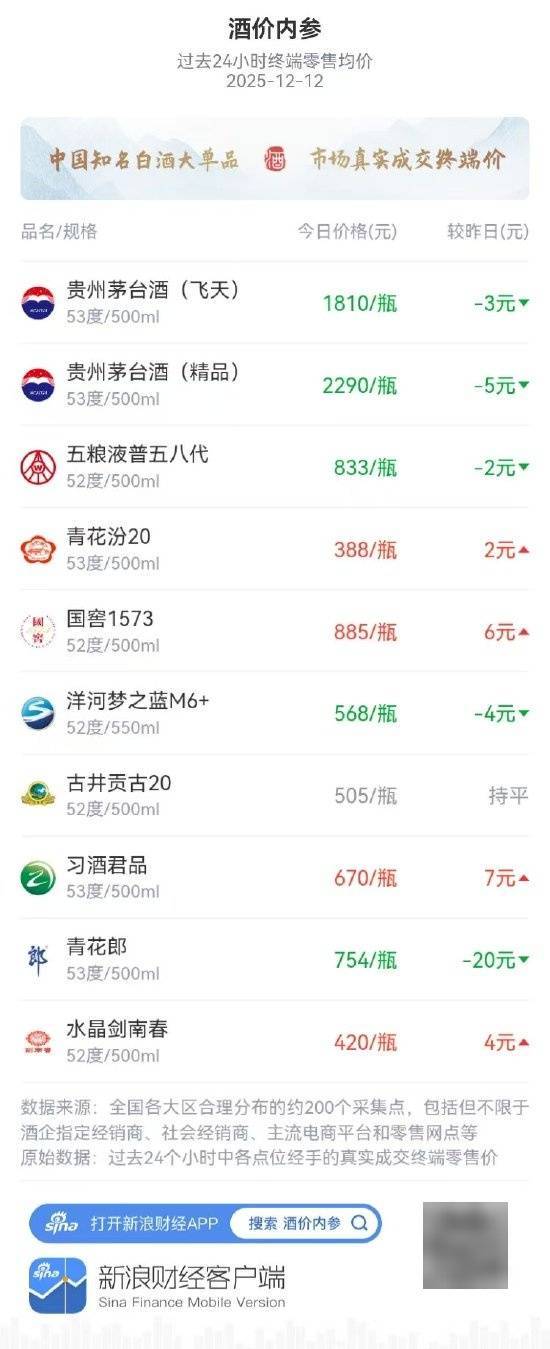
酒价内参12月12日价格发布,国窖1573上涨6元
Xin Lang Cai Jing· 2025-12-12 01:31
Core Viewpoint - The white liquor market is experiencing a downward trend in retail prices, with significant structural differentiation among brands, as indicated by the latest data from Sina Finance's "Wine Price Reference" [1][6]. Price Trends - The average retail price of the top ten white liquor products has decreased to 9,123 yuan, down 15 yuan from the previous day, reflecting a continued weak market overall [1][6]. - Notable price changes include: - Qinghua Lang: down 20 yuan per bottle - Feitian Moutai: down 3 yuan per bottle - Premium Moutai: down 5 yuan per bottle - Yanghe Dream Blue M6+: down 4 yuan per bottle - Wuliangye Pu 58th generation: down 2 yuan per bottle - Xijiu Junpin: up 7 yuan per bottle - Guojiao 1573: up 6 yuan per bottle - Shuijing Jian Nan Chun: up 4 yuan per bottle - Qinghua Fen 20: up 2 yuan per bottle - Guqing Gong Gu 20: unchanged [1][7][8]. Industry Developments - In a recent meeting, Moutai Group's chairman emphasized the need to consolidate market advantages amid ongoing industry adjustments and market decline, signaling a shift from passive to active competition for market share [2][8].
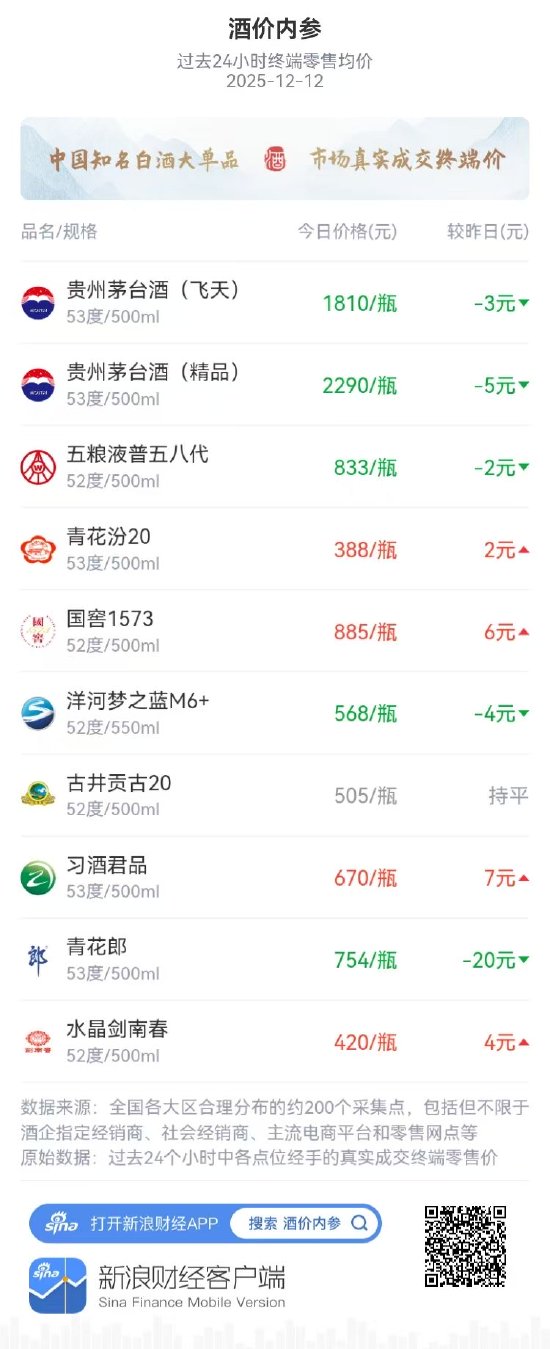
酒价内参12月12日价格发布,五粮液普五八代下跌2元
Xin Lang Cai Jing· 2025-12-12 01:31
Core Insights - The overall retail price of the top ten Chinese liquor products continues to decline, with a total packaged price of 9,123 yuan, down 15 yuan from the previous day, indicating a weak market trend with notable internal structural differentiation [1][6][7] - The data for "Liquor Price Reference" is collected from approximately 200 sampling points across various regions, ensuring an objective and traceable representation of market prices [1][6] Brand Performance - The price of Qinghua Lang has significantly decreased by 20 yuan per bottle, leading the market decline after a previous rapid increase [7] - Prices for Feitian Moutai and Premium Moutai have continued to slightly decline, down 3 yuan and 5 yuan per bottle respectively [7] - Yanghe Dream Blue M6+ saw a price drop of 4 yuan per bottle, while Wuliangye Pu 58th generation decreased by 2 yuan per bottle [7] - Some brands have shown resilience, with Xijiu Junpin increasing by 7 yuan per bottle, and Guojiao 1573 rising by 6 yuan per bottle [7] - Other brands like Shuijing Jian Nan Chun and Qinghua Fen 20 increased by 4 yuan and 2 yuan respectively, while Guqingong Gu 20 remained stable [7][9][10] Strategic Developments - In response to the ongoing industry adjustment and market decline, Moutai Group's chairman has emphasized the need to consolidate market advantages, shifting the focus from merely pursuing price benchmarks to actively competing for market share [2][8]