
结构性机会

Search documents
融资盘突发降温!部分赛道恐短期承压,要不要撤?
Sou Hu Cai Jing· 2026-01-15 08:40
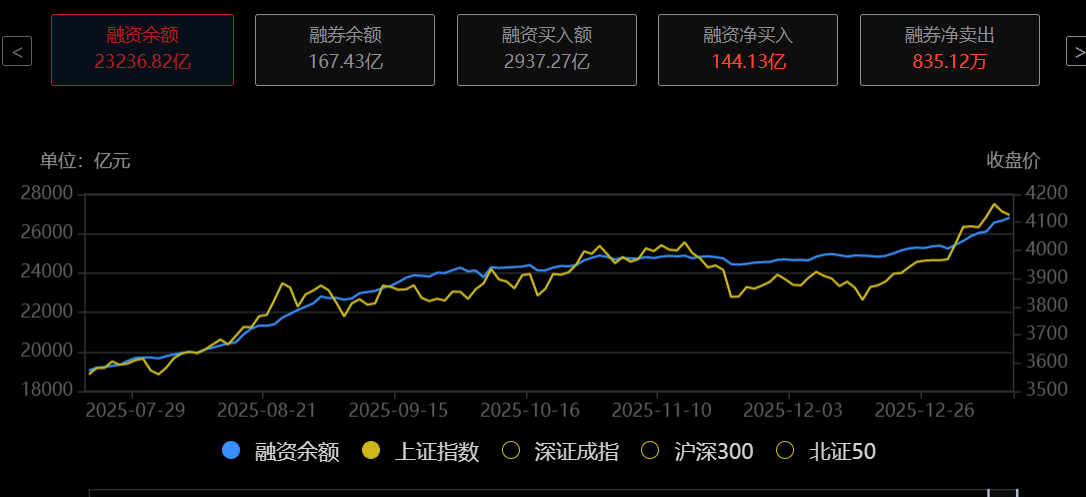
Market Overview - On January 14, a sudden announcement from three major exchanges raised the minimum margin requirement for financing from 80% to 100%, effective immediately, leading to a significant market downturn after an initial rally [1] - The A-share market's margin balance reached a historical high of 2.67 trillion yuan, with net financing inflow nearing 140 billion yuan in just the first seven trading days of 2026 [1][4] - Trading activity has been notably high, with daily transaction volumes exceeding 3 trillion yuan on multiple occasions, indicating elevated market sentiment [1] Impact of Margin Requirement Adjustment - Historical data suggests that previous increases in margin requirements in November 2015 and May 2017 resulted in a decrease of 6.3% and 4.1% in margin balances within a week, with the Shanghai Composite Index experiencing declines of 5% to 8% [4] - On January 14, the most affected sectors included TMT (Technology, Media, and Telecommunications) and non-bank financials, with the CSI 2000 index dropping by 4.6% and the number of stocks hitting the daily limit increase from 3 to 58 [4] - Northbound capital also reacted negatively, with a net outflow of 6.2 billion yuan, marking the largest single-day outflow in January [4] Sector Analysis - High Beta sectors such as TMT and non-bank financials, which have high financing balances and volatility, are expected to face immediate pressure due to the margin increase [4] - Key industries like electronics, power equipment, and computing, which are significant players in margin financing, may see a slowdown in capital inflow in the short term [4] - Despite the margin increase, existing investors are not required to add additional margin, which helps maintain stability in the over 2 trillion yuan of existing margin balances [4] ETF Market Insights - Certain ETFs, such as the Hai Fu Tong CSI Short Bond ETF and the Bosera Convertible Bond ETF, have seen active margin trading, although their overall contribution to total margin trading remains limited due to their large scale [6] - ETFs with high margin trading ratios, like the Hang Seng Technology ETF and the Huaxia Hang Seng Internet Technology ETF, should be approached with caution as forced liquidations could lead to significant price drops [6] Long-term Outlook - The adjustment of margin requirements is viewed as a "counter-cyclical fine-tuning," primarily affecting new contracts while leaving existing ones intact, suggesting limited long-term impact on market dynamics [10] - Historical patterns indicate that after initial emotional reactions, funds will likely return to selecting stocks based on fundamentals and valuations, minimizing the long-term effects of margin adjustments [10] - Despite short-term pressures, sectors such as AI applications and commercial aerospace continue to attract significant capital, indicating ongoing interest in certain growth areas [10] Future Projections - Analysts expect continued structural differentiation in the A-share market, driven by technological innovation and concentrated corporate performance, with a projected net profit growth rate for the CSI 300 index of 7.2% and 8.4% for 2026 and 2027, respectively [12][13]

80%提高至100%!三大交易所集体上调,对A股有何影响?最新解读来了
券商中国· 2026-01-14 09:30
Core Viewpoint - The adjustment of the financing margin ratio from 80% to 100% aims to promote a healthier long-term upward trend in the market, reflecting regulatory measures based on market conditions [1][3]. Group 1: Financing Margin Ratio Adjustment - On January 14, the China Securities Regulatory Commission approved the adjustment of the minimum financing margin ratio for buying securities from 80% to 100%, applicable only to new financing contracts [2]. - Historical adjustments of the financing margin ratio have occurred multiple times, with the initial ratio set at 50% when the margin trading was launched [3]. Group 2: Growth of Margin Trading Balance - The A-share margin trading balance has rapidly increased, surpassing 1 trillion yuan since September 24, 2024, driven by improved market profitability [4]. - As of January 13, the total margin trading balance reached approximately 26,829.92 billion yuan, accounting for 2.59% of the A-share circulating market value, with a financing balance of 26,653.91 billion yuan [1][5]. Group 3: Market Impact and Analyst Insights - Analysts suggest that the impact of the margin ratio increase will primarily affect market sentiment rather than significantly reduce the actual margin trading scale, as existing contracts will remain under previous regulations [6]. - The adjustment is viewed as a counter-cyclical measure to prevent excessive leverage in financing transactions, thereby reducing potential market volatility risks [6]. Group 4: Future Market Outlook - Many institutions remain optimistic about the long-term upward trend of the Chinese stock market, identifying structural opportunities driven by favorable liquidity and regulatory environments [8]. - Analysts predict that the A-share market will continue to exhibit structural characteristics, with a focus on sectors such as high-end manufacturing, cultural consumption, and passive investment strategies [9].

阀门行业正处于市场稳健扩容与技术升级的关键阶段 | 券商晨会
Sou Hu Cai Jing· 2026-01-08 00:33
Group 1: Valve Industry Insights - The valve industry is currently in a critical phase of market expansion and technological upgrades, driven by high-demand sectors such as energy, electricity, petrochemicals, and new energy [1] - While overseas giants dominate the high-end market due to their technological expertise, China is making significant technological breakthroughs in nuclear power, deepwater oil and gas, and special working conditions, leveraging its strong infrastructure capabilities [1] - The combination of demand growth, technological upgrades, and accelerated localization is reshaping the competitive landscape and driving long-term upward momentum in the industry [1] Group 2: Oil and Gas Market Projections - By 2026, the global crude oil market is expected to enter a supply surplus phase, with the IEA forecasting a surplus of 3.84 million barrels per day, leading to a systemic decline in oil price levels [2] - Geopolitical conflicts, sanctions, and inventory fluctuations will create short-term trading opportunities, while structural opportunities are shifting from "oil prices" to "companies" [2] - Key beneficiaries in a low oil price environment will include high refining margins, resilient production from U.S. shale oil around $60 per barrel, and increased mergers and acquisitions in the natural gas sector driven by LNG expansion and electricity demand [2] Group 3: Commercial Aerospace Industry Developments - The commercial aerospace industry is poised to enter a new era, supported by national policy and technological breakthroughs [3] - Key segments of the commercial aerospace industry include remote sensing applications, satellite control systems, CAE simulation/testing, and space data processing platforms, with a focus on new scenarios like space computing [3] - Successful development in the commercial aerospace sector relies on the synergy of policy, technology, and business models, with cost-reducing technologies such as reusable rockets and modular satellite manufacturing being central to scaling the industry [3]
兴业证券:95%个股仍待新高 市场或存在结构性机会
智通财经网· 2026-01-06 12:43
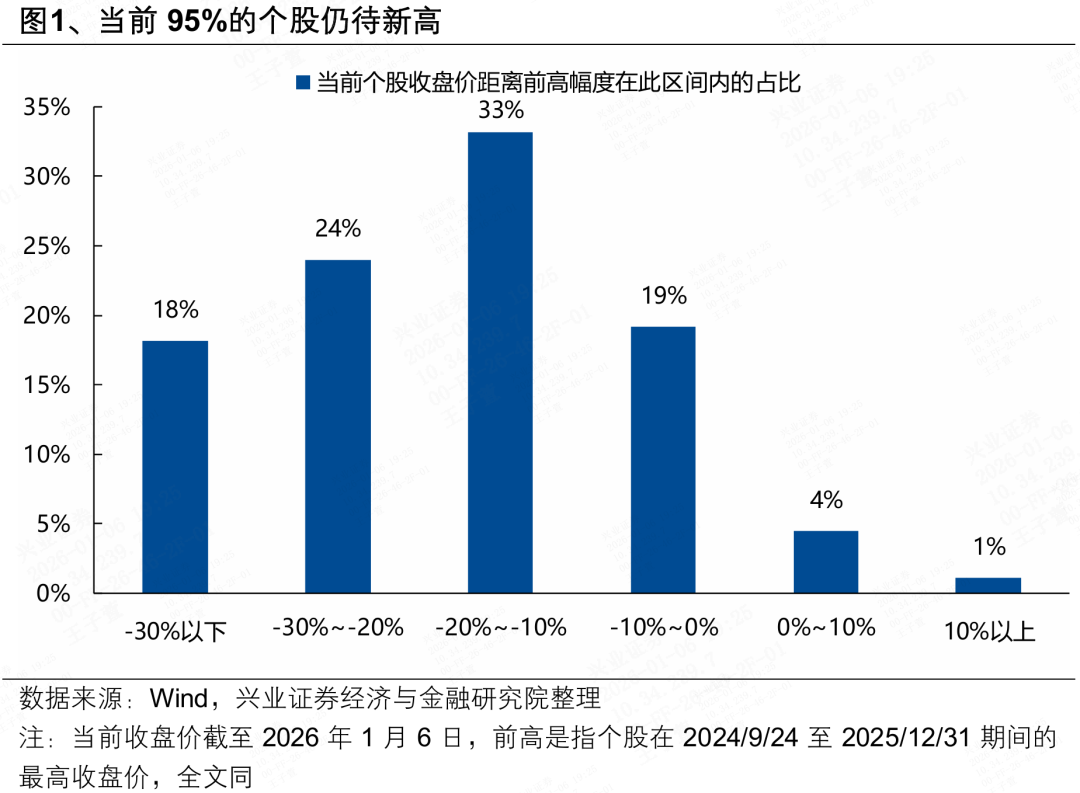
Core Viewpoint - As of January 6, 95% of individual stocks have not broken their previous highs, despite major indices reaching new highs, indicating potential structural opportunities in the market [1][2]. Group 1: Market Overview - Major indices such as the Shanghai Composite Index, All A-shares, CSI 300, and CSI 800 have all reached new highs, but only 5% of individual stocks have surpassed their previous highs [2]. - The previous high for individual stocks is defined as the highest closing price from September 24, 2024, to December 31, 2025, with most stocks still down by over 10% from these highs [2]. Group 2: Sector Performance - The sectors that have broken through previous highs are concentrated in a few segments, particularly in large financials represented by insurance, and sectors benefiting from price increases such as non-ferrous metals, chemicals, petrochemicals, and construction materials [1][5]. - Other sectors that have seen new highs include military, machinery, and home appliance components driven by commercial aerospace and robotics [1][5]. Group 3: Sectors Near Previous Highs - Sectors that have not yet broken their previous highs but are close include technology growth (commercial vehicles, semiconductors, communication equipment), cyclical industries (steel raw materials, renovation materials), and consumer sectors (animal health, textiles, agriculture) [10]. - Industries with significant gaps to their previous highs include technology growth (motors, software, batteries, photovoltaics), dividend sectors (electricity, white goods, banks), and consumer sectors (food and beverage, social services, retail) [13].

35亿资金,跑了
Zhong Guo Ji Jin Bao· 2026-01-06 05:27
Market Overview - On January 5, 2026, the A-share market experienced a strong start with a total trading volume exceeding 2.5 trillion yuan, and the Shanghai Composite Index regained the 4000-point mark, with both the Shenzhen Component Index and ChiNext Index rising over 2% [2] - Despite the positive market performance, there was a net outflow of over 3.5 billion yuan from stock ETFs, indicating some investors chose to cash out after a series of gains [6] ETF Performance - The total scale of stock ETFs reached 4.87 trillion yuan, with a trading volume of 276.91 billion yuan on the same day, an increase of over 85 billion yuan compared to the previous trading day [3] - The top-performing ETFs included the A500 ETF from Huatai-PB and the A500 ETF from China Asset Management, both with trading volumes exceeding 150 billion yuan [3] - The healthcare and pharmaceutical sectors led the gains among ETFs, with eight out of the top ten performing ETFs belonging to this category, showing significant increases [3] Fund Inflows and Outflows - The net inflow of funds was concentrated in broad-based ETFs such as the Southern CSI 500 ETF and Huatai-PB CSI 300 ETF, which saw inflows of 28.42 billion yuan and 11.02 billion yuan respectively [7] - Conversely, several ETFs experienced significant outflows, including the A500 ETF and the ChiNext 50 ETF, with outflows of 14.20 million yuan and 9.97 million yuan respectively [8] Sector Analysis - The commodity and strategy-style ETFs saw net inflows of 63.73 billion yuan and 4.55 billion yuan respectively, while bond ETFs faced a net outflow of 480.62 billion yuan [6] - The CSI 500 index recorded a net inflow of 30.08 billion yuan, while the AAA tech bonds saw a net outflow of 165.22 billion yuan [6] Fund Management Insights - Leading fund companies like E Fund and Huaxia Fund reported substantial net inflows across various ETFs, indicating strong investor interest [9][10] - E Fund's gold ETF saw a net inflow of 10.20 billion yuan, while the CSI 300 ETF had a net inflow of 5.39 billion yuan, reflecting a trend towards defensive assets [9] - The overall sentiment in the market suggests a focus on structural opportunities and a balanced approach to investment, with an emphasis on sectors like AI, solid-state batteries, and innovative pharmaceuticals [11]

35亿资金,跑了
中国基金报· 2026-01-06 05:21
Group 1 - The A-share market experienced a strong start to 2026, with the overall trading volume exceeding 25 trillion yuan and the Shanghai Composite Index surpassing 4000 points, while the Shenzhen Component Index and ChiNext Index both rose over 2% [2][3] - On January 5, the total scale of stock ETFs in the market reached 4.87 trillion yuan, with a trading volume of 276.91 billion yuan, an increase of over 85 billion yuan compared to the previous trading day [4][8] - The healthcare and pharmaceutical sector ETFs led the gains, with eight out of the top ten performing ETFs in this category, including significant increases in the Hong Kong medical ETFs [3][4] Group 2 - On January 5, stock ETFs saw a net outflow of over 3.5 billion yuan, with 49 ETFs experiencing net outflows exceeding 100 million yuan, particularly in broad-based ETFs like A500 and industry-specific ETFs such as Hong Kong securities and semiconductors [7][13] - The top three ETFs with the highest net inflows included the Southern CSI 500 ETF, Huatai-PB CSI 300 ETF, and Southern Nonferrous Metals ETF, indicating a preference for broad-based ETFs [8][11] - Major fund companies like E Fund and Huaxia Fund saw significant net inflows in their ETFs, with E Fund's gold ETF and CSI 300 ETF attracting substantial investments [11][12]

市场中枢有望缓步抬升 做好均衡配置把握结构性机会
Zheng Quan Shi Bao· 2026-01-04 18:09
Group 1 - The core viewpoint is that the macroeconomic environment in China is expected to remain stable in 2026, but market volatility may increase, making it difficult to replicate the "steady happiness" market of 2025 [1] - The investment strategy suggested includes balancing asset allocation based on individual risk preferences, with a focus on dividend assets, technology, and domestic demand sectors for structural opportunities [1] - The overall economic growth is anticipated to have limited support for corporate earnings, leading to a judgment of a fluctuating market with a gradually rising central tendency [2] Group 2 - The A-share and Hong Kong stock markets are expected to exhibit a pattern of oscillation with a gradual upward trend, as market valuations are currently neutral and not in a bubble [2] - The support logic for market reversal since September 2024 remains solid, with the capital market playing a more crucial role in social financing and long-term funds providing stability against market downturns [2] - Three key investment directions for 2026 are highlighted: dividend assets for higher certainty in returns, AI-focused technology sectors with rapid penetration despite valuation debates, and the undervalued domestic demand sector which may take time to realize its potential [2]
南方基金唐小东:市场中枢有望缓步抬升 做好均衡配置把握结构性机会
Zheng Quan Shi Bao· 2026-01-04 17:48
Group 1 - The core viewpoint is that the macroeconomic environment in China is expected to remain stable in 2026, but market volatility may increase, making it difficult to replicate the "steady happiness" market of 2025 [1] - The investment strategy suggested includes balancing asset allocation based on individual risk preferences, with a focus on dividend assets, technology, and domestic demand sectors for structural opportunities [1] Group 2 - For the A-share and Hong Kong stock markets, a fluctuating operation with a gradually rising central tendency is anticipated in 2026, due to limited support from economic growth for corporate profits and market valuations moving away from significantly undervalued levels [2] - The support logic for market reversal since late September 2024 remains solid, with the capital market playing a more important role in social financing and long-term funds, such as state-owned insurance, buffering market downturn risks [2] - Three key investment directions for 2026 are highlighted: dividend assets for higher certainty in returns, technology sector focused on AI with rapid penetration despite valuation disputes, and the domestic demand sector which has been undervalued and requires time for market recognition [2]
2026年,你会把钱放在哪里?
Sou Hu Cai Jing· 2026-01-01 07:22
Stock Market - The A-share market is expected to see a continuous improvement in net profits of listed companies, with an estimated growth rate of 4.8% for the year 2026, driven by the gradual implementation of domestic demand policies [4] - Structural opportunities are anticipated to become the norm in the market, with a potential for a "low volatility, steady rise" trend in indices [4] Gold - The bull market for gold may not have ended, as the Federal Reserve's policies and the U.S. economy have not yet shown a turning point; however, it is advised to focus on the timing of asset trend changes rather than specific price predictions [7] - In early 2026, U.S. inflation is expected to rise, which may temporarily suppress gold performance, but a potential shift in the Fed's policy in the second half of 2026 could support further gold price increases [7] Banking Wealth Management - The growth of wealth management scale is projected to reach approximately 38 trillion yuan in 2026, driven by the migration of deposits to various asset management products [10] - Asset allocation by wealth management subsidiaries is expected to prioritize safety and yield, with an increased proportion of liquid assets and a decrease in bond investments and non-standard assets [10] Bonds - The yield on China's 10-year government bonds is expected to decrease by 10 basis points in 2026, with a maintained fluctuation range of around 30 basis points [13] - Interest rates are anticipated to exhibit a "two-phase" characteristic, with a downward trend expected in the first half of 2026, followed by potential upward pressure in the second half due to rising inflation and improving credit conditions [13] Public Funds - Active equity funds are seen to have both opportunities and potential, with significant improvement in excess returns relative to the market since 2025, although there is a declining trend in fund shares due to profit-taking [16] - The "Action Plan for Promoting High-Quality Development of Public Funds" emphasizes performance benchmarks and long-term returns, which, combined with a stable upward trend in A-shares, lays a foundation for the high-quality development of active equity funds [16]

和讯投顾张汇:震荡加大,趋势向上!
Sou Hu Cai Jing· 2025-12-29 10:52
Market Overview - The market has experienced a nine-day consecutive rise, starting from 3815, but the latest candlestick indicates a weakening momentum, forming a doji with a long upper shadow, suggesting increased selling pressure and potential profit-taking [1] - The current question is whether this upward trend has ended and if the market will enter a correction phase or continue to rise after some fluctuations [1] Technical Analysis - A strong adjustment would be characterized by a shallow decline, allowing the market to continue rising and potentially reach new highs. The critical resistance level is identified at 3936, where a consolidation above this level could lead to further upward movement towards 4000 [2] - If the market breaks below 3936, a stronger correction is expected, leading to a decline below the 5-day moving average and a longer consolidation period. However, the overall trend remains upward as a short-term upward trend has already formed [3] Sector Performance - The market is currently in a broad upward consolidation phase, with sector performance being more critical than the overall index. Notable active sectors include carbon fiber, robotics, and commercial aerospace, which have shown strong performance [4] - The robotics sector, particularly humanoid robots, has surpassed previous highs and is expected to continue upward, although caution is advised regarding potential pullbacks for better entry points [4] - The market has seen volatility due to futures trading, impacting individual stocks, particularly in the lithium battery and resource sectors, which experienced significant declines [4]