股市波动

Search documents
股市波动回撤大,平安公司债ETF可作为低风险资金避风港
Sou Hu Cai Jing· 2025-08-28 02:45
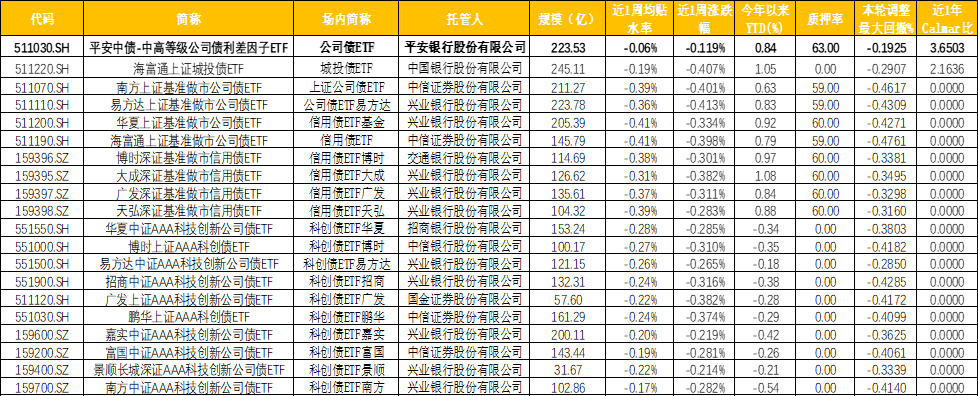
Core Viewpoint - The overall profit growth of major indices, including the A-share and ChiNext Composite Index, has significantly declined compared to Q1, indicating a potential downturn in corporate earnings [1] Industry Summary - Profits of industrial enterprises above designated size peaked at 9.3 trillion in 2021 and are projected to drop to 7.4 trillion in 2024, with a 1.7% year-on-year decline in profits observed in the first seven months of this year [1] - State-owned enterprises reported a revenue growth rate of -0.2% and a profit growth rate of -3.1% for the first half of 2025, reflecting a challenging economic environment [1] Market Dynamics - The current stock market bull run is primarily driven by capital inflows rather than improvements in corporate earnings, with significant institutional funds shifting from the bond market to equities [1] - Despite increased volatility in the stock market, many bond market investors maintain high expectations for equities and are patiently waiting for favorable conditions [1] Bond Market Outlook - The company maintains a bullish outlook on the bond market for the second half of the year, forecasting a 10-year government bond yield between 1.6% and 1.8%, with a potential challenge to 1.6% within the year [1] - The three to five-year capital bonds are considered to have high cost-effectiveness, with a recommendation to value yields above 2% for 30-year government bonds and five-year capital bonds [1] ETF Performance - The Ping An Company Bond ETF (511030) has shown the best performance in terms of controlling drawdown since the recent bond market adjustment, with minimal trading discounts and stable net value [1]

瑞银示警:美股要跌!现在就是标普年内高点,年底看6100点
Zhi Tong Cai Jing· 2025-08-13 14:06
Core Viewpoint - UBS has raised its S&P 500 index targets for the end of 2025 from 5500 to 6100 and for the end of 2026 from 6100 to 6800, reflecting better-than-expected health of the U.S. economy and corporate sector [1] Group 1: Economic Outlook - UBS indicates that the worst-case scenario regarding tariffs has not materialized, and confidence in fiscal support along with a weaker dollar has alleviated profit pressures [1] - The combination of U.S. economic growth and inflation may worsen, leading to reduced profit growth expectations and increased market volatility [1] - UBS expects a short-term market decline, potentially remaining below current levels until the end of 2025, followed by a significant rebound in the second half of 2026 [1] Group 2: Upside Risks - Surprises in earnings from technology and related companies could push the S&P 500 index to 7200 [2] - Companies affected by tariffs may maintain profit margins despite increased tariffs [2] - The impact of tariffs on U.S. inflation may be less than UBS currently anticipates [2] - Consumer spending continues despite a decline in real disposable income [2] - U.S. capital expenditures and industrial production may rebound due to domestic production repatriation, foreign direct investment, and new technology applications [2] - The Federal Reserve may adopt more accommodative policies in response to tariffs than UBS expects [2] - A weaker dollar and stronger global economic growth could exceed UBS's current expectations [2] Group 3: Downside Risks - Increased tariffs could trigger retaliatory tariffs [3] - Companies that previously hoarded labor may begin large-scale layoffs, harming consumer income and spending as excess savings deplete [3] - The Federal Reserve's rate cuts may be less than expected, negatively impacting market sentiment [3] - Rising import costs could lead to a significant decline in company profit margins from high levels [3] - Confidence in the positive growth impacts of the Inflation Reduction Act, industrial repatriation, and increased direct investment may diminish [3]
日韩股市大跌,韩元兑美元汇率一度跌破1400,发生了什么?
Mei Ri Jing Ji Xin Wen· 2025-08-01 02:38
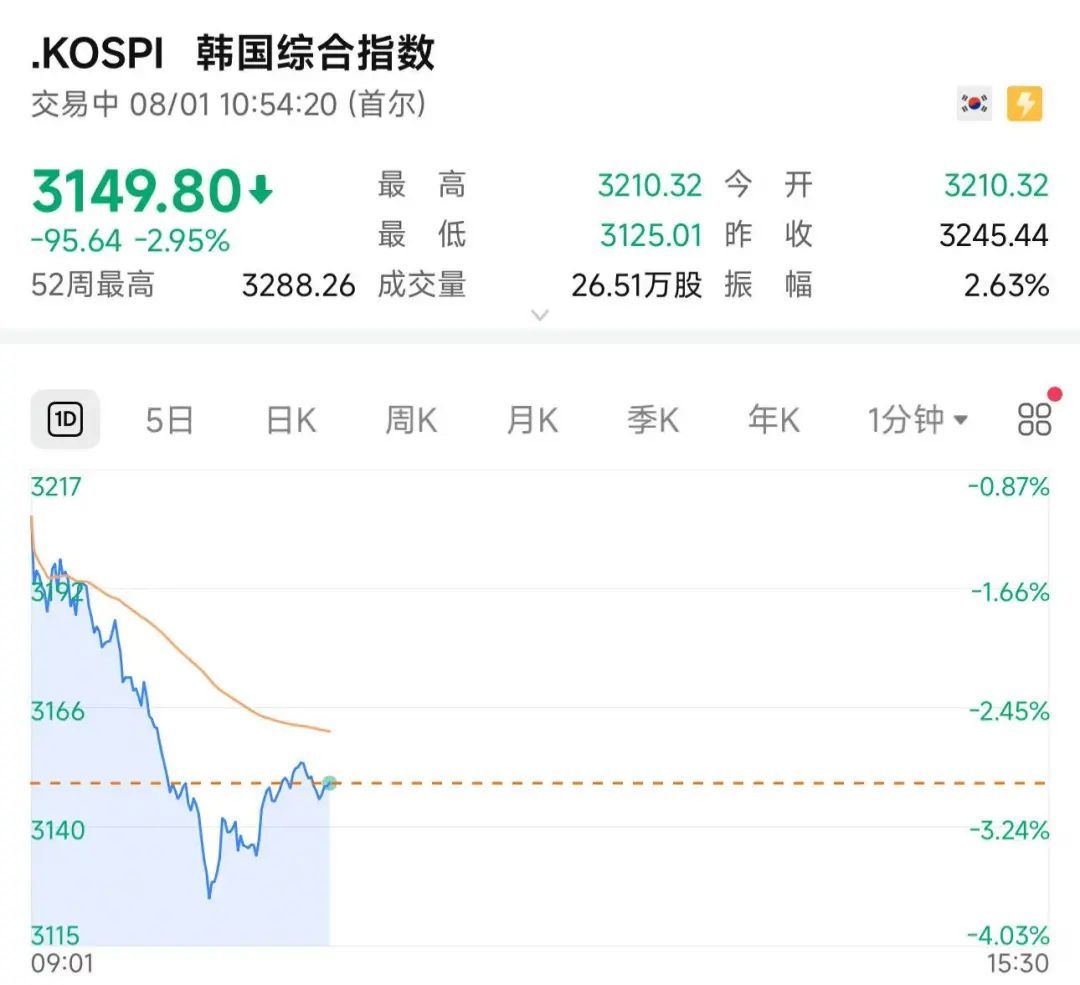
Group 1 - The South Korean won has fallen below the 1400 mark against the US dollar for the first time since May 19 [1] - The current exchange rate is 1,398.82 for selling and 1,399.16 for buying, with a daily range of 1,391.63 to 1,400.77 [3] - The 52-week range for the won is between 1,302.94 and 1,488.32, with the previous close at 1,392.07 and the opening at 1,392.70 [3] Group 2 - The Nikkei 225 index experienced a significant drop before rebounding [4] - The index reached a high of 40,910.47 and a low of -159.35, reflecting a decrease of 0.39% [6] - The trading volume was 580 million shares, with a fluctuation of 1.82 trillion, representing a change of 1.16% [6] Group 3 - The Shanghai Composite Index turned negative, while the Shenzhen Component and ChiNext indices saw increases, with over 2,900 stocks rising across the market [8]
特朗普近期谈话对市场的多维度影响
Sou Hu Cai Jing· 2025-07-05 15:07
Group 1: Trade Tariffs and Market Impact - Trump's announcement on July 4 regarding unilateral tariffs ranging from 10% to 70% has intensified trade tensions, disrupting previous market expectations of easing trade negotiations [2] - Historical data shows that a 10% tariff implemented in April led to a nearly 19% drop in the S&P 500 index, indicating that a potential 70% tariff could have a significantly greater negative impact on the market [2] - The imposition of higher tariffs is expected to increase inflation risks in the U.S. economy and further disrupt supply chains, leading to a bearish sentiment in the market [2] Group 2: Negotiation Stalemates with Trade Partners - Ongoing trade negotiations with the EU, Japan, and India are facing significant challenges, with no breakthroughs achieved, leading to increased market pessimism [3][4] - The EU has indicated that failure to reach an agreement may result in retaliatory measures, while Japan's Prime Minister has labeled U.S. tariffs as a "national crisis" [3][4] - India's response to U.S. tariffs has been to propose retaliatory tariffs, emphasizing that any trade agreement must align with its national interests, further complicating U.S.-India trade relations [4] Group 3: Economic Policy and Market Reactions - Trump's encouragement for investors to buy stocks has had a diminishing effect, as market participants are increasingly focusing on fundamental analysis rather than presidential statements [5] - The pressure on the Federal Reserve to lower interest rates has been influenced by Trump's comments, with Goldman Sachs predicting a rate cut in September due to the lesser-than-expected impact of tariffs on inflation [6] - Adjustments in market expectations regarding Fed policy are affecting bond markets, foreign exchange rates, and corporate financing costs, which could have broader implications for investment decisions [6] Group 4: Market Uncertainty and Strategic Recommendations - The unpredictability of Trump's policies and trade negotiations creates a complex market environment, with potential repercussions for global economic growth and corporate profitability [7] - Investors are advised to maintain a diversified portfolio to mitigate risks associated with trade policies, particularly in sectors like automotive, steel, and electronics that are heavily impacted [8] - Companies should proactively adapt to a high-tariff environment by optimizing supply chains and exploring alternative markets, while policymakers are encouraged to foster multilateral trade negotiations to stabilize the global economy [8]
美国经济局势风云变幻:贸易、股市与政策的多面博弈
Sou Hu Cai Jing· 2025-07-02 01:55
Trade Negotiations - The uncertainty surrounding trade negotiations between the U.S. and Japan has intensified, with President Trump expressing skepticism about reaching an agreement and threatening tariffs as high as 30% to 35% on Japanese imports, significantly higher than the previously announced 24% [2] Stock Market Volatility - On July 1, U.S. stock indices showed mixed results, with the Nasdaq down 0.82% and the Dow Jones up 400.17 points (0.91% increase). Notably, Tesla's stock plummeted over 5%, resulting in a loss of approximately $54.5 billion (around 390.5 billion RMB) in market value due to Trump's comments regarding Elon Musk [3] - Nvidia's stock also fell over 2% after internal insiders sold more than $1 billion in company shares over the past 12 months, raising concerns about its internal operations and executive confidence [3] - The Nasdaq Golden Dragon Index, which tracks Chinese stocks, rose 0.20%, while other popular Chinese stocks like Tiger Brokers and Futu Holdings declined, indicating a mixed performance in the market [3] Fiscal Policy - The U.S. Senate passed a comprehensive tax and spending bill on July 1, which now requires re-evaluation by the House of Representatives due to significant amendments. The outcome of this fiscal policy is uncertain and could have profound implications for the U.S. economy and global investors [4] Monetary Policy - Federal Reserve Chairman Jerome Powell indicated that while the U.S. economy is in good shape, the impact of tariffs will soon be reflected in inflation data. Most Fed members expect a rate cut later this year, with Goldman Sachs predicting cuts in September, October, and December, although the likelihood of a July cut depends on upcoming employment data [5]


近期股市为何起伏不定?深度解析市场波动原因与投资策略
Sou Hu Cai Jing· 2025-06-24 20:23
Group 1: Recent Market Volatility - Global stock markets have shown alternating rises and falls, with accelerated sector rotation since June 2025 [2] - A-shares are fluctuating between 3200-3500 points, with growth stocks like new energy and semiconductors experiencing increased volatility, while defensive sectors like banks and consumer goods remain stable [2] - The Nasdaq index has seen daily fluctuations exceeding 2% due to tech stock earnings reports, with Federal Reserve policy expectations being a focal point [2][3] Group 2: Core Reasons for Market Fluctuations - Uncertainty in global economic recovery is evident, with the U.S. experiencing easing inflation pressures but volatile employment data, leading to debates on the timing of Federal Reserve rate cuts [4][5] - European economies face recession risks due to fluctuating energy prices and weak manufacturing [5] - China's economic recovery is mixed, with consumer and investment rebounds but ongoing adjustments in the real estate sector affecting market confidence [6][7] Group 3: Policy Adjustments and Regulatory Changes - The Federal Reserve's June 2025 FOMC meeting signaled a hawkish stance, cooling rate cut expectations and pushing up U.S. Treasury yields, which suppresses risk assets [8] - In China, the A-share market is influenced by the "New National Nine Articles," which strengthen dividend requirements for listed companies, putting pressure on some high-valuation growth stocks [9][10] Group 4: Geopolitical Factors and Market Sentiment - Ongoing disruptions in energy and food supply chains due to the Russia-Ukraine conflict are exacerbating global inflation expectations [11][12] - The U.S.-China relationship impacts foreign investment risk appetite in A-shares, with rising investor caution reflected in the VIX index [12] Group 5: Fund Flows and Institutional Adjustments - Foreign capital inflows into A-shares have slowed, with significant net outflows on certain trading days [13] - Institutional investors are reducing holdings in high-valuation sectors, shifting towards low-valuation, high-dividend assets [13] Group 6: Divergence in Corporate Earnings Expectations - Some AI and semiconductor companies are reporting earnings below expectations, putting pressure on the Nasdaq index [14] - Domestic consumption recovery is weak, with sectors like liquor and home appliances experiencing slowed growth [14] Group 7: Investment Strategies in Volatile Markets - Diversification is recommended to mitigate risks associated with single assets, including a balanced allocation between stocks and bonds [16] - Focus on high-dividend, low-valuation assets such as banks and utilities is advised for conservative investors [16] - Implementing a systematic investment approach, such as dollar-cost averaging in index funds, can help smooth market volatility [17][18] - Maintaining a cash reserve of 30%-50% during high uncertainty allows for flexibility in investment opportunities [19] - A long-term perspective is crucial to avoid emotional trading and capitalize on the inherent value of quality assets [20] Group 8: Outlook for the Second Half of 2025 - The stock market in the second half of 2025 will be influenced by monetary policy decisions, including potential rate cuts by the Federal Reserve and further easing in China [20]
Moody's Just Downgraded the United States' Pristine Credit Rating -- Here's What History Says Happens Next for Stocks
The Motley Fool· 2025-05-25 07:06
Core Viewpoint - The recent downgrade of the U.S. credit rating by Moody's has historical implications for equity markets, suggesting potential volatility and directional moves in major indices like the Dow Jones, S&P 500, and Nasdaq Composite [5][16]. Group 1: Credit Rating Downgrade - Moody's downgraded the U.S. credit rating from AAA to AA1, marking the last major agency to do so, following similar actions by S&P and Fitch [6][7]. - The downgrade highlights ongoing economic challenges, including persistent federal deficits, rising interest rates, and demographic shifts affecting labor force participation [8][9][11][12]. Group 2: Historical Context and Market Reactions - Historical data indicates that the S&P 500 experienced a 2.6% decline one month after the 2011 downgrade and a 1.2% dip after Fitch's downgrade in 2023, attributed to increased market volatility [17]. - Conversely, the S&P 500 saw significant gains of 18.8% and 20.8% one year after the respective downgrades, suggesting a potential recovery trajectory despite initial declines [18][20]. Group 3: Economic Resilience - Despite concerns over national debt and economic headwinds, historical trends show that U.S. recessions are typically short-lived, averaging around 10 months, while periods of economic expansion last approximately five years [21]. - The average bear market for the S&P 500 has lasted about 286 days, while bull markets have persisted for around 1,011 days, indicating a favorable long-term outlook for investors betting on U.S. economic growth [22].


美联储古尔斯比:美联储的职责是保持稳定,而不是对股市的每日波动或政策声明做出反应。
news flash· 2025-05-14 09:39
Core Viewpoint - The Federal Reserve's primary responsibility is to maintain stability rather than react to daily fluctuations in the stock market or policy statements [1] Group 1 - The Federal Reserve emphasizes its focus on long-term economic stability over short-term market movements [1]
巴基斯坦在战场上大获全胜,股市却遭遇2008年以来最大跌幅!
Sou Hu Cai Jing· 2025-05-12 11:32
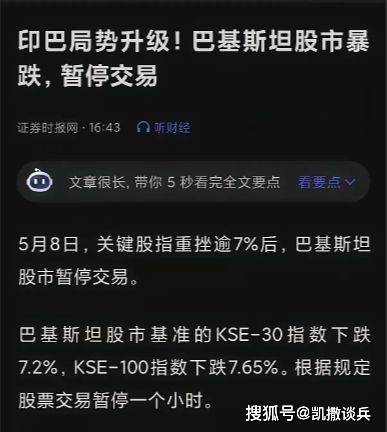
按道理巴基斯坦空战打赢了对方,股市不说暴涨吧?最起码不可能跌幅这么大吧?而印度虽然战场上打 了败仗,但股市基本没有多大跌幅,这到底什么原因呢? 而战场上打了败仗的印度股市Nifty指数收盘下跌0.58。 印巴冲突越来越看不懂了,巴基斯坦在战场上打了胜仗,但巴基斯坦股市在5月8日KSE-30指数跌幅超 过8.8%,为2008年以来最大跌幅,KSE-100指数下跌7.65%,触发熔断暂停交易一小时。 不过股市大跌只是暂时的,就像胡锡进说的那样:我手里导弹股票只要不抛售,我就不会赔钱! 声明:个人原创,仅供参考 而巴基斯坦虽然在战场上赢了,但是巴基斯坦内部采取了一些行动,比如暂时关闭航空48小时,暂停所 有航班,而巴基斯坦的水源也被印度切断,这一切都引起了投资者对巴基斯坦经济的恐慌,导致投资者 不计成本撤离。 虽然巴基斯坦在空战表现比较优秀,但是其经济和经济发展前途和印度还是有比较大的差距,因为相比 较巴基斯坦,有大量的投资者在印度投资建厂并且印度未来会因为贸易战而获利,加上印度愿意就关税 问题和美国进行谈判,所以投资者比较看好印度。 而巴基斯坦经济比较脆弱,不管是经济总量、发展前景、外商投资以及和美国欧盟的关系, ...
崩盘、重挫!股市大波动,巴菲特为何不惧?
券商中国· 2025-05-10 23:35
Core Viewpoint - The article emphasizes the importance of viewing stock investments as business investments, highlighting that market fluctuations should not deter long-term investors like Warren Buffett, who focuses on the underlying value and productivity of the assets rather than short-term price movements [2][11]. Investment Stories - Story One: Buffett's investment in a farm in Nebraska illustrates that despite significant market fluctuations, the farm's value and profitability increased over time, demonstrating a return of three times the initial investment and a value increase of five times or more [4][5]. - Story Two: Buffett's investment in a retail property near New York University showcases how strategic investments can yield substantial returns, with dividends exceeding 35% of the initial investment and total distributions surpassing 150% of the original amount [7][8]. Fundamental Investment Principles - Buffett's experiences underline that satisfactory investment returns do not require expert knowledge, but investors must recognize their limitations and follow a reasonable investment path [11]. - The focus should be on the future productivity of the assets; if estimating future earnings is challenging, it is advisable to move on to other opportunities [11]. - Market fluctuations should be viewed as opportunities for identifying mispriced assets, and investors should not be swayed by market noise but rather focus on the underlying profitability of the companies [11].