银行息差

Search documents
贷款利息已创新低!中国LPR却按兵不动,真相竟是银行扛不住?
Sou Hu Cai Jing· 2025-09-24 03:51
Core Viewpoint - The LPR in China has remained unchanged for four consecutive months despite global interest rate cuts, primarily due to constraints from bank interest margins and deposit rates [1][22]. Group 1: LPR Stability - The 1-year and 5-year LPR rates have been stable at 3.0% and 3.5% respectively since May 2025, despite expectations for a decrease following the Federal Reserve's rate cuts [1][22]. - The Federal Reserve initiated its first rate cut since December 2024 on September 18, 2025, leading to speculation about similar actions in China [1][22]. Group 2: Bank Profitability Constraints - As of the second quarter of 2025, the net interest margin for commercial banks in China has decreased to 1.42%, down 10 basis points from the previous quarter, limiting banks' profitability [4][6]. - The decline in loan interest rates, coupled with limited room for further reductions in deposit rates, has resulted in shrinking interest margins for banks [4][12]. Group 3: Deposit Rate Limitations - Major commercial banks have reduced their deposit rates significantly, with current account rates at 0.05% and one-year fixed deposit rates below 1% [8][9]. - The potential for further reductions in deposit rates is limited, as excessively low rates could lead to a loss of deposits to alternative financial products [12][13]. Group 4: Monetary Policy Considerations - The LPR's pricing mechanism is tied to the 7-day reverse repurchase rate, which has remained unchanged at 1.40%, making it difficult for the LPR to decrease [15]. - China's monetary policy is expected to remain cautious, balancing internal economic conditions with external pressures, and any future adjustments to the LPR will be gradual [17][22]. Group 5: Future Outlook - Experts suggest that while there may be room for LPR adjustments, significant decreases are unlikely, with a focus on maintaining stability in growth, interest margins, and employment [20][22]. - The possibility of a reserve requirement ratio cut is anticipated, which could lower banks' funding costs and create conditions for a potential LPR decrease [18][20].


LPR连续按兵不动,如何理解?
Jin Rong Shi Bao· 2025-09-22 12:48
Group 1 - The Loan Prime Rate (LPR) for 1-year remains at 3.0% and for 5-year and above at 3.5%, unchanged from the previous month [1] - The stability of LPR aligns with market expectations, influenced by the unchanged reverse repurchase rate since May [1][2] - The current lending rates for both corporate loans and personal housing loans are at historically low levels, contributing to the decision to maintain LPR [1] Group 2 - The 7-day reverse repurchase rate has become the new pricing anchor for LPR, facilitating the transmission of interest rates from short to long-term [2] - Commercial banks are facing pressure on net interest margins, limiting their motivation to lower LPR quotes further [2] - The balance between supporting the real economy and maintaining the health of the banking system is crucial for future monetary policy [2] Group 3 - Macroeconomic indicators such as consumption, investment, and industrial production have shown a decline due to various factors including extreme weather and real estate market adjustments [3] - The People's Bank of China is expected to continue a moderately loose monetary policy while balancing internal and external factors [3] - Future policies will focus on reducing social financing costs and enhancing the transmission of interest rates, alongside fiscal and consumption policies to stimulate demand [3]
宏观政策处于观察期,LPR连续四个月“按兵不动”
Di Yi Cai Jing· 2025-09-22 10:11
Core Viewpoint - The stability of the Loan Prime Rate (LPR) in September is attributed to multiple factors, including pressure on bank interest margins and limited room for deposit rate cuts, despite favorable external conditions [1][2][3] Group 1: LPR Stability - The LPR for both 1-year and 5-year terms remained unchanged at 3.0% and 3.5% respectively, marking four consecutive months of stability since June [1] - The recent U.S. Federal Reserve rate cut is expected to ease the pressure on the China-U.S. interest rate differential and the RMB exchange rate, providing more room for China's monetary policy adjustments [1] Group 2: Bank Interest Margins - As of Q2 2025, the net interest margin of commercial banks has decreased to 1.42%, down 10 basis points from the end of Q4 2024, indicating significant pressure on banks [1] - A rapid decline in LPR could further compress bank interest margins, negatively impacting the stability of the banking system and its ability to serve the real economy [1] Group 3: Deposit Rates - The current interest rate for demand deposits at major commercial banks is at a historical low of 0.05%, limiting further downward adjustments [1] - New corporate loans and personal housing loan rates are also at historical lows, leading to a consensus that the LPR's stability is expected [1] Group 4: Monetary Policy Outlook - The third quarter is characterized as an observation period for macroeconomic policies, with various factors contributing to a decline in macro data such as consumption and investment [3] - The central bank is anticipated to maintain a moderately loose monetary policy, with potential room for further rate cuts and reserve requirement ratio reductions [3] - The necessity for policies to stabilize growth and employment is expected to increase in Q4, with potential adjustments to policy rates and LPR quotes [3]
宁波银行(002142):质量前瞻改善 中期分红落地
Xin Lang Cai Jing· 2025-08-30 16:38
Core Viewpoint - Ningbo Bank released its 25H1 semi-annual report, showing revenue, PPOP, and net profit growth rates of 7.9%, 11.8%, and 8.2% year-on-year, with increases of +2.3pct, +1.8pct, and +2.5pct compared to 25Q1 [1] Financial Performance - Revenue growth of 7.9%, PPOP growth of 11.8%, and net profit growth of 8.2% year-on-year [1] - Significant contributions from scale growth, lower cost-to-income ratio, and decreased effective tax rate, while net interest margin contraction, non-interest income decline, and provisioning were major drags [1] Capital and Dividends - As of the end of 25Q2, the core Tier 1 capital adequacy ratio was 9.65%, up 0.33% from 25Q1, benefiting from interest rate declines and increased OCI gains [1] - The company announced an interim cash dividend of 0.3 CNY per share, representing 13.41% of net profit attributable to shareholders [1] Asset Growth - As of 25H1, interest-earning assets and loans grew by 14.9% and 18.7% year-on-year, respectively [2] Loan Structure - The company shifted its customer base strategy, reducing retail loan scale while increasing infrastructure loans [3] - Personal loan scale decreased by 22.4 billion CNY compared to the beginning of the year, with corporate loans accounting for 89.1% of total loan growth [3] Provisioning and Asset Quality - As of 25Q2, the non-performing loan ratio was 0.76%, stable compared to the previous quarter, with a provisioning coverage ratio of 374%, up 4pct [3] - The company reported a non-performing loan generation rate of 1.05% for 25H1, a year-on-year decrease of 23bp [3] Non-Interest Income - Net fee and commission income grew by 4% year-on-year in 25H1, with a quarter-on-quarter increase of 5.4pct, driven by wealth management and asset management income [3] Tax Rate - The effective tax rate for 25H1 was 7.56%, down 4.43pct year-on-year, contributing positively to performance [3] Interest Margin - The net interest margin for 25H1 was 1.76%, narrowing by 4bp from 25Q1 [4] - Asset yield decreased by 47bp since the beginning of the year, while the cost of liabilities dropped by 27bp compared to 24A [4] Profit Forecast - The company expects net profit growth rates of 10.6% and 11.5% for 25 and 26, respectively, with EPS of 4.39 and 4.91 CNY per share [4] - Current stock price corresponds to PE ratios of 6.45X and 5.76X for 25 and 26, respectively, with a reasonable value of 33.31 CNY per share based on a 1.00x PB [4]

渝农商行(601077):利润稳健增长
ZHESHANG SECURITIES· 2025-08-27 01:14
Investment Rating - The investment rating for the company is "Buy" and is maintained [5] Core Views - The company has shown steady profit growth with a year-on-year increase in revenue and net profit of 0.5% and 4.6% respectively for the first half of 2025, although the growth rates have slightly decreased compared to the first quarter [2][5] - The net interest margin remains resilient, with a slight decrease to 1.60% in the first half of 2025, indicating improved profitability despite challenges in non-interest income [2][3] - The non-interest income has faced significant pressure, declining by 16.6% year-on-year, primarily due to a substantial drop in card-related income [2] Summary by Sections Financial Performance - For the first half of 2025, the company reported a revenue of 28,741 million and a net profit attributable to the parent company of 12,114 million, with respective year-on-year growth rates of 0.5% and 4.6% [6] - The non-performing loan ratio remained stable at 1.17% as of the end of Q2 2025, while the provision coverage ratio decreased by 8 percentage points to 356% [4][6] Profitability and Margins - The average net interest margin for the first half of 2025 was 1.60%, slightly down from the previous quarter, with the asset yield decreasing to 3.05% [3] - The cost of liabilities improved, with a decrease in the cost of time deposits contributing to a better margin [3] Asset Quality - The non-performing loan ratio for retail operating loans increased to 2.46% by the end of the first half of 2025, indicating a need for close monitoring of this segment [4] - The company’s TTM non-performing loan generation rate was 0.86%, showing a slight increase in pressure [4] Earnings Forecast and Valuation - The company is expected to achieve a net profit growth of 5.2%, 5.5%, and 6.3% for the years 2025 to 2027, with a target price of 7.81 CNY per share, reflecting a potential upside of 21% [5]

成都银行(601838):息差稳,不良优
ZHESHANG SECURITIES· 2025-08-27 00:17
Investment Rating - The investment rating for Chengdu Bank is "Buy" with a target price of 21.12 CNY per share, indicating an upside potential of 18% from the current price of 17.86 CNY [5][7]. Core Insights - Chengdu Bank's H1 2025 earnings growth has improved, with revenue and net profit attributable to shareholders increasing by 5.9% and 7.3% year-on-year, respectively [2][5]. - The bank's asset quality remains strong, with a non-performing loan (NPL) ratio stable at 0.66% and a provision coverage ratio of 453% as of the end of Q2 2025 [4][5]. - Future growth is supported by strong regional economic vitality and robust credit demand, which is expected to sustain rapid profit growth [3][5]. Summary by Sections Earnings Performance - Chengdu Bank's revenue and net profit for H1 2025 increased by 5.9% and 7.3% year-on-year, with quarter-on-quarter growth rates improving by 2.7 percentage points and 1.6 percentage points, respectively [2][5]. - The bank's total assets grew by 14.3% year-on-year, with loans increasing by 18.0% [2][5]. Interest Margin and Cost of Deposits - The net interest margin for Q2 2025 slightly decreased by 2 basis points to 1.58%, but improved by 1 basis point year-on-year, primarily due to a reduction in deposit costs [3][4]. - The cost of deposits improved to 1.96% in H1 2025, down from 2.16% in 2024, benefiting from interest rate cuts [3][4]. Asset Quality - The NPL ratio remained stable at 0.66%, while the attention loan ratio increased slightly to 0.44% [4][5]. - The TTM generation rate for NPLs and attention loans decreased by 14 basis points to 0.27%, indicating continued improvement in asset quality [4][5]. Profit Forecast and Valuation - Chengdu Bank's net profit is projected to grow by 7.95%, 7.35%, and 9.52% for 2025, 2026, and 2027, respectively, with corresponding book values per share of 21.12, 23.60, and 26.35 CNY [5][12]. - The target valuation for 2025 is set at a price-to-book (PB) ratio of 1.0x [5].
9月银行兑现浮盈压力预计不大
Tianfeng Securities· 2025-08-25 13:43
Investment Rating - Industry Rating: Outperform the market (maintained rating) [4] Core Insights - The pricing of bank assets and liabilities this year shows a trend of "stable loan rates and improved deposit costs," effectively alleviating NIM pressure and laying a solid foundation for achieving annual profit targets [9][18] - The bank's gold market trading and allocation segments are facing certain pressures this year compared to last year's "bull market," primarily due to increased interest rate volatility affecting capital gains and a "preserve capital, minimal profit" state for allocation [2][19] - The contribution of the bank's lending and deposit segment is significant, while the gold market segment faces pressure in completing KPIs, leading to a weaker motivation to realize floating profits through selling old bonds in September [3][36] Summary by Sections Section 1: Asset and Liability Pricing - The trend of stable loan rates and improved deposit costs has been observed, with new corporate loan and mortgage rates stabilizing at 3.2% and 3.1% respectively [9][10] - The average deposit cost rate for listed banks is expected to decline to 1.6-1.65% in the first half of 2025, with a potential further decrease due to the expiration of high-interest fixed deposits [12][36] Section 2: Gold Market Performance - The performance of the bank's gold market trading and allocation segments is under pressure, with capital gains ability significantly weakened due to increased interest rate volatility [2][22] - The allocation segment may continue to face a "preserve capital, minimal profit" state, influenced by the strong liability attributes of CDs and mismatches in loan and deposit growth rates [23][26] Section 3: Contribution of Lending and Deposit Segment - The lending and deposit segment is expected to contribute significantly to overall bank profits, with a narrowing of interest margin declines anticipated [31][36] - The gold market segment's KPI completion faces challenges, and the motivation to sell old bonds for profit realization is weak as the year progresses [3][36]
一上市银行被员工举报周末无偿加班,“领导不来,全体员工坐一天”
第一财经· 2025-08-25 06:58
Core Viewpoint - The article discusses allegations of unpaid overtime at Hangzhou Bank's Chengdong branch, highlighting the broader issue of work pressure in the banking industry amid declining profitability and performance metrics [3][7]. Group 1: Allegations of Overtime - An anonymous post on social media claims that employees at Hangzhou Bank's Chengdong branch are required to work unpaid overtime on weekends, with management absent [3][7]. - The bank's initial response indicates no evidence of mandatory weekend work, although some employees may work weekends as needed [7]. Group 2: Industry Performance Metrics - The banking sector is experiencing pressure on performance, with the net interest margin for commercial banks dropping to 1.42% in Q2 2025, a decrease of 0.01 percentage points from Q1 and 0.12 percentage points year-on-year [8]. - The cumulative net profit for commercial banks in 2025 is reported at 12,423 billion yuan, reflecting a year-on-year decline of 1.2% [8]. Group 3: Hangzhou Bank's Financial Performance - For the first half of 2025, Hangzhou Bank reported operating income of 20.093 billion yuan, a year-on-year increase of 3.89%, and a net profit attributable to shareholders of 11.662 billion yuan, up 16.67% from the previous year [8]. - As of June 30, 2025, Hangzhou Bank's total assets reached 2,235.595 billion yuan, a growth of 5.83% from the end of the previous year, with total loans and deposits increasing by 7.67% and 5.17%, respectively [9]. - The bank's non-performing loan ratio stands at 0.76%, with a provision coverage ratio of 520.89%, and its core Tier 1 capital adequacy ratio is 9.74%, reflecting improvements from the previous year [9].


银行研思录12:每年存款到期有多少?
CMS· 2025-08-12 09:05
Investment Rating - The industry is rated as "Recommended" with a positive outlook for the sector's fundamentals, expecting the industry index to outperform the benchmark index [2][35]. Core Insights - As of June 2025, the total deposit scale in China reached 280.7 trillion, with household deposits at 162 trillion and corporate deposits at 118.7 trillion. The growth rates from 2018 to mid-2025 show household time deposits increased by 165.4%, significantly outpacing corporate deposits [5][9][24]. - The estimated maturity of time deposits in 2025 is approximately 105 trillion, with a year-on-year increase of 14 trillion. This includes about 45 trillion maturing in the first quarter, indicating a substantial liquidity source for the capital market [15][30]. - The re-pricing of time deposits maturing from 2022 to 2024 is projected to reduce the annualized cost of liabilities for banks by approximately 1.5 trillion, contributing positively to the banks' interest margins [24][30]. - The liquidity impact of maturing time deposits is expected to create significant market expectations, with potential inflows into the capital market if market sentiment aligns [30][31]. Summary by Sections Current Deposit Scale and Structure - As of June 2025, total deposits in China are 280.7 trillion, with household deposits at 162 trillion and corporate deposits at 118.7 trillion. The growth rates from 2018 to mid-2025 indicate a significant increase in household time deposits [5][9][24]. Maturity Scale and Rhythm of Time Deposits - The estimated total maturity of time deposits in 2025 is around 105 trillion, with a notable increase in the first quarter. The data suggests a growing trend in the maturity of time deposits, which is crucial for liquidity in the capital market [15][30]. Impact on Interest Margins from Maturing Time Deposits - The re-pricing of time deposits maturing from 2022 to 2024 is expected to lower banks' annualized liability costs by about 1.5 trillion, positively affecting interest margins. This is anticipated to alleviate pressure on banks' interest margins starting in the second half of 2025 [24][30]. Liquidity Impact of Maturing Time Deposits - The large scale of maturing deposits is expected to create significant liquidity impacts, with potential inflows into the capital market. However, the transition of wealth into the capital market is viewed as a long-term process rather than an immediate outcome [30][31].
银行首批2025中期业绩出炉:5家上市银行营收、净利双增,杭州银行预计息差降幅或收窄
Xin Lang Cai Jing· 2025-08-04 00:53
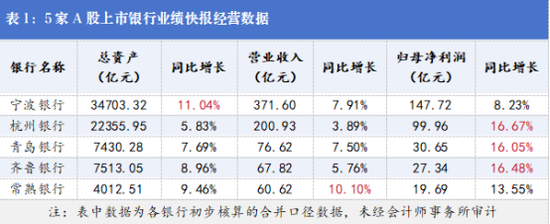
Core Viewpoint - The A-share banking sector has shown positive mid-year performance for 2025, with several banks reporting significant growth in both operating income and net profit, indicating a robust financial environment [1][2]. Group 1: Performance of Listed Banks - Five listed banks have reported positive growth in operating income and net profit for the first half of 2025, with four banks achieving double-digit growth in net profit [1][2]. - Notable performances include Hangzhou Bank with a net profit growth of 16.67% and Changshu Bank with an operating income growth of 10.10% [2][3]. - Ningbo Bank leads with an operating income of 371.60 billion yuan and a net profit of 147.72 billion yuan [2][3]. Group 2: Asset Quality and Capital Adequacy - As of June 2025, all five banks reported positive growth in total assets, with Ningbo Bank's total assets reaching 3.47 trillion yuan, a year-on-year increase of 11.04% [2][3]. - The non-performing loan (NPL) ratios for the banks remained stable or slightly decreased, with Hangzhou Bank maintaining the highest provision coverage ratio at 520.89% despite a year-on-year decline of 20.56 percentage points [5][6]. - Capital adequacy ratios for Ningbo Bank and Hangzhou Bank improved, with Ningbo Bank's capital adequacy ratio at 15.21% and core Tier 1 capital ratio at 9.65% [6][7]. Group 3: Non-Listed Banks Performance - Non-listed banks, including Chengdu Rural Commercial Bank, have also reported positive results, with Chengdu Rural Commercial Bank achieving an operating income of 95.37 billion yuan and a net profit of 42.31 billion yuan, both showing year-on-year growth [8][9]. - Other non-listed banks such as Tai Long Bank and Qin Nong Bank reported declines in net profit, indicating mixed performance across the sector [10]. Group 4: Future Outlook - Hangzhou Bank anticipates a better overall decline in interest margins for 2025 due to rapidly decreasing external funding costs and ongoing business structure optimization [5]. - Both Ningbo Bank and Hangzhou Bank expressed confidence in maintaining stable asset quality despite potential risks in small and micro loans [7].