高端制造业

Search documents
第三季度创单季单月“双新高” 前三季度增速比全国高1.4个百分点 上海交出一份亮眼外贸“成绩单”
Jie Fang Ri Bao· 2025-10-23 01:30
Core Insights - Shanghai's GDP growth rate of 5.5% outperformed the national average, showcasing resilience in a challenging economic environment [1] - The city's foreign trade performance was notable, with total imports and exports reaching 3.34 trillion yuan, a year-on-year increase of 5.4%, surpassing the national growth rate by 1.4 percentage points [1] Trade Performance - Exports from Shanghai totaled 1.48 trillion yuan, reflecting an 11.3% year-on-year increase, which is 4.2 percentage points higher than the national average [1] - Imports amounted to 1.86 trillion yuan, with a modest growth of 1.1%, also exceeding the national growth rate by 1.3 percentage points [1] - The trade volume showed a "stair-step upward" trend, with the third quarter achieving a record high of 4.059 billion yuan in imports and exports, marking the first time it surpassed 4 trillion yuan in a single month [1] Sector Contributions - The acceleration in exports is closely linked to the growth in industrial manufacturing output, particularly in three leading industries: integrated circuits, artificial intelligence, and biomedicine, which collectively exported 193.67 billion yuan, a 10.3% increase [2] - High-end manufacturing exports also saw significant growth, with industrial robots, aerospace equipment, high-end machine tools, and petrochemical machinery increasing by 41.6%, 39%, 36.5%, and 29.6% respectively [2] - Green products maintained strong export performance, with the "new three samples" exporting over 100 billion yuan, including lithium batteries at 32.15 billion yuan (20.7% growth) and hybrid vehicles at 19.61 billion yuan (a 2.1-fold increase) [2] Import Dynamics - Imports of semiconductor manufacturing equipment, computers and components, and aircraft parts surged, indicating a pressing need for industrial transformation [3] - The import of metal ores also showed a simultaneous increase in both volume and value [3] Market Diversification - Shanghai's foreign trade market is becoming more diversified, with a notable decline in trade with traditional partners like the EU and the US, which saw decreases of 0.4% and 8.1% respectively [3] - Exports to emerging markets, particularly BRICS countries and Africa, grew significantly, with exports to Brazil and India increasing by 27.7% and exports to African nations rising by 79.2% [3] Role of Private Enterprises - Private enterprises in Shanghai demonstrated strong performance, with imports and exports reaching 1.32 trillion yuan, a substantial increase of 27.1%, contributing 164.5% to the city's overall trade growth [3] - The share of private enterprises in Shanghai's foreign trade has risen to nearly 40%, an increase of 6.7 percentage points compared to the previous year, indicating a surge in market vitality [3]
前三季度上海市进出口规模呈现“阶梯式”上行走势
Zhong Guo Xin Wen Wang· 2025-10-22 10:56
Core Insights - Shanghai's import and export scale showed a "stepwise" upward trend in the first three quarters of the year, with total import and export value reaching 3.34 trillion yuan, an increase of 5.4% year-on-year [1][2] Group 1: Import and Export Performance - In Q1, Q2, and Q3, Shanghai's import and export values were 1.01 trillion yuan, 1.14 trillion yuan, and 1.19 trillion yuan respectively, with year-on-year changes of -2.5%, +7.2%, and +11.3% [1] - In September, the import and export value exceeded 400 billion yuan, reaching 405.9 billion yuan, a growth of 12.5%, with exports increasing by 9.4% and imports by 15% [1] - The export value for the first three quarters was 1.48 trillion yuan, growing by 11.3%, while imports totaled 1.86 trillion yuan, with a growth of 1.1% [1] Group 2: Contribution of Private Enterprises - Private enterprises in Shanghai achieved an import and export value of 1.32 trillion yuan, a significant increase of 27.1%, contributing 8.9 percentage points to the city's overall foreign trade growth [1] - The share of private enterprises in the total import and export value rose to 39.5%, marking a historical high, an increase of 6.7 percentage points compared to the same period last year [1] Group 3: Market Diversification - Import and export values to ASEAN, the Middle East, and Africa grew by 12.5%, 22.9%, and 32.5% respectively, while exports to India and Mexico increased by 33% and 17.4% [1] - Conversely, the import and export value with the EU saw a slight decline of 0.4% [1] Group 4: Sector-Specific Export Growth - Exports of integrated circuits, general machinery, and electrical control devices grew by 10%, 25%, and 20.5% respectively, while green shipping equipment liquid cargo ship exports surged by 82.7% [2] - The "new three items" including new energy vehicles, lithium batteries, and solar cells saw an export growth of 6.3%, becoming new drivers for Shanghai's high-end manufacturing export growth [2] Group 5: Import Trends - High-tech product imports increased by 6.4%, outpacing the overall import growth by 5.3 percentage points [2] - Despite a 6.5% decline in consumer goods imports, essential consumer goods such as dairy products, fruits, and meat saw import increases of 19.7%, 15.3%, and 2.8% respectively [2]
京产汽车每3辆就有1辆来自顺义
Bei Jing Ri Bao Ke Hu Duan· 2025-10-10 22:34
Core Insights - Shunyi District has become a significant hub for high-end manufacturing, particularly in the fields of new energy vehicles, aerospace, third-generation semiconductors, intelligent equipment, and healthcare, achieving an average industrial output growth of 8.2% annually since the 14th Five-Year Plan [1][2] High-End Manufacturing Development - The new energy vehicle sector in Shunyi has attracted major companies such as Li Auto, Beijing Hyundai, and Mercedes-Benz, with a total production of 1.65 million vehicles and an output value of 336 billion yuan, growing at an average rate of 13% [2] - In aerospace, Shunyi hosts over 20 key enterprises and has seen an average industrial output growth of 15%, particularly in aircraft maintenance, contributing 14 billion yuan to the national output [2] - The pharmaceutical trade sector has seen significant growth, with major companies like Sinopharm and Merck, and a trade scale exceeding 100 billion yuan, accounting for nearly one-third of the national total [3] Open Development Platforms - Shunyi has over 950 foreign-funded enterprises and is developing three major open development platforms, including the Capital Airport Economic Zone, which generated over 350 billion yuan in revenue last year, marking a 53% increase since 2020 [4] - The Tianzhu Comprehensive Bonded Zone ranks highly among national bonded zones, while the Sino-German Industrial Park has attracted over 120 German enterprises [4] Social Investment and Employment - The district allocates over 85% of its fiscal spending to social welfare, with significant investments in education and healthcare, including the addition of 11,000 preschool and 20,000 primary school seats [6] - Shunyi has created 170,000 new jobs over the past five years and has been recognized as a "fully employed district" for 13 consecutive years [6]
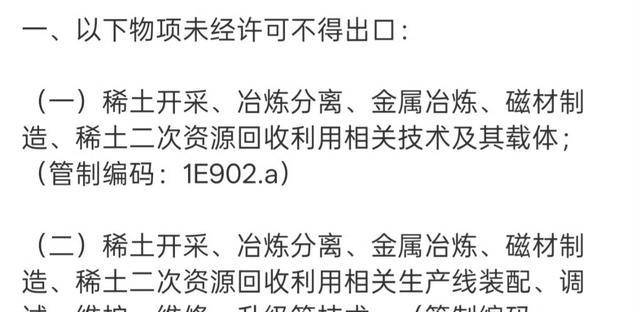
中国商务部连发两份通告,稀土技术严禁出口!
Sou Hu Cai Jing· 2025-10-10 02:21
Core Insights - The U.S. is facing a significant challenge regarding rare earth elements, particularly after issues with soybeans and sorghum, as China has implemented strict export controls to maintain its autonomy in this sector [1][10] Group 1: Regulatory Changes - China's Ministry of Commerce issued two key announcements, with the most notable being Announcement No. 62, which prohibits the export of data, software, and equipment maintenance related to mining, smelting, and magnetic material processing [1][3] - Announcement No. 61 requires that all rare earths used in logic chips below 14 nanometers, storage devices with over 256 layers, or various AI-specific chips must undergo individual approval, directly impacting companies like Samsung [5][10] Group 2: Impact on Industry - The new regulations create a closed-loop system that strengthens China's long-term competitive advantage by controlling not just raw materials but also the technical processes of separation, refining, and smelting [7][10] - The U.S. is attempting to diversify its supply and stockpile rare earths, but challenges remain, including stalled projects and high budgets, indicating that issues may also lie within U.S. offices [9][10] Group 3: Strategic Implications - The control over rare earths is not just about resources but also about global influence, with China solidifying its position to showcase its strength while promoting domestic high-end manufacturing [10]

2025年中国四聚丙烯行业专利申请情况、产业链图谱、供需现状、市场规模、竞争格局及发展趋势研判:行业内参与者较少,市场竞争较为宽松[图]
Chan Ye Xin Xi Wang· 2025-09-26 01:46
Overview - Propylene Tetramer (四聚丙烯) is an organic compound with the chemical formula C12H18, primarily used in the production of various chemical products such as acrylonitrile-butadiene-styrene (ABS) and butadiene rubber [1] Market Demand and Growth - The demand for propylene tetramer is expected to grow steadily, with a projected demand of 176,500 tons and a market size of 5.334 billion yuan in 2024 [1] - High-performance propylene tetramer is expected to account for approximately 33.43% of the market, while general-purpose propylene tetramer will make up about 66.57% [1] Industry Applications - High-performance propylene tetramer is widely used in aerospace and high-end electronics due to its excellent chemical resistance and molecular weight distribution [2] - General-purpose propylene tetramer is utilized in surfactants and daily consumer products, benefiting from good flexibility, processing performance, and cost advantages [2] Technological Development - The number of patent applications related to propylene tetramer in China reached a peak of 11 in 2023, indicating a significant increase in technological advancements [4] - Companies are investing in research and development to improve product quality, reduce production costs, and minimize environmental pollution [4] Industry Chain - The upstream of the propylene tetramer industry includes suppliers of raw materials such as propylene and catalysts, while the midstream consists of production companies [6] - The downstream market primarily uses propylene tetramer for synthesizing various products, with the largest consumption being for the production of 24-carbon alkenes, accounting for 21.98% of usage in 2024 [7] Competitive Landscape - The propylene tetramer industry in China has relatively few participants, leading to a more relaxed market competition [9] - Key players include Hebei Xinxinyuan Energy Co., Ltd., Guangdong Renkangda Material Technology Co., Ltd., and others, with many companies primarily using their production for internal purposes rather than external sales [9] Future Trends - Companies are expected to increase R&D investments to develop high-value-added products to meet the demands of high-end manufacturing [13] - Environmental policies are becoming increasingly influential, prompting companies to enhance their environmental facilities and improve production processes to comply with regulations [13]

杨德龙:中国资产估值向上空间很大
Xin Lang Ji Jin· 2025-09-25 07:53
Group 1 - The ChiNext Index showed strong performance, rising by 1.58% and reaching a nearly three-year high of 3266 points, indicating a bullish trend in the market [1] - The technology sector led the gains, with significant contributions from gaming, AI applications, and controllable nuclear fusion, while the lithium battery sector saw a substantial increase, with leading stocks hitting historical highs [1] - The market's shift from traditional consumer staples to technology and high-end manufacturing reflects China's economic transformation, with strong performance in sectors benefiting from this transition [1] Group 2 - Buffett's investment strategy has evolved to include technology stocks, notably Apple, which has generated significant returns for Berkshire Hathaway, demonstrating the importance of adapting to market changes [2] - Buffett's approach emphasizes the importance of holding quality stocks long-term but also includes a willingness to sell when a company's fundamentals deteriorate, valuations become excessive, or better opportunities arise in the same sector [3] - The current bull market in A-shares and Hong Kong stocks is supported by policy and capital, with a potential for a prolonged slow bull market, contrasting with the recent adjustments in U.S. markets [4]

年薪破百万、涨薪60%,人形机器人企业疯狂“抢人”
Hu Xiu· 2025-09-24 10:49
Core Viewpoint - The humanoid robot industry is experiencing explosive growth, leading to a fierce competition for talent, with companies offering high salaries to attract top scientists and recent graduates [1][2][3]. Group 1: Talent Acquisition and Salary Trends - In 2023, the demand for humanoid robot talent surged, with job openings increasing over four times compared to the previous year, while job seekers rose by 396% [5]. - Companies like Yushun Technology and Ubtech are offering salaries ranging from 30K to 100K per month for various positions, with some roles requiring only 1-3 years of experience [9][8]. - A significant salary increase of over 60% has been reported for candidates with 2-3 years of relevant experience, indicating a highly competitive job market [6][18]. Group 2: Industry Dynamics and Challenges - The humanoid robot sector is characterized by a mix of large companies and startups, each with different recruitment strategies based on their financial capabilities [13][14]. - Startups typically offer 10%-20% lower salaries than larger firms but have quicker hiring processes and are more open to hiring candidates with less experience [14][15]. - The industry is still in its early stages, with many companies focusing on hardware and basic operational roles, while advanced software roles remain limited to industry leaders [16][17]. Group 3: Market Outlook and Investment Sentiment - Despite the current hiring frenzy, some industry insiders caution against the high salary levels, suggesting they may not be sustainable in the long term [20][24]. - The humanoid robot market is still considered a "blue ocean" with significant untapped potential, as many applications remain in the research and demonstration phase [22][23]. - The industry is expected to see substantial advancements over the next 5-10 years, as it has not yet fully developed its market needs [22][23].

全国制造业税收“压舱石”作用凸显 文旅市场火热带动旅游业税收增长
Yang Shi Wang· 2025-09-19 04:10
Group 1: Tax Revenue Growth - The latest data from the National Taxation Administration shows that tax revenue has maintained positive growth in the first eight months of this year, with significant recovery in July and August [1] - Manufacturing tax revenue increased by over 5% year-on-year, accounting for more than 30% of total tax revenue, highlighting its stabilizing role in the economy [1] - In Zhejiang Province, manufacturing tax revenue grew by 5.5% year-on-year, with high-tech and high-end equipment manufacturing sectors seeing increases of 15.3% and 10.5% respectively [7][9] Group 2: Manufacturing Sector Developments - A smart equipment manufacturing company in Hangzhou has seen stable growth in business volume, driven by advancements in industrial intelligent vision products applied in the automotive manufacturing sector [3] - The company reported a year-on-year revenue growth of approximately 30% in the first eight months, with successful project deliveries in international markets such as Spain, the United States, and Sweden [5] Group 3: Tourism Sector Performance - The tourism market has experienced significant growth during the summer, with double-digit increases in sales revenue for travel agencies and leisure activities [9] - In Yunnan Province, the tourism sector received 198 million visitors during the summer months, generating over 330 billion yuan in total spending, a year-on-year increase of over 20% [9] - Dali's tourism industry saw a remarkable tax revenue growth of 117.6% in the first eight months, with notable increases in the accommodation and retail sectors [15]
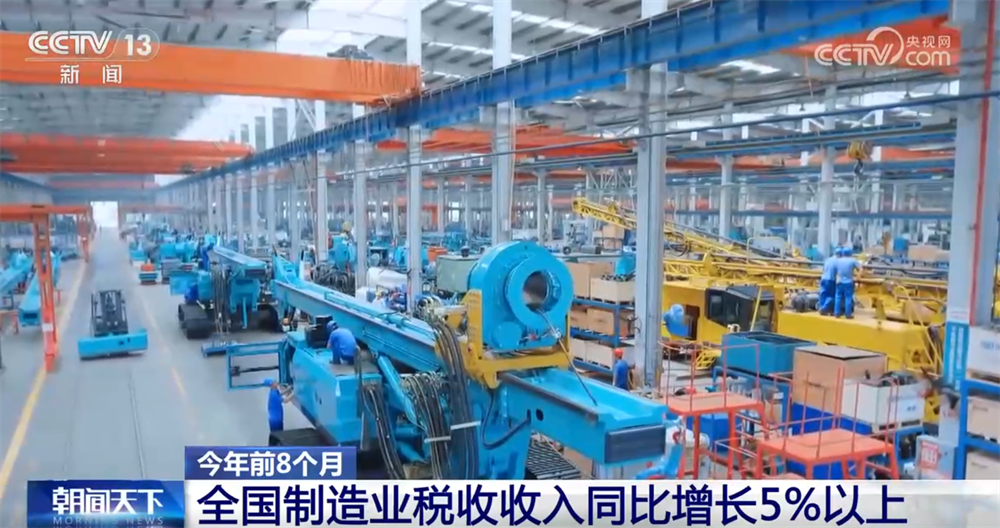
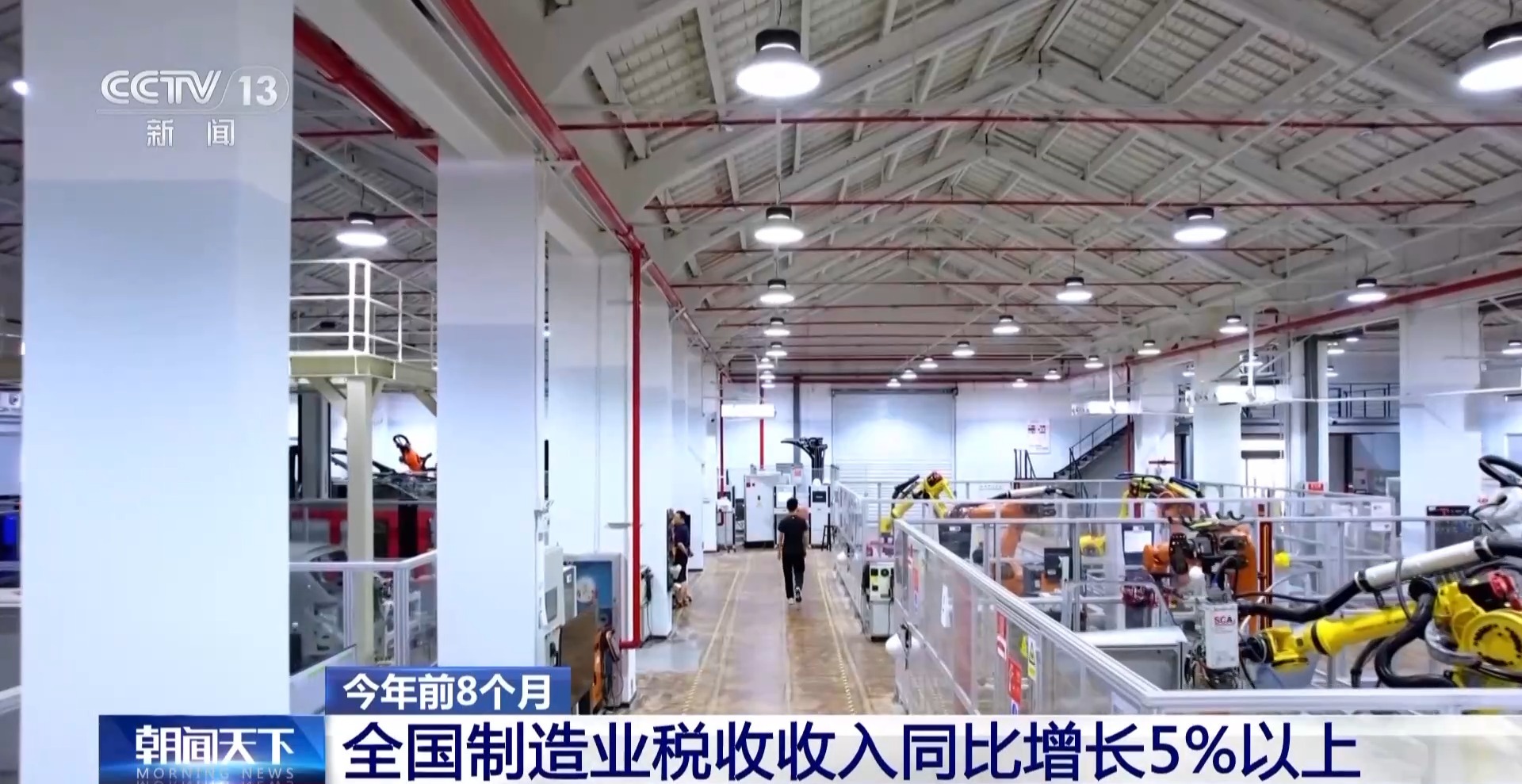
今年前8个月全国制造业税收收入同比增长5%以上
Yang Shi Xin Wen Ke Hu Duan· 2025-09-18 23:56
Group 1 - The latest data from the National Taxation Administration shows that tax revenue has maintained positive growth in the first eight months of this year, with significant recovery in growth rates during July and August, particularly in the manufacturing sector [1] - Nationally, tax revenue from the manufacturing industry has increased by over 5% year-on-year, accounting for more than 30% of total tax revenue, highlighting its "ballast stone" role, especially in high-end manufacturing sectors [1] - In Zhejiang Province, manufacturing tax revenue has grown by 5.5% year-on-year, with local tax authorities actively engaging with businesses to support equipment upgrades and transformation needs [5] Group 2 - In Zhejiang Province, manufacturing enterprises reported a year-on-year sales revenue increase of 4.4% from January to August, with high-tech manufacturing and high-end equipment manufacturing growing by 15.3% and 10.5% respectively, significantly boosting overall growth [7] - A smart equipment manufacturing company in Hangzhou has seen stable growth in business volume, driven by increased R&D efforts in industrial intelligent vision products applied in the automotive manufacturing sector [3]
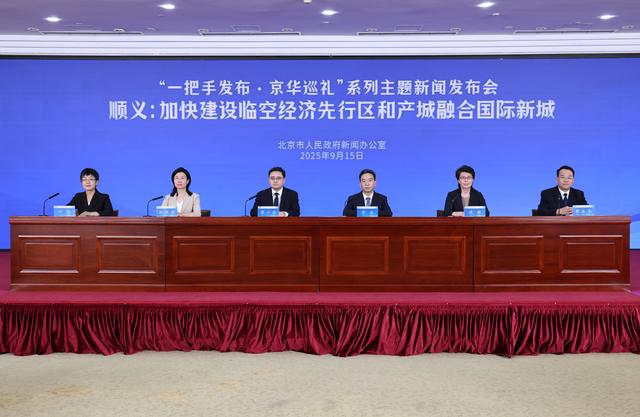
北京每生产3辆汽车,就有1辆顺义制造
Bei Jing Ri Bao Ke Hu Duan· 2025-09-16 04:56
Core Viewpoint - Shunyi District has become a significant hub for high-end manufacturing in Beijing, particularly in the fields of new energy vehicles, aerospace, semiconductors, intelligent equipment, and healthcare, with industrial output growing at an average annual rate of 8.2% since the 14th Five-Year Plan, reaching nearly 200 billion yuan last year [1][4]. Group 1: Economic Growth - Shunyi District's GDP has grown at an average annual rate of 5.8% since the 14th Five-Year Plan, totaling 238.8 billion yuan last year [3]. - Fixed asset investment has increased at an average annual rate of 6.5%, surpassing 60 billion yuan last year [3]. Group 2: High-End Manufacturing Development - The new energy vehicle sector in Shunyi has attracted major manufacturers such as Li Auto, Beijing Hyundai, and Mercedes-Benz, producing 1.65 million vehicles with an output value of 336 billion yuan, growing at an average annual rate of 13% [4]. - The aerospace industry has seen an average annual industrial output growth of 15%, with over 20 key enterprises and a significant presence in aircraft maintenance, contributing 14 billion yuan to the industrial output [5]. - The pharmaceutical trade sector has gathered leading companies like Sinopharm and Merck, with a trade scale exceeding 100 billion yuan for two consecutive years, accounting for nearly one-third of the national total [5][6]. Group 3: Open Development Platforms - Shunyi District hosts over 950 foreign-funded enterprises, with the Capital Airport Economic Zone being a key area, generating over 350 billion yuan in revenue last year, a 53% increase from 2020 [6]. - The Tianzhu Comprehensive Bonded Zone ranks highly among national bonded zones, while the Sino-German Industrial Park has attracted over 120 German-funded enterprises [6]. Group 4: Social Investment and Employment - Over 85% of Shunyi's fiscal spending is allocated to social welfare, with 22 billion yuan invested in education over the past five years [8]. - The district has created 170,000 new jobs in five years and has been recognized as a "fully employed district" in Beijing for 13 consecutive years [8].