
鸽派货币政策

Search documents
“Buy the facts”: Will FED's Shift Support the US Dollar?
FX Empire· 2025-09-22 07:57
Group 1 - The US dollar has corrected higher despite dovish signals, indicating a market reaction to profit-taking by short sellers [1] - The market is anticipating new narratives and drivers for price action as the likelihood of three interest rate declines in 2025 is already priced in [1][4] - The US labor market shows signs of cooling, but GDP growth data for Q3 is not yet available, making recession predictions difficult [2] Group 2 - The 10-2 spread remains above zero, indicating a balanced situation, while the US manufacturing PMI has been below 50 since February, signaling weakness [3] - Despite weak signals, US stocks have performed steadily, with indices reaching new all-time highs alongside Gold [3] - The upcoming PCE index publication on September 25th is crucial for assessing inflation and interest rate stability [4] Group 3 - The official beginning of the interest rate decline cycle in the US may lead to speculation around selling the US dollar coming to an end [5] - Stronger-than-expected inflation data could lead to a rebound in EUR/USD and other USD-related pairs, while failure to break resistance may indicate Euro weakness against the dollar [5]
欧股开盘走高 投资者消化美联储不够鸽派影响
Ge Long Hui A P P· 2025-09-18 07:38
Core Viewpoint - European stock markets opened higher, with the German DAX index rising over 1% and the Euro Stoxx 50 index increasing nearly 1% [1] - U.S. stock index futures also saw an uptick, with the S&P 500 futures up by 0.5% [1] - The Federal Reserve's interest rate decision is perceived as not overly dovish, yet it still provides some benefits for risk assets [1] Market Performance - The French, Spanish, and Italian stock markets also showed positive performance, contributing to the overall bullish sentiment in Europe [1] - The typical market behavior of dip buyers is noted, as they tend to steer market narratives in their favor [1] Economic Outlook - The focus is on U.S. economic data, which needs to validate that the dovish market pricing for October and December is incorrect [1]
德银上调明年黄金均价预期至4000美元,预计金价易涨难跌
Jin Shi Shu Ju· 2025-09-18 06:14
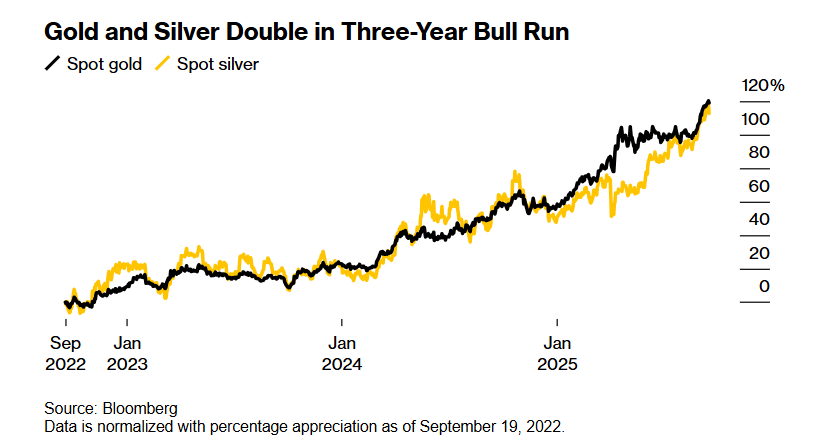
Group 1 - Deutsche Bank predicts that due to Federal Reserve rate cuts and central bank gold purchases, gold will continue its record-breaking rally, with an average price of $4,000 per ounce by 2026, up from a previous estimate of $3,700 [1] - The report indicates that central bank gold purchases could reach 900 tons next year, primarily from China, and that the likelihood of further gold price increases outweighs the possibility of a correction to fair value [1][2] - Gold prices have surged approximately 40% this year, recently surpassing the inflation-adjusted record high set in 1980, driven by ongoing economic and geopolitical uncertainties [1] Group 2 - Concerns regarding U.S. President Trump's recent attacks on the Federal Reserve have heightened market anxiety, with expectations for a more dovish monetary policy supporting non-yielding gold [2] - Deutsche Bank's latest forecasts do not account for potential risks to Federal Reserve independence, although changes in the Federal Open Market Committee (FOMC) membership could introduce uncertainty in policy responses [2] - Goldman Sachs indicated that if the Federal Reserve's independence is compromised, gold prices could potentially soar to nearly $5,000 per ounce with even a small shift in investor holdings from U.S. Treasuries to gold [2] Group 3 - Deutsche Bank raised its 2026 silver price target from $40 to $45 per ounce, citing a fifth consecutive year of physical supply shortages for silver [3]

金价触及新高 美联储降息箭在弦上
Sou Hu Cai Jing· 2025-09-16 03:22
Core Viewpoint - Gold prices have reached a new high, driven by investor expectations of an interest rate cut by the Federal Reserve and considerations of further monetary policy easing in the coming months [1] Group 1: Gold Price Movement - On September 16, gold prices briefly surpassed the previous day's record high of approximately $3,685 per ounce, supported by a decline in the dollar index to a seven-week low [1] - As of 9:01 AM Singapore time, gold prices increased by 0.2% to $3,686.39 [2] Group 2: Federal Reserve Influence - The market has already priced in expectations for a rate cut this week, but investors are keenly awaiting the Federal Reserve's latest quarterly economic and interest rate forecasts, along with Chairman Powell's press conference [1] - A series of weak labor market data and the absence of significant inflation surprises have enhanced the outlook for further rate cuts by the Federal Reserve this year, which is favorable for gold [1] Group 3: Political Pressure - President Trump has intensified pressure on the Federal Reserve, including attempts to remove Fed Governor Cook, which has reinforced market bets on a more dovish monetary policy [1] - The confirmation of Trump's economic advisor Stephen Moore as a Federal Reserve Governor coincides with this monetary policy meeting [1]
华尔街热议“特朗普开除库克”:美联储独立性危,利空美元,利好黄金、比特币
3 6 Ke· 2025-08-27 03:45
Group 1 - President Trump announced the immediate dismissal of Federal Reserve Governor Lisa Cook, potentially allowing him to appoint a more dovish candidate, which could lead to greater control over the Federal Reserve [1][2] - The market reacted negatively to the news, with the dollar weakening across the board, short-term Treasury yields declining, and safe-haven assets like gold and Bitcoin gaining popularity [1][3] - Analysts express concerns that this action undermines trust in the Federal Reserve as an independent institution, which may pose long-term challenges to the dollar's status as a global reserve currency [2][4] Group 2 - The expectation of a more dovish Federal Reserve following Cook's dismissal is likely to increase the prospects of interest rate cuts, further pressuring the dollar [3][4] - The demand for gold, yen, and Bitcoin is rising as investors seek to hedge against the potential long-term implications of diminished Federal Reserve independence [4][5] - Despite the market's initial reaction, analysts believe that the potential risks have not been fully priced in, indicating high uncertainty for the future [4][5]
美联储新主席竞争激烈,沃勒当选概率最高
Sou Hu Cai Jing· 2025-08-12 06:55
Core Viewpoint - The competition for the next chair of the Federal Reserve is intensifying, with Christopher Waller currently seen as the frontrunner. Analysts suggest that regardless of who is selected, the Fed is likely to adopt a more dovish stance [1][2]. Candidate Overview - The list of candidates for the next Fed chair has expanded from four to around ten, including notable figures such as Christopher Waller, James Bullard, Stephen Moore, Kevin Hassett, Mark Sulzman, and Kevin Warsh. The U.S. Treasury Secretary, Scott Bessenet, is leading the selection process and has expressed a strong impression of Waller after his interview [1][4]. - Waller, who has been a Fed governor since December 2020, is viewed as a suitable candidate due to his willingness to adjust policies based on future economic predictions rather than current data [4][5]. Monetary Policy Perspectives - Waller's monetary policy stance is considered dovish, having supported a 25 basis point rate cut in July. He advocates for quicker policy easing to stimulate the economy as long as inflation risks are manageable [5][6]. - Other candidates also show support for rate cuts, with Hassett criticizing the Fed for slow rate reductions and Warsh and Bullard shifting from hawkish to dovish positions recently [5][6]. Candidate Profiles - **Christopher Waller (65 years)**: Supports rate cuts and focuses on potential inflation excluding tariff impacts. He is seen as a leading candidate due to his understanding of the Fed's system [6]. - **Kevin Warsh (55 years)**: Previously hawkish, now supports rate cuts and advocates for coordination between the Fed and Treasury on national debt management [6]. - **Kevin Hassett (63 years)**: Critiques the Fed's slow rate cuts and has a close relationship with Trump, favoring aggressive fiscal stimulus [6]. - **Stephen Moore (42 years)**: Known for advocating for tax cuts and deregulation, he supports structural reforms in the Fed [6]. - **James Bullard (64 years)**: Historically a hawk, he has recently indicated a willingness to support rate cuts [6]. - **Mark Sulzman (55 years)**: His recent views are unclear, but he has a background in coordinating economic policies during the Bush administration [6]. Implications of New Appointments - The nomination of Stephen Moore by Trump to fill a vacancy at the Fed could further strengthen the dovish faction within the Fed, although it may not significantly impact recent monetary policy decisions [7][8]. - Analysts believe that Moore's potential influence on the Fed's decision-making will depend on the economic conditions at the time of his confirmation [8].
美股周一收盘点评:芯片板块面临税收挑战,科技股小幅下跌
Sou Hu Cai Jing· 2025-08-12 02:44
Group 1 - The proposed taxation may negatively impact the profit margins of chip manufacturers and set a precedent for Washington to impose taxes on key U.S. export products, potentially extending beyond semiconductors [1] - The agreement allowing semiconductor sales to China is a critical topic in the deal signed earlier this year between Washington and Beijing, which is set to expire on Tuesday [1] - Investors are focusing on economic data as the earnings season concludes, looking for clues on whether the Federal Reserve will cut interest rates in September [1] Group 2 - There are expectations that recent personnel changes at the Federal Reserve and signs of a weak job market may lead to a dovish monetary policy stance later this year, contributing to a sense of optimism [1] - The consumer inflation report for July is set to be released on Tuesday, with investors anticipating a reduction in borrowing costs by approximately 60 basis points before December [1] - Other financial indicators show a slight increase in bonds and the dollar, while gold futures have reduced losses after Trump stated that gold imports would not face U.S. tariffs [1]
【UNFX课堂】当美联储开始演奏“软着陆小夜曲”,黄金却在敲响“末日警钟”
Sou Hu Cai Jing· 2025-08-09 02:47
Group 1: Federal Reserve and Market Signals - The Federal Reserve is hinting at a potential "soft landing" with possible interest rate cuts, contrasting sharply with the surge in gold prices, indicating market anxiety about economic stability [2][4] - The appointment of Stephen Miran to the Federal Reserve is seen as a temporary measure, while the real power struggle involves Waller eyeing Powell's position, which could lead to significant market shifts by year-end [3] - The labor market data shows a rise in initial jobless claims and a peak in continuing claims, suggesting a weakening job market and economic uncertainty [4] Group 2: Trade Policies and Market Reactions - Trump's proposed 100% tariffs on semiconductors are perceived as a strategic move to encourage domestic manufacturing rather than a straightforward economic threat [5] - The tariffs are expected to prompt major companies like TSMC and Samsung to consider building factories in the U.S. to avoid these tariffs, potentially reshaping the semiconductor supply chain [5] - The recent imposition of tariffs on gold imports has led to a dramatic price increase, indicating that gold is becoming a geopolitical asset rather than just a hedge against inflation [6][7] Group 3: Currency and Economic Outlook - The U.S. dollar index is fluctuating around 98.0, reflecting uncertainty in the market as it awaits upcoming economic data, with expectations leaning towards a downward trend [4][8] - The combination of the Federal Reserve's dovish stance, weak labor market signals, and trade policy changes is creating a complex environment that could lead to significant market volatility [8]
特朗普开始重塑美联储决策层
Sou Hu Cai Jing· 2025-08-08 03:16
Core Points - President Trump appointed Stephen Miran as a member of the Federal Reserve Board, filling a vacancy left by former member Adriana Kugler, with a term ending on January 31, 2026 [1] - Miran has a strong academic background with a PhD in economics from Harvard and has experience in both the private sector and federal government, making him a key figure in shaping economic policy [1] - Trump's administration is actively seeking to influence the Federal Reserve's decision-making, particularly in light of upcoming midterm elections [1][5] Group 1 - The Federal Reserve Board consists of 7 members who directly influence the Federal Open Market Committee (FOMC) decisions, which include evaluating economic conditions to adjust interest rates [1] - Miran has previously criticized the large-scale fiscal stimulus policies favored by Fed Chair Jerome Powell, indicating potential shifts in monetary policy direction [2] - Trump has been pressuring Powell to resign due to dissatisfaction with the Fed's interest rate policies, aiming to mitigate the negative impacts of tariffs and government debt [5] Group 2 - Powell's term ends in May 2026, and he has faced significant pressure from Trump but remains committed to his position [6] - Trump is interviewing three candidates for potential replacements for Powell, all of whom align with his ideological views, suggesting a more dovish approach to monetary policy in the future [7] - The upcoming FOMC meetings on September 16, October 28, and December 9 will be crucial in determining the future monetary policy stance, which may impact global capital confidence [7]
美联储副主席公开唱“鸽”:最早或7月降息!
Jin Shi Shu Ju· 2025-06-23 14:34
Core Viewpoint - The timing for interest rate cuts may be approaching as concerns about the labor market risks are increasing, while inflation from tariffs is not seen as a significant issue [1][2]. Group 1: Interest Rate Policy - Bowman supports considering a reduction in policy rates as early as the next meeting to bring rates closer to neutral and maintain a healthy labor market [2]. - The Federal Reserve maintained its overnight target rate range at 4.25% to 4.5% during the last meeting, amid economic uncertainty caused by trade policies [2]. - Bowman expressed optimism about the economic outlook, suggesting that the future economic clouds are becoming clearer [2]. Group 2: Labor Market and Inflation - The labor market is currently in good shape, but there are growing concerns about its future prospects, which contributes to a dovish monetary policy stance [3]. - Bowman noted that any upward pressure on prices from higher tariffs is being offset by other factors, and the core Personal Consumption Expenditures (PCE) inflation trend is closer to the 2% target than current data suggests [3].