
估值修复

Search documents
高盛“强烈买入”名单新添一员:世纪互联(VNET.US)成唯一入围IDC企业 转型批发模式驱动估值重塑
Zhi Tong Cai Jing· 2025-10-08 05:23
Core Viewpoint - Goldman Sachs has included CenturyLink (VNET.US) in its "Strong Buy" list for the Asia-Pacific region, making it the only IDC company on this list, highlighting its transition from traditional retail IDC operations to high-growth wholesale IDC operations, benefiting from increasing AI investments [1][2] Group 1: Company Transformation and Growth Potential - CenturyLink is expected to derive approximately 75% of its revenue from IDC business and 25% from cloud computing and value-added services by 2025 [1] - Goldman Sachs forecasts a compound annual growth rate (CAGR) of 52%-55% for CenturyLink's wholesale IDC business revenue and EBITDA from 2024 to 2027 [1] - The overall EBITDA margin for the company is projected to increase from 29.4% in 2024 to 33.3% in 2027 [1] Group 2: Market Dynamics and Order Growth - Due to the rapid growth in AI demand and reduced reliance on foreign chips, CenturyLink's new order volume is expected to significantly increase by the end of 2025 or early 2026, supported by its quick delivery capabilities for AI hyperscale clients [2] - If NVIDIA's Blackwell architecture-based chips for China receive approval, CenturyLink's new order volume in 2026 could be even stronger [1] Group 3: Valuation and Price Target - CenturyLink's current stock price corresponds to a forward EV/EBITDA of about 10 times for the next 12 months, with a projected EBITDA CAGR of 23% from 2024 to 2027 [2] - As new orders materialize and the contribution of wholesale IDC business to revenue and EBITDA increases, there is potential for further valuation recovery, with a target price of $13 based on a 12 times forward EV/EBITDA for 2026 [2]

证券ETF一个月吸金超266亿元
2 1 Shi Ji Jing Ji Bao Dao· 2025-10-03 00:17
Core Viewpoint - The A-share market has shown a fluctuating upward trend since September, but the brokerage sector is still undergoing adjustments, with a decline of 4.73% in the brokerage index for the month despite a significant rise of nearly 5% on September 29 [1][5]. Group 1: Market Performance - The Shanghai Composite Index, Shenzhen Component Index, and ChiNext Index increased by 0.64%, 6.54%, and 12.04% respectively from September 1 to September 30 [4]. - The brokerage sector's index experienced a notable drop of 4.73% during September, but rebounded with a 4.89% increase on September 29, with several major brokerages hitting their daily limit [5][6]. Group 2: Fund Inflows - From September 1 to September 29, the Guotai Junan ETF attracted over 10 billion yuan in net inflows, making it the top-performing stock ETF for the month [1][5]. - The Huabao Brokerage ETF and Tianhong Securities ETF also saw significant inflows of 6.03 billion yuan and 2.52 billion yuan respectively, ranking among the top stock ETFs [1][5]. - Cumulatively, ETFs with "securities" or "brokerage" in their names saw a total net inflow of 26.61 billion yuan since September [5][6]. Group 3: Future Outlook - Analysts predict that the brokerage sector will benefit from a dual boost of improved performance and valuation recovery, especially as market activity increases and policy support remains strong [9][10]. - The average daily trading volume in the A-share market has surged to 2.1 trillion yuan, reflecting a 211% increase compared to the third quarter of 2024 [9]. - Forecasts suggest that the brokerage sector's net profit could increase by approximately 48% year-on-year by the third quarter of 2025, with a return on equity (ROE) expected to rise by 1.8 percentage points to 7.7% [9][10]. Group 4: Investment Opportunities - The brokerage sector is currently viewed as undervalued, with active equity funds holding only 0.64% of their portfolios in brokerage stocks, the lowest level since 2018 [11]. - The current price-to-book (PB) ratio for the A-share brokerage sector stands at 1.60, which is in the 39th percentile since 2014, indicating potential for valuation recovery [11]. - Investment strategies should focus on high-quality brokerages with strong wealth management and international business capabilities, as well as mid-sized brokerages with lower valuations [12].







港股科技ETF(513020)涨超1.7%,连续10日净流入近6亿元,机构:科技板块成长弹性受关注
Mei Ri Jing Ji Xin Wen· 2025-09-30 07:00
Group 1 - The technology sector is characterized by a natural growth style, defined by four primary industries: electronics, media, computers, and communications [1] - The pricing logic of technology stocks focuses on the discounting of future free cash flows and is sensitive to interest rate environments, with low interest rates promoting valuation increases [1] - The Hong Kong technology sector, as a key weighty segment, includes unique tech leaders like Tencent and Meituan, complementing the A-share technology market and presenting significant allocation value [1] Group 2 - The core driving force of the technology sector has shifted from internet model innovation to AI and hard technology innovation, supported by industrial policy and valuation recovery, potentially leading to a market surge [1] - The Hong Kong Technology ETF (513020) tracks the Hong Kong Stock Connect Technology Index (931573), which selects securities from technology-related industries among Hong Kong-listed companies, focusing on the top 30 constituents by market capitalization [1] - This index emphasizes TMT (Technology, Media, and Telecommunications) and internet sectors, reflecting the overall performance of technology companies listed in the Hong Kong market, characterized by high technological content and growth potential [1]
中金:首次覆盖保利置业(00119)予目标价2.15港元 评级“跑赢行业”
智通财经网· 2025-09-30 03:24
Core Viewpoint - CICC initiates coverage on Poly Real Estate (00119) with a target price of HKD 2.15 and an "outperform" rating, expecting earnings per share of RMB 0.04 for 2025-2026 [1] Group 1: Company Performance - The company is identified as one of the few central state-owned enterprises in the real estate sector with high valuation cost-effectiveness [1] - Despite a 44% and 68% decline in national and top 100 new home sales from 2020 to 2024, the company's total sales remained stable at RMB 50-60 billion, improving its industry ranking by 50 positions to 17th [1] - The company is expected to achieve its annual sales target of RMB 50 billion with a high degree of certainty, potentially realizing slight positive growth year-on-year [1] Group 2: Market Conditions - The market has a perception gap regarding the company's operations and valuation, with expectations for operational improvements and valuation recovery driven by policy changes [1] - The company's stock price had been under pressure due to "peer competition" and uncertainties related to governance, but these issues are now being resolved [1]
逾六成私募将重仓过节!
券商中国· 2025-09-30 02:07
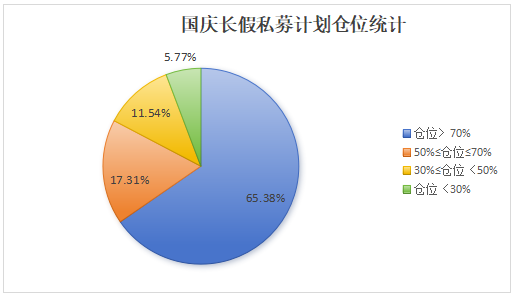
Core Viewpoint - The article discusses the positioning of private equity funds ahead of the National Day holiday and their outlook for the market post-holiday, indicating a generally optimistic sentiment among private equity managers [2][10]. Group 1: Private Equity Fund Positioning - Over 65% of private equity funds are opting for heavy or full positions during the holiday, believing that external market disturbances will be limited and that domestic fundamentals and policy environments provide a solid safety margin [4][5]. - The stock private equity position index reached 78.41% as of September 19, marking a new high for the year, reflecting a trend of increased positions among private equity funds [4][10]. Group 2: Market Outlook Post-Holiday - Approximately 70.19% of private equity managers hold an optimistic view on the A-share market post-holiday, expecting a gradual recovery driven by policy and capital [6][11]. - 62.50% of private equity funds anticipate a balanced market style post-holiday, with rotation among technology growth, value blue chips, and white horse stocks [7]. Group 3: Investment Focus Areas - 59.62% of private equity funds are focusing on technology growth sectors, particularly AI, semiconductors, humanoid robots, smart driving, and innovative pharmaceuticals, which are seen as key drivers for future economic transformation [7][8]. - 21.15% of private equity funds are optimistic about the valuation recovery in the new energy and real estate sectors, expecting rebound opportunities as industry policies become clearer [7]. Group 4: Market Dynamics and Strategies - The article suggests that the current market is in a "slow bull" phase, with expectations of continued structural opportunities in the stock market, particularly in high-growth sectors and stable value stocks [10][11]. - The upcoming third-quarter earnings reports are expected to play a crucial role in determining market rotation, with high-growth stocks and stable value stocks alternating in attracting capital [10].

逾六成私募选择重仓过节 投资主线聚焦科技成长
Zheng Quan Shi Bao Wang· 2025-09-29 23:09
Group 1 - Over 60% of private equity funds choose to hold heavy positions or fully invested during the National Day holiday, indicating a positive outlook for the market trend post-holiday [1] - The overall position index of private equity has risen to a new high for the year, reflecting increased confidence among investors [1] - Most private equity funds favor technology growth sectors, while some are betting on the valuation recovery of the new energy and real estate industry chains [1]
超六成私募机构“重仓过节” 科技主线获共识
Zheng Quan Ri Bao· 2025-09-29 16:10
Group 1 - Over 60% of private equity firms plan to maintain high positions (over 70% allocation) during the upcoming holidays, indicating a positive outlook for the market post-holiday [1] - 65.38% of surveyed private equity firms intend to keep positions above 70%, while 17.31% prefer a moderate allocation (50% to 70%) focusing on structural opportunities post-holiday [1] - Approximately 70% of private equity firms are optimistic about the A-share market's performance after the holiday, expecting gradual recovery after a period of consolidation [1] Group 2 - The technology growth sector remains the mainstream choice among private equity firms, with nearly 60% favoring sectors like AI, semiconductors, humanoid robots, smart driving, and innovative pharmaceuticals [2] - Some firms, such as Anhui Anjue Asset Management, express a neutral to positive outlook for the A-share market, anticipating that capital inflow and sentiment recovery will drive market fluctuations upward [2] - The overall sentiment among private equity firms is optimistic regarding the post-holiday market, with a consensus on technology growth as the leading direction while maintaining a balanced approach in structural rotation [3]
保利置业(00119.HK):藏器待时 锋芒渐露 高估值性价比央资房企
Ge Long Hui· 2025-09-29 04:33
Investment Highlights - Company is covered for the first time by CICC with an "outperform" rating and a target price of HKD 2.15, corresponding to 0.24x P/B for 2025/2026 and an upside potential of 28% [1] - Company is an important real estate development platform under Poly Group, demonstrating stable operational performance during the current downturn cycle [1] - The low valuation is a prerequisite, as the company's fundamentals have not been fairly priced due to previous impacts from "peer competition" and governance uncertainties [1] Operational Performance - Despite a 44% and 68% cumulative decline in new home sales nationally and among the top 100 developers from 2020 to 2024, the company's total sales remained stable at RMB 50-60 billion, improving its industry ranking by 50 positions to 17th [1] - The company is expected to achieve its annual sales target of RMB 50 billion, with a possibility of slight year-on-year growth [1] Valuation and Market Position - The reasonable valuation range is estimated at 0.35-0.45x P/B based on NAV models and comparable companies in the industry [1] - The company possesses unique attributes such as being a central enterprise and a small-to-mid-cap stock, which are rare in the market [1] - The current trading at 0.17x P/B reflects a 63% discount to NAV, indicating high valuation potential [2] Catalysts and Future Outlook - Anticipated catalysts include potential outperformance in sales and land acquisition in Q4 2025, driven by policy support and improved operational performance [2] - The company is viewed as one of the few central enterprise real estate firms with high valuation cost-effectiveness, with expectations for operational improvements exceeding market forecasts [2]
逾六成私募拟重仓过节,预期节后市场风格将趋于均衡
Xin Hua Cai Jing· 2025-09-29 03:27
Group 1 - A significant majority of private equity firms (65.38%) plan to maintain high or full positions (over 70% allocation) during the upcoming National Day holiday, indicating a belief that external market disturbances will be limited [1] - 70.19% of private equity firms are optimistic about the post-holiday A-share market, expecting a gradual recovery after the pre-holiday consolidation [3] - 62.50% of private equity firms anticipate a balanced market style post-holiday, with rotation between technology growth, value blue chips, and traditional industry leaders [5] Group 2 - The main investment themes post-holiday are expected to focus on technology growth sectors such as AI, semiconductors, humanoid robots, smart driving, and innovative pharmaceuticals, with 59.62% of private equity firms expressing this view [7] - Current market conditions are characterized as being in the second phase of a bull market, with a focus on maintaining high stock positions and targeting sectors with upward momentum [9] - The market is expected to remain in a slow bull trend, with various sectors presenting opportunities, particularly in technology and consumer sectors due to favorable policies and economic recovery [10] Group 3 - The dual main lines of investment post-holiday are expected to be technology growth and valuation recovery, driven by policy support and technological innovation [11] - The market is experiencing structural differentiation, with a potential for valuation recovery in low-valued sectors as macroeconomic data improves [11] - The investment strategy should balance between high elasticity in technology growth and the stability of valuation recovery, allowing investors to capture structural opportunities in the post-holiday market [11]
恒生科技还有多大上行空间
2025-09-28 14:57
Summary of the Conference Call on Hang Seng Technology Index Industry Overview - The Hang Seng Technology Index is currently undervalued compared to international mainstream indices and A-share innovation indices, indicating significant potential for valuation recovery [1][2][3] - The current Price-to-Earnings (PE) ratio is 23.7 times, with a historical average of approximately 33 times, suggesting a potential upside of about 38% [1][2][4] Key Points and Arguments - The top ten constituent stocks of the Hang Seng Technology Index account for about 70% of its weight, with major internet companies like Alibaba, Tencent, and Meituan having valuations at historical lows [1][2][3] - If these leading stocks recover to the average valuation level of the constituents, it is expected to drive the Hang Seng Technology Index up by approximately 15% [2][3][4] - The anticipated interest rate cuts by the Federal Reserve and the continuous inflow of southbound funds are expected to provide additional support for the Hong Kong stock market [1][5] - The AI application cycle is seen as a major growth driver for Hong Kong internet companies, which are positioned as pioneers in AI applications, benefiting from the accelerated development of the AI industry [1][5][6] Additional Important Insights - The Hang Seng Technology Index has shown a significant increase of over 15% since September, reaching new highs for the current bull market in 2024 [5] - The overall market environment, including the expected foreign capital inflow and improved asset allocation due to the Federal Reserve's actions, is favorable for the continued rise of the Hong Kong stock market [5][6] - The potential for a "double boost" in profitability and valuation for the Hang Seng Technology sector is supported by the recovery of leading internet companies and the favorable macroeconomic conditions [6][7]