人民币国际化

Search documents
原来美国的金融政策是这样的。
Sou Hu Cai Jing· 2026-01-20 07:58
看蔡正元谈人民币的国际化。才了解了一点美国的金融制度,原来美国的金融市场向全世界开放,全世界的资本可以自由进出美国。无怪乎美联储的主 席,是全世界关注的一个职位。无形之中,他在影响着全世界的货币政策,美国人的豪横,美国人的舍我其谁,还是有一定道理的。 ...

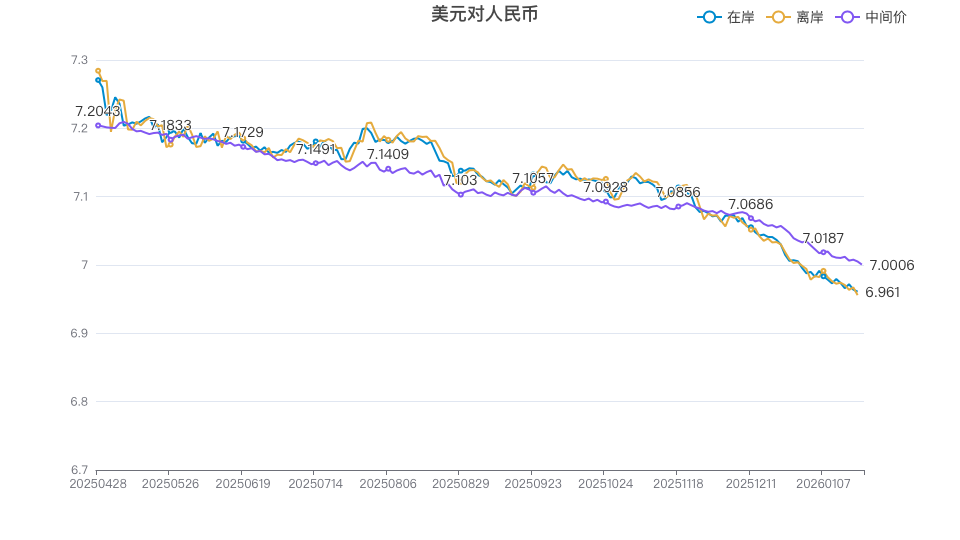
人民币兑美元升破6.96关口 创32个月新高
Xin Hua Cai Jing· 2026-01-20 07:40
Core Viewpoint - The Chinese yuan has strengthened significantly against the US dollar, reaching a 32-month high in the onshore market and a new high since May 15, 2023, in the offshore market, driven by seasonal demand for currency settlement and expectations of continued appreciation due to internationalization efforts and easing trade tensions [1][4]. Group 1: Currency Performance - The onshore yuan against the US dollar broke the 6.96 mark, reaching a peak of 6.9593 [1]. - The offshore yuan peaked at 6.95285, marking the highest level since May 15, 2023 [1]. - The central parity rate of the yuan against the US dollar was adjusted up by 45 points to 7.0006, the highest since May 18, 2023 [3]. Group 2: Year-to-Date Appreciation - Year-to-date, the onshore yuan has appreciated by 0.4% against the US dollar, while the offshore yuan has appreciated by 0.3% [4]. - Historical data indicates that the yuan typically appreciates by 0.5% and 0.8% in December and January, respectively, with appreciation probabilities of 75% and 67% [4]. Group 3: Future Outlook - Analysts from China International Capital Corporation (CICC) suggest that the recent strengthening of the yuan is significantly influenced by seasonal settlement demand, particularly in December and January [4]. - Citigroup economists predict that the yuan will strengthen further due to China's efforts to internationalize the currency and mitigate trade tensions, forecasting a rise to 6.80 against the US dollar in the next 6 to 12 months [4]. - Chief economist Zhao Wei from Shenwan Hongyuan anticipates that the yuan will enter an appreciation phase starting in 2025, potentially appreciating by at least 2-3% annually over the next several years, leading to a total appreciation of over 30% in about a decade [4].
特朗普扛不住了?美国对华芯片加税25%,中国一招反制,他急着找中方沟通,中方就一个态度:减持不变
Sou Hu Cai Jing· 2026-01-20 06:14
Core Viewpoint - China has significantly reduced its holdings of U.S. Treasury bonds, reaching a historic low of $682.6 billion, while other countries have increased their investments in U.S. debt amid global economic uncertainty [2][5][7]. Group 1: China's Actions and Strategies - Since March 2025, China has systematically reduced its U.S. Treasury holdings by nearly $500 billion over nine months, averaging a monthly reduction of about $10 billion [5][9]. - China's foreign exchange reserves remain above $3.3 trillion, indicating that the reduction in U.S. debt holdings is a strategic asset allocation decision rather than a forced sell-off [5][9]. - The reduction in U.S. Treasury holdings is part of a broader strategy to enhance the resilience of China's foreign exchange reserves, with the proportion of U.S. dollar assets decreasing from 37% in 2018 to 24% [9][17]. Group 2: Global Context and Implications - Other countries, such as Japan and the UK, have increased their U.S. Treasury holdings significantly, with Japan holding $1.2 trillion and the UK adding $10.6 billion [4][7]. - The U.S. government faces a debt crisis, with total federal debt nearing $40 trillion and interest payments exceeding $1.2 trillion, raising concerns about the sustainability of U.S. debt as a safe asset [7][11]. - The ongoing geopolitical tensions and trade disputes have led to a reevaluation of U.S. Treasury bonds as a safe investment, with major credit rating agencies downgrading U.S. sovereign credit ratings [7][11]. Group 3: Financial Market Dynamics - The yield on 30-year U.S. Treasury bonds has surpassed 5%, leading to increased interest payments for the U.S. government, which could amount to an additional $20 billion annually for every 0.1% rise in yield [13]. - China's exit from the U.S. Treasury market could trigger a "herd effect," influencing other countries to diversify their reserves away from U.S. debt [13][17]. - The international financial landscape is shifting towards a more multipolar system, as China's actions challenge the long-standing dominance of the U.S. dollar and its associated debt instruments [17].

上海“十五五”规划建议多处提及期市
Qi Huo Ri Bao Wang· 2026-01-20 01:40
Core Insights - The "15th Five-Year Plan" for Shanghai emphasizes the significant role of futures and derivatives in economic and social development, aiming to enhance the city's international financial competitiveness and influence [1] Group 1: Financial Market Development - The proposal includes measures to accelerate the establishment of a global RMB asset allocation center and risk management center, such as enriching currency hedging tools and exploring RMB foreign exchange futures trading [1] - A robust financial market system is to be established, with a focus on the steady development of futures and derivatives markets [1] Group 2: International Trade Enhancement - The plan aims to strengthen the resource allocation function of bulk commodities and innovate in the linkage between spot and futures markets, enhancing the international pricing influence of key bulk commodities [1] - Support for the establishment of a national bulk commodity warehouse registration center is also highlighted [1] Group 3: Shipping and Financial Services - The proposal advocates for the development of shipping finance, supporting shipbuilding and RMB settlement for shipping costs, while enhancing the influence of shipping index derivatives [1] - The futures market is expected to provide essential tools for enterprises to hedge against exchange rate and commodity price fluctuations, thereby supporting the development of Shanghai's shipping finance [2] Group 4: Industry Opportunities - The plan is anticipated to accelerate futures product innovation, expanding derivatives in foreign exchange and shipping, and improving the product system [3] - The establishment of an international financial asset trading platform is expected to deepen the interconnection between domestic and foreign markets, attracting foreign financial institutions and promoting futures companies to transition into comprehensive risk management service providers [3]
上海国际金融中心建设 从“规模扩张”转向“功能升级”
Shang Hai Zheng Quan Bao· 2026-01-19 18:45
Core Viewpoint - The Shanghai "14th Five-Year Plan" emphasizes the transformation of Shanghai into a global center for RMB asset allocation and risk management, marking an upgrade in its role as an international financial center [1][2]. Group 1: Strategic Developments - The plan proposes to expand cross-border and offshore financial services, establish an offshore financial functional zone, and enhance the interconnectivity of domestic and international financial markets [2][3]. - It aims to create the Shanghai International Financial Asset Trading Platform and explore pilot programs for RMB foreign exchange futures trading, which will significantly enhance the global pricing power and attractiveness of Shanghai's financial market [2][3]. - The emphasis on technology in risk management and regulatory collaboration is intended to ensure the stability of Shanghai's financial system amid increasing global uncertainties [2][3]. Group 2: Key Innovations - Five important innovations in the construction of Shanghai's international financial center are identified: upgrading functional positioning, establishing an offshore financial functional zone, creating the Shanghai International Financial Asset Trading Platform, elevating risk management to a core function, and reshaping the technological foundation with digital financial infrastructure [3][4]. - These innovations can be distilled into three core transformations: functional transformation, institutional transformation, and technological transformation, which are interdependent and collectively form the strategic line of the "14th Five-Year Plan" [3]. Group 3: Financial System Enhancements - The plan emphasizes the need to improve financial services for the real economy, with specific focus areas including technology finance, green finance, inclusive finance, pension finance, and digital finance [4]. - It highlights the transition of Shanghai's international financial center from a phase of "scale expansion" to one of "functional upgrade," driven by higher levels of institutional openness and deeper integration of technology [4]. - The vision is to establish Shanghai not just as a larger international financial center, but as a pivotal hub for the reconstruction of the global financial system, supporting RMB internationalization and high-level financial openness in China [4].
中国美债持仓暴跌至6826亿美元,17年来最低!马斯克通知白宫,坦言美国财政已濒临崩溃
Sou Hu Cai Jing· 2026-01-19 16:30
Core Insights - The article highlights a significant shift in China's investment strategy, as it reduces its holdings of US Treasury bonds to $682.6 billion, the lowest level since the 2008 financial crisis, contrasting with other countries like Japan and the UK that are increasing their investments [1][3] - This reduction is part of a systematic adjustment in China's foreign exchange reserve structure over the past decade, with a peak holding of $1.3 trillion in US Treasuries [1][3] Group 1: China's Actions - China has been reducing its US Treasury holdings for four consecutive years, with a total reduction exceeding $280 billion from 2022 to 2024 [3][4] - The People's Bank of China has restarted gold purchases, increasing its reserves to 7.402 million ounces by August 2025, indicating a shift towards diversifying its reserves [3][4] Group 2: Global Context - As of July 2025, global investors hold a record $9.36 trillion in US Treasuries, with Japan and the UK increasing their holdings significantly [3][4] - The US federal debt has surpassed $37 trillion, with annual interest payments exceeding $1 trillion, raising concerns about fiscal sustainability [4][6] Group 3: Market Dynamics - The Federal Reserve's interest rate hikes have led to a decline in the market value of existing US Treasuries, prompting China to adjust its investment strategy [3][4] - The structure of US Treasury holders is changing, with the proportion held by the Federal Reserve and foreign investors dropping from 58% in early 2022 to 44% by 2025 [6][8] Group 4: Implications for Currency and Investment - China's reduction in US Treasury holdings is seen as a move to decrease reliance on the US dollar, supporting the internationalization of the renminbi [9] - Investments through the Asian Infrastructure Investment Bank and Silk Road Fund have exceeded $65 billion in Asian projects, reflecting a strategic shift in utilizing foreign exchange reserves [9]
信用半月谈系列报告之三:如何看待熊猫债的投资价值?
Shenwan Hongyuan Securities· 2026-01-19 14:14
Group 1 - Panda bonds are RMB-denominated bonds issued by foreign entities in the Chinese market, which have evolved significantly since their inception in 2005, becoming an important part of China's bond market opening [2][6][12] - The regulatory framework for Panda bonds has transitioned from strict limitations to a more open system, with key milestones including the relaxation of fundraising restrictions in 2016 and the establishment of a classification registration system in 2018 [2][8][12] - The current Panda bond market features a diverse range of issuers, with a total outstanding bond balance of approximately 425.8 billion RMB, where over 80% of bonds have a remaining maturity of less than 3 years and a high proportion of issuers rated AA+ or above [2][18][23] Group 2 - The investor structure in the Panda bond market is becoming more diversified, with foreign institutions maintaining stable holdings and domestic securities firms, policy banks, and commercial banks increasing their participation significantly [2][28][30] - The liquidity in the secondary market for Panda bonds is relatively low, with monthly turnover rates generally between 7% and 14%, which is lower than that of ordinary credit bonds in the interbank market [2][28][31] - The pricing level of Panda bonds is generally consistent with domestic bonds of the same credit rating, with yields for different maturities as of January 14, 2026, showing no significant premium [2][38][39] Group 3 - The investment value of Panda bonds is expected to remain attractive in 2026, with the bond market likely to exhibit characteristics of "low interest rates and high volatility," making short to medium-term credit bonds appealing for yield and leverage strategies [2][41][42] - Specific strategies for investment include focusing on short to medium-term bonds with a remaining maturity of less than 3 years that have a yield spread of over 20 basis points compared to similar domestic bonds, and identifying structural arbitrage opportunities in high-quality state-owned enterprises issuing bonds abroad [2][42][44] - The report highlights that there are currently 23 eligible Panda bonds with a total balance of 17.55 billion RMB that meet the criteria for significant yield spreads, indicating potential investment opportunities [2][44]
上海2030:打造离岸金融功能区,补强国际金融中心“关键拼图”
Xin Lang Cai Jing· 2026-01-19 10:30
Core Insights - The Shanghai "15th Five-Year Plan" emphasizes enhancing the competitiveness and influence of Shanghai as an international financial center, focusing on building a global RMB asset allocation center and risk management center, and improving financial services for the real economy [1][2]. Group 1: Offshore Financial Zone - The plan proposes the establishment of an offshore financial (economic) functional zone, which is a significant innovation aimed at facilitating the return of foreign capital for RMB asset investment [3][4]. - The offshore financial market will operate under more relaxed regulations, providing a new trading market for foreign investments, with the Shanghai Free Trade Zone serving as a typical example [3][4]. - Measures include expanding cross-border financial services, enhancing offshore credit and free trade offshore bond development, and optimizing regulatory frameworks [4][5]. Group 2: RMB Foreign Exchange Futures - The plan includes exploring the pilot launch of RMB foreign exchange futures trading, which is crucial for managing RMB exchange rate risks and enhancing the market's pricing power [6][7]. - Establishing an RMB foreign exchange futures market is seen as a strategic move to deepen financial reforms and promote RMB internationalization [7]. - The pilot program will adhere to principles of practical demand and risk neutrality, ensuring that financial innovations serve the real economy while managing risks [7]. Group 3: Support for Technology Finance - The plan emphasizes the development of technology finance, supporting early-stage investments in hard technology and the growth of the Sci-Tech Innovation Board and technology bond markets [9][10]. - Shanghai plays a critical role in supporting equity and bond financing for technology enterprises, with significant fundraising achievements in the Sci-Tech Innovation Board and technology bonds [10]. - The overall strategy aims to transition the international financial center from scale expansion to quality improvement, focusing on serving the real economy through institutional innovation and technological empowerment [10].
增强国际金融中心竞争力和影响力,“十五五”时期上海准备这样做
2 1 Shi Ji Jing Ji Bao Dao· 2026-01-19 10:21
Core Viewpoint - The Shanghai "14th Five-Year Plan" aims for a comprehensive upgrade of Shanghai's "five centers" by 2035, with a goal of doubling the per capita GDP compared to 2020 [1][3]. Group 1: Five Centers Development - The "five centers" include international economic, financial, trade, shipping, and technological innovation centers, with the international financial center being a key component [3]. - The plan emphasizes innovation-driven and coordinated development, enhancing global resource allocation, technological innovation, and high-end industry leadership [3]. Group 2: Enhancing International Financial Center Competitiveness - The strategy to enhance the competitiveness and influence of the international financial center will focus on three areas: building a global RMB asset allocation center, improving the modern financial system, and enhancing financial services for the real economy [4]. Group 3: Global RMB Asset Allocation Center - The plan includes expanding cross-border and offshore financial services, deepening cross-border investment and settlement facilitation, and optimizing offshore account systems [5]. - It aims to promote the internationalization of the RMB by enriching RMB-denominated financial products and enhancing international reinsurance capabilities [5]. Group 4: Modern Financial System - The proposal calls for a robust financial market system, promoting direct financing, and enhancing the functions of capital markets [6]. - It encourages the establishment of diverse and specialized financial products and services, and supports the development of financial infrastructure [6]. Group 5: Financial Services for the Real Economy - The plan emphasizes the development of technology finance, green finance, and inclusive finance to address financing challenges for small and medium-sized enterprises [7]. - It also highlights the importance of pension finance and digital finance innovations, including the application of digital RMB [7]. Group 6: RMB Foreign Exchange Futures Trading Pilot - The suggestion to explore the pilot of RMB foreign exchange futures trading has been reiterated in multiple policy documents, indicating a significant step in the development of China's foreign exchange market [8][9]. - The collaboration between the People's Bank of China and the China Securities Regulatory Commission to promote RMB foreign exchange futures is seen as a major advancement in regulatory coordination [10].
专访渣打中国施旅:以负责任AI理念推动银行业数字化转型
Nan Fang Du Shi Bao· 2026-01-19 10:01
2 2026年是中国"十五五"规划的开局之年,也是经济结构深化转型、开放水平持续提升的关键节点。面对 新质生产力的蓬勃发展与全球产业链的重构机遇,金融业如何升级服务能力、创新业务模式、坚守风险 与伦理底线,已成为行业共同探讨的命题。 在此背景下,南都·湾财社发起《开局2026:在新周期起点上》高端访谈系列,本期专访渣打银行(中 国)有限公司企业及投资银行业务总经理施旅,从科技金融、绿色转型、跨境服务与数字化治理等多个 维度,分享其对银行业未来演进路径的思考与实践,为行业在新时代下的价值重塑提供有益参照。 渣打银行(中国)有限公司企业及投资银行业务总经理 施旅 1 构建覆盖科创企业全周期的金融服务体系 南都·湾财社:在政策鼓励科技金融、绿色金融的背景下,您认为银行业在支持新质生产力发展过程 中,自身面临哪些核心能力升级需求?渣打银行在组织架构、风控模式或产品设计上,是否有相应调整 以呼应这一趋势? 施旅:中国正加速培育以创新为主导的新质生产力,高科技企业随之蓬勃涌现,日益成为经济增长的重 要驱动力。银行业需围绕科创企业的生命周期,构建覆盖不同阶段的综合服务能力。渣打银行较早便组 建了新经济团队,并推出"陪跑计划 ...