
新旧动能转换

Search documents
前三季度固定资产投资增速进入全省第一方阵,乐山决胜四季度 点上突破 面上推进
Si Chuan Ri Bao· 2025-10-31 00:35
Core Insights - The construction of the largest oak barrel production base in Asia is underway in the Emei Mountain beverage industrial park, with a target to commence production in November [5] - Over 60 industrial projects are accelerating in Leshan, with significant investment completion rates in key provincial and municipal projects, indicating strong economic growth [5] - The total investment of approximately 51 billion yuan in the high-purity semiconductor materials project in Wutongqiao is expected to enhance China's self-sufficiency in key semiconductor materials, with an anticipated annual output value of 56 billion yuan [6] - The sodium-ion battery material project in Jingyan Economic Development Zone, with a total investment of 8.5 billion yuan, is set to fill a gap in the sodium-ion battery materials sector in Leshan [7] - The bamboo pulp paper industry project in Muchuan, with a total investment of 61 billion yuan, aims to create a complete production chain and is expected to generate an annual output value of 21 billion yuan from its first phase [9] Project Updates - The high-purity arsenic project in Wutongqiao is progressing rapidly, with a construction timeline significantly shorter than the industry average [6] - The sodium-ion battery material project is 75% complete and is expected to be finished by the end of the year [7] - The bamboo pulp paper project will introduce a full chain of paper product enterprises, enhancing the overall efficiency and scale of the bamboo pulp paper industry [9] Development Support - Leshan is focusing on infrastructure development and optimizing policies to enhance the business environment, including the upcoming poultry egg trading market [10] - The chemical park in Qianwei-Mabian is nearing completion of essential facilities, which will inject new momentum into the city's chemical industry [10] - The "sharp knife team" in Wutongqiao is actively involved in project support, ensuring timely completion of major industrial projects [11]

为何要再造一个高技术产业
Jing Ji Ri Bao· 2025-10-30 22:14
Core Insights - The Chinese government aims to cultivate and expand emerging and future industries, with the goal of creating a new high-tech industry equivalent to the size of China's existing high-tech sector over the next decade, injecting continuous new momentum into the economy and high-quality development [1][3] Economic Context - China's economic growth faces challenges due to the weakening of traditional growth drivers and the slow replacement by new drivers, necessitating the reconstruction of a high-tech industry to stabilize growth [1][2] - The current contribution of high-tech manufacturing to industrial value added is less than 20%, indicating a significant gap compared to developed countries, which positions the reconstruction of a high-tech industry as a strategic move to enhance competitiveness [2] Strategic Importance - The reconstruction of a high-tech industry is seen as a critical step in reshaping industrial advantages, allowing China to consolidate its leading position in advantageous sectors and seize opportunities in future markets [2][4] - The ongoing technological revolution, particularly in areas like artificial intelligence, presents both opportunities and uncertainties, making the establishment of a high-tech industry essential for capturing new technological advancements and mitigating risks [2][3] Industrial Foundation - China's "three new" economy is projected to contribute 24.29 trillion yuan to GDP in 2024, exceeding 18%, supported by a robust industrial system and leadership in sectors like new energy vehicles and 5G [3] - The country ranks second globally in R&D expenditure, with significant breakthroughs in quantum computing and artificial intelligence, indicating a strong foundation for the development of a new high-tech industry [3] Future Industry Development - The focus will be on nurturing emerging pillar industries such as new energy, new materials, and aerospace, which are expected to create substantial market opportunities and drive the expansion of the high-tech sector [3][4] - Future industries will be strategically developed in areas like quantum technology and brain-computer interfaces, transitioning from technological reserves to market applications, thus becoming new growth points for the economy [3] Transformation of Manufacturing - The initiative to rebuild a high-tech industry represents a qualitative transformation of Chinese manufacturing, moving away from being "big but not strong" to a more resilient and innovative position in global competition [4]
神州泰岳(300002):静待新游大规模推广后进展
Xin Lang Cai Jing· 2025-10-30 12:44
Core Viewpoint - The company reported a significant decline in net profit for Q3 2025, primarily due to a high profit base from the previous quarter and a decrease in gaming revenue and net profit [1][3] Financial Performance - In Q3 2025, the company achieved operating revenue of 1.384 billion yuan, a year-on-year decrease of 5.29% and a quarter-on-quarter increase of 1.7% [1] - The net profit attributable to shareholders was 215 million yuan, down 53.55% year-on-year [1] - The non-recurring net profit was 208 million yuan, a year-on-year decrease of 3.20% and a quarter-on-quarter decrease of 20.6% [1] - For the first three quarters of 2025, the company reported total operating revenue of 4.068 billion yuan, a year-on-year decline of 9.86% [1] Gaming Business - Existing games like "Age of Origins" and "War and Order" have seen a decline in revenue but still show resilience [2] - The company has several new "SLG+X" products in the pipeline, including "DL" and "LOA," which have received approval for domestic release [2] - The revenue decline from new games is expected to impact short-term performance, but future product releases may drive growth [2] AI Product Development - The company launched the AI voice digital employee product OurWorks in July, targeting cost reduction for small and medium enterprises [3] - The product's international version was launched in October, focusing on B2B users, with revenue growth expected to develop over time [3] - Q4 is anticipated to see seasonal growth in the computer business, potentially improving overall revenue and profit [3] Profit Forecast and Valuation - The company has revised down its net profit forecasts for 2025-2027 to 960 million, 1.4 billion, and 1.61 billion yuan, reflecting a decrease of 16.46%, 17.92%, and 20.63% respectively [4] - Based on relative valuation, the target price for 2026 is set at 16.37 yuan, corresponding to a PE ratio of 23 times [4] - The company maintains a "buy" rating despite the adjustments in profit forecasts [4]

今年前三季度广州GDP同比增长4.1%,增速继续回升
Sou Hu Cai Jing· 2025-10-30 08:32
Core Insights - Guangzhou's GDP for the first three quarters of 2025 reached 23,265.65 billion yuan, showing a year-on-year growth of 4.1% at constant prices [1] - The economic recovery in Guangzhou is accelerating, with GDP growth improving from 3.8% in the first half of the year to 4.1% in the first three quarters [2] Economic Performance - The primary industry added value was 197.94 billion yuan, growing by 4.2% - The secondary industry added value was 5,564.37 billion yuan, with a growth of 2.7% - The tertiary industry added value was 17,503.34 billion yuan, increasing by 4.6% [1] - The industrial added value for large-scale enterprises grew by 1.4%, an increase of 0.7 percentage points compared to the first half of the year [2] Investment Trends - Fixed asset investment in Guangzhou grew by 1.3%, up by 0.5 percentage points from the first half of the year - Industrial investment surged by 9.6%, while infrastructure investment rose by 2.2% - Real estate development investment increased by 2.4%, driven by urban renewal projects - Investment in the automotive manufacturing sector grew by 15.8%, with a notable 38.6% increase in automotive parts manufacturing investment [2] Contribution to GDP - The tertiary sector contributed over 80% to the city's GDP growth - The financial sector, buoyed by an active securities market, achieved a 6.1% increase in added value, contributing significantly to the overall GDP growth [2] Transportation and Logistics - The total passenger volume for the first three quarters reached 254 million, with a year-on-year growth of 6.5% - Air and rail transport saw passenger volume increases of 2.4% and 0.9%, respectively - Cargo transport also showed stability, with a total cargo volume of 700 million tons, growing by 2.4% [3] Economic Outlook - The overall economic performance in Guangzhou is characterized by steady progress and quality improvement - However, challenges remain, including external uncertainties and structural issues in supply and demand - Future strategies will focus on stabilizing existing economic activities, expanding new investments, and enhancing quality to foster high-quality development [3]
长期增长潜力巨大!创业板50ETF(159949)重获资金青睐 近5日净流入超4800万
Xin Lang Ji Jin· 2025-10-29 03:58
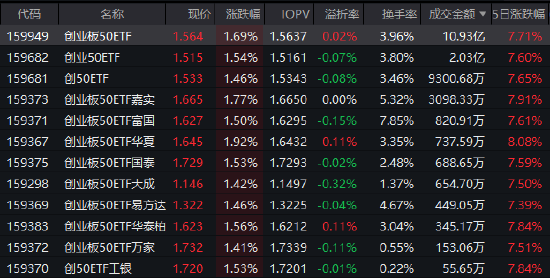
Core Viewpoint - The A-share market experienced a rebound, with the Shanghai Composite Index reclaiming the 4000-point mark and the ChiNext Index showing a significant increase, indicating positive market sentiment and potential investment opportunities in the technology sector [1][2]. Market Performance - On October 29, the ChiNext 50 ETF (159949) rose by 1.69% to 1.564 CNY, with a trading volume of 10.93 billion CNY, leading among similar ETFs in terms of transaction scale [1][4]. - The ETF's turnover rate was recorded at 3.96%, reflecting active trading interest [4]. Fund Flow - The ChiNext 50 ETF has shifted from net outflows to net inflows recently, with a total circulating scale of 271.20 billion CNY as of October 28, 2025 [2]. - Over the past 60 trading days, the ETF saw a cumulative net outflow of approximately 72 billion CNY, but in the last 5 trading days, it recorded a net inflow of 4.827 million CNY [2]. Holdings Analysis - The top ten holdings of the ChiNext 50 ETF predominantly showed price increases, with significant positions in companies like CATL, Zhongji Xuchuang, and Dongfang Wealth, among others [5]. - The total market value of the top ten holdings amounted to approximately 20.07 billion CNY, accounting for 69.35% of the ETF's total stock value [5]. Future Outlook - The fund manager's report indicates a cautious outlook due to weakening global economic growth and increasing trade barriers, particularly in the technology sector [6]. - However, there is a long-term positive trend towards high-end manufacturing, modern services, and innovation-driven industries, with significant growth potential in sectors such as information technology, new energy, and biomedicine [6]. - The ChiNext 50 ETF is positioned as a convenient investment tool for those optimistic about the long-term growth of China's technology sector, with recommendations for investors to adopt systematic investment strategies to mitigate short-term volatility [6].






省份工业三季报 轮到中部“上分”了?
Mei Ri Jing Ji Xin Wen· 2025-10-28 17:35
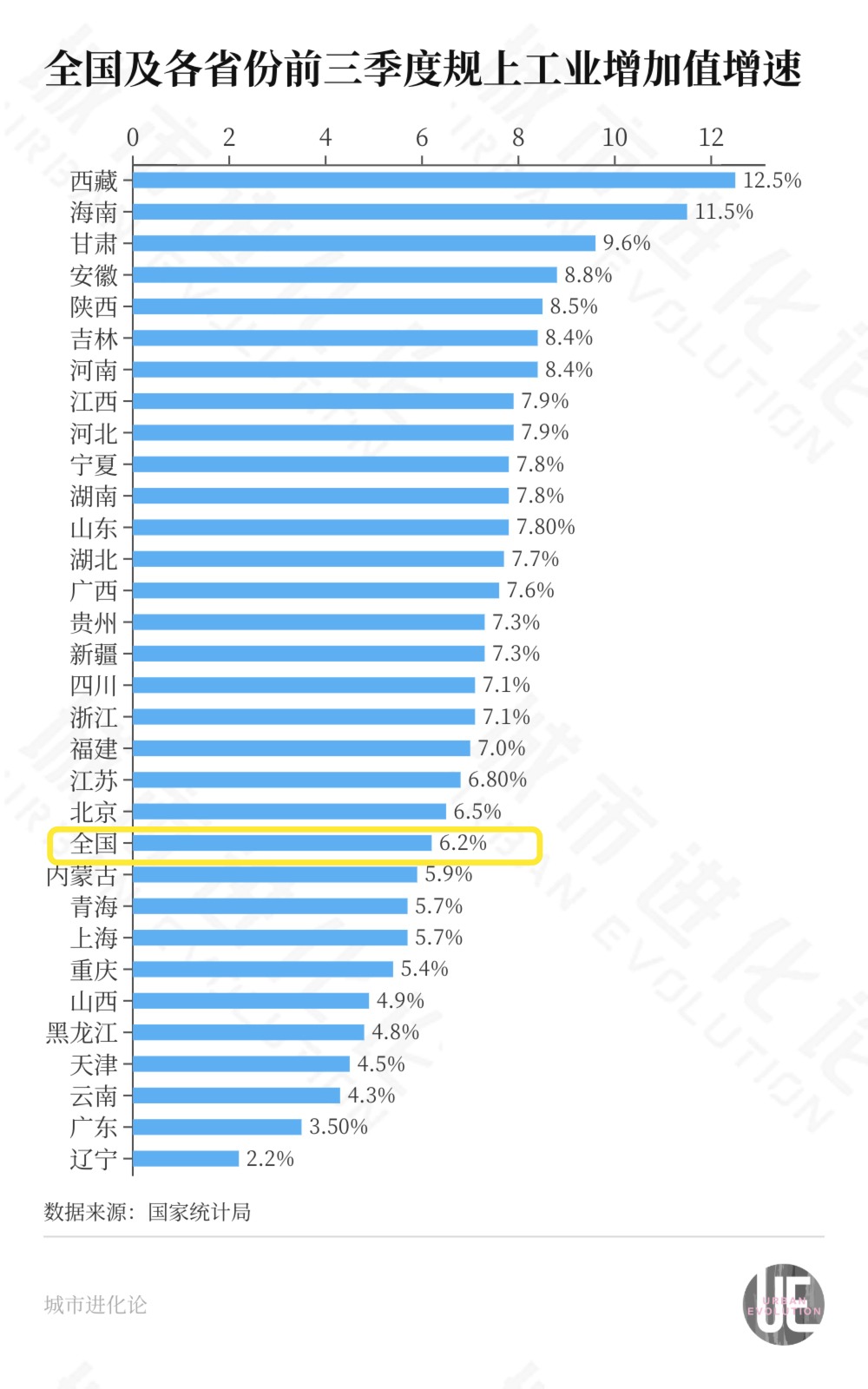
Core Insights - The article highlights the significant changes in China's industrial landscape as the country approaches the end of the "14th Five-Year Plan," with 21 provinces surpassing the national average industrial value-added growth rate of 6.2% [1][3] - Among the top ten economic provinces, Henan leads with an 8.4% growth rate in industrial value-added, driven primarily by the automotive industry, particularly in the new energy vehicle sector [3][4] Economic Performance - In the first three quarters, Anhui's industrial value-added grew by 8.8%, positioning it as a strong contender to break into the top ten economic provinces [3][5] - Jilin's industrial value-added increased by 8.4%, contrasting sharply with Liaoning's 2.2% growth, which is the lowest in the country [3][13] Industry Dynamics - The automotive and new energy vehicle sectors are pivotal in driving industrial growth in provinces like Henan and Anhui, with Henan's automotive industry growing by 20.0% and new energy vehicles by 19.3% [4][5] - In contrast, Liaoning's traditional fuel vehicle industry is under pressure, with a 10.1% decline in production, highlighting the need for industrial transformation [15] Strategic Initiatives - The national "15th Five-Year Plan" emphasizes building a modern industrial system and strengthening the manufacturing sector, which will influence provincial industrial strategies [3][10] - Shandong and Hunan are focusing on digital transformation and upgrading traditional industries to find new growth points, with Shandong implementing numerous technology upgrade projects [11][12] Future Outlook - Jilin's industrial investment is on the rise, with a 2.7% increase in the first three quarters, indicating a positive trajectory for future growth [14] - Liaoning aims for a 4.5% growth target in industrial value-added by 2025, despite current challenges [16]

慈星股份2025年前三季度“夯实”传统业务并在车用纺织领域取得突破
Zheng Quan Ri Bao Wang· 2025-10-28 13:43
Core Insights - Ningbo Cixing Co., Ltd. reported a revenue of 1.489 billion yuan and a net profit attributable to shareholders of 122 million yuan for the first three quarters of 2025, demonstrating resilience amid macroeconomic challenges and industry cyclicality [1] - The company has strategically adjusted its low-end product lines while maintaining strong performance in traditional computer knitting and shoe upper machine businesses, which have seen growth despite industry headwinds [1] - Significant breakthroughs have been made in new application areas, particularly in automotive textiles, with innovative knitted products successfully entering the supply chain of a well-known domestic car manufacturer [1] Financial Performance - Revenue for the first three quarters reached 1.489 billion yuan [1] - Net profit attributable to shareholders was 122 million yuan [1] - Net profit excluding non-recurring items was 96.2368 million yuan [1] Strategic Initiatives - The company is undergoing a critical period of new and old energy conversion, focusing on R&D investment and customer orientation to strengthen core businesses and innovate [2] - Regional research institutes have been established in key industrial clusters to enhance customer service efficiency and local responsiveness [2] - A research center has been set up in Shanghai to focus on fashion design needs and promote research outcomes to various regional institutions and clients [2] Market Engagement - The company is enhancing market interaction through participation in domestic and international professional exhibitions, showcasing representative knitting equipment products [2] - Efforts are being made to optimize the agent structure and business team management to improve overall market response speed [2]

山东昌邑:攻坚突破 助力工业经济稳进向好
Zhong Guo Jing Ji Wang· 2025-10-28 07:56
今年以来,昌邑市深化"项目建设攻坚年",系统谋划、精准发力,以全流程服务提速项目落地,印发 《关于全力抓好2025年市级重大重点项目建设的通知》,构建起市级领导帮包、部门协同、上下联动的 项目推进机制,从项目签约到投产所有环节精细化服务、所有问题直通党政主官,全流程全链条提速。 为加快建设达效,该市实行"红黄绿"挂牌管理,制定《化工行业投资项目落户服务机制》,通过组织各 职能部门及相关镇街召开化工项目手续办理推进会,明确69个重点项目责任分工与办理时限,涉及219 项审批手续、24个责任单位。创新采用"容缺预审+并联办理"模式,打破部门壁垒,目前已在规定时间 内完成147项手续办理,整改完成7项,办结率达99.4%。 营商环境的优化同样体现在日常服务的点滴之中。在昌邑市的政务服务中心大厅,专门设立企业开办服 务专区,创新推行"邑企工作日"服务模式,重点企业还配备上了"金牌管家",提供企业开办、准营、变 更、注销等涉企事项的咨询指导等一对一"保姆式"服务。昌邑市坚持"邑心为企"服务理念,建立服务企 业"快速通道"和解决问题"绿色通道",对重点项目优先保障、优先服务,审批效能提升60%以上、新设 市场主体0.5个 ...
看“十四五”山东答卷:经济总量将跨上10万亿大台阶
Zhong Guo Fa Zhan Wang· 2025-10-28 07:08
Economic Growth and Development - Shandong Province is on track to surpass a GDP of 10 trillion yuan, with GDP expected to grow from 7.44 trillion yuan in 2020 to 9.86 trillion yuan by 2024, increasing its share of the national economy from 7.19% to 7.31% [1] - The average annual GDP growth rate for the first four years of the 14th Five-Year Plan is 6.1%, exceeding the planned target by 0.6 percentage points [2] Human Development Indicators - Per capita GDP is projected to rise from 73,400 yuan in 2020 to 97,600 yuan in 2024, while the urban-rural income ratio has improved from 2.33 to 2.14 [2] - The average years of education for the working-age population increased from 10.8 to 11.44 years, and life expectancy rose from 79.1 to 80.5 years [2] Innovation and Technology - Shandong has established a national laboratory in the marine field and has integrated two major scientific facilities into the national infrastructure layout, accounting for nearly 1/7 of the national total [3] - The province has 222 national-level enterprise technology centers, leading the nation, with enterprise R&D investment making up 88.4% of total social R&D investment [3] Manufacturing and Industry - The proportion of high-tech industry output in the industrial sector increased from 45.1% in 2020 to 55.2% in the first half of this year [4] - Shandong has seven national-level strategic emerging industry clusters and 235 manufacturing champions, both the highest in the country [4] Energy Transition - Non-fossil energy generation capacity reached 134 million kilowatts, accounting for 53.4% of total capacity, a 22.6 percentage point increase since 2020 [5] - The province is expected to generate over 210 billion kilowatt-hours from non-fossil sources this year, significantly reducing carbon emissions [5] Regional Development and Urbanization - The Shandong Peninsula urban agglomeration has seen its overall competitiveness improve, with three cities surpassing a GDP of 1 trillion yuan [7] - The province has maintained a stable grain production of over 110 billion jin for four consecutive years, reinforcing its agricultural strength [7] Marine Economy - The marine economy's output is projected to grow from 1.3 trillion yuan in 2020 to 1.8 trillion yuan by 2024, increasing its share of the national marine economy from 16.6% to 17.1% [8] - Shandong has launched significant marine projects, including the world's first 10,000-ton aquaculture vessel [8] Reform and Opening Up - Shandong has implemented a "no proof province" initiative, achieving a 90% online service rate for government affairs [9] - The province's foreign trade is expected to reach 3.38 trillion yuan in 2024, more than 1.5 times that of 2020, with exports surpassing 2 trillion yuan for the first time [10] Social Welfare and Public Services - Social spending is projected to exceed 1 trillion yuan in 2024, with urban employment consistently exceeding 1.2 million annually [11] - The province has achieved a 90% direct settlement rate for medical services across regions, enhancing healthcare accessibility [11]
“粮食安全看山东”之广饶:“引凤筑巢”赋能粮食产业高质量发展
Zhong Guo Fa Zhan Wang· 2025-10-27 08:03
Core Insights - Shandong Province's Guangrao County has successfully transformed its grain industry from a quantity-focused model to a quality and efficiency-oriented one, ensuring high-quality economic development and regional food security [1][5] Group 1: Mechanism and Environment - Guangrao County has established a comprehensive support system for grain industry development, focusing on food security and implementing a phased approach to the "Quality Grain Project" [2] - The county has optimized its business environment by forming a grain industry chamber of commerce and facilitating deep cooperation between local enterprises and major groups like COFCO [2] - Financial support has been significant, with over 200 million yuan in annual financing assistance to local enterprises, helping them grow into provincial agricultural industrialization leaders [2] Group 2: Investment and Project Development - The county has leveraged government funding to attract social capital, with total investments in quality grain projects reaching 110 million yuan, including 33 million yuan from the government and 74.56 million yuan from private sources [3] - Key projects include a smart trading cloud platform and logistics upgrades, with total investments of 176 million yuan, contributing to the growth of a grain industry cluster [3] - The annual processing capacity of flour processing enterprises in the county has reached 938,000 tons, with actual production exceeding 400,000 tons, indicating a robust industry dynamic [3] Group 3: Service and Win-Win Outcomes - Guangrao County has implemented precise services to benefit both farmers and enterprises, with post-harvest service centers achieving significant processing and storage capabilities [4] - The county's leading enterprises have adopted a "company + base + farmer" model, securing purchase agreements for 170,000 tons of wheat, enhancing farmers' income by 35 million yuan [4] - Guangrao County has established a strong grain logistics trade network, collaborating with major companies to reinforce food security [4]