产业升级

Search documents
首超20万亿美元!我国去年GDP超140万亿人民币,增长率5%利好多多
Sou Hu Cai Jing· 2026-01-30 08:08
Economic Overview - In 2025, China's economy demonstrated resilience and growth amidst global economic challenges, achieving a GDP of 140 trillion RMB (over 20 trillion USD) [3][11] - The economic growth rate of 5% is significant given the complex international environment, showcasing China's strong resilience and potential [5][10] Structural Changes - A notable shift in the economic drivers is observed, moving away from real estate and infrastructure towards high-tech manufacturing [7][8] - High-tech manufacturing saw a value-added growth of 9.4%, outpacing overall industrial growth by 3.5 percentage points, indicating a transition to technology-driven and smart manufacturing [8] Digital Economy - The information transmission, software services, and leasing business services sectors are thriving, contributing to economic vitality and changing the economic structure [10] - The digital economy, including short videos, food delivery apps, and mobile games, is becoming a new engine for growth, reflecting China's adaptation to modern economic trends [10] Income and Employment - In 2025, the per capita disposable income reached 43,377 RMB, with a real growth of 5.0%, indicating equitable distribution of economic gains [10] - The urban unemployment rate averaged 5.2%, with new job creation comparable to the labor force of a medium-sized city, highlighting employment stability [10] Trade and Global Positioning - China's total import and export volume reached 45.4687 trillion RMB, growing by 3.8%, solidifying its role as a key hub in global trade [11] - The share of private enterprises in imports and exports increased to 57.3%, showcasing the vibrancy and resilience of the Chinese economy [12] Future Outlook - The achievement of 140 trillion RMB is seen as a new starting point, indicating China's ability to withstand external risks and pursue transformation [12] - The future economic growth is expected to be driven by new energy, artificial intelligence, a unified national market, and the evolving consumption demands of 1.4 billion people [12]


国机精工(002046) - 002046国机精工投资者关系管理信息20260130
2026-01-30 07:46
Company Overview - The history of Guoji Precision Engineering dates back to 1958 with the establishment of the Luoyang Bearing Research Institute and Zhengzhou Abrasives Research Institute, and it was listed on the Shenzhen Stock Exchange in 2005 [2][3] - The company focuses on precision manufacturing, driven by technological innovation, providing key products, technologies, and services that meet national strategic needs [2][3] Business Segments and Applications - Guoji Precision operates in five major sectors: new materials, basic components, machine tools, high-end equipment, and supply chain management, with applications in aerospace, military, electronics, renewable energy, high-end machine tools, and automotive industries [2][3] - The company has achieved significant technological advancements, with over 2,400 research outcomes and 1,076 national and industry standards established [3] Financial Performance - In the first three quarters of 2025, the company reported a revenue of CNY 2.296 billion, a year-on-year increase of 27%, driven primarily by the growth in wind power bearing business [3][4] - Gross profit reached CNY 797 million, up 20% year-on-year, while net profit was CNY 245 million, reflecting a 15.4% increase [3][4] Business Highlights Bearing Business - The special bearing segment is a key driver of profit growth, with a market share of over 90% in the aerospace sector [4][9] - The wind power bearing business has shown strong growth, with the successful development of high-capacity bearings [4][9] Abrasives Business - The superhard materials segment continues to grow, with significant contributions from semiconductor applications [5][9] - The company has achieved breakthroughs in diamond functional applications, which are expected to be a new source of profit [5][9] Strategic Focus and Future Outlook - The company aims to consolidate its existing advantages in bearings and abrasives while exploring new high-growth areas such as commercial aerospace and humanoid robotics [8][9] - A long-term shareholder return plan is in place, targeting a dividend payout ratio of no less than 40% [8][9] Governance and Investor Relations - Guoji Precision emphasizes transparency in governance and investor relations, establishing a trust system that includes information disclosure and ESG governance [9][10] - The company has been recognized as a model enterprise for reform and innovation by the State-owned Assets Supervision and Administration Commission for four consecutive years [6][9]

展现中国智造、消费新机遇:深市8公司亮相香港路演
2 1 Shi Ji Jing Ji Bao Dao· 2026-01-30 06:59
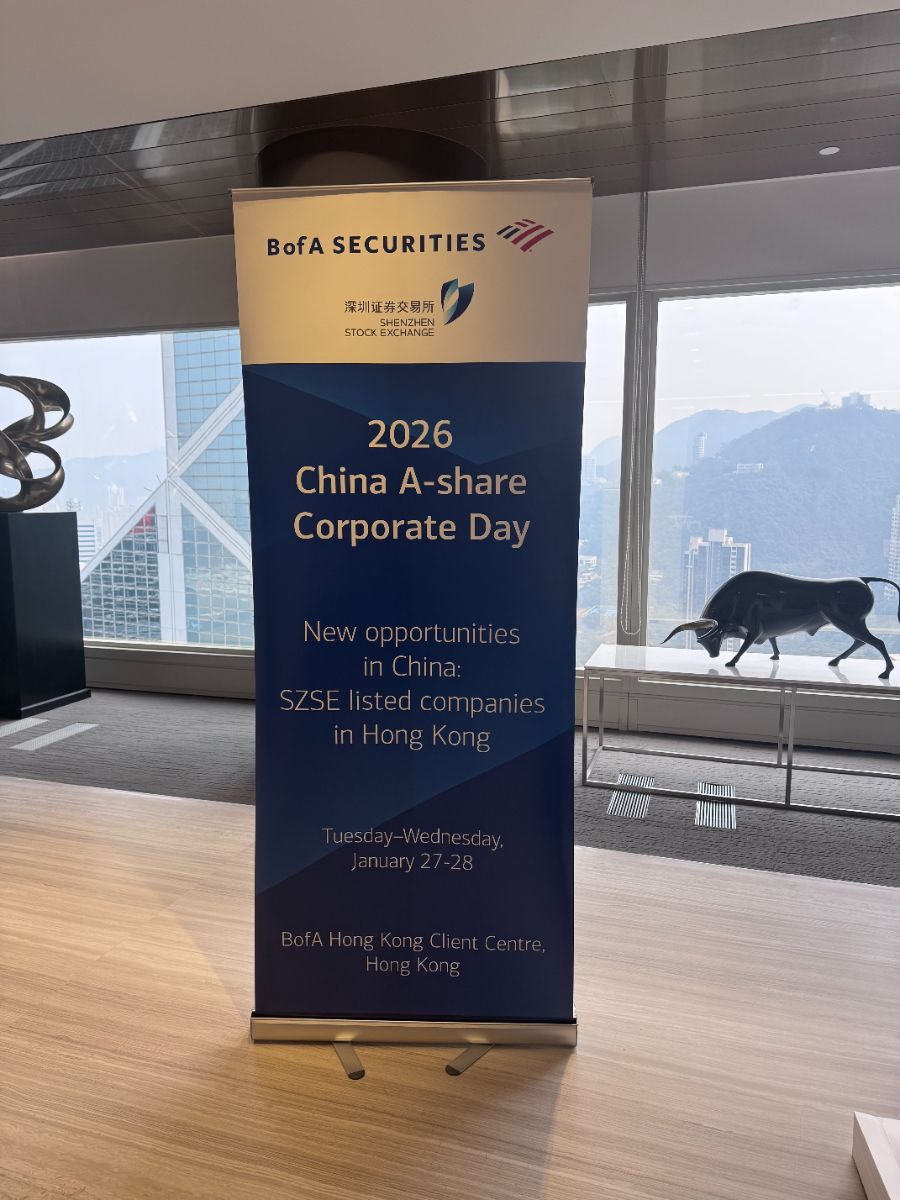
Group 1: Event Overview - The Shenzhen Stock Exchange held a special roadshow in Hong Kong titled "Investing in New Opportunities in China," featuring eight listed companies from the Shenzhen market [1] - The event aimed to showcase the investment value of high-quality assets in Shenzhen and the industrial upgrades of these companies to overseas asset management institutions [1] - Since 2023, the Shenzhen Stock Exchange has organized overseas roadshows covering 14 countries and regions, connecting over 2,000 foreign institutional investors [1] Group 2: Company Highlights - Juxing Technology operates 23 production bases globally, with over 95% of its revenue coming from overseas, making it a major supplier for top global retailers [7] - Yilian Network maintains a global market share of over 95% in SIP phones and ranks among the top five in video conferencing systems, benefiting from a dynamic order allocation mechanism [7] - Changying Precision is expanding its production bases in Vietnam and Mexico to meet the diversified supply chain needs of major clients like Apple and CATL [7] - Shenghong Technology is leading the market with advanced materials and technologies, focusing on AI-related products and sustainable development strategies [7][8] Group 3: Consumer Sector Insights - Yunnan Baiyao is projected to exceed 40 billion yuan in revenue in 2024, with a net profit of 4.75 billion yuan, showcasing a strong dividend policy and brand strength [8] - Salted Fish has established a closed-loop system for product development, achieving a rapid iteration cycle and a return on equity of 40.9%, attracting significant foreign investor interest [8] Group 4: Investor Sentiment and Future Outlook - Foreign investors remain optimistic about the Chinese stock market, anticipating a sustainable growth cycle driven by improving fundamentals and long-term growth potential [9] - The "14th Five-Year Plan" emphasizes increasing domestic consumption and technological self-reliance, which may lead to new growth opportunities in the consumer sector and for companies with strong R&D capabilities [9] - The Shenzhen Stock Exchange plans to enhance services for overseas investors and facilitate cross-border investment activities to support domestic and international economic circulation [9]
民生保障、产业升级、乡村振兴 重庆两会“委员通道”传递发展信心
Zhong Guo Xin Wen Wang· 2026-01-30 06:51
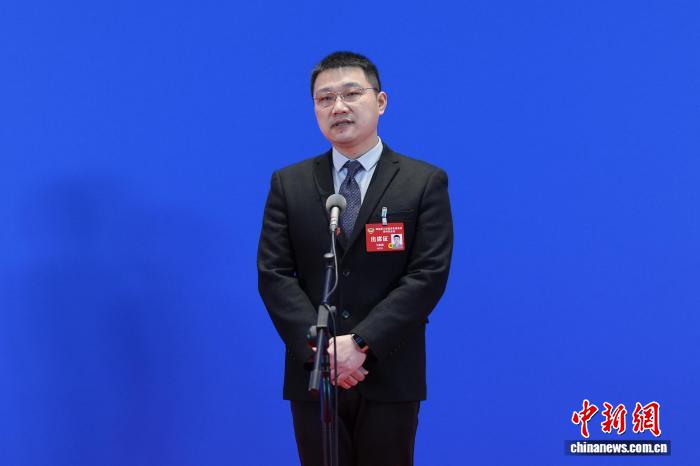
Group 1 - The Chongqing Municipal Political Consultative Conference emphasizes high-quality development and modernized construction of a new Chongqing, showcasing confidence through personal experiences shared by committee members [1][3] - The rise of the platform economy has integrated new employment groups such as delivery riders and ride-hailing drivers into daily life, with the government implementing 64 customized care projects for these groups over the past year [1][3] - The service work for new employment groups has evolved from basic safety nets to comprehensive quality improvements, with over 6,500 service stations established [1] Group 2 - The "public welfare + business" model adopted by the Chongqing Liangjiang New Area Happiness Plus Social Work Service Center has provided over 25,000 services including job matching and skills training for new employment groups in 2025 [3][5] - The Zongshen Industrial Group, founded in 1982, has successfully navigated multiple economic cycles while transitioning towards high-end, green, digital, and international manufacturing [5] - Zongshen's motorcycle production ranks first in China, and its non-handheld machinery has become a global leader, showcasing the company's confidence in future manufacturing trends [5] Group 3 - The Liangping District has successfully integrated agricultural and tourism sectors through the promotion of Liangping pomelo, enhancing both economic value and ecological aesthetics [7] - The district attracts over 6 million tourists annually, generating a comprehensive income of 800 million yuan from rural tourism, demonstrating effective urban-rural integration [7] - The transformation of traditional agriculture into a thriving tourism model illustrates the potential for rural revitalization and economic growth [7]
宁夏平罗:固定资产投资领跑经济高质量发展
Zhong Guo Jing Ji Wang· 2026-01-30 06:28
近日,从宁夏石嘴山市平罗县了解到,2025年平罗县固定资产投资、现代农业、财政收入三大支柱共同 发力,支撑县域经济实现稳中向好。其中,固定资产投资同比增长54%,增速位居宁夏22个县区首位。 现代农业成果丰硕,平罗县2025年实现农林牧渔业总产值64.5亿元,同比增长6.9%,农业增加值34.3亿 元。粮食总产量达39.07万吨,连续四年领跑全区,实现"二十二连丰"。完成4628亩盐碱地改良,三大 粮食作物全程机械化率达95%以上。 2025年,平罗县项目建设全面发力,110个重点建设项目全部开工,覆盖产业升级、基础设施、社会民 生等领域,形成强劲投资拉动。投资结构持续优化。传统产业升级加速,特色合金、电石化工等行业转 型升级,贝利特获评氰胺产业"链主"企业;50个延链补链项目增强产业发展韧性。新动能培育效果明 显,新认定国家高新技术企业9家、创新标杆企业5家、雏鹰企业3家;登记科技成果34项,技术合同交 易额突破2.1亿元,一批科技创新成果落地。 2025年,平罗县一般公共预算收入9.34亿元,增长6.8%。全年争取各类政策性资金43.2亿元,其中"两 债一资金"规模达13.45亿元,同比增长1.7倍,创历 ...
长沙国资纾困助力转型 友阿股份双主业开辟增长新航道
Zheng Quan Ri Bao· 2026-01-30 05:06
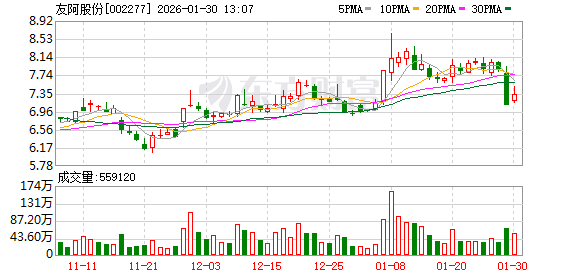
Core Viewpoint - Hunan Friendship Apollo Commercial Co., Ltd. (hereinafter referred to as "Friendship Shares") is expected to report a net loss of 250 million to 372 million yuan for the year 2025, primarily due to asset impairment and credit impairment losses totaling 260 million to 370 million yuan [2] Group 1: Financial Performance and Support - The actual controller of Friendship Shares, Hu Zijing, has pledged 14.375% of his shares in the controlling shareholder, Hunan Friendship Apollo Holdings Co., Ltd. (hereinafter referred to as "Friendship Holdings"), to Changsha State-owned Assets Industry Holding Group Co., Ltd. (hereinafter referred to as "Changsha State Control") as a guarantee for loans [3] - Changsha State Control, as the largest shareholder with 28.25% of Friendship Holdings, aims to alleviate short-term liquidity pressure and stabilize operations through this support [3] Group 2: Strategic Transformation - Friendship Shares is pursuing an acquisition of Shenzhen Shangyangtong Technology Co., Ltd. (hereinafter referred to as "Shangyangtong") to establish a dual-main business layout, which is seen as a new growth engine for the company [3][4] - Shangyangtong, recognized as a national high-tech enterprise, has shown strong growth with a 27.88% year-on-year increase in revenue and a 58.09% increase in net profit attributable to shareholders in the first half of 2025 [4] Group 3: Industry Context and Future Outlook - The global power semiconductor market is projected to reach 488.6 billion yuan by 2029, driven by demand in AI computing, new energy, and industrial automation [4] - The dual-main business strategy of Friendship Shares addresses current challenges in the retail sector while maintaining a refined operational strategy in its retail business [5] - The transition from retail to semiconductor presents integration challenges, but aligns with national industrial upgrade strategies and market trends, positioning the company for a potential turnaround and value reconstruction [6]

陕西:能源化工产业答卷亮眼
Zhong Guo Hua Gong Bao· 2026-01-30 02:27
Core Viewpoint - The article highlights the significant advancements in Shaanxi's energy and chemical industry during the "14th Five-Year Plan" period, emphasizing the province's role in modernizing China's industrial system and its strategic importance in energy security [1][4]. Group 1: Industrial Development - Shaanxi has focused on building a modern industrial system, leading to the transformation and upgrading of traditional industries and the rapid rise of emerging industries [1]. - Major projects such as the 800,000 tons/year ethylene production from ethane cracking and the 1.5 million tons/year clean and efficient coal conversion project have been completed, contributing to an increase in coal-based chemical product capacity by over 8 million tons/year and generating nearly 50 billion yuan in output value [2]. - The province is transitioning from a raw material base to a materials base, diversifying its product offerings and moving from upstream to downstream in the industrial chain [2]. Group 2: Technological Innovation - Shaanxi has prioritized technological innovation, achieving breakthroughs in various fields, including new materials and renewable energy, which support national projects like the "Shenzhou" space missions and "Beidou" satellite network [3]. - The province has developed 12 globally first-of-a-kind technologies and 16 domestically first-of-a-kind technologies in the energy and chemical sectors, showcasing its competitive edge [3]. - Key technologies such as the world's highest efficiency for HIBC solar cells and advancements in carbon capture and storage (CCS) have been achieved, positioning Shaanxi as a leader in these areas [3][5]. Group 3: Regional Development and Coordination - Shaanxi has enhanced regional development by promoting innovation in the Guanzhong area, energy transformation in northern Shaanxi, and ecological upgrades in southern Shaanxi [4]. - The energy supply capacity in northern Shaanxi has significantly increased, with coal production reaching 680 million tons and natural gas production at 35.3 billion cubic meters, marking growth rates of 19.4% and 28.5% respectively compared to the end of the "13th Five-Year Plan" [4]. - The establishment of a 2 billion yuan innovation fund and a 10 square kilometer pilot base in Yulin demonstrates the province's commitment to fostering technological innovation and industrial demonstration [4]. Group 4: Environmental Sustainability - Shaanxi's energy and chemical enterprises are committed to reducing carbon emissions through various projects, including carbon capture, utilization, and storage (CCUS) initiatives [5]. - The successful pilot test of a 4 million tons/year CCS project marks a significant milestone in the large-scale application of modern coal chemical engineering in China [5].
2026年中国花洒进入壁垒、产业链及供需现状洞悉:行业从价格竞争转向价值竞争[图]
Chan Ye Xin Xi Wang· 2026-01-30 01:58
Industry Overview - The showerhead, also known as a lotus head, is a common bathroom fixture that connects to water pipes and features multiple holes for water flow. It is a core category in the bathroom industry, combining practicality and widespread use [1][3] - The main types of showerheads currently available include handheld, overhead, and side spray options, catering to various showering needs [1][3] - By 2025, China's showerhead production is projected to reach 22,765 million units, with a total demand of 13,751 million units. The demand for showerheads that accompany shower systems is estimated at 8,056 million units, while standalone showerheads will account for 5,695 million units. The former represents approximately 58.6% of total demand, and the latter about 41.4% [10][11] Market Dynamics - The overall market supply and demand structure is relatively stable, with a slight differentiation in demand reflecting various consumer scenarios [10][11] - The market size for showerheads is influenced by factors such as consumption upgrades, policies for renovating old kitchens and bathrooms, and the implementation of water-saving product standards [12][13] - The market size is expected to reach 4.237 billion yuan by 2025, a decrease of 5.6% compared to 2024 [12][13] Industry Barriers - The entry barriers in China's showerhead industry are primarily related to technology research and development, supply chain integration, and quality compliance. Companies must master core technologies such as water-saving and temperature control, establish stable supply chains, and achieve various safety certifications [4][5] - The domestic bathroom consumption market heavily relies on brand recognition and established distribution channels, making it challenging for new brands to gain market trust and establish partnerships [4][5] Industry Chain - The upstream of the showerhead industry consists of suppliers of various raw materials such as aluminum, steel, plastics, rubber, and ceramics, providing essential materials for production [8][9] - The midstream includes well-known manufacturers like Jiumu, Hansgrohe, Kohler, and Arrow, responsible for the design and manufacturing of showerhead products [8][9] - The downstream encompasses channels such as home decoration and renovation, facilitating market delivery and end-user consumption of showerhead products [8][9] Competitive Landscape - The leading companies in the showerhead industry include both international brands and domestic leaders, with market power derived from brand premium, technology development, and channel layout [15][16] - International brands like Kohler maintain a strong position in the high-end market through technological advantages and global marketing systems, while domestic leaders like Arrow and Jiumu leverage local advantages to penetrate the mid-to-high-end market [15][16] Development Trends - Consumer upgrades and high expectations for bathroom experiences are driving continuous product upgrades in the showerhead market. Companies are increasing R&D investments to integrate water-saving technologies, smart features, and antibacterial materials into their products [18][19] - The market share of mid-to-high-end products is gradually increasing, leading to a stable rise in industry average prices. Technological iteration and scenario-based innovation are becoming core competitive advantages [18][19] - Leading domestic showerhead companies are transitioning from OEM models to developing their own brands for international markets, enhancing their global presence and industry influence [19]

2026年山西推出629项省级重点工程,总投资超2.4万亿元
Zhong Guo Xin Wen Wang· 2026-01-30 01:00
Core Insights - The financing promotion conference for key provincial projects and private investment in Shanxi was held on January 29, 2026, aimed at injecting financial momentum for stable growth and supporting high-quality development in the province [1] Group 1: Key Projects and Investments - Shanxi plans to launch 629 key provincial projects in 2026, with a total investment exceeding 2.4 trillion yuan and an annual planned investment of 282.93 billion yuan [1] - The projects include foundational engineering for long-term development, livelihood-enhancing projects, and high-quality carriers for industrial upgrades, positioning them as "potential stocks for Shanxi's transformation" [1] - The projects cover five major areas, including energy transition and industrial upgrades, with 309 energy transition projects planned, requiring an investment of 109.04 billion yuan, where projects with investments over 500 million yuan account for over 60% [1] Group 2: Private Investment and Financing Needs - The Shanxi Provincial Bureau of Private Economy highlighted 41 private investment projects with a financing demand of approximately 16.5 billion yuan [1] - The province has been promoting cooperation between government, banks, and enterprises to guide financial resources towards key projects and industries [1] - The conference is part of Shanxi's "Major Project Construction Year Action," aimed at providing solid support for the start of the 14th Five-Year Plan [1]
海外资金 大幅加仓中国资产
Shang Hai Zheng Quan Bao· 2026-01-29 23:22
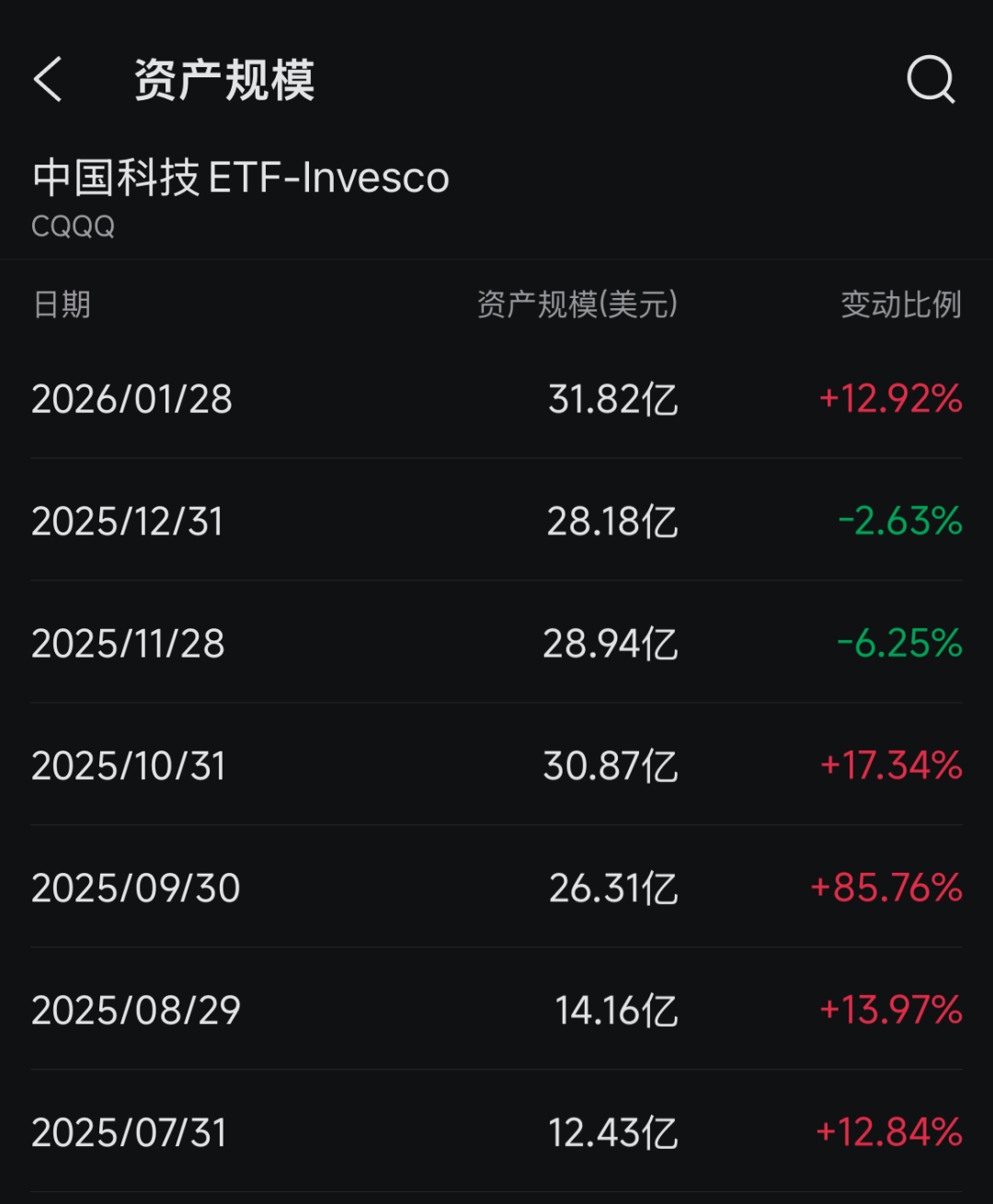
Group 1 - Significant inflow of overseas funds into Chinese assets has been observed since the beginning of 2026, particularly favoring technology-related assets [2][7] - In the month leading up to January 14, global funds saw a net inflow of $105.52 billion into stock funds, with Chinese mainland stock funds receiving a net inflow of $16.66 billion [2] - The Invesco China Technology ETF's asset size reached $3.182 billion as of January 28, 2026, marking a nearly 13% increase from $2.818 billion at the end of 2025 [4][5] Group 2 - The KraneShares CSI China Internet ETF's asset size was $8.699 billion as of January 27, 2026, reflecting an 8.51% increase from $8.017 billion at the end of 2025 [5] - The Rayliant ChinaAMC Transformative China Tech ETF saw its size grow to $18.1726 million as of January 27, 2026, a nearly 30% increase from $13.984 million at the end of 2025 [6] - Major asset management firms like Franklin Templeton, Invesco, and Morgan Asset Management express optimism about the Chinese stock market's valuation and potential for further upward movement in 2026 [7][8] Group 3 - Key investment opportunities identified for 2026 include the consumer electronics sector, lithium battery supply chain, financial sector, and emerging fields related to domestic demand expansion [8] - The consumer electronics sector is expected to remain in a major innovation cycle, with leading companies' valuations at historically low levels [8] - The lithium battery industry is anticipated to see growth in demand due to favorable policies supporting the domestic electric vehicle market [8]