
智能汽车

Search documents
浙江世宝涨2.05%,成交额2.24亿元,主力资金净流出228.52万元
Xin Lang Zheng Quan· 2025-10-29 03:07
Group 1 - The core viewpoint of the news is that Zhejiang Shibao has shown a significant increase in stock price and financial performance, indicating a positive trend in the automotive parts industry [1][2]. - As of October 29, Zhejiang Shibao's stock price rose by 2.05% to 13.93 CNY per share, with a total market capitalization of 11.459 billion CNY [1]. - The company has experienced a year-to-date stock price increase of 23.17%, with a recent 4.82% rise over the last five trading days [1]. Group 2 - Zhejiang Shibao's main business involves the research, design, manufacturing, and sales of automotive steering systems and key components, with 95.55% of revenue coming from steering systems and components [1][2]. - For the period from January to September 2025, Zhejiang Shibao achieved a revenue of 2.462 billion CNY, representing a year-on-year growth of 35.44%, and a net profit of 150 million CNY, up 33.66% year-on-year [2]. - The company has distributed a total of 209 million CNY in dividends since its A-share listing, with 69.36 million CNY distributed over the past three years [3].

腾势N8L正式上市:全系标配易三方、云辇-A,售价29.98万元起
Xin Lang Ke Ji· 2025-10-29 02:17
Core Points - The Tengshi N8L has officially launched, positioned as a large six-seat luxury SUV, with a price range of 299,800 to 329,800 yuan [1] - The vehicle features six core technologies for a smart travel experience, including a powerful hybrid powertrain and advanced safety systems [2][3] Design and Specifications - The dimensions of the Tengshi N8L are 5200mm in length, 1999mm in width, and 1820mm in height, with a spacious interior design [1] - The interior includes high-quality materials and a customizable seating arrangement for various family scenarios, featuring 49 storage spaces and a 51L hidden storage box [1] Performance and Safety - The N8L is equipped with a hybrid power system that includes a 2.0T efficient engine and three electric motors, achieving a 0-100 km/h acceleration in 3.9 seconds [1] - The vehicle's braking system features a six-piston caliper, providing a stopping distance of 35.4 meters, and it has a turning radius of 4.58 meters [1] - Safety features include a body made from 2000MPa hot-formed steel, nine airbags, and advanced active safety technologies that allow for high-speed evasive maneuvers [2] Intelligent Features - The N8L supports various smart features, including a mobile app for vehicle management, smart parking assistance, and OTA updates for additional functionalities [2][3] - Collaborations with brands like Goodbaby and Beilingsong enhance the vehicle's smart ecosystem, allowing for integration with smart home devices [3]
东软集团跌2.07%,成交额5556.13万元,主力资金净流出533.94万元
Xin Lang Cai Jing· 2025-10-29 02:02
Core Points - Dongsoft Group's stock price decreased by 2.07% on October 29, trading at 10.42 CNY per share with a market capitalization of 12.424 billion CNY [1] - The company has experienced a year-to-date stock price decline of 1.88%, with a 5-day drop of 0.86% and a 20-day decline of 3.43%, while showing a 60-day increase of 4.83% [1] - Dongsoft Group has appeared on the stock market's "龙虎榜" three times this year, with the latest occurrence on September 19, where it recorded a net purchase of 1.01 billion CNY [1] Financial Performance - For the period from January to September 2025, Dongsoft Group achieved a revenue of 7.491 billion CNY, reflecting a year-on-year growth of 8.72%, while the net profit attributable to shareholders decreased by 66.47% to 51.0818 million CNY [2] - The company has distributed a total of 1.894 billion CNY in dividends since its A-share listing, with 332 million CNY distributed over the past three years [2] Shareholder Information - As of September 30, 2025, Dongsoft Group had 98,200 shareholders, an increase of 8.72% from the previous period, with an average of 12,145 circulating shares per shareholder, a decrease of 9.15% [2] - The third-largest circulating shareholder is Hong Kong Central Clearing Limited, holding 23.2244 million shares, a decrease of 21.662 million shares from the previous period [2]

特斯拉董事长呼吁批准马斯克万亿薪酬计划 鸿蒙智行全系累计交付突破100万辆 | 汽车早参
Mei Ri Jing Ji Xin Wen· 2025-10-28 22:41
Group 1: Tesla's Executive Compensation Plan - Tesla's chairman, Robyn Denholm, warned shareholders that CEO Elon Musk may leave if his 10-year compensation plan is not approved, which could grant him stock worth approximately $1 trillion [1] - The compensation plan includes challenging phased goals, with Musk potentially receiving 12% of Tesla's stock if he meets all 12 targets, leading to a projected company valuation of $8.5 trillion [1] - Approval of this plan may enhance investor confidence in Tesla's future, while rejection could raise concerns about the company's long-term growth potential [1] Group 2: Automotive Subsidy Policy Adjustments - Shenzhen's automotive replacement subsidy program has been halted due to reaching its budget limit for 2025, indicating the effectiveness of the policy in stimulating consumption [2] - Sichuan province announced a lottery system for automotive replacement subsidies, ensuring fairness while managing limited funds [2] - These policy adjustments reflect strong demand for vehicle replacements, suggesting manufacturers may need to increase promotional efforts to maintain sales growth and address potential inventory pressures [2] Group 3: Xiaoma Zhixing's IPO - Xiaoma Zhixing has initiated its IPO process in Hong Kong, with plans to list on November 6, offering approximately 41.96 million shares at a maximum price of 180 HKD per share [3] - The company has secured cornerstone investors totaling $120 million, indicating strong market confidence in its growth prospects, particularly in the Robotaxi sector, which saw a revenue increase of 178.8% [3] - The dual listing structure (U.S. and Hong Kong) is expected to enhance liquidity and provide a financial foundation for market expansion and technological development [3] Group 4: Hongmeng Zhixing's Milestone - Hongmeng Zhixing announced the delivery of its one-millionth vehicle, achieving this milestone in just 43 months, showcasing rapid growth in the electric vehicle market [4] - The company also reported that its AITO M9 model has set a record for luxury vehicles priced over 500,000 RMB, with total deliveries exceeding 250,000 units in 21 months [4] - This achievement highlights Hongmeng Zhixing's increasing competitiveness in smart driving and related technologies, potentially boosting confidence in the electric vehicle industry as a whole [4]

特斯拉董事长呼吁批准马斯克万亿薪酬计划,鸿蒙智行全系累计交付突破100万辆 | 汽车早参
Mei Ri Jing Ji Xin Wen· 2025-10-28 22:32
Group 1 - Tesla's chairman, Robyn Denholm, warns shareholders that CEO Elon Musk may leave if his $1 trillion compensation plan is not approved, highlighting the company's reliance on Musk's leadership [1] - The compensation plan, announced on September 5, sets ambitious phased goals for Tesla, with Musk potentially receiving 12% of the company's stock if all 12 targets are met, leading to a projected market value of $8.5 trillion [1] - Approval of the compensation plan could boost investor confidence in Tesla's future, while rejection may raise concerns about the company's long-term growth potential [1] Group 2 - Shenzhen's automotive replacement subsidy policy has been halted due to reaching its budget limit, indicating the effectiveness of the policy in stimulating consumption [2] - Sichuan province has implemented a lottery system for automotive replacement subsidies to ensure fairness amid limited funding, with the first lottery scheduled for October 31 [2] - The adjustments in subsidy policies reflect strong demand for vehicle replacements, suggesting that manufacturers may need to increase promotional efforts to maintain sales growth and manage potential inventory pressures [2] Group 3 - Xiaoma Zhixing has launched its IPO in Hong Kong, with shares priced up to 180 HKD, and has secured $120 million from cornerstone investors, indicating strong market interest [3] - The company reported a revenue of $35.43 million in the first half of 2025, a 43.3% year-on-year increase, with its Robotaxi segment seeing a remarkable 178.8% revenue growth [3] - The dual listing in the US and Hong Kong is expected to enhance liquidity and support the company's market expansion and technological development [3] Group 4 - Hongmeng Zhixing announced the delivery of its one-millionth vehicle, marking a significant milestone for Huawei in the smart automotive sector, achieved in just 43 months [4] - The company also reported that its AITO M9 model has set a record for luxury vehicles priced over 500,000 yuan, with total deliveries exceeding 250,000 units in 21 months [4] - This achievement underscores Huawei's rapid growth in the electric vehicle market and its increasing competitiveness in smart driving and related technologies [4]
焕新极氪7X正式上市:全系标配千里浩瀚辅助驾驶系统H7,限时售价21.98万元起
Xin Lang Ke Ji· 2025-10-28 11:41
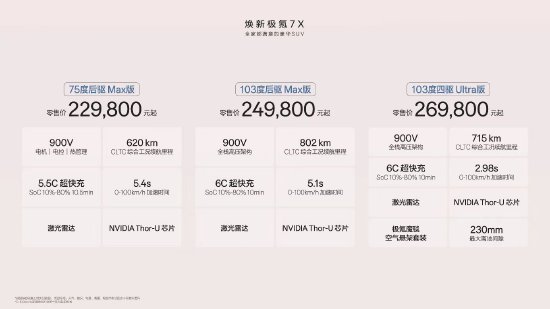
Core Viewpoint - The newly launched ZEEKR 7X positions itself as a luxury family SUV, offering three configurations with competitive pricing and advanced features aimed at enhancing user experience and safety [1][2]. Group 1: Product Launch and Pricing - The ZEEKR 7X has been officially launched with three configurations: 75-degree rear-wheel drive Max version priced at 229,800 yuan, 103-degree rear-wheel drive Max version at 249,800 yuan, and 103-degree four-wheel drive Ultra version at 269,800 yuan. Limited-time prices after trade-in are 219,800 yuan, 239,800 yuan, and 259,800 yuan respectively [1]. - The ZEEKR 7X has become the sales champion for pure electric SUVs priced above 200,000 yuan in China and has expanded to over 20 countries within five months, gaining recognition from 100,000 global families [2]. Group 2: Space and Comfort Features - The ZEEKR 7X features an 83.34% room utilization rate, with a rear legroom of 1187mm and a trunk space of 905L, along with 40 storage compartments [2]. - The second-row seats are equipped with movable sliding tracks and can open to nearly 90 degrees. New features include graphene heating and thermal therapy in the rear [2]. Group 3: Performance and Battery Technology - The ZEEKR 7X is equipped with a 900V motor, control, and thermal management system. The 75kWh battery version can increase its range by 425km with a 10-minute charge, while the 103kWh version achieves a peak charging power of 620kW, with a maximum range of 802km under CLTC conditions [3]. - The four-wheel drive model features a high-performance silicon carbide electric drive system with a peak power of 585kW and a maximum torque of 812N·m, achieving 0-100km/h in as fast as 2.98 seconds [3]. Group 4: Safety and Advanced Technology - The ZEEKR 7X includes 10 safety technologies, such as a reinforced body structure and advanced active safety systems capable of recognizing obstacles and stopping at speeds up to 130km/h [3]. - It is equipped with the Thor-U auxiliary driving chip, laser radar, and the H7 driving assistance system, which incorporates various high-level driving assistance features [4]. The intelligent cockpit includes a 36.21-inch AR-HUD and a 16-inch 3.5K Mini-LED central control screen [4].

AI终端、卫星通信、汽车电子驱动多元增长 信维通信第三季度扣非净利润增长22.06%
Quan Jing Wang· 2025-10-28 11:21
Core Viewpoint - The company has reported a steady growth in revenue and profit, indicating an improvement in profitability and a successful strategic transformation towards becoming a diversified technology solution provider [1] Group 1: Financial Performance - In Q3 2025, the company achieved a revenue of 2.759 billion yuan, a year-on-year increase of 4.20% [1] - The net profit attributable to the parent company, excluding non-recurring items, was 314 million yuan, reflecting a year-on-year growth of 22.06% [1] - The gross margin for the first three quarters was 21.53%, up by 0.73 percentage points compared to the same period last year, while the gross margin for Q3 alone was 25.45%, an increase of 1.69 percentage points year-on-year [1] Group 2: Strategic Transformation - The company is transitioning from a single RF leader to a diversified technology solution provider, focusing on new business areas such as AI terminal hardware, commercial satellites, smart vehicles, data centers, and robotics [1][2] - The company has established a comprehensive product matrix for AI glasses, which is a key area for growth, and has successfully entered the supply chains of well-known brands like Meta [2] Group 3: AI Terminal Business - The company is leveraging its first-mover advantage in AI terminal business to gain additional growth momentum during the recovery phase of consumer electronics [3] - The demand for AI end-side hardware is rapidly increasing, driven by the proliferation of smart devices, which presents significant growth opportunities for the company [2] Group 4: Satellite Communication - The company is positioned to benefit from favorable satellite policies and has developed a product matrix that includes connectors, antennas, and structural components, enhancing its competitive edge in the satellite communication industry [4] - The company has strengthened its leading position in the commercial satellite sector through deepened collaborations with key North American clients [4] Group 5: Automotive Electronics - The rapid penetration of smart connected vehicles has opened up growth opportunities in automotive electronics, with the company establishing a diverse product matrix in this sector [6][7] - The company is actively exploring commercial opportunities in digital keys, wireless communication, and perception technologies within the automotive sector [7] - The company's overseas manufacturing bases in Vietnam and Mexico enhance its global delivery capabilities and cost control, supporting stable supply chains [7] Group 6: Overall Business Outlook - The company's diversified business layout, including consumer electronics, satellite communication, and smart vehicles, is showing initial success, positioning it for sustained growth [7] - Continuous breakthroughs in new industries, clients, technologies, and products are expected to enhance the company's growth certainty as it evolves from a "RF leader" to a "diversified technology solution provider" [7]

拓邦股份(002139) - 拓邦股份投资者关系活动记录表
2025-10-28 10:42
Financial Performance - In the first three quarters of 2025, the company achieved revenue of CNY 8.188 billion, a year-on-year increase of 6.34% [3] - The revenue for Q3 2025 was CNY 2.685 billion, remaining flat year-on-year [3] - The net profit attributable to shareholders was CNY 420 million, a year-on-year decrease of 23.86% [3] - The non-recurring net profit was CNY 396 million, down 26.58% year-on-year [3] - The gross profit margin for the first three quarters was 21.98%, a decrease of 1.73 percentage points year-on-year [3] Cost and Investment - Period expenses increased by CNY 211 million, a growth of 17.94%, mainly due to strategic investments [4] - The increase in expenses included CNY 77 million for stock incentives and employee shareholding plans [4] - The company is focusing on technology R&D and new business layouts, particularly in digital energy, AI, and robotics [4] Market and Business Strategy - The company is implementing a "components + complete machine" dual-engine strategy to strengthen partnerships with leading clients [2] - Digital energy is in a critical market expansion phase, with new products receiving validation and orders in Europe and Asia-Pacific [2] - The smart automotive sector continues to grow rapidly, leveraging technological advantages and customer loyalty [2] Challenges and Outlook - The company faces short-term pressure on profits due to external environment factors, strategic investments, and stock incentive costs [3] - The impact of tariffs on demand is minimal, but they affect delivery and cost structures [5] - As overseas production capacity increases, revenue is expected to recover [5] New Business Developments - The digital energy sector is expected to accelerate growth, with high unit prices anticipated to surpass tools and home appliances [8] - The smart automotive business is gaining momentum, with products like charging stations and laser radar motors showing strong market presence [8] - Robotics is a strategic focus, with products like cooking robots entering mass delivery stages [8] Future Prospects - The company aims to enhance revenue and profitability through strategic cooperation with global leading clients [12] - The release of overseas production capacity and improved operational efficiency are expected to drive growth [12] - The company is committed to focusing on core technologies and expanding into new application scenarios [12]

全球发售1.55亿股,“汽车+机器人Tier1”均胜电子开启港股招股
Quan Jing Wang· 2025-10-28 08:25
Core Viewpoint - Junsheng Electronics officially launched its Hong Kong IPO on October 28, with plans to list on the Hong Kong Stock Exchange under the stock code "0699" on November 6, aiming to become a dual-listed "automotive + robotics Tier 1" leader in both A-share and H-share markets [1] Group 1: IPO Details - The global issuance scale for Junsheng Electronics is set at 155 million H-shares, with 15.51 million H-shares available for public offering in Hong Kong and approximately 140 million H-shares for international offering, subject to adjustments based on demand and over-allotment options [1] - The maximum offer price is set at HKD 23.60 per share [1] Group 2: Company Overview - Established in 2004, Junsheng Electronics focuses on automotive electronics and safety, providing cross-domain solutions for OEM clients across key automotive domains including cockpit, intelligent driving, connectivity, power, and body [1] - By 2024 revenue projections, Junsheng Electronics ranks 41st among global automotive parts companies, is the second largest in China, and the fourth largest globally in intelligent cockpit domain control systems, as well as the second largest in the automotive passive safety sector [1] Group 3: Use of Proceeds - The funds raised from the IPO will be allocated towards the development and commercialization of automotive intelligent solutions and cutting-edge technologies, upgrading smart manufacturing, optimizing the supply chain, expanding overseas operations, and potential investments and acquisitions [2]

拓邦股份20251027
2025-10-27 15:22
Summary of TuoBang Co., Ltd. Conference Call Company Overview - **Company**: TuoBang Co., Ltd. - **Date**: October 27, 2025 - **Industry**: Digital Energy, Smart Automotive, Robotics Key Points Business Strategy - TuoBang adheres to a "whole machine + components" dual-engine strategy, focusing on product innovation and global expansion to navigate complex external environments and trade conflicts [2][4][22] - The company is adjusting its digital energy business to concentrate on advantageous categories, accelerating the incubation and growth of new businesses such as smart automotive and robotics [2][4] Financial Performance - For the first three quarters of 2025, TuoBang reported revenue of 8.188 billion yuan, a year-on-year increase of 6.34%, while net profit attributable to shareholders was 420 million yuan, a decline of 24% due to external factors, new business investments, and stock incentive costs [2][6] - In Q3 2025, the company achieved revenue of 2.685 billion yuan, remaining flat year-on-year, but profits were pressured by external conditions and new business investments [5][6] Global Operations - The company is transferring overseas production capacity due to trade wars, with a factory in Vietnam expected to be operational in the first half of 2026, which will enhance order-taking capacity and operational efficiency [2][7][9] - Current overseas production capacity utilization is between 70% and 80%, with sales scale around 2 billion yuan [10] New Business Development - The digital energy sector is in a critical market expansion phase, with smart automotive and robotics businesses expected to grow significantly, potentially reaching a scale of 10 billion yuan, outpacing the company's average growth rate [4][11] - The robotics business accounted for approximately 5% of total revenue in 2024, with expectations for significant growth in the coming years [12] Market Trends and Opportunities - The A-share market is currently in a technology bull market, with TuoBang positioned as a leading player in its niche, benefiting from global operations and competitive advantages [3] - The company is embracing AI and other cutting-edge technologies, with expectations for the whole machine business to start contributing to performance in 2026 [8][22] Challenges and Risks - Recent gross margin fluctuations are influenced by tariff policy adjustments and increased industry competition, with margins historically ranging from 22% to 24% [13] - The company has temporarily abandoned some low-margin orders to prioritize high-margin ones due to limited current capacity [7] Future Outlook - TuoBang anticipates that the new production capacity from the Vietnam factory will contribute to growth and operational efficiency starting in 2026 [9][21] - The company aims to maintain rapid growth through the integration of AI technologies and the expansion of its core business areas, including home appliances and tools [22][23] Conclusion - TuoBang's strong fundamentals, rapid growth in new businesses, and strategic focus on AI integration position it well for future success, with expectations for revenue and profit recovery as new capacities come online and market conditions stabilize [22][23]