
半导体

Search documents
国泰海通晨报-20260122
国泰海通· 2026-01-22 00:45
Group 1: Textile and Apparel Industry - The textile and apparel industry is expected to see a tightening supply as both Brazil and the US, the two largest cotton exporters, are projected to reduce production for the 2025/26 season, with Brazil's cotton output expected to decline by 6.3% year-on-year and the Mato Grosso region facing a more aggressive reduction of 14.5% [2][3] - The US cotton yield forecast has been significantly revised down by 7.8%, with a 2.5% reduction in overall production, leading to a notable decrease in inventory pressure [3] - Current cotton prices are significantly below the average planting cost, indicating a clear bottoming out, with prices around 65 cents per pound compared to an average cost of 80 cents per pound, suggesting limited downside potential [3] - Investment recommendations include focusing on companies like Baolong Oriental and Tianhong International Group, which are expected to benefit from the rising cotton prices and improved profit margins due to low-cost cotton inventory [3] Group 2: Anfu Technology - Anfu Technology has released its earnings forecast for 2025, expecting a net profit of 216 to 254 million yuan, representing a year-on-year increase of 28.6% to 50.9%, with a significant increase in Q4 profits expected [5][24] - The company is focusing on its core business of rechargeable batteries while also investing in high-potential sectors such as semiconductors to create a second growth curve [6][24] - Anfu's strategic acquisitions have increased its stake in Nanfu batteries to 46.02%, which is anticipated to further enhance profitability as the company continues to increase its ownership [24][25] Group 3: Cement Manufacturing in Uganda - Uganda is emerging as a key market for cement exports in Africa, with rapid population growth and urbanization driving demand, leading to a significant increase in cement production from 370,000 tons in 2000 to 5.1 million tons in 2023 [11][12] - The competitive landscape is favorable, with only three clinker production lines in the country, and major players like West Cement and Tororo holding a combined market share of 56% [12] - Despite high cement prices, profitability remains challenging due to high production costs driven by a lack of raw materials and logistical challenges [12] Group 4: Smart Glasses Industry - The smart glasses industry is poised for rapid growth, with companies like Mingyue Lens and Yingpais expected to benefit from the rising demand for AR technology and smart eyewear [14][15] - The launch of new products, such as Ray-Ban Meta, is expected to drive sales, with significant improvements in features and integration with social media platforms [14][15] - The supply chain for smart glasses is expanding, with a diverse range of players entering the market, including traditional eyewear manufacturers and tech companies [15][17]

2026年,两单IPO终止!
Xin Lang Cai Jing· 2026-01-22 00:40
Core Viewpoint - The IPO applications of two companies, Qinheng Micro and Yadian Technology, have been terminated due to the withdrawal of their applications by the issuers and their sponsors, marking a total of two terminated IPO cases in the A-share market since 2026 [1][9]. Group 1: Yadian Technology - Yadian Technology's IPO application was accepted on June 27, 2025, but was withdrawn on January 14, 2026, without a response to the inquiries from the Shanghai Stock Exchange [2][10]. - The company specializes in the research, production, and sales of wet cleaning equipment for silicon-based semiconductors, compound semiconductors, and photovoltaic fields, contributing to the localization and technological breakthroughs in core semiconductor equipment [11]. - Yadian Technology aimed to raise 950 million yuan through its IPO, with plans to invest 718 million yuan in high-end semiconductor equipment industrialization and advanced process semiconductor technology research and development projects, 82.45 million yuan in advanced process wet cleaning equipment development, and 150 million yuan for working capital [3][11]. Financial Data - Yadian Technology's revenue for the years 2022, 2023, 2024, and the first half of 2025 was 121 million yuan, 442 million yuan, 580 million yuan, and 267 million yuan, respectively. The net profit attributable to the parent company was -93.99 million yuan, 10.36 million yuan, 85.12 million yuan, and 11.06 million yuan for the same periods [3][11]. Group 2: Qinheng Micro - Qinheng Micro's IPO application was accepted on June 30, 2025, but was also withdrawn on January 20, 2026, without a response to the inquiries from the Shanghai Stock Exchange [6][14]. - The company focuses on integrated circuit design, specializing in the research of connection technology and microprocessors, aiming to develop integrated chips based on self-developed interface IP and core IP [7][14]. - Qinheng Micro planned to raise 932 million yuan through its IPO, with intended investments of 263 million yuan in USB chip research and industrialization, 302 million yuan in network chip research and industrialization, and 367 million yuan in full-stack MCU chip research and industrialization [7][14]. Financial Data - Qinheng Micro's revenue for the years 2022, 2023, 2024, and the first half of 2025 was 238 million yuan, 308 million yuan, 397 million yuan, and 249 million yuan, respectively. The net profit attributable to the parent company was 59.10 million yuan, 72.40 million yuan, 104 million yuan, and 81.80 million yuan for the same periods [15][16].


业绩关注度逐渐升温 机构建议关注两大方向
Zhong Guo Zheng Quan Bao· 2026-01-21 21:08
Group 1 - The A-share market is experiencing a structural rally with over 3,000 stocks rising and more than 80 stocks hitting the daily limit up, particularly in sectors like GPU, advanced packaging, gold, and semiconductors [1][2] - As of January 21, 587 listed companies have disclosed their 2025 earnings forecasts, with over 50% showing positive profit growth expectations, leading to significant stock price increases for companies like Jinhaitong and Baiwei Storage [1][2] - Analysts suggest that as earnings forecasts are released, market focus on fundamentals is increasing, with recommendations to invest in cyclical and technology sectors [1][3] Group 2 - The performance of large-cap stocks is mixed, with the Shanghai 50 Index down 0.11% while the CSI 300 Index is up 0.09%, indicating stronger performance in small-cap stocks [2] - Notable stocks that have surged following their earnings forecasts include Baiwei Storage and Tongfu Microelectronics, with increases of 65.83% and 48.83% respectively since January [2] - The correlation between stock prices and earnings forecasts has increased significantly in January, with sectors like electronics, new energy, chemicals, and pharmaceuticals showing strong earnings [3][4] Group 3 - Analysts recommend focusing on large-cap growth stocks and suggest sector allocations based on the spring market and earnings previews, particularly in power equipment, machinery, non-bank financials, electronics, and basic chemicals [4]


总资产超4528亿港元!中国人寿海外公司参与多宗香港H股IPO
Bei Jing Shang Bao· 2026-01-21 13:00
Core Viewpoint - China Life Overseas Company has established itself as a leading Chinese insurance company and institutional investor in the Hong Kong and Macau regions, with total assets exceeding 452.8 billion HKD [1] Group 1: Company Overview - China Life Overseas Company is the only wholly-owned subsidiary of China Life Insurance (Group) Company operating overseas [1] - The company’s business encompasses life insurance, savings insurance, annuities, and mandatory provident funds [1] Group 2: Market Participation - The company actively supports the Hong Kong government and the Ministry of Finance of China in issuing government bonds in Hong Kong, thereby enhancing the influence of the Hong Kong bond market [1] - In November 2025, the Hong Kong SAR government will issue multi-currency digital green bonds, including USD, offshore RMB, HKD, and EUR bonds, with China Life Overseas Company participating in all four currency bond subscriptions, totaling approximately 2.4 billion HKD [1] Group 3: Investment Activities - In 2025, China Life Overseas Company will participate in multiple Hong Kong H-share IPOs, supporting the Stock Exchange's Chapter 18A regulations that allow unprofitable biotech companies to list [1] - The company is actively investing in hot sectors such as semiconductors, AI, and healthcare, supporting outstanding Chinese enterprises in achieving reasonable pricing during IPOs and contributing to the prosperity of the Hong Kong financial market [1] - Through various private equity funds focused on semiconductors, AI, and healthcare, the company is involved in equity investments in several star innovative enterprises [1]

3家甬企入围全球榜单!从“瞪羚”企业看产业蝶变
Xin Lang Cai Jing· 2026-01-21 10:20
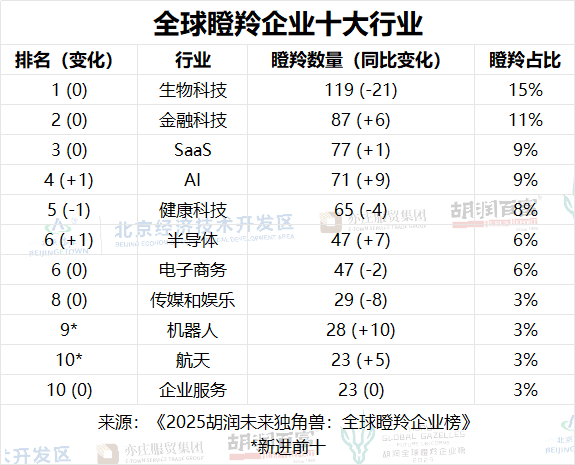
Group 1: Global Trends in "Gazelle" Companies - The report identifies 819 global "gazelle" companies, with 278 from China, indicating a significant presence in the market [2] - The average age of these companies is 9 years, with an average valuation of $700 million, showcasing rapid growth and innovation [4] - AI has become a dominant force, with 35% of "gazelle" companies driven by AI, reflecting its evolution from a niche sector to a foundational system across various industries [5] Group 2: Industry Insights - The top three industries for "gazelle" companies are biotechnology (119), fintech (87), and SaaS (77), with a notable shift in China's focus towards hard technology sectors like biotechnology and semiconductors [5] - The Long Triangle region, particularly Ningbo, has shown strong growth with 134 "gazelle" companies, benefiting from regional collaboration and industrial chain advantages [6] Group 3: Notable Companies in Ningbo - Ningbo's three notable companies—Wanyou Yili, Zhijia Technology, and Lanzhu—represent key advancements in AI, semiconductors, and industrial services, respectively [7][14] - Wanyou Yili focuses on XR chip development, addressing challenges in power consumption and performance for XR devices [8] - Zhijia Technology has achieved mass production of 1 million units and accumulated over 1 billion kilometers of real-world data, enhancing its position in the smart driving sector [10] - Lanzhu has developed an industrial operating system, empowering over 1,500 smart factories, and is recognized as a leader in industrial software [12] Group 4: Investment Landscape - Ningbo is experiencing a vibrant investment climate, with 171 pre-IPO financing events in 2025, averaging three funding rounds per week [15] - Emerging companies in AI and semiconductors, such as Jisuilian Optoelectronics, are positioned to capitalize on global trends in computing power infrastructure [15] - The focus on hard technology and future industries is evident in the city's strategic investments, indicating a strong commitment to innovation and growth [16]
昌红科技(300151) - 2026年1月20日投资者关系活动记录表
2026-01-21 09:56
Group 1: Company Overview - The company is Shenzhen Changhong Technology Co., Ltd., with stock code 300151 and bond code 123109 [1] - The meeting was held on January 20, 2026, with 14 investors from various institutions [2] Group 2: Business Segments and Revenue - Precision molds and automated lines account for 7.24% of total revenue, smart manufacturing products for 64.94%, and medical consumables for 27.36% [2] - The semiconductor product market is estimated to have an annual market size of approximately 3 billion RMB [2] Group 3: Profit Margins - The gross margin for precision molds and automated lines is 34.82%, for smart manufacturing products is 19.85%, and for medical devices and consumables is 35.64% [3] Group 4: Recent Developments - The company has made significant breakthroughs in the domestic wafer carrier field, securing over half of the procurement amount from a major domestic wafer factory, totaling over 10 million RMB [3] - This achievement indicates the company's capability for stable production and continuous supply, with expectations for scaled production in 2026 [3]

山东前首富做起了LP
投资界· 2026-01-21 08:58
Core Viewpoint - The article discusses the recent announcement by GoerTek Inc. regarding the establishment of a new fund with a total scale of approximately 6.97 billion yuan, focusing on cutting-edge technology sectors such as AI, XR, new materials, advanced manufacturing, and semiconductors [5][6]. Group 1: Fund Details - The new fund, tentatively named Shanghai Tongge Phase II Venture Capital Partnership (Limited Partnership), has a total scale of about 6.97 billion yuan, with a duration of 7 years, including a 4-year investment period followed by an exit period [6]. - GoerTek plans to invest no more than 2.3 billion yuan of its own funds, accounting for no more than 33% of the fund's total size [6]. - Other limited partners (LPs) will contribute 4.6 billion yuan, representing 66% of the fund [6]. Group 2: Company Background - GoerTek, founded by a couple in Shandong, initially entered the Apple supply chain and has transformed into a leading consumer electronics company with a market value exceeding 100 billion yuan [5][7]. - The company has faced challenges, including a significant order cut from a major client, Apple, in 2022, which led to performance bottlenecks [7]. - GoerTek is shifting its focus towards emerging fields such as VR/AR and AI smart hardware to drive growth, evidenced by its acquisition of Micro-LED technology company Plessy and a 1.903 billion yuan acquisition of Shanghai Aolai [7][8]. Group 3: Industry Trends - The establishment of the new fund reflects a broader trend among listed companies to engage in venture capital activities, leveraging their financial resources to strengthen their industry positions [9][10]. - Many listed companies are increasingly participating in the primary market as limited partners, seeking to enhance their competitive advantages and achieve synergistic effects [9][10]. - The article notes that the influx of capital from listed companies into the primary market is crucial for revitalizing investment opportunities, especially in the context of a market that has recently seen significant growth [10][11].

山东前首富做LP了
3 6 Ke· 2026-01-21 08:56
Core Viewpoint - Goer Technology announced the establishment of a new fund with a total scale of approximately 697 million yuan, primarily targeting cutting-edge technology sectors, with the company contributing no more than 230 million yuan of its own funds [1][2]. Group 1: Fund Details - The new fund, tentatively named Shanghai Tongge Phase II Venture Capital Partnership (Limited Partnership), has a total scale of about 697 million yuan and a duration of 7 years, with the first 4 years designated for investment and the subsequent period for exit [2]. - Goer Technology's contribution will not exceed 230 million yuan, accounting for no more than 33% of the fund's total size, while other limited partners (LPs) will contribute 460 million yuan, representing 66% of the fund [2]. Group 2: Investment Focus - The fund will primarily focus on advanced technology areas, including artificial intelligence, XR and spatial computing, new materials and advanced manufacturing, aerial mobility, and semiconductors [2][4]. Group 3: Company Background - Goer Technology, founded by a couple in Shandong, initially entered the Apple supply chain and has transformed into a leading consumer electronics company with a market value exceeding 100 billion yuan [1][3]. - The company has faced challenges, including a significant order cut from Apple in 2022 and the termination of a major acquisition deal due to unresolved key terms [3]. Group 4: Previous Investment Activities - This is not Goer Technology's first foray into the primary market; in July 2022, the company announced a partnership with MiHoYo and 37 Interactive Entertainment to invest a total of 556 million yuan in the Tongge Phase I Venture Capital Fund [5]. - The Tongge Phase I Fund, established in May 2022, aims to invest in unlisted startups in advanced manufacturing, intelligent connected vehicles, AR/VR, and semiconductors [5]. Group 5: Industry Trends - Many listed companies are increasingly choosing to participate in the primary market as limited partners, leveraging their substantial funds to strengthen their industry chains and build competitive barriers [6][7]. - The trend of listed companies investing in venture capital is seen as a valuable influx of capital into the primary market, especially as the market experiences significant growth [7].

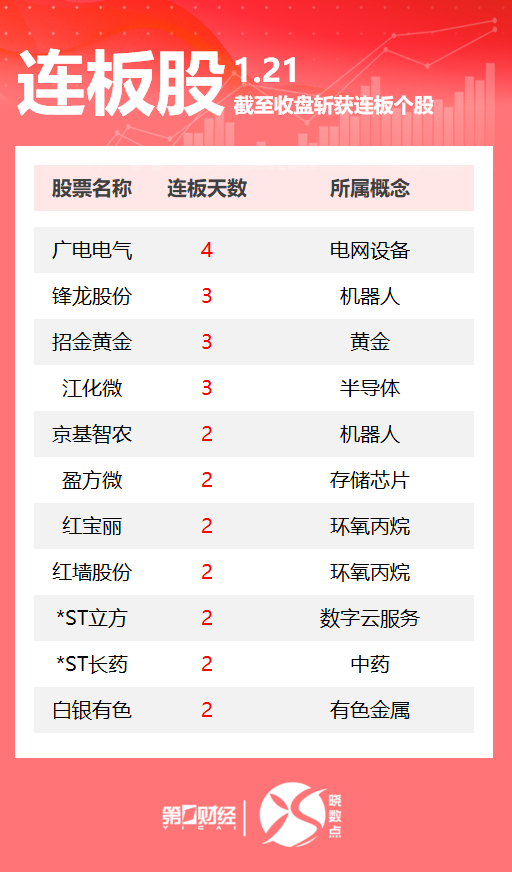
连板股追踪丨A股今日共91只个股涨停 这只黄金股3连板
Di Yi Cai Jing· 2026-01-21 08:24
Group 1 - The core viewpoint of the article highlights the performance of various stocks in the A-share market, with a total of 91 stocks hitting the daily limit up on January 21 [1] - The stock "Guangdian Electric" in the power grid equipment sector achieved a four-day consecutive limit up [1] - "Zhaojin Gold" in the gold sector recorded a three-day consecutive limit up, while "Hongbaoli" and "Hongqiang Co." in the epoxy propylene concept both achieved a two-day consecutive limit up [1] Group 2 - The article provides a detailed list of stocks with consecutive limit ups, including "Fenglong Co." with three days in the robotics sector and "Jianghua Micro" also with three days in the semiconductor sector [1] - Other notable stocks include "Jingji Zhino" and "Yingfang Micro" with two days in the robotics and storage chip sectors respectively, and "ST Cube" and "ST K Medicine" with two days in digital cloud services and traditional Chinese medicine sectors respectively [1] - The article also mentions "Baiyin Youse" in the non-ferrous metals sector achieving two days of consecutive limit up [1]
侨源股份2025年归母净利润同比预增超50% 三重驱动筑牢行业领跑地位
Zheng Quan Ri Bao Wang· 2026-01-21 07:25
Core Viewpoint - Sichuan Qiaoyuan Gas Co., Ltd. (Qiaoyuan Shares) expects significant growth in net profit for 2025, driven by expanding gas business, reduced electricity costs, and a low base effect from the previous year [1] Group 1: Financial Performance - For the year 2025, the company anticipates a net profit attributable to shareholders between 226 million to 256 million yuan, representing a year-on-year increase of 51.51% to 71.62% [1] - The expected net profit after deducting non-recurring gains and losses is projected to be between 215 million to 245 million yuan, reflecting a year-on-year growth of 49.80% to 70.71% [1] - The impact of non-recurring gains and losses on net profit is estimated to be 11 million yuan [1] Group 2: Business Drivers - The growth in performance is attributed to three main factors: continuous expansion of gas business capacity, a decrease in electricity costs improving overall gross margin, and a low base effect from significant long-term asset impairment losses in the previous year [1] - The company has established a comprehensive gas supply and service network, focusing on high-purity gas research, production, and sales, catering to both traditional industries and emerging sectors [1] Group 3: Regional and Technical Development - Qiaoyuan Shares has the largest full liquid air separation gas production line in Southwest China, with ongoing expansions in multiple production bases [2] - In Fujian, the company has set up two air separation gas production lines, primarily serving key clients through pipeline gas supply while also marketing surplus liquid capacity [2] - The company employs strict quality control measures throughout the production process, ensuring stable and compliant product quality [2] Group 4: Competitive Positioning - The company's high growth is supported by a recovery in core business, cost advantages, and a low base effect, positioning it as a leader in the industry [3] - The precise alignment of production capacity with the demands of high-end sectors like renewable energy and semiconductors creates a positive cycle of demand growth, capacity release, and revenue increase [3] - The combination of cost advantages, market share expansion, and scale effects strengthens the company's competitive barriers in emerging fields [3]