AI大模型

Search documents
康耐特光学(02276.HK):预计2025年业绩高增 智能眼镜产业催化密集
Ge Long Hui· 2026-01-20 14:02
Core Viewpoint - The company has issued a positive profit forecast, expecting a year-on-year growth of no less than 30% in net profit attributable to shareholders for the year 2025, driven by increased sales of high-refractive index lenses and other multifunctional products, ongoing scale effects, and improved financing structure [1] Group 1: Company Performance and Forecast - The company anticipates significant growth in net profit for 2025, with a projected increase of at least 30% year-on-year [1] - Key drivers for this growth include increased sales of 1.74 refractive index lenses and other multifunctional products, continued scale effects, and enhanced automation levels [1] - The company has received approximately RMB 10 million in revenue from its XR business as of August 31, 2025, with expectations for further growth in the latter half of 2025 and into 2026 [1] Group 2: Industry Trends and Collaborations - The company is the exclusive lens supplier for Alibaba's Quark AI glasses, indicating strong collaboration with major domestic clients [2] - The inclusion of smart glasses in the new consumer upgrade policy is expected to lower consumer thresholds and enhance market penetration [2] - Internationally, Meta Platforms and Essilor Luxottica are discussing plans to double AI glasses production capacity by the end of 2026, reflecting a growing interest in the smart glasses market [2] Group 3: Production and Capacity Expansion - The company is actively expanding its overseas production capacity, with a new automated facility in Japan focusing on progressive lenses and youth vision health products [3] - The Thai production base is also progressing steadily, which is expected to enhance the company's market share and brand premium in overseas markets [3] Group 4: Financial Adjustments and Ratings - The company has adjusted its profit forecasts, now expecting net profits of RMB 561 million, 682 million, and 821 million for 2025-2027, respectively [3] - The corresponding price-to-earnings ratios are projected to be 47X, 38X, and 32X for the same period [3]
智能驾驶2026年春季投资策略报告:AI的重要应用,智驾的质变时刻-20260120
GUOTAI HAITONG SECURITIES· 2026-01-20 12:38
Group 1 - The core viewpoint of the report suggests that AI large models are expected to lead a valuation reshaping in the automotive industry, particularly in the context of autonomous driving and subscription services [2] - The report highlights the projected growth in various segments such as traditional vehicle sales, subscription services, and Robotaxi, with significant increases expected by 2035 [8][9] - It emphasizes the importance of advanced AI models in enhancing user acceptance of autonomous driving and subscription software, potentially transforming the automotive sales model from low-frequency to high-frequency consumption [48] Group 2 - The report indicates that the penetration rate of Robotaxi in the ride-hailing market is a critical metric, with a focus on revenue and cost factors such as vehicle costs and operational efficiency [42] - It outlines the competitive landscape, noting that leading companies like Tesla and SAIC Group are expected to dominate the Robotaxi market, with significant projected sales and profits by 2025 [46] - The report identifies investment opportunities in the supply chain, particularly in components related to L3 and above autonomous driving, highlighting the potential for domestic alternatives in high-barrier products [48]
粤产AI手机引领新消费,广东“手机天团”何以狂飙?
2 1 Shi Ji Jing Ji Bao Dao· 2026-01-20 10:49
Core Insights - Guangdong manufactures one out of every three smartphones sold globally, with five major brands dominating the market [1][3] - The smartphone industry in Guangdong has maintained its position as the largest in China for 35 consecutive years, with a projected combined global market share of 34.6% for major brands in 2024 [1][3] - The integration of AI technology into smartphones is expected to drive a new wave of consumer electronics innovation and a subsequent "upgrade wave" in the market [1][6] Industry Overview - Guangdong is the most significant hub for smartphone production in China, leading in scale, output, and export volume [2][3] - The city of Dongguan is a core area for smartphone manufacturing, accounting for 28.6% of Guangdong's smartphone output in 2024 [3] - The region has developed a complete supply chain for smartphone production, with over 90% of components sourced locally [3] Technological Advancements - Continuous R&D investment by major brands has led to significant technological innovations, including advancements in chip design, fast charging, and foldable screens [4][5] - Notable innovations include OPPO's 125W fast charging technology and Huawei's breakthrough in foldable phone hinge design [5][6] - The introduction of AI capabilities in smartphones is transforming them into intelligent assistants, enhancing user experience and functionality [6][7] Market Trends - The shift towards AI-integrated smartphones is expected to redefine market competition, moving beyond hardware performance to functional innovation [6][8] - Major brands are actively incorporating AI features into their flagship models, with Huawei's HarmonyOS enhancing user interaction through AI [6][7] - The emergence of AI Agent smartphones is anticipated to lead a new "upgrade wave" in the context of stagnant smartphone sales growth [6][8] Future Outlook - Guangdong plans to accelerate the development of high-quality action plans for AI terminal products, indicating a strategic focus on innovation and market leadership [7][8] - The ongoing evolution of smartphones in Guangdong reflects a broader trend of the manufacturing sector integrating advanced technologies and moving up the global value chain [8]


BOSS直聘:2025年推送安全提示近2.5亿次,AI拦截80%违规账号
Xin Lang Cai Jing· 2026-01-20 10:36
Core Insights - The report highlights the increasing penetration of AI large models in job security across various processes, with 80% of accounts banned throughout the year being proactively intercepted by AI-supported risk control systems [1][2] Group 1: AI and Job Security - AI large models are becoming integral to job security, influencing multiple aspects of the hiring process [1][2] - The platform's risk control system, powered by AI, has played a crucial role in identifying and banning accounts involved in fraudulent activities [1][2] Group 2: Criminal Activities and Law Enforcement - The report identifies a new trend in illegal activities disguised as recruitment, characterized by "industrialization, gang formation, and outsourcing" [1][2] - The platform has collaborated with law enforcement to combat these crimes, assisting in the resolution of 58 cases and the arrest of 607 suspects, dismantling several criminal gangs involved in scams [1][2] Group 3: Safety Measures for Job Seekers - The safety team has intensified efforts to send safety alerts and anti-fraud educational information to job seekers, establishing a "first line of defense" [1][2] - Throughout the year, nearly 250 million safety-related messages were sent to job seekers to enhance their awareness [1][2]
锐明技术:公司事件点评报告:25年业绩高增,无人巴士加速落地-20260120
Huaxin Securities· 2026-01-20 10:24
Investment Rating - The report maintains a "Buy" investment rating for the company [9] Core Views - The company is experiencing high growth, with a projected net profit of approximately 3.85 billion yuan for 2025, reflecting a year-on-year increase of 30% [5] - The penetration of advanced driver-assistance systems is accelerating, with the company leveraging high-value products to expand its customer base and increase revenue and profit [6] - The company is focusing on the development of autonomous buses, with significant progress in the Robobus project and a dedicated testing facility for L4 autonomous driving capabilities [7] - Revenue forecasts for 2025-2027 are 26.7 billion, 33.5 billion, and 41.5 billion yuan respectively, with corresponding EPS of 2.19, 2.95, and 3.67 yuan, indicating a strong growth trajectory [8] Summary by Sections Market Performance - The company has shown significant improvement in Q4, with a projected net profit of about 1.11 billion yuan, a substantial increase from 0.71 billion yuan in Q3 [5] Financial Forecasts - The company is expected to achieve a net profit growth rate of 36.3% in 2025, 34.6% in 2026, and 24.6% in 2027, with a projected ROE of 20.5% in 2025 and increasing to 26.1% by 2027 [11][14]

马斯克开源推荐算法,完全基于AI大模型
Sou Hu Cai Jing· 2026-01-20 09:16
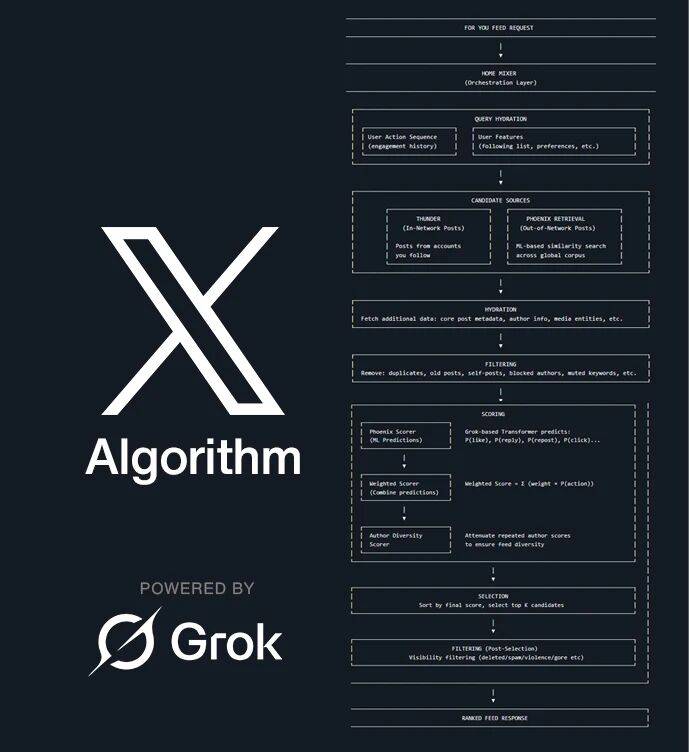
Core Insights - Elon Musk announced that the core algorithm for the social platform's "For You feed" has been officially open-sourced [12] - The algorithm retrieves, ranks, and filters posts from two main sources: Thunder (posts from accounts users follow) and Phoenix Retrieval (posts discovered from a global corpus) [12] - The algorithm utilizes a Grok-based Transformer model to merge and rank content, predicting the adoption probability of each post [12] System Architecture - The system relies entirely on a Grok-based Transformer to learn relevance from user interaction sequences, eliminating the need for manual feature engineering [6] - Candidate models are isolated during the Transformer inference process, ensuring that post scores do not depend on the content of other posts in the batch, which guarantees score consistency and cacheability [7] - Multiple hash functions are used for embedding lookups in both retrieval and ranking processes [8] Prediction and Scoring - The model predicts multiple behavior probabilities rather than a single "relevance" score, enhancing the understanding of user engagement [9] - The final score for each post is a weighted combination of predicted adoption probabilities, with higher scores indicating a stronger recommendation for users [12] Pipeline Architecture - The candidate-pipeline framework provides a flexible structure for building recommendation pipelines, separating pipeline execution and monitoring from business logic [10] - It allows for parallel execution of independent stages and graceful error handling, facilitating the addition of new sources, hydration, filters, and scoring components [10]

一周对战2500万局,这些“AI假人”让人类游戏玩家破防了
3 6 Ke· 2026-01-20 08:38
Core Insights - The article discusses the innovative integration of AI in the gaming industry, specifically through the game "Supernatural Action Team" by Giant Network, which has achieved significant popularity and engagement [1][3][14] - The game features AI-controlled characters that interact with players in real-time, creating a dynamic and unpredictable gaming experience, which has garnered positive player feedback [10][11][16] Group 1: Game Features and AI Integration - "Supernatural Action Team" allows players to team up in a treasure-hunting adventure, with AI characters that can mimic human behavior and voice, enhancing the gameplay experience [1][3] - The AI characters, referred to as "dummies," can deceive players by pretending to be allies and then turning against them, adding a layer of strategy and excitement to the game [10][11] - The game has successfully integrated AI into its core gameplay, with AI participating in nearly 25 million matches within a week of its launch, showcasing its scalability and stability in high-concurrency environments [7][12] Group 2: Industry Impact and Player Reception - The gaming industry is increasingly embracing AI, but many applications remain in a "safe zone," where AI acts as a tool rather than a core gameplay element [8][9] - Concerns about player acceptance of AI in core gameplay have been prevalent, with a rising percentage of players believing AI could negatively impact the gaming experience [16] - However, "Supernatural Action Team" demonstrates that when AI is effectively integrated into gameplay, it can enhance player engagement and be well-received, challenging previous industry assumptions [16][17] Group 3: Company Strategy and Development - Giant Network has been strategically investing in AI development, establishing an AI lab in 2022 and integrating AI into their game development pipeline, which has led to the successful launch of "Supernatural Action Team" [13][14] - The company’s approach combines self-research, investment, and industry collaboration, positioning it as a leader in the integration of AI within gaming [13][14] - The success of "Supernatural Action Team" reflects the culmination of years of preparation and innovation, indicating Giant Network's commitment to pushing the boundaries of gaming technology [14][15]


南威软件(603636.SH):目前未与MiniMax合作开发AI大模型
Ge Long Hui· 2026-01-20 07:44
格隆汇1月20日丨南威软件(603636.SH)在投资者互动平台表示,公司目前未与MiniMax合作开发AI大模 型。未来若有相关进展,公司将严格按照有关法律法规的要求及时履行信息披露义务。 ...

受益AI大模型深度参与,两大板块大幅拉升!
Zheng Quan Ri Bao Zhi Sheng· 2026-01-20 04:36
Core Viewpoint - The integration of AI in short dramas and interactive games is reshaping the media industry, creating new growth opportunities and transforming traditional content monetization methods [2][3]. Group 1: Market Performance - On January 20, A-shares opened high but quickly retreated, with cultural media stocks, particularly in short dramas and games, experiencing significant price increases [1]. - Companies like Jiayun Technology and Zhejiang Wenlian saw their stocks hit the daily limit, with notable performances from Yue Media and Tiandi Online [1]. - Giant Network's stock price reached 51.70 yuan per share, with a market capitalization of 100.1 billion yuan [1]. Group 2: AI Integration in Media - AI short dramas and interactive games are seen as a new growth engine in the media sector, combining narrative appeal with interactive experiences [2]. - AI is revolutionizing the gaming industry by enhancing gameplay through real-time interactions and reducing costs by over 30% [2]. - In the short drama sector, AI is significantly shortening production cycles to 2-3 days and increasing content output [2]. Group 3: Industry Trends and Opportunities - The integration of AI is lowering entry barriers and expanding market size, allowing smaller teams to innovate and create diverse content [3]. - AI is expected to play a crucial role in the future of content creation, with a focus on human-machine collaboration to enhance creativity while maintaining content quality [3]. - The AI application sector is projected to be a key focus area in 2026, with ongoing trends indicating accelerated adoption [3][5]. Group 4: Specific Company Developments - Giant Network has introduced AI models into its core gameplay, enhancing user engagement and attracting millions of players [4]. - Zhejiang Wenlian's partnership with ByteDance's Douyin has led to significant growth in digital marketing applications, with a reported 250 million yuan consumption in 2025, marking a fivefold increase [5]. Group 5: Investment Focus Areas - Investment opportunities are emerging in three key areas: companies leading in AI-native gameplay, full-service providers for short dramas, and AI computing power suppliers [5].
海螺水泥:公司联合华为发布行业首个水泥建材AI大模型
Zheng Quan Ri Bao· 2026-01-19 14:17
Core Viewpoint - The company is actively promoting AI applications in the context of digital transformation, collaborating with Huawei to launch the industry's first AI model for cement and building materials, which enhances quality control, production optimization, equipment management, and safety production [1] Group 1: AI Application and Collaboration - The company has partnered with Huawei to release the first AI model specifically for the cement and building materials industry [1] - The AI model is being utilized in various areas including quality control, production optimization, equipment management, and safety production [1] - The application scenarios of the AI model are continuously being promoted and optimized [1] Group 2: Business Impact - The implementation of AI is aimed at reducing costs, increasing efficiency, and improving quality, thereby injecting new momentum into the company's high-quality development [1]