
加息预期

Search documents
加息预期下澳元逼近14个月高位
Jin Tou Wang· 2026-01-06 02:17
Core Viewpoint - The Australian dollar (AUD) is maintaining a strong oscillating trend against the US dollar (USD), driven by diverging monetary policies, commodity prices, and inflation data between Australia and the US [1][2]. Group 1: Monetary Policy Divergence - The Reserve Bank of Australia (RBA) has indicated rising uncertainty regarding the sufficiency of current restrictive policies, with expectations for at least two rate hikes in 2026, potentially starting as early as February, depending on the upcoming CPI report [1]. - In contrast, the Federal Reserve has already cut rates by 75 basis points in 2025, with increasing internal disagreements on the pace of future cuts, leading to a cautious approach among officials [1]. Group 2: Commodity Prices and Economic Outlook - The Australian dollar benefits from its status as a commodity currency, with rising prices for key exports like gold and iron ore, and the Australian government has raised its forecasts for commodity export revenues [2]. - The weakening US dollar index provides additional support for the AUD, with expectations of continued declines due to factors like interest rate cuts and fiscal deficits [2]. Group 3: Technical Analysis and Market Sentiment - The AUD/USD exchange rate is currently in a strong upward trend, supported by technical indicators such as the 9-day moving average and a relative strength index of 64.22, indicating strong momentum without entering overbought territory [2]. - Key resistance is identified at the 14-month high of 0.6727, with potential for further upward movement towards 0.6840 if this level is breached [2]. Group 4: Future Outlook - The AUD is expected to maintain a strong trend in the medium to long term, supported by interest rate differentials, commodity prices, and structural weaknesses in the USD [3]. - Short-term risks include potential economic outperformance in the US, slower-than-expected Fed rate cuts, or a slowdown in the Chinese economy affecting commodity demand, which could lead to a temporary pullback in the AUD [3].
加息预期打击楼市情绪 澳大利亚房价涨幅2025年末放缓
Xin Lang Cai Jing· 2026-01-01 23:30
Core Viewpoint - Australian housing prices showed a slowdown in December, with slight declines in Sydney and Melbourne, raising concerns about the real estate market outlook for 2026 due to the risk of the central bank resuming interest rate hikes [1][2]. Group 1: Housing Price Trends - The housing price index in major Australian cities increased by 0.5% month-on-month, with Sydney and Melbourne experiencing a decrease of 0.1% [1][2]. - Perth and Adelaide led the price increases, both rising by 1.9%, while Brisbane and Darwin followed with increases of 1.6% [1][2]. Group 2: Central Bank Policy Impact - Following a brief easing period from February to August 2025, the Governor of the Reserve Bank of Australia, Michele Bullock, has nearly ruled out further rate cuts and warned of the possibility of resuming rate hikes if inflation pressures persist [1][2]. - The majority of Australian homeowners have floating-rate mortgages, indicating that any shift in monetary policy could quickly impact market sentiment [1][2].
澳元站稳0.67关口加息预期
Jin Tou Wang· 2025-12-31 02:33
Core Viewpoint - The Australian dollar (AUD) has strengthened significantly, reaching a 14-month high against the US dollar (USD) due to a combination of hawkish signals from the Reserve Bank of Australia (RBA), expectations of US Federal Reserve (Fed) rate cuts, and favorable commodity prices driven by China's recovery [1][2]. Group 1: Economic Indicators - As of December 31, 2025, the AUD/USD exchange rate reached 0.6700, reflecting a daily increase of 0.12% and an annual rise of over 7% since the low of 0.6420 in mid-November [1]. - Australia's inflation rate in October was reported at 3.8%, exceeding the RBA's target of 2%-3%, with December inflation expectations rising to 4.7% [1]. - Market pricing indicates a nearly 50% probability of an interest rate hike by March 2026, with mainstream forecasts suggesting a potential increase to 3.85% in the first meeting of the year [1]. Group 2: Market Dynamics - The RBA's hawkish stance is a key driver of the AUD's strength, while the Fed's easing expectations have contributed to a decline in the USD index by over 10% for the year [1][2]. - The Fed has implemented three rate cuts since September 2025, with current rates at 3.50%-3.75%, and further cuts are anticipated next year [1]. - The AUD benefits from rising commodity prices and improved trade balances due to recovering exports of iron ore and coal, alongside positive expectations from China's targeted investment plans [1]. Group 3: Technical Analysis - The AUD/USD has formed an upward trend from 0.6420, currently consolidating around 0.6700, with resistance at 0.6727 and support at 0.6650 [2]. - The MACD indicates that bullish momentum remains, although it is slowing, while the RSI (14) is at 66.4278, suggesting that the market is not yet overbought [2]. - Institutions are optimistic about the AUD's future, with target prices ranging from 0.72 to 0.92 USD, although risks such as global economic slowdown and trade tensions may limit gains [2].
澳元14个月新高 政策分化商品涨势成核心推手
Jin Tou Wang· 2025-12-30 02:25
澳大利亚国内经济韧性为鹰派政策提供底气。数据显示,10月家庭支出环比增1.3%超预期,三季度 GDP同比增长2.1%,创下2023年三季度以来最快增速,新私人需求与商业投资表现亮眼,驱动力已从 传统矿业延伸至数据中心、民用航空等新兴领域。就业市场保持稳健,11月失业率稳定在4.3%的低 位,虽就业人数小幅减少,但整体市场健康度良好。通胀黏性持续凸显成为澳联储收紧政策的重要依 据,10月整体通胀率从3.6%回升至3.8%,始终高于2%-3%的政策目标区间,12月消费者通胀预期反弹 至4.7%,进一步强化加息预期。 展望后市,澳元兑美元走势将聚焦三大核心线索。其一,澳大利亚通胀数据至关重要,1月底公布的第 四季度CPI数据若超预期走高,将为澳联储2月加息提供直接依据,进一步为澳元添能;其二,澳联储 与美联储政策动向需紧密跟踪,两者加息与降息节奏的差异将直接决定利差格局,美联储1月FOMC会 议纪要将为其政策路径提供关键线索;其三,大宗商品价格走势及中国经济复苏进度将直接关联澳大利 亚出口表现,进而影响澳元基本面支撑。技术面来看,汇价突破14个月高点后上行空间打开,关键阻力 关注0.6800整数关口,回调支撑集中在 ...
邦达亚洲:日本央行加息预期升温 美元日元小幅收跌
Xin Lang Cai Jing· 2025-12-26 08:40
Group 1: Monetary Policy and Economic Outlook - The Governor of the Bank of Japan, Kazuo Ueda, signaled a likely interest rate hike next year, indicating increased confidence in achieving sustainable price targets [1][5][6] - Ueda mentioned that the prospects for achieving the 2% price stability target are steadily approaching, supported by rising wages and changes in corporate behavior regarding wage and price setting [1][5] - A Bloomberg survey indicated that most observers expect the Bank of Japan to raise interest rates every six months from now [1][5] Group 2: Fiscal Policy and Budget - Prime Minister Fumio Kishida's cabinet plans to announce a record initial budget for the fiscal year starting April 2024, totaling approximately 122.3 trillion yen (about 786 billion USD), which is a 6.3% increase from the current fiscal year's budget [1][6] - The government plans to raise about 29.6 trillion yen through new government bonds to fund the budget, with the reliance on bond issuance expected to decrease from 24.9% to 24.2% [1][6] - Kishida stated that the budget aims to balance economic strengthening and fiscal sustainability [1][6]
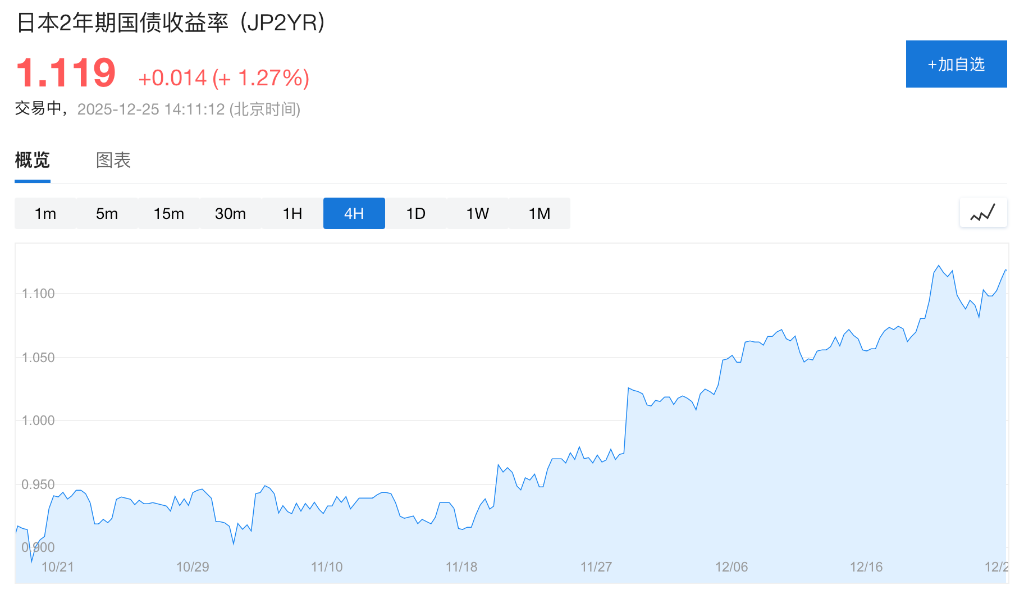
日本2年期国债标售疲软,市场预计通胀或倒逼央行“更猛烈加息”
Hua Er Jie Jian Wen· 2025-12-25 09:43
Core Viewpoint - The market is experiencing increased inflation expectations and pressure from the depreciation of the yen, leading to a potential need for the Bank of Japan to adopt a more aggressive interest rate hike strategy, which has resulted in weak demand for the 2-year Japanese government bond auction held on December 25 [1][4]. Group 1: Auction Results - The bid-to-cover ratio for the 2-year bond auction was only 3.26, down from 3.53 in the previous auction and below the 12-month average of 3.65, indicating weak demand [1]. - Following the auction results, the yield on the 2-year government bond rose by 2.5 basis points to 1.125%, marking the highest level since 1996 [1]. Group 2: Market Sentiment - The weak auction results highlight market unease regarding the Bank of Japan's policy stance, with the 10-year breakeven inflation rate reaching its highest level since data collection began in 2004 [4]. - There are concerns that the Bank of Japan is lagging behind inflation trends, which may lead investors to avoid 2-year bonds due to their sensitivity to such risks [5]. Group 3: Interest Rate Expectations - The market anticipates a possibility of another interest rate hike by the Bank of Japan before September next year, as indicated by overnight index swaps [5]. - The Bank of Japan's recent verbal warnings regarding the yen's depreciation have somewhat alleviated the pressure, but the auction results remain a key indicator of market sentiment towards the central bank's policies [5]. Group 4: Bond Issuance Plans - Investors are concerned about the government's bond issuance plans related to the fiscal year 2026 budget, which is expected to be approved soon [6]. - Major dealers have expressed a desire to increase the issuance of 2-year, 5-year, and 10-year bonds in the next fiscal year while calling for a reduction in the sale of ultra-long-term bonds [6]. - The new issuance of ultra-long-term bonds may be reduced to approximately 17 trillion yen (about 109 billion USD), the lowest level in 17 years [6].

爆拉!澳元冲破0.67创14个月新高 加息预期点燃涨势
Jin Tou Wang· 2025-12-25 02:45
Core Viewpoint - The Australian dollar (AUD) maintains a strong position against the US dollar (USD), with a slight decline of 0.0447% and a trading range of 0.6698-0.6710, following a significant rise that broke the 0.67 mark, reaching a 14-month high since October 2024 [1][2]. Group 1: Economic Factors - The Reserve Bank of Australia (RBA) has kept the policy interest rate at 3.6%, with a hawkish tone suggesting potential rate hikes in the future, which has increased market expectations for a rate increase in early 2025 [1]. - Domestic demand in Australia remains robust, with private consumption and investment data showing resilience, which offsets some external pressures and enhances confidence in the AUD [2]. - The RBA's cautious optimism regarding the economic outlook, without concerns of recession, further supports the strength of the AUD [2]. Group 2: Currency Dynamics - The USD index has declined over 9% this year, primarily due to the Federal Reserve's rate cuts and internal policy discrepancies, which have weakened the dollar and increased the relative attractiveness of the AUD [2]. - The AUD/USD exchange rate is currently in an upward channel, with key support at 0.6620 and resistance at 0.6707, indicating a solid bullish structure [2]. Group 3: Future Considerations - Upcoming key indicators include the Australian fourth-quarter CPI data at the end of January, which could reinforce rate hike expectations if inflation rises [3]. - Monitoring the Federal Reserve's policy direction and US economic performance is crucial, as these factors will directly impact the strength of the USD [3].
机构:交易员押注澳洲联储明年将转向加息 助力澳元攀升至一年多新高
Sou Hu Cai Jing· 2025-12-24 03:15
在交易员预期澳洲联储将在明年初迅速转向加息后,澳元兑美元AUD/USD上涨约0.2%,至67.13,为 2024年10月以来的最高水平。这一走势使其本季度的涨幅扩大至1.5%,是表现最好的主要发达市场货 币之一。澳元自11月中旬以来一直走高,交易员押注随着消费者支出增加和强劲的薪资数据加剧通胀压 力,澳洲的货币政策将迅速转变。交易员预计,澳洲联储最早可能在明年6月份上调基准利率,此前央 行在12月的会议上暗示,其宽松周期已经结束。包括Kristina Clifton在内的澳大利亚联邦 银行策略师在 一份报告中写道,澳元的涨势可能会在年底前延伸至68,因为澳元通常在一年的最后两周走强。他们表 示,全球背景的改善以及对澳洲联储在2026年初加息的预期,将在未来一个月支撑澳元。 ...
澳洲联储鹰派纪要点燃加息预期 利率路径惊现大反转
Xin Hua Cai Jing· 2025-12-23 05:44
Group 1 - The core viewpoint of the article indicates that the Reserve Bank of Australia (RBA) maintains a hawkish stance due to concerns over inflation trends [1] - Sally Auld, Chief Economist at National Australia Bank Group, noted that the minutes reflect anxiety regarding recent inflation trends [1] - The RBA acknowledges a certain level of excess demand in the economy but is uncertain if the current financial environment is restrictive enough to balance total demand and supply [1] Group 2 - The meeting minutes discussed the potential necessity for interest rate hikes in the coming year [1] - Market expectations have shifted significantly; previously, the market anticipated a 25 basis point cut in the official cash rate by the end of 2026, but now it expects a 25 basis point increase instead [1]
澳美震荡加息预期升温
Jin Tou Wang· 2025-12-23 02:32
Core Viewpoint - The Australian dollar (AUD) is experiencing narrow fluctuations against the US dollar (USD), driven by diverging monetary policies between the Reserve Bank of Australia (RBA) and the Federal Reserve (Fed) [1][2] Group 1: Monetary Policy Divergence - The RBA has paused interest rate cuts and indicated an upward risk for inflation, leading the market to speculate on potential rate hikes in the coming year [1] - The RBA maintained the interest rate at 3.6% for the third consecutive time on December 9, signaling that the current easing cycle may be over, with a 50% probability of a rate hike by May next year [1] - In contrast, the Fed has implemented three rate cuts this year totaling 75 basis points, maintaining a loose monetary stance, which limits the attractiveness of the USD and indirectly supports the AUD [1] Group 2: Economic Fundamentals - Australia's GDP grew by 2.1% year-on-year in Q3, driven by strong private demand, particularly business investment, although the quarter-on-quarter growth was below expectations [1] - Inflation pressures are rising, with core inflation remaining above target levels, which is a key concern for the RBA [1] - Household consumption remains stable, with the savings rate returning to pre-pandemic levels, but consumer caution is limiting economic recovery momentum, affecting the upward trajectory of the AUD [1] Group 3: Commodity Prices and Capital Flows - As a resource-exporting economy, Australia's export performance is closely tied to global commodity demand, with recent stabilization in commodity prices providing marginal support for the AUD [2] - Diverging central bank policies have led to capital restructuring, with rising expectations for RBA rate hikes enhancing the attractiveness of AUD assets, prompting some capital to shift from USD to AUD [2] - However, the traditional safe-haven status of the USD may lead to periodic capital inflows back to the USD, complicating the trend for AUD/USD [2] Group 4: Technical Analysis and Market Outlook - Technical indicators suggest that the AUD/USD pair has broken below an upward channel, indicating ongoing downward pressure, although a weaker USD provides some buffer [2] - Current support for the exchange rate is around 0.6650, with significant resistance at the 0.67 level [2] - The short-term fluctuations are seen as a market re-evaluation of RBA policies, with future movements dependent on inflation and labor data; if these data reinforce rate hike expectations, the exchange rate may break through resistance [2]