
大数据

Search documents
经济开门红——全面解读1-2月经济数据
泽平宏观· 2026-03-16 16:06
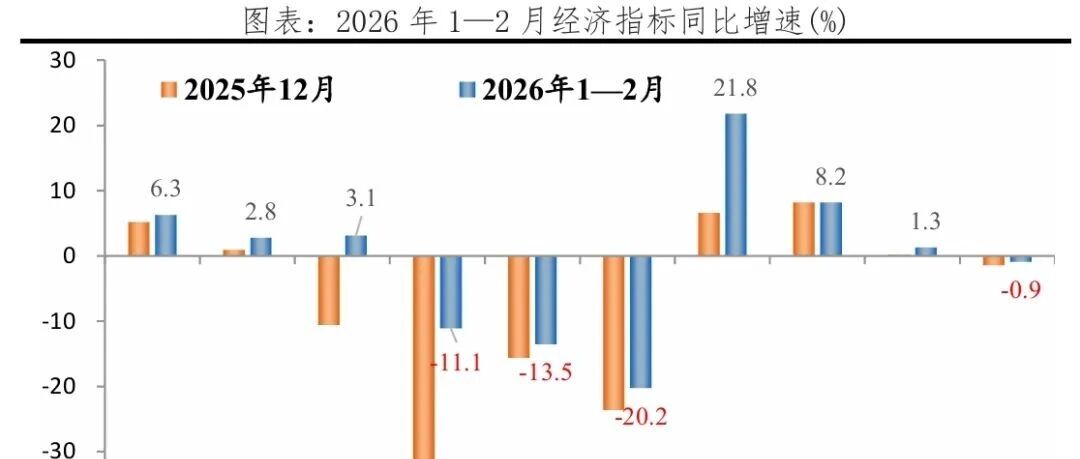
Economic Overview - The national economy showed a "new strong, old weak, external strong, internal stable" trend in the first two months of 2026, with high-tech manufacturing and equipment manufacturing leading the growth [2][3] - Industrial production accelerated, with a year-on-year increase of 6.3% in industrial added value, up 1.1 percentage points from December [2][8] - Fixed asset investment turned positive, growing by 1.8% year-on-year, a significant recovery of 16.9 percentage points from December [2][12] Industrial Production - High-tech manufacturing and equipment manufacturing sectors experienced significant growth, with high-tech manufacturing value-added increasing by 13.1% year-on-year [6][9] - The production of upstream raw materials improved due to rising international oil prices, while midstream machinery and equipment sectors benefited from policy effects [9][10] Investment Trends - Fixed asset investment (excluding rural households) showed a year-on-year increase of 1.8%, with high-tech industry investment growing by 5.1% [12][20] - Infrastructure investment surged by 11.4% year-on-year, driven by the acceleration of major projects and statistical adjustments [17][18] Real Estate Market - The decline in real estate investment narrowed, with sales area and sales amount decreasing by 13.5% and 20.2% respectively, but showing improvement from December [15][16] - Real estate companies are still cautious in land acquisition, with a significant drop in land transaction volume [16] Export Performance - Exports exceeded expectations, with a year-on-year growth of 21.8%, driven by global manufacturing recovery and enhanced competitiveness [25][26] - Exports to countries along the Belt and Road increased by 28.5%, accounting for over 50% of total exports [25][26] Consumer Spending - Social retail sales increased by 2.8% year-on-year, with service consumption performing well due to the long Spring Festival holiday [23][24] - Traditional consumer goods saw a significant demand boost during the holiday period, with restaurant income rising by 4.8% [23] Financial Data - Social financing maintained a stable growth rate of 8.2%, supported by government bonds and bank loans [28][29] - M2 growth remained at 9.0%, while M1 increased by 5.9%, indicating a shift in deposit trends towards non-bank institutions [29] Price Trends - CPI rose by 1.3% year-on-year, the highest in nearly three years, influenced by the timing of the Spring Festival [31][32] - PPI decline narrowed, reflecting input inflation and strong demand in certain technology sectors [31][32]

刚刚,中基协发布私募基金信披实施细则
母基金研究中心· 2026-03-13 09:34
Summary of Key Points Core Viewpoint The article discusses the recent developments in China's mother fund industry, highlighting the total management scale of 111.2 billion yuan, with investments spanning various sectors such as artificial intelligence, big data, and advanced manufacturing. Group 1: Fund Manager Recruitment - Beijing's Chaoyang Science and Technology Innovation Fund is seeking a General Partner (GP) for its sub-fund focused on the exhibition industry and technology integration [3] - Zhejiang's Wenzhou Science and Technology Innovation and Entrepreneurship Investment Fund is also recruiting a GP to support strategic emerging industries [4] Group 2: Mother Fund Establishment - Guangdong's Nansha Science and Technology Innovation Mother Fund 3.0 has been officially launched with a target scale of 10 billion yuan, focusing on integrating technology and industry [6][7] - Shaanxi has introduced its first "perpetual mother fund" with a scale of 10 billion yuan, aimed at enhancing funding support for key industries and early-stage tech projects [8] - Zhejiang has completed the registration of its first mother fund with S-function capabilities, aimed at deepening collaboration between provincial and local resources [10] Group 3: Mother Fund Policies - The China Securities Investment Fund Industry Association has released implementation details for private fund information disclosure, enhancing self-regulation and investor protection [11] Group 4: LP Contributions - The Beijing-Tianjin-Hebei Venture Capital Guidance Fund has officially contributed 500 billion yuan, focusing on early-stage and hard technology investments [12] - Fujian's Zijin Mining has invested in a fund with a total scale of approximately 2.82 billion yuan, contributing around 100 million yuan [13] - Zhejiang's Huace Navigation has established a fund with a total commitment of 2.52 billion yuan, with Huace being the largest single LP [14] - Shanghai's Fulede has announced a contribution of 40 million yuan to a new fund, marking its entry into the investment space [15] - Zhejiang's Yongji Co. has committed 20 million yuan to a fund focused on semiconductor and new energy sectors [17] - Wenzhou's Science and Technology Innovation Fund has added five new sub-funds totaling 9.5 billion yuan, targeting AI and high-end manufacturing [18]





朝阳科创基金首都会展科创基金招GP
FOFWEEKLY· 2026-03-12 10:05
Core Viewpoint - The Chaoyang District of Beijing is launching the Capital Exhibition Technology Innovation Sub-Fund to enhance the integration of the exhibition industry with technological innovation, supporting high-quality regional economic development [1]. Group 1: Fund Objectives and Focus - The Capital Exhibition Technology Innovation Sub-Fund aims to cultivate new productive forces and implement a dual-driven development strategy of "business + technology" in Chaoyang District [1]. - The fund will focus on equity investments in the exhibition industry, particularly in the integration of technologies such as artificial intelligence and big data within exhibition scenarios [1]. Group 2: Strategic Development - The fund is designed to promote the collaborative development of "fund + exhibition + park," leveraging the resource advantages of the exhibition platform to facilitate the transformation of technological achievements and the aggregation of quality enterprises [1]. - The initiative is part of the broader "3+X+N" industrial system upgrade strategy in Chaoyang District, aimed at fostering high-quality economic growth in the region [1].
全国政协委员孟振平:深化交通运输与能源融合发展,支撑交通强国和能源强国建设
中国能源报· 2026-03-11 07:16
Core Viewpoint - The integration of transportation and energy, referred to as "交能融合," is essential for achieving a strong transportation and energy nation, promoting green and low-carbon development, and enhancing the resilience and competitiveness of the industrial system [1][2]. Group 1: Integration Strategies - The integration of transportation and energy is not merely an overlap of two industries but a deep fusion that generates new productive forces [2]. - During the 14th Five-Year Plan period, there is a focus on deepening the integration of transportation and energy, emphasizing smart, green, and integrated development [2]. - The Southern Power Grid Company is actively exploring new models and business formats for this integration, including the largest cross-province vehicle-grid interaction in the country, involving over 100,000 electric vehicles [2]. Group 2: Challenges and Recommendations - Current challenges in the integration include the need for stronger cross-industry collaborative planning and effective coordination of the layout and construction of "roads, charging piles, sources, and networks" [2]. - Recommendations include considering transportation energy characteristics, clean energy endowments, and grid capacity to promote deep integration of transportation planning with grid and new energy planning [2]. Group 3: Standardization and Technology - Standardization is crucial for the large-scale development of integrated transportation and energy, as current standards for planning, design, construction, and technology are not unified [3]. - There is a call for the establishment of a comprehensive standard system covering all scenarios of integration, as well as accelerating key technology breakthroughs in areas like vehicle-grid interaction and virtual power plants [3]. Group 4: Data Sharing and Collaboration - Data sharing is identified as a key method to break down barriers between transportation flow and energy flow, as current data interactions are insufficient to accurately reflect their coupling relationship [4]. - Recommendations include leveraging AI and big data to create a cross-regional, cross-industry, and cross-enterprise data sharing system and intelligent control platform [4]. - There is an emphasis on strengthening strategic collaboration among relevant departments and improving project management mechanisms to enhance efficiency and promote shared benefits among enterprises [4].

芯片公司,争夺人才
半导体行业观察· 2026-03-11 02:00
Group 1 - Samsung Electronics and SK Hynix are expanding their recruitment efforts in the semiconductor market, with Samsung planning to hire around 8,000 new employees this year [2][4] - SK Hynix aims to recruit at least 1,000 new employees and has introduced a new recruitment strategy called "Talent hy-way," focusing on rolling recruitment to ensure talent reserves [3][4] - The demand for semiconductor professionals is increasing as the industry shifts towards AI, next-generation memory, advanced packaging, and ASICs, highlighting the importance of human resources [2][5] Group 2 - TSMC is also engaging in large-scale recruitment, with an average annual salary of approximately 2.2 million New Taiwan Dollars (around 1.0296 billion Korean Won) for entry-level engineers with master's degrees [4] - Major U.S. tech companies, including Microsoft and Google, are increasingly favoring Korean engineers for AI chip development, reflecting Korea's rising status in the global AI supply chain [5] - To retain top talent, domestic companies in Korea need to develop strategic talent management plans as competition for skilled professionals intensifies [5]


高股息真的依赖于成长性吗
雪球· 2026-03-07 01:31
Core Viewpoint - The article emphasizes the importance of focusing on companies with competitive advantages and high dividend yields, rather than solely on growth potential, to achieve sustainable long-term investment returns [5][11]. Group 1: Company Analysis - Gree Electric Appliances has faced concerns regarding its growth potential since 2014, with a saturated market leading to low valuations. Its revenue increased from 140 billion in 2014 to 190 billion in 2024, reflecting a cumulative growth of 35.73%, equating to an annualized growth rate of only 3.1% [6]. - Despite the limited revenue growth, Gree's net profit rose significantly from 14.155 billion to 32.185 billion, showing a cumulative growth of 127.36% and an annualized rate of approximately 8.56%, which exceeds inflation levels [7]. - The increase in net profit is attributed to improvements in social productivity, with advancements in advertising and inventory management leading to enhanced economic efficiency [9]. Group 2: Industry Insights - The article suggests that as new technologies mature and are applied, the positive effects on leading companies' performance will continue, provided they maintain their market share [10]. - The core principle of the high dividend strategy is to closely monitor whether a company's competitive advantage is being undermined, as this is crucial for long-term investment success [11].


全国人大代表、河南证监局原局长牛雪峰:强化政策预期管理 加强市场信息治理
证券时报· 2026-03-07 00:51
Core Viewpoint - The article emphasizes the need for enhanced policy expectation management and improved information governance in China's capital market to support high-quality development and effective macro policy management [1][2]. Group 1: Current Issues in Capital Market - The current capital market faces issues such as imprecise policy transmission, the easy spread of false information, and difficulties for investors in protecting their rights, which hinder market development [2]. Group 2: Recommendations for Policy Management - It is suggested to establish a coordination mechanism for major policy releases, led by the National Development and Reform Commission, to assess the potential impacts of policies on the capital market and prevent abnormal market fluctuations [2]. - The article recommends enhancing policy interpretation by increasing the reporting and interpretation efforts of central media and authoritative platforms to clarify misunderstandings and stabilize market expectations [2]. Group 3: Data Integration and Monitoring - The proposal includes promoting data integration and sharing, led by the National Data Bureau, to break down departmental data barriers and support policy formulation, risk assessment, and regulatory enforcement [3]. - Establishing a monitoring and early warning mechanism for significant policy and sensitive market information is advised, utilizing big data and AI technologies to enhance oversight of misleading information [3]. Group 4: Accountability and Regulation - The article calls for a robust accountability system for misleading and misinterpreting policies, suggesting a multi-faceted approach involving civil, administrative, and criminal accountability to deter such behaviors [3]. - It is recommended to impose strict penalties for malicious dissemination of false information that causes significant market fluctuations or losses, including legal actions against offenders [3].
中国银行保险报 | 中国东方旗下中华人寿前端基础服务平台破局数字化转型
Xin Lang Cai Jing· 2026-03-05 12:23
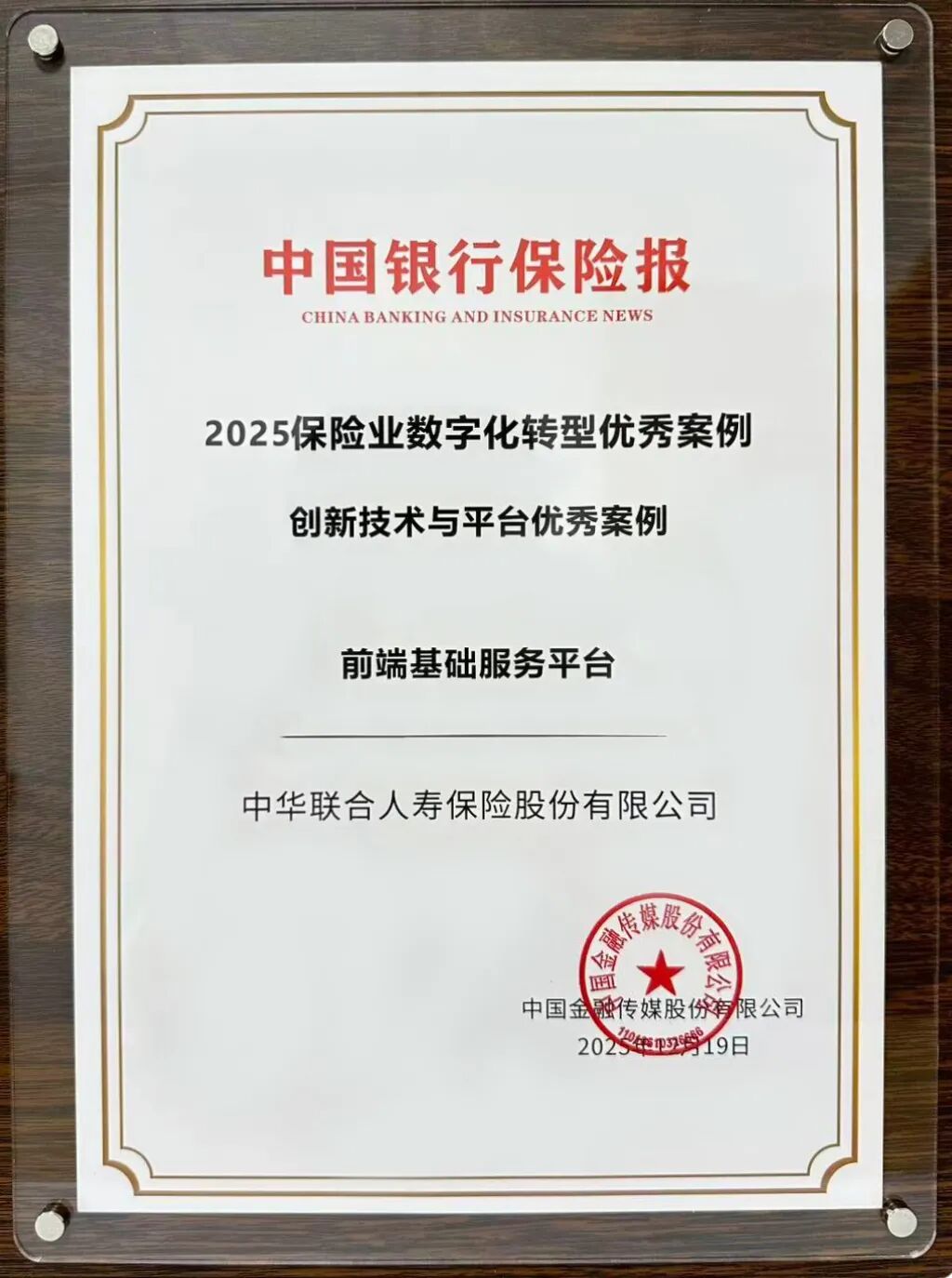
Core Insights - The core achievement of China United Life Insurance Co., Ltd. is the successful development of its "Front-End Basic Service Platform," which has earned two industry awards for innovation in digital transformation [1][10]. Industry Context - The insurance industry is undergoing a deep transformation driven by data and technology, with AI, large models, and big data increasingly integrated into product design, marketing, underwriting, and claims management [3][12]. - Despite advancements, insurance companies face challenges in data governance, system integration, and customer experience optimization [3][12]. Challenges Faced - The motivation behind the development of the Front-End Basic Service Platform stems from the widespread issue of "digital debt" within the insurance sector, particularly for companies that have been established for some time [4][13]. - As business scales transition from startup to growth phases, the complexity of front-end services such as sales, underwriting, and claims increases significantly, while outdated systems hinder efficiency and data sharing [4][13]. - The existing "siloed" system architecture leads to high operational costs, prolonged development cycles, and difficulties in launching innovative products that require cross-system collaboration [4][13]. Strategic Response - In response to these challenges, the company opted to build a new, unified "Front-End Basic Service Platform" rather than patching existing systems, aiming to resolve core issues of system fragmentation and data inaccessibility [5][14]. - The platform's development began in 2023, focusing on upgrading front-end sales and service systems to enhance business support capabilities and eliminate service barriers [5][14]. Platform Architecture - The platform employs a three-layer design philosophy centered on "business decomposition and architectural layering," standardizing widely used capabilities across various business scenarios [6][15]. - It integrates 51 tool capabilities into 13 categories, providing standardized APIs and components, which significantly reduces development pressure across business lines [6][15]. - The platform utilizes a SpringCloud microservices architecture, establishing a unified technical stack and interface standards, which enhances overall efficiency and security [6][15]. Service Integration - The platform supports diverse service integration methods, facilitating smooth connections between new and legacy systems and easing collaboration with third-party channels [7][16]. - This flexibility reduces technical barriers and costs for channel expansion, transforming the technical foundation into a competitive advantage for business ecosystem growth [7][16]. Value Realization - The establishment of the Front-End Basic Service Platform signifies a successful transformation approach, emphasizing the importance of solidifying foundational capabilities before pursuing application innovations [8][17]. - The platform has led to reduced development costs and delivery cycles for various business systems, enabling rapid upgrades of critical systems such as online policy maintenance and unified underwriting platforms [8][17]. - The case of China United Life illustrates the challenge of transitioning from isolated technology applications to systematic capability building in the insurance industry's digital transformation [8][17]. Industry Recognition - The awards received by China United Life are seen as a validation of a pragmatic and rational transformation path within the insurance industry, highlighting the need for both innovative exploration and the dismantling of outdated systems [9][18].

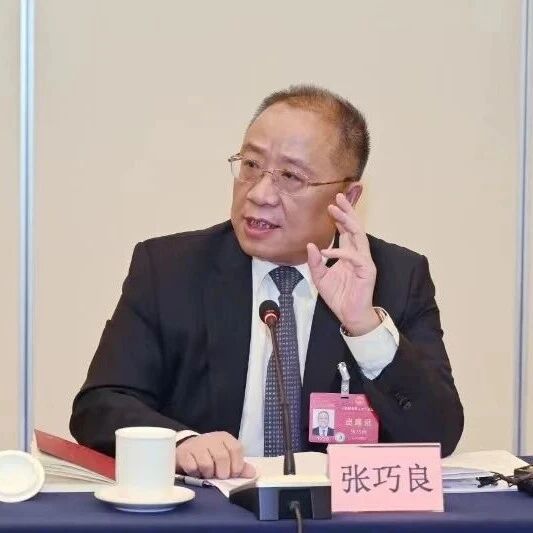
推进民促法落地,全国人大代表张巧良:建议开展专项执法检查
第一财经· 2026-03-05 09:47
Core Viewpoint - The implementation of the Private Economy Promotion Law has significantly boosted market confidence, but there are still obstacles in execution at the local level, including deviations in enforcement and hidden barriers that hinder the law's effectiveness [3][5][6]. Group 1: Legal Framework and Implementation - The Private Economy Promotion Law, as the first fundamental law regarding the development of the private economy in China, enhances predictability, stability, and reliability in policies related to fair competition, property rights protection, and financing support [5][6]. - Since its implementation, over 150 supporting systems have been introduced by relevant national departments, and local regulations have been established to address specific concerns of enterprises [6]. - Despite the law's provisions, local execution faces challenges, including hidden barriers that are not explicitly stated in regulations, such as unclear market access paths and unreasonable thresholds in bidding processes that favor state-owned enterprises [6][7]. Group 2: Recommendations for Improvement - To ensure the effective implementation of the Private Economy Promotion Law, it is recommended to conduct a nationwide review and alignment of regulations and policies [9][10]. - A total of 1,466 normative documents were identified for modification or repeal, with 947 local regulations already amended or abolished to eliminate barriers to market entry and fair competition [9][10]. - It is suggested to enhance the supervision and accountability mechanisms for law enforcement, ensuring that local governments are held accountable for their performance in implementing the law [14][15]. Group 3: Fair Competition and Financial Services - To guarantee equal participation rights for private enterprises, it is proposed to develop a guiding list for private enterprises' participation in major national projects and infrastructure, clarifying access paths and support policies [11][12]. - Strengthening the rigidity of fair competition review systems and establishing a unified platform for reporting discriminatory practices against private enterprises in bidding and procurement processes is recommended [11][12]. - Financial institutions are encouraged to innovate financing models using technologies like big data and blockchain to address the challenges faced by asset-light enterprises in securing loans [13].
泰凌微(688591):AIoT与音频领域稳中有进,公司行业地位稳固
Guotou Securities· 2026-03-03 11:18
Investment Rating - The investment rating for the company is "Buy-A" with a target price of 50.29 CNY, maintaining the rating [3][10]. Core Insights - The company reported a revenue of 1.016 billion CNY for 2025, representing a year-on-year growth of 20.32%, and a net profit of 128 million CNY, up 31.53% year-on-year [1]. - The AIoT market is expected to grow significantly, with the number of IoT device connections projected to reach 21.1 billion by 2025 and 39 billion by 2030, benefiting the company's performance [2]. - The company has established itself as a leading player in the low-power wireless IoT chip sector, with its Bluetooth low-power SoC chips ranking among the top globally [2]. - The company has seen structural growth across its business segments, with traditional IoT business revenue around 850 million CNY, and notable growth in audio products, which achieved a 50% increase [3][10]. Financial Performance - The company’s comprehensive gross margin is approximately 50.33%, an increase from the previous year [3]. - Revenue projections for 2025 to 2027 are 1.016 billion CNY, 1.449 billion CNY, and 1.923 billion CNY respectively, with net profits expected to be 128 million CNY, 258 million CNY, and 376 million CNY [10][12]. - The company’s earnings per share (EPS) is projected to grow from 0.53 CNY in 2025 to 1.56 CNY in 2027 [12].
