存储芯片短缺

Search documents
苹果突然宣布,支持华为、小米等以旧换新
中国基金报· 2026-01-16 07:33
Group 1 - Apple's Trade In program now includes Android brands such as Huawei and Xiaomi for device trade-in [2][3] - The trade-in values for various devices are as follows: iPhone 16 Pro Max up to 5800 yuan, iPad Pro up to 5800 yuan, iPad Air up to 3500 yuan, MacBook Pro up to 6050 yuan, and Mac Pro up to 14000 yuan [4] - Specific trade-in values for Android devices include: Huawei Mate X5 up to 2850 yuan, Huawei Mate 70 Pro+ up to 2750 yuan, Oppo Find X8 Pro up to 1700 yuan, Vivo iQOO 13 up to 1600 yuan, and Xiaomi 15 Pro up to 1600 yuan [4] Group 2 - Previously, only e-commerce platforms like JD and Tmall supported cross-brand trade-in services, while Apple's official site only accepted its own brand devices [6] - IDC forecasts that global smartphone shipments will reach 1.26 billion units by 2025, with Apple maintaining the top position in shipments at 247 million units, a 6.3% year-on-year increase [7] - In the Chinese market for 2025, Huawei is projected to lead with a market share of 16.4%, closely followed by Apple at 16.2% [7] - IDC warns that the smartphone market, particularly for Android manufacturers, will face significant challenges in 2026, with a potential decline in sales due to a shortage of storage chips [7]



怕赌场被玩炸 又怕没人气
Datayes· 2026-01-15 12:22
Core Viewpoint - The article discusses recent monetary policy adjustments by the People's Bank of China (PBOC) aimed at stimulating economic growth, particularly focusing on support for small and medium-sized enterprises (SMEs) and technological innovation [4][5][8][10]. Monetary Policy Adjustments - Starting January 19, 2026, the PBOC will lower the re-lending and re-discount rates by 0.25 percentage points, with new rates set at 0.95%, 1.15%, and 1.25% for 3-month, 6-month, and 1-year re-lending respectively [4][8]. - An additional 400 billion yuan will be allocated to support technological innovation and transformation loans, increasing the total to 1.2 trillion yuan [5][10]. - The PBOC will also increase the re-lending quota for agricultural and small business support by 500 billion yuan, with a total quota of 1 trillion yuan for private enterprises [5][10]. Support for Green Projects - Projects related to energy efficiency, green upgrades, and low-carbon transitions will be included in the carbon reduction support tool, with an annual operation limit of 800 billion yuan [5][10]. Market Reactions - The article notes a mixed performance in the stock market, with significant fluctuations in various sectors, particularly in technology and materials [15][28]. - The semiconductor sector is highlighted, with companies like TSMC planning substantial capital expenditures and projecting significant sales growth [18][22]. Economic Indicators - In December, new RMB loans totaled 910 billion yuan, marking the lowest seasonal increase since 2018, with corporate loans being the primary contributor [12]. - The M2 money supply grew by 8.5% year-on-year, indicating ample liquidity in the market, while M1 growth was only 3.8%, suggesting businesses are not converting funds into active deposits for expansion [12].


手机市场混战下的新变数:规模与利润之间的博弈,华为、苹果成最大赢家
Tai Mei Ti A P P· 2026-01-15 03:57
Group 1 - In 2025, global smartphone shipments reached 1.26 billion units, marking a 1.9% year-over-year growth, while the Chinese market saw a decline of 0.6% with shipments of approximately 285 million units [2][9][10] - Apple and Samsung maintained their leadership in the high-end market, with Apple achieving a market share of 19.7% and Samsung at 19.1%, both showing significant year-over-year growth [6][7] - Huawei regained the top position in the Chinese market with a market share of 16.4%, despite a slight decline in shipments compared to 2024 [9][10] Group 2 - Apple's iPhone 17 series significantly boosted its performance, leading to a record-breaking market share in China, with a 21.5% year-over-year increase in Q4 shipments [5][6] - Samsung achieved a remarkable 7.9% growth in 2025, the highest among the top five brands, driven by the popularity of its Galaxy A series [7][8] - The smartphone market is expected to face challenges in 2026 due to rising storage costs and changing consumer demands, with predictions of a potential decline in shipments [12][14] Group 3 - The competitive landscape is shifting towards high-end products, with brands focusing on premium offerings to counteract market pressures [16][17] - Xiaomi experienced a mixed performance, benefiting from government subsidies but facing significant declines in Q4, highlighting the volatility in the market [11] - The ongoing shortage of storage chips is anticipated to impact production costs and pricing strategies, leading to adjustments in product specifications and offerings [13][14]

2025年中国智能手机市场出货量约2.85亿部 同比下降0.6%
Zheng Quan Shi Bao Wang· 2026-01-14 12:06
Group 1 - The global smartphone market is expected to show resilience in 2025, with a projected year-on-year growth of 1.9%, reaching 1.26 billion units for the year, despite challenges such as tariff fluctuations and supply chain disruptions [1] - The fourth quarter of 2025 is anticipated to see a 2.3% year-on-year increase in global smartphone shipments, totaling 336.3 million units [1] - High-end models and strong performance of foldable phones, along with consumer anticipation of price increases, are driving market growth [1] Group 2 - In the Chinese market, smartphone shipments are projected to be approximately 75.78 million units in the fourth quarter of 2025, reflecting a slight year-on-year decline of 0.8% [2] - Huawei has regained the top position in the Chinese smartphone market with a market share of 16.4%, followed by Apple, Vivo, Xiaomi, and OPPO [2] - Local brands in China are adjusting their product strategies by reducing low-end model shipments to maintain profitability amid rising storage chip costs [2] Group 3 - The market environment for smartphones in 2026 is expected to differ significantly, with a forecasted decline due to ongoing storage chip shortages [3] - The duration of the storage chip shortage will directly impact the extent of market contraction, emphasizing the importance of scale and supply chain management for manufacturers [3] - Despite overall shipment pressures, the average selling price is expected to continue rising due to increased costs [3]
IDC:2025年第四季度全球智能手机出货量同比增长2.3% 达到3.363亿部
智通财经网· 2026-01-14 05:53
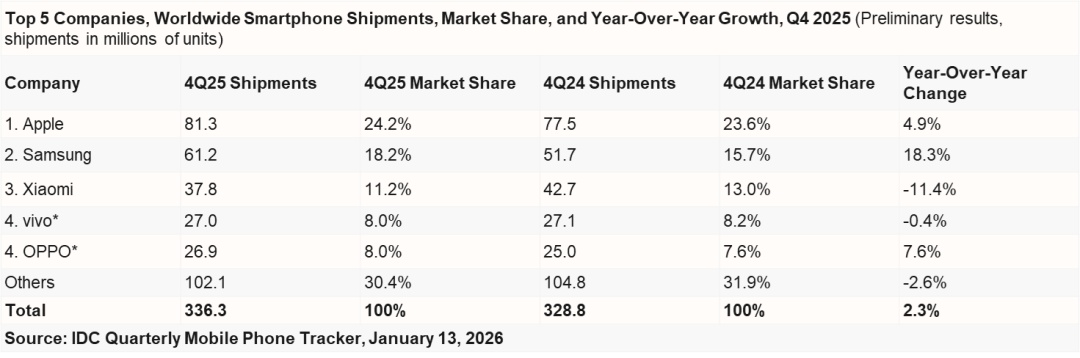
Core Insights - The global smartphone market is projected to grow by 2.3% year-on-year in Q4 2025, reaching 336.3 million units, driven by high-end model demand, strong performance of foldable phones, and consumer anticipation of price increases [1][2] - Apple and Samsung are the primary growth engines in the smartphone market, with year-on-year growth rates of 6.3% and 7.9% respectively, leading to a combined market share increase to 39% [2][3] - The overall smartphone market in 2025 is expected to reach 1.26 billion units, reflecting a 1.9% year-on-year growth despite challenges such as tariff fluctuations and supply chain disruptions [2][5] Global Market Performance - In Q4 2025, Apple shipped 81.3 million units, capturing 24.2% of the market share, while Samsung shipped 61.2 million units with an 18.2% market share [6] - The average selling price (ASP) of smartphones is expected to reach a historical high due to the strong performance of high-end models [3][5] - The overall market share of other manufacturers decreased slightly, with a total of 102.1 million units shipped, representing 30.4% of the market [6] Chinese Market Dynamics - The Chinese smartphone market saw a slight decline of 0.8% year-on-year in Q4 2025, with shipments around 75.8 million units [7][8] - Apple led the Chinese market with 16.0 million units shipped, achieving a market share of 21.1%, while vivo and OPPO faced challenges with year-on-year declines [8][9] - The overall annual shipment for the Chinese smartphone market is estimated at 284.6 million units, reflecting a 0.6% decrease compared to the previous year [9] Future Outlook - The smartphone market is expected to face challenges in 2026 due to a significant shortage of storage chips, which may lead to a market contraction [5] - Manufacturers' ability to manage supply chains and scale will be crucial in navigating the anticipated downturn [5] - Despite potential declines in shipments, the ASP is likely to continue rising due to increased costs [5]
2025中国手机出货:苹果四季度第一,华为全年第一
Guan Cha Zhe Wang· 2026-01-14 05:44
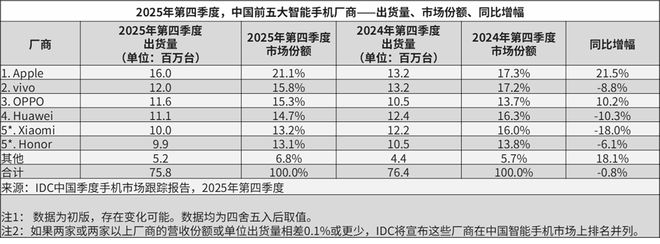
Core Insights - The Chinese smartphone market is projected to have a shipment volume of approximately 75.78 million units in Q4 2025, showing a slight year-on-year decline of 0.8%, with an annual total of about 285 million units, down 0.6% from the previous year [1][3] Q4 2025 Market Performance - Apple leads the Q4 2025 shipments with 16 million units, capturing a market share of 21.1%, marking a significant year-on-year increase of 21.5% [2] - Vivo ranks second with 12 million units shipped, holding a market share of 15.8, but experiencing a decline of 8.8% year-on-year [2] - OPPO follows closely with 11.6 million units, a year-on-year increase of 10.2%, and a market share of 15.3% [2] - Huawei's shipments are approximately 11.1 million units, down 10.3% year-on-year, with a market share of 14.7% [2] - Xiaomi and Honor are tied for fifth place, with Xiaomi shipping 10 million units (down 18%) and Honor shipping 9.9 million units (down 6.1%) [2] Annual Market Overview - For the entire year of 2025, Huawei tops the market with 46.7 million units shipped, a slight decline of 1.9%, and a market share of 16.4% [4] - Apple follows closely with 46.2 million units, reflecting a 4% increase year-on-year, and a market share of 16.2% [4] - Vivo's annual shipments are 46.1 million units, down 6.6% from the previous year, also sharing a market share of 16.2% with Apple [4] - Xiaomi and OPPO have annual shipments of 43.8 million and 43.4 million units, respectively, with Xiaomi showing a growth of 4.3% and OPPO a growth of 2.1% [4] Global Smartphone Market Insights - The global smartphone shipments reached 1.26 billion units in 2025, with Apple and Samsung leading the market shares at 19.7% and 19.1%, respectively [5][6] - Despite challenges such as storage chip shortages, the global market is driven by high-end model growth and consumer anticipation of price increases [5][6] - The average selling price is expected to continue rising, even as overall shipments face pressure [6]
2025中国手机市场:苹果四季度第一,华为全年第一
Guan Cha Zhe Wang· 2026-01-14 05:38
Core Insights - The Chinese smartphone market is projected to see a slight decline in shipments, with approximately 75.78 million units expected in Q4 2025, representing a year-on-year decrease of 0.8% [1][2] - Apple leads in Q4 shipments with 16 million units, achieving a market share of 21.1%, while Huawei tops the annual rankings with 46.7 million units shipped [1][3] Q4 2025 Performance - Apple: 16 million units shipped, 21.1% market share, 21.5% increase year-on-year [2] - Vivo: 12 million units shipped, 15.8% market share, 8.8% decrease year-on-year [2] - OPPO: 11.6 million units shipped, 15.3% market share, 10.2% increase year-on-year [2] - Huawei: 11.1 million units shipped, 14.7% market share, 10.3% decrease year-on-year [2] - Xiaomi: 10 million units shipped, 13.2% market share, 18% decrease year-on-year [2] - Honor: 9.9 million units shipped, 13.1% market share, 6.1% decrease year-on-year [2] Annual Performance 2025 - Total shipments in China are estimated at 285 million units, down 0.6% from the previous year [3][4] - Huawei: 46.7 million units, 16.4% market share, 1.9% decrease year-on-year [4] - Apple: 46.2 million units, 16.2% market share, 4% increase year-on-year [4] - Vivo: 46.1 million units, 16.2% market share, 6.6% decrease year-on-year [4] - Xiaomi: 43.8 million units, 15.4% market share, 4.3% increase year-on-year [4] - OPPO: 43.4 million units, 15.2% market share, 2.1% increase year-on-year [4] Global Market Overview - Global smartphone shipments reached 1.26 billion units in 2025, with Apple (19.7% market share) and Samsung (19.1% market share) leading the market [5][6] - The global market is expected to face challenges in 2026 due to ongoing storage chip shortages, which may lead to a decline in shipments [6]

涨疯了!一盒100根 价值400万元 堪比上海一套房 龙头股今夜狂飙
Zhong Guo Neng Yuan Wang· 2026-01-07 00:29
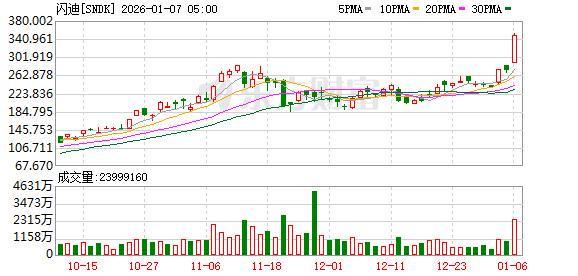
Core Viewpoint - The storage sector in the U.S. stock market experienced significant gains, driven by expectations of rising DRAM prices due to supply shortages and increased demand from AI infrastructure [4][6]. Group 1: Market Performance - SanDisk surged by 27.56%, marking its largest daily increase in ten months, while Micron Technology rose over 10%, reaching a historical high [4]. - Seagate Technology and Western Digital also saw substantial gains, with increases of 14% and over 16%, respectively [4]. Group 2: Price Increases and Demand - Samsung and SK Hynix have proposed price increases of 60%-70% for DRAM used in servers, PCs, and smartphones for Q1 2023 compared to Q4 2022 [5]. - The semiconductor industry anticipates that clients will accept these price hikes due to the inability of Samsung and SK to quickly ramp up production [5]. - Major clients are willing to absorb the costs associated with AI infrastructure, prioritizing profitability from AI over resisting DRAM price increases [5]. Group 3: Supply Constraints - The focus of memory manufacturers on producing HBM3E has led to a backlog in server DRAM production, widening the supply-demand gap [6][7]. - Companies like Google and Microsoft are expanding their AI service offerings, driving a surge in demand for general-purpose server DRAM [7]. - The trend of rising storage prices is expected to continue through 2026, with predictions of a 144% year-on-year increase in average selling prices for server DRAM [7]. Group 4: Financial Projections - Citigroup forecasts Samsung's operating profit to reach 155 trillion KRW, a 253% increase from the previous year, while Morgan Stanley predicts SK Hynix's operating profit to rise by 224% to 148 trillion KRW [7]. - Analysts expect that the supply shortage of memory chips will persist into 2026, benefiting companies like Micron Technology [7]. Group 5: Market Sentiment - The global DRAM market is undergoing a significant price surge, with many categories experiencing price increases exceeding 100% since July 2025 [8]. - The price of DDR4 and DDR5 memory has increased by 2-3 times within the year, with a single 256G DDR5 server memory module exceeding 40,000 yuan [8].


A股开门红,近4200股上涨,127股涨停,脑机接口、存储芯片集体爆发
21世纪经济报道· 2026-01-05 07:28
Market Overview - The A-share market opened positively on January 5, 2026, with the Shanghai Composite Index rising 1.38% and surpassing the 4000-point mark, marking a twelve-day winning streak [1] - The total market turnover reached 2.57 trillion yuan, an increase of 501.5 billion yuan compared to the previous trading day, with nearly 4200 stocks rising, including 127 stocks hitting the daily limit [1] Sector Performance - The brain-computer interface (BCI) concept led the market, with over thirty constituent stocks hitting the daily limit, and the BCI index rising by 13.7% [4][7] - The insurance sector saw significant gains, with companies like Xinhua Insurance and China Pacific Insurance reaching new historical highs [4] - The commercial aerospace concept remained active, with stocks like Leike Defense and China Satellite Communications showing strong performance [4] - The semiconductor industry chain also performed well, with stocks such as Yaxin Integration and Shenghui Integration hitting the daily limit [4] Key Stocks - Notable stocks in the BCI sector included: - Beikang (920199) with a rise of 29.98% - Botao Bio (688767) increasing by 20.01% - Sanbo Brain Science (300409) also up by 20.01% [5][6] - In the precious metals sector, silver and gold prices surged due to geopolitical tensions, with silver rising over 5% and gold recovering above 4400 USD [7] - The storage chip sector experienced a significant boom, with companies like Yunhan Chip City and Puran Shares hitting the daily limit [8][11] Industry Insights - The semiconductor supply shortage is described as "unprecedented" and "extremely severe," which is expected to impact prices of end products like smartphones [11] - Analysts predict that the storage chip supply shortage will persist into 2026, benefiting companies like Micron Technology [11] - The domestic semiconductor equipment market is expected to grow, with increased production capacity and technological advancements [11]

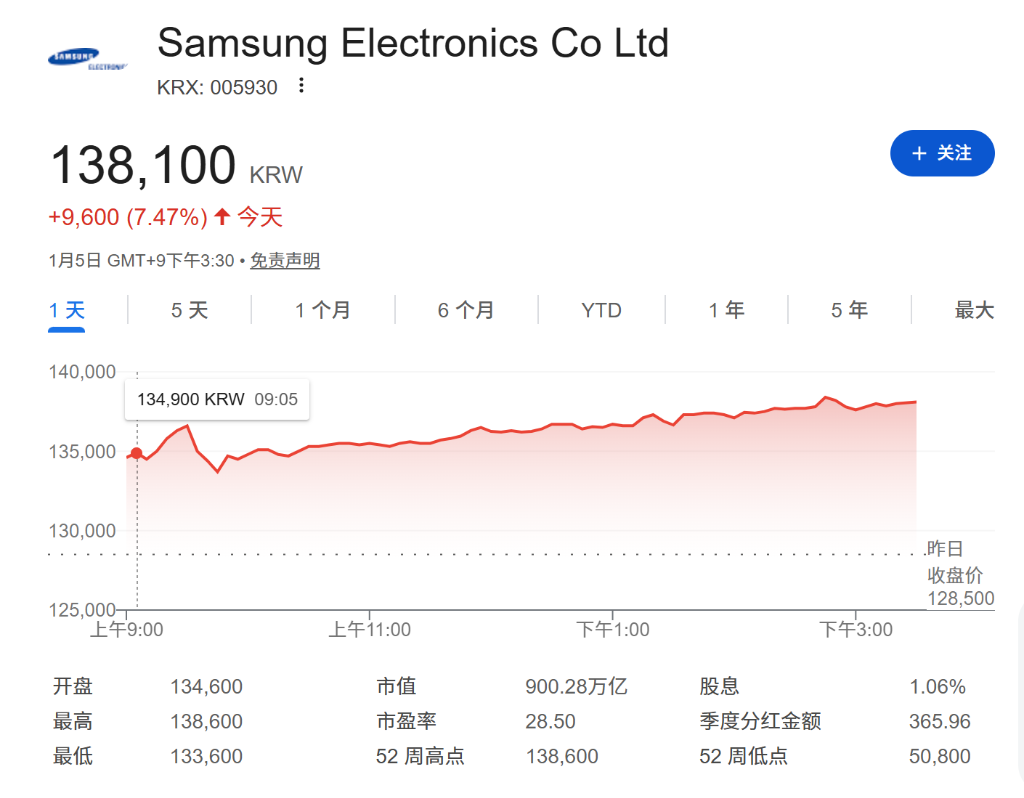
激进押注AI!三星计划将搭载Gemini的移动设备数量翻番至8亿台,全面迎战苹果
Hua Er Jie Jian Wen· 2026-01-05 07:22
Core Insights - Samsung Electronics plans to significantly expand its artificial intelligence strategy by doubling the production of mobile devices equipped with Google's Gemini AI model to 800 million units by 2026, marking a strong competitive response against Apple and rivals in the chip sector [1][3] - The company's advancements in high bandwidth memory (HBM) technology are expected to enhance investor confidence and position Samsung to re-enter Nvidia's core supply chain by 2026 [3][4] - Samsung aims to integrate AI across all products and services, reinforcing its position as the largest supporter of the Android platform and aiding Google in competing with OpenAI [3][4] AI Strategy Expansion - Samsung's aggressive device expansion plan is set to intensify the competition in the AI model space, particularly against Google's Gemini 3, which has shown strong performance metrics [4] - A survey indicated that awareness of Samsung's Galaxy AI brand surged from 30% to 80% within a year, reflecting accelerated AI adoption among consumers [4] - The company is focusing on enhancing its competitive edge in AI functionalities, including image generation, productivity tools, and translation services, to differentiate itself from Apple [4] Market Position and Competition - According to Counterpoint, Apple became the world's largest smartphone manufacturer last year, prompting Samsung to reclaim lost market share through comprehensive AI integration [5][6] - Samsung's TV and home appliance divisions are under pressure from Chinese competitors, and the company plans to leverage a cross-category AI ecosystem to strengthen its market position [6] - Despite leading the foldable smartphone market with a two-thirds share, Samsung acknowledges slower-than-expected growth due to engineering complexities and a lack of compatible applications [6] Semiconductor Market Challenges - The global shortage of memory chips is benefiting Samsung's semiconductor business but is simultaneously pressuring profit margins in its smartphone segment [7][8] - The CEO noted that this unprecedented situation affects not only smartphones but also TVs and other consumer electronics, with potential price increases being considered due to rising storage chip costs [8] - Market research firms predict that the smartphone market may contract next year due to the impact of memory chip shortages on pricing [8]