
存储超级周期

Search documents
存储迎超级周期,部分厂商业绩大幅预喜
3 6 Ke· 2026-02-02 23:54
自2025年三季度起,全球存储市场迎来颠覆性涨价行情。TrendForce集邦咨询数据显示,存储芯片领域 两大主要产品类别DRAM与NAND闪存现货价格累计上涨超过300%。该机构还预测,2026年第一季度 NAND闪存产品价格将上涨33%-38%,一般型DRAM价格将上涨55%-60%。在涨价行情带动之下,不少 存储公司业绩亮眼。Wind数据显示,截至2月2日,41家存储概念公司中,25家披露业绩预告,其中16 家预喜,多家公司在2025年第四季度业绩提升明显。存储芯片公司普遍表示,业绩预喜的主要原因是, 受AI及算力产业发展拉动,产业进入高景气周期、产品持续涨价,并持续看好未来的景气周期。(中 证报) ...
存储超级周期 又有三家国产厂商港股IPO竞速
Sou Hu Cai Jing· 2026-02-02 23:17
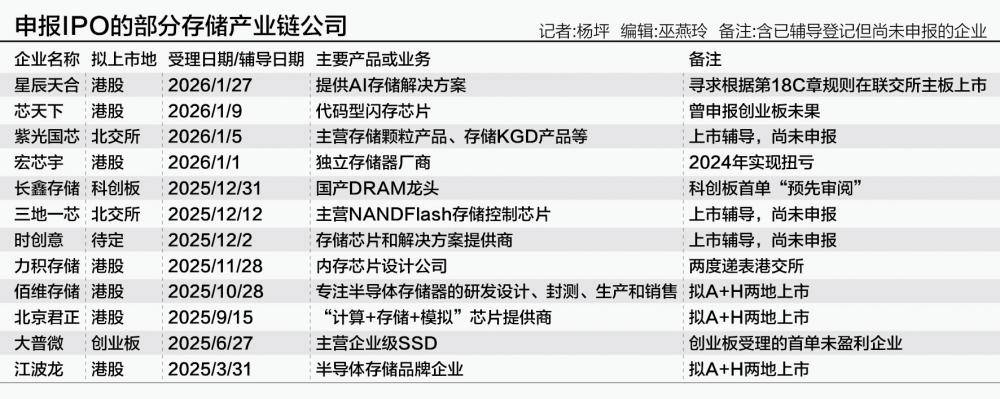
来源:21世纪经济报道 随着AI崛起引爆存储市场超级周期,国产存储厂商不仅迎来业绩上涨,更在资本化道路上加速竞跑。 继1月13日国内存储芯片厂商兆易创新正式登陆港股后,1月30日,全球最大的内存互连芯片厂商澜起科技也正式启动港股全球发售,预计在2 月9日开始在香港交易所挂牌交易,实现A+H两地上市。 这只是当前存储产业上市潮的一角。1月以来,又有三家存储企业向港股递交了上市申请,分别是独立存储器厂商宏芯宇电子、生产代码型闪 存芯片的企业芯天下、AI存储方案提供商星辰天合。其中,星辰天合拟寻求通过第18C章规则在联交所主板上市。 与此同时,北交所与创业板也迎来存储企业冲刺。 主营存储颗粒产品、存储KGD产品等的专精特新小巨人企业——紫光国芯在近期进行了上市辅导备案登记,拟申请在北交所上市。去年上半 年获得创业板受理的首家未盈利企业——大普微,也在1月19日收到了证监会的注册批文,有望成为企业级SSD第一股。 | 企业名称 拟上市地 受理日期/辅导日期 主要产品或业务 | | | | 备注 | | --- | --- | --- | --- | --- | | 星辰天合 港股 | | 2026/1/27 | 提供 ...

存储迎超级周期 部分厂商业绩大幅预喜
Zhong Guo Zheng Quan Bao· 2026-02-02 23:01
Group 1 - The global storage market is expected to experience a disruptive price increase starting in Q3 2025, with DRAM and NAND flash prices rising over 300% cumulatively, and forecasts indicate a further increase of 33%-38% for NAND and 55%-60% for DRAM in Q1 2026 [1][2] - Many storage companies are reporting strong performance, with 16 out of 25 companies forecasting positive earnings due to the high demand driven by AI and computing power industries, indicating a high prosperity cycle [1][2] - The structural supply-demand imbalance is primarily driven by AI, which has significantly increased memory demand, particularly from AI servers that consume 8-10 times more memory than standard servers, leading to a reduction in supply for consumer products [2] Group 2 - Companies like Baiwei Storage and Demingli are projecting substantial revenue growth for 2025, with Baiwei expecting revenues between 10 billion to 12 billion yuan (approximately $1.54 billion to $1.85 billion) and a net profit increase of 427.19% to 520.22% [3][4] - Demingli anticipates revenues of 10.3 billion to 11.3 billion yuan (approximately $1.59 billion to $1.74 billion) with a net profit growth of 85.42% to 128.21%, driven by AI demand and improved sales margins [3][4] - The industry is expected to enter a "super cycle" lasting 2-3 years, with supply capacity lagging behind demand growth, leading to significant price increases for DRAM and NAND products [5][6] Group 3 - Companies are enhancing their production capabilities, with Demingli planning to raise up to 3.2 billion yuan (approximately $490 million) for SSD and DRAM expansion projects [6] - Strategic acquisitions are being pursued by various companies to strengthen their product lines and supply capabilities, such as the acquisition of a majority stake in Noah Changtian by Purang Co. [6] - The overall market outlook remains positive, with companies like Jiangbolong establishing deep partnerships with major clients to ensure supply stability amid tight wafer supply conditions [6]
存储迎超级周期部分厂商业绩大幅预喜
Zhong Guo Zheng Quan Bao· 2026-02-02 20:45
Group 1 - The global storage market is expected to experience a disruptive price increase starting from Q3 2025, with DRAM and NAND flash prices rising over 300% [1] - Predictions indicate that NAND flash prices will increase by 33%-38% and general DRAM prices by 55%-60% in Q1 2026 [1] - 25 out of 41 storage companies have disclosed earnings forecasts, with 16 companies expecting positive results, driven by the AI and computing industry [1] Group 2 - The price surge is attributed to a structural supply-demand imbalance caused by AI, with AI servers consuming 53% of global memory monthly production [1] - Major manufacturers are shifting over 80% of their advanced production capacity to high-margin HBM, leading to a reduction in mature capacity [1] - The average inventory cycle for the DRAM industry is projected to drop to 10 weeks, indicating a tight supply situation [1] Group 3 - Domestic companies like Changxin Technology and Yangtze Memory are expected to benefit from increased opportunities in DDR4 and 3D NAND products due to foreign manufacturers focusing on high-end production [2] - Baiwei Storage anticipates revenues of 10 to 12 billion yuan in 2025, with a net profit increase of 427.19% to 520.22% [2] - Demingli expects revenues of 10.3 to 11.3 billion yuan in 2025, with a net profit increase of 85.42% to 128.21% [2] Group 4 - The company Shannon Chip Innovation expects over 40% revenue growth in 2025, with its brand "Haipu Storage" entering mass production [3] - The current market is viewed as a "super cycle" lasting 2-3 years, with supply capacity lagging behind demand growth [3] - Citigroup predicts average price increases of 88% for DRAM and 74% for flash products in 2026, higher than previous forecasts [3] Group 5 - Companies are focusing on inventory management and supply stability, with Baiwei Storage maintaining sufficient inventory levels [4] - Demingli plans to raise up to 3.2 billion yuan for SSD and DRAM expansion projects [4] - Several companies are pursuing acquisitions to enhance product lines and supply capabilities, such as Yingxin Development's acquisition of Guangdong Changxing Semiconductor [5]


去年净利增超五成,运力芯片龙头澜起科技H股上市在即
2 1 Shi Ji Jing Ji Bao Dao· 2026-02-02 09:53
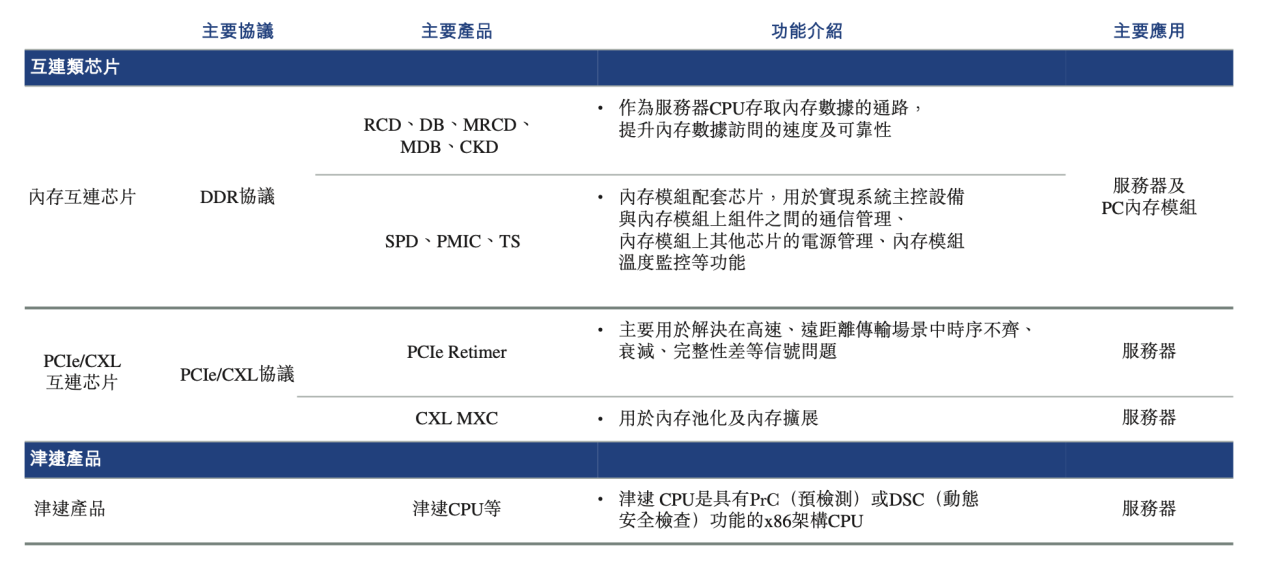
近日,澜起科技(688008.SH)正式启动H股公开招股,招股期自1月30日起,预计于2月4日结束,H股预计于2月9日在香港联交所主板挂牌并开始上市交 易。 作为科创板首批25家上市公司之一,澜起科技是全球领先的内存接口芯片企业。根据弗若斯特沙利文的资料,按收入计算,该公司在2024年位居全球最大的 内存互连芯片供应商,市场份额达36.8%。 从2025年6月宣告将在港股IPO,到2026年2月H股即将上市,澜起科技踩准了存储"超级周期"。 在刚刚过去的2025年,澜起科技预计实现归属于母公司所有者的净利润21.50亿元-23.50亿元,较上年同期增长52.29%-66.46%。其表示,受益于AI产业趋 势,行业需求旺盛,该公司互连类芯片出货量显著增加,推动2025年度经营业绩较上年同期实现大幅增长。 标准优势确立 2004年5月,杨崇和、StephenTai在上海联合创立了澜起科技。这一年,恰逢DDR2世代开启。 作为该市场的新进入者,澜起科技完成了DDR2高级内存缓冲芯片(AMB)的认证,在竞争激烈的内存接口芯片市场站住了脚跟。 但在DDR3时代,服务器内存市场发生了技术路线更迭:此前由英特尔力推的FBD ...

存储超级周期 又有三家国产厂商IPO竞速
2 1 Shi Ji Jing Ji Bao Dao· 2026-02-02 06:56
(原标题:存储超级周期 又有三家国产厂商IPO竞速) 随着AI崛起引爆存储市场超级周期,国产存储厂商不仅迎来业绩上涨,更在资本化道路上加速竞跑。 继1月13日,国内存储芯片厂商兆易创新正式登陆港股后,1月30日,全球最大的内存互连芯片厂商澜起科技也正式启动港股全球发售,预计在2月 9日开始在香港交易所挂牌交易,实现 A+H 两地上市。 从规模和体量来看,申报企业中既有已在A股上市的成熟企业,如佰维存储、北京君正,两企业总市值分别达到875 亿元、694亿元(截至1月30日 收盘)。此外,长鑫存储凭借295亿元的拟募资额,位居科创板开板以来第二大IPO(第一名为中芯国际)。同时,还有各大细分领域的领跑者。 值得关注的是,今年1月递表的三家存储产业链企业规模差异较大,收入从亿元到八十多亿不等,盈利周期均相对较短。 其中,1月27日递表的星辰天合,是中国最大的独立分布式AI存储解决方案提供商,有望冲刺港股"AI存储第一股"。 2023年、2024年及2025年前9个月,星辰天合的营收分别为1.67亿元、1.72亿元、1.95亿元,净利润为-1.81亿元、-0.84亿元、0.08亿元。 根据灼识咨询的资料,按2024 ...
存储超级周期,又有三家国产厂商IPO竞速
2 1 Shi Ji Jing Ji Bao Dao· 2026-02-02 06:24
Core Insights - The rise of AI has triggered a super cycle in the storage market, leading to increased performance for domestic storage manufacturers and accelerating their path to capitalization [1] - Multiple storage companies have submitted IPO applications, indicating a diverse and tiered advancement in the industry [3] Group 1: Market Trends - Since January, several storage companies have filed for IPOs in Hong Kong, including Micron Technology, Starry Sky Technology, and Chip Universe, reflecting a growing trend in the storage industry [1][3] - The top five distributed AI storage solution providers in China hold a combined market share of 52.3%, with Starry Sky Technology ranking second at 10.4% [4] Group 2: Company Performance - Zhaoyi Innovation's stock price surged by 106.79% since its debut on January 13, reaching a market capitalization of 245.3 billion HKD by January 30 [7] - Micron Technology, the largest independent storage manufacturer in China, reported stable revenue of 8.78 billion CNY, 8.72 billion CNY, and 7.74 billion CNY for the first three quarters of 2023, 2024, and 2025 respectively [6] - Starry Sky Technology, aiming to be the first AI storage stock in Hong Kong, reported revenues of 167 million CNY, 172 million CNY, and 195 million CNY for 2023, 2024, and the first nine months of 2025, with a net profit turning positive in 2025 [3][4] Group 3: Investment Dynamics - The current IPO wave is driven by emerging demands in AI and automotive electronics, supported by a favorable capital market environment [6][9] - The cautious expansion strategies of leading companies have reinforced supply-demand imbalances, providing ongoing support for price increases and corporate profitability [9]
未知机构:光大证券科技研究两光符合预期存储超级周期航天全面超预期20260202-20260202
未知机构· 2026-02-02 02:00
【光大证券科技研究】两光符合预期、存储超级周期、航天全面超预期-20260202 一、AI:两光符合预期 1.1、中际旭创2025年归母净利润98~118亿元,剔除股权激励前的净利润108-131亿元。 一、AI:两光符合预期 1.1、中际旭创2025年归母净利润98~118亿元,剔除股权激励前的净利润108-131亿元。 2025Q4约27~47亿元,中值约37亿元。 考虑2025Q4约~2亿元汇兑损失和研发费用等扰动客户,2025Q4中值39亿元符合预期,2025Q4上限49亿元超预 期。 1.2、新易盛2025年归母净利润94~99亿元,2025Q4约31~36亿元,符合预期。 1.3、Scale Up有望新增数百亿美元以上市场空间,Scale Up NPO/CPO将为光模块公司打开全新空间。 OCS、3.2T铌酸锂光模块等创新不断。 2025Q4约27~47亿元,中值约37亿元。 考虑2025Q4约~2亿元汇兑损失和研发费用等扰动客户,2025Q4中值39亿元符合预期,2025Q4上限49亿元超预 期。 【光大证券科技研究】两光符合预期、存储超级周期、航天全面超预期-20260202 #存储行业建议关 ...


“存储模组一哥”业绩大爆发!
是说芯语· 2026-02-02 00:21
Core Viewpoint - Jiangbolong (301308), a leading domestic storage company, is expected to achieve significant growth in its 2025 performance, with a projected net profit increase of over 210% year-on-year and a non-recurring profit increase exceeding 700% [1][3]. Financial Performance - For the fiscal year 2025, Jiangbolong anticipates revenue between 22.5 billion to 23 billion yuan, a steady increase from 17.464 billion yuan in 2024 [3]. - The projected net profit attributable to shareholders is expected to reach between 1.25 billion to 1.55 billion yuan, reflecting a year-on-year growth of 150.66% to 210.82% [3]. - The net profit after deducting non-recurring items is forecasted to be between 11.3 billion to 13.5 billion yuan, with a staggering year-on-year increase of 578.51% to 710.60% [3]. - The fourth quarter's non-recurring net profit is estimated to be around 650 million to 870 million yuan, indicating strong growth momentum in the second half of the year [3]. Market Dynamics - In 2025, storage prices are expected to stabilize after hitting a low in the first quarter, with demand from AI server requirements and a shift in production capacity towards enterprise-level products exacerbating supply-demand conflicts [3][7]. - The global storage industry is currently experiencing a rare super cycle characterized by simultaneous increases in volume and price, driven by high demand from AI servers and data centers [7][10]. - The price of DDR4 has surged nearly 30% in less than a month, with a cumulative increase of over 200% in six months, and predictions indicate that NAND Flash prices will rise by 33% to 38% in early 2026 [8][10]. Technological Advancements - Jiangbolong has successfully completed the first tape-out of the UFS 4.1 main control chip, positioning itself among the few companies globally with self-research capabilities for this generation of chips [4]. - The company has established deep collaborations with several wafer manufacturers and leading smart terminal manufacturers, with flagship storage products set for mass shipment [4]. Strategic Initiatives - Jiangbolong plans to raise 3.7 billion yuan to focus on the development of storage product application technologies, NAND Flash main control chip design, and storage chip packaging testing [5]. - The company is exploring a PTM model to enhance industry collaboration through technology customization and localized services, aiming to become a core supplier in the smart wearable storage market [5][11]. Industry Outlook - The high prosperity of the storage industry is expected to continue, with the super cycle potentially extending until 2027 or beyond, driven by ongoing AI infrastructure development [10][11]. - Domestic storage companies are likely to capture market share in traditional and mid-to-high-end segments as international manufacturers shift focus to high-end products [11].
存储“超级周期”来了, 涨价持续到何时?
Zhong Guo Zheng Quan Bao· 2026-02-01 23:14
Core Viewpoint - The global storage market is expected to enter a price increase phase starting from Q3 2025, driven by structural supply-demand imbalances due to the AI wave, with significant price hikes projected for NAND flash and DRAM products [1][2]. Group 1: Price Increase Drivers - The primary driver of the price increase is a structural supply-demand imbalance caused by AI, leading to a surge in memory demand for AI servers, which is 8-10 times that of regular servers, thereby squeezing supply for consumer products [1]. - Major manufacturers like Samsung and SK Hynix are shifting over 80% of their advanced production capacity to high-margin HBM, resulting in a reduction of mature capacity [1]. - TrendForce predicts that by 2025, the average inventory cycle for the DRAM industry will drop to 10 weeks, with original factory inventory at a critically low level of 2-4 weeks [1]. Group 2: Duration of Price Trends - The storage industry is anticipated to experience a "super cycle" lasting 2-3 years, as capacity release lags behind demand growth [2]. - TrendForce forecasts that in Q1 2026, contract prices for general DRAM will increase by 55%-60%, while NAND flash products will see a rise of 33%-38% [2]. - Citigroup expects average selling prices for DRAM and flash products to rise by 88% and 74%, respectively, surpassing previous estimates [2]. Group 3: Impact on Downstream Industries - The consumer electronics, automotive electronics, and cloud computing sectors will be significantly affected by the storage price increases [3]. - In consumer electronics, the proportion of storage costs in the BOM is expected to rise from 20% to over 30%, leading to price increases for laptops by 500-1500 yuan [3]. - The automotive sector anticipates a 50% price increase for automotive-grade DDR4, with companies like Xiaomi and NIO highlighting the substantial cost pressures from rising memory prices [3]. Group 4: Opportunities for Domestic Storage Companies - Domestic storage companies such as Changxin Technology and Yangtze Memory are expected to benefit from the market space left by overseas manufacturers focusing on high-end products [5]. - Companies involved in equipment and materials are also likely to gain from the expansion needs of storage manufacturers, with firms like Baiwei Storage and Demingli projecting significant performance improvements in 2025 [5]. Group 5: Recommendations for Consumers and Investors - For consumers with rigid demand, early purchases are advised to avoid further cost increases, while non-essential purchases can be delayed [6]. - Investors should focus on core segments of the storage industry chain, including upstream equipment materials and midstream IDM manufacturers, considering the technological strength and capacity release pace of companies [6].