智能消费

Search documents
全文|商务部等9单位关于印发《2026“乐购新春”春节特别活动方案》的通知
Xin Lang Cai Jing· 2026-02-02 03:39
商务部等9单位关于印发《2026"乐购新春"春节特别活动方案》的通知 来源:消费促进司 金融监管总局 广电总局 体育总局 中国民航局 中央宣传部、中央网信办、商务部、文化和旅游部、中国人民银行、金融监管总局、广电总局、体育总 局、中央广电总台、中国民航局、中国国家铁路集团有限公司,各省、自治区、直辖市及计划单列市、 新疆生产建设兵团党委宣传部门,网信、商务、文化和旅游、广播电视、体育主管部门,中国人民银行 上海总部,各省、自治区、直辖市及计划单列市分行,金融监管总局各监管局,民航各地区管理局,各 铁路局集团公司: 为贯彻落实党的二十届四中全会和中央经济工作会议精神,按照国务院部署,繁荣节日市场,激发消费 活力,更好满足人民美好生活需要,商务部会同有关部门研究制定了《2026"乐购新春"春节特别活动方 案》,现予以印发。请各地区各部门提高政治站位,加强组织领导,健全工作机制,强化协同联动,确 保活动取得实效;加强节日市场监测,综合利用大数据等各种手段,多维度分析评价活动成效,全方位 反映春节消费市场情况;统筹发展和安全,严格落实安全生产各项要求,确保各项活动安全有序开展。 商务部 中央宣传部 文化和旅游部 中国 ...


创新供给激发消费活力(专家点评)
Ren Min Ri Bao· 2026-01-23 22:27
今冬消费市场热潮涌动,不仅是季节性文旅的繁荣,更是我国消费市场持续升级、内需潜能加速释放的 生动缩影。 冬日消费的暖流,映射出中国市场的深厚底蕴与创新活力。未来,以科技赋能场景创新、政策保障民生 需求、产业融合生态重构为主线,银发经济、智能消费、绿色经济等新增长极释放潜力,"供给端提 质"与"需求端挖潜"双向发力,将为经济高质量发展注入持久动能。 (作者为全国政协常委、中国企业财务管理协会会长,本报记者杨昊采访整理) (文章来源:人民日报) 当前,体验式、沉浸式消费成为主流,冰雪运动从专业竞技走向大众休闲,与城市观光、民俗文化深度 融合;国潮IP、非遗元素与消费场景的创新结合,既满足了品质追求,也增强了文化认同;全龄化、普 惠性需求日益凸显,消费活力正加速向更广泛人群和地域渗透。以需求为导向、以融合为手段、以品质 为核心的创新供给,正成为激活消费、牵引经济的重要动力。 以融合创新持续创造新供给。打破产业与消费场景界限,系统推进"文旅+""体育+""数字+",鼓励冰 雪、康养与乡村生态、文化遗产、科技体验深度融合,发展全季、全龄、全域的融合型产品。 以精准适配充分满足分层需求。建设更多普惠便民、贴近社区的消费基 ...
商务部:截至去年底,每售出10辆乘用车就有6辆是新能源车
Nan Fang Du Shi Bao· 2026-01-22 08:43
Group 1 - The core viewpoint is that China's consumption market is expected to maintain stable growth in 2025, with both scale and quality improving, showcasing the advantages of a super-large market [1] Group 2 - The total retail sales of consumer goods are projected to exceed 50 trillion yuan for the first time, reaching 50.1 trillion yuan, a 3.7% increase from the previous year, with final consumption expenditure contributing 52% to economic growth [1] - The implementation of the old-for-new consumption policy led to sales in related categories reaching 2.61 trillion yuan, benefiting 366 million people [1] - Retail sales of household appliances, furniture, cultural office supplies, and communication equipment increased by 11%, 14.6%, 17.3%, and 20.9% respectively [1] Group 3 - New types of consumption, such as green and smart products, are thriving, with retail sales of new energy vehicles growing by 17.6%, and by the end of 2025, 6 out of every 10 passenger cars sold are expected to be new energy vehicles [1] - The number of consumers purchasing first-level energy-efficient or water-efficient appliances is expected to increase by 20% compared to the previous year, with smart glasses, smartwatches, and smart bands each growing over 40% [1] - Health-related consumption is expanding, with retail sales of sports and entertainment products increasing by 15.7% [1] Group 4 - The Ministry of Commerce will continue to combine benefits for the public and promote consumption through a dual approach of "policy + activities" to continuously unleash consumption potential [2]
上海“十五五”规划建议:大力发展文化、旅游、体育、健康等改善型服务消费
Zheng Quan Shi Bao Wang· 2026-01-18 23:54
Core Viewpoint - The Shanghai Municipal Committee has released recommendations for the 15th Five-Year Plan, emphasizing the implementation of strategies to expand domestic demand and enhance consumption [1] Group 1: Consumption Strategies - The plan includes a continuation of special actions to boost consumption and the development of Shanghai as an international consumption center [1] - There is a focus on expanding service consumption, particularly in cultural, tourism, sports, and health sectors, to improve the quality of service supply [1] - The initiative promotes green and smart consumption, aiming to upgrade and expand product consumption [1] Group 2: Innovation and Integration - Encouragement for innovation in consumption models and formats, promoting the integration of online and offline consumption [1] - The plan supports the development of "AI + consumption," intellectual property derivative products, and interactive, immersive, and experiential consumption [1] - There is a push for the growth of the live-streaming economy and the deep integration of culture, tourism, commerce, and sports [1] Group 3: Economic Environment and Infrastructure - The recommendations include optimizing the consumption environment and advancing the construction of world-class business districts [1] - Development of distinctive commercial streets and enhancement of tax refund and cross-border payment convenience to increase inbound consumption [1] - The plan aims to create an all-age-friendly quality living circle to better match supply and demand in consumer goods, stimulating consumption potential among the elderly and youth [1]
“新国补”落地 持续激发市场活力
Yang Shi Wang· 2026-01-15 12:01
Core Viewpoint - The implementation of the new round of consumer goods replacement subsidy policy has accelerated the revitalization of the consumption market across various regions in China, with local governments optimizing consumption scenarios and services to enhance consumer experience [1] Group 1: Policy Implementation and Local Initiatives - Anhui province is promoting the subsidy policy by integrating it into communities, enterprises, and townships, creating "policy + experience" consumption scenarios with designated "subsidy product experience zones" [1] - In Hunan, collaboration between manufacturers and stores, along with increased subsidy efforts, has attracted consumers, resulting in the issuance of government subsidies amounting to 232 million yuan, which directly drove sales to 1.699 billion yuan [1] Group 2: Market Trends and Consumer Behavior - The upgraded "national subsidy" has sparked a surge in the consumption of green and smart products, with energy-efficient appliances becoming mainstream in Liaoning as consumers are incentivized to choose energy-saving and water-saving options [1] - In Sichuan, new subsidy categories such as smart glasses and smartwatches have attracted younger consumers, becoming a new growth point in the digital consumption market and meeting the demand for high-tech products [1] - In Shanxi, the daily sales of related digital products have shown continuous growth, with merchants offering additional subsidies for trade-ins and interest-free installment plans, creating a synergistic effect with government consumption vouchers to stimulate consumer purchasing enthusiasm [1]
发布28条政策促进消费和服务业联动发展 上海:优化汽车贷款流程 放宽申请条件
Zhong Guo Zheng Quan Bao· 2026-01-13 21:03
Group 1 - The core viewpoint of the article is the introduction of 28 policy measures by the Shanghai Municipal Government to enhance service quality and boost consumption across six key sectors: finance, information services, transportation, cultural and entertainment services, life services, and inspection and certification [1][3] Group 2 - In the financial sector, the measures encourage innovation in financial products tailored to new consumption trends, such as holiday, night, nostalgic, and anime economies, and include personal consumption loan interest subsidies and optimized auto loan processes [1][2] - In transportation services, the government supports airlines in launching new international routes and developing luxury tourism trains, as well as enhancing airport commercial layouts to create composite consumption scenarios [2] - In the cultural and entertainment sector, there is a focus on promoting the gaming and esports industry, supporting the development of original IP games, and incentivizing quality micro-short film content creation [2] Group 3 - The next steps involve ensuring the effective implementation of the measures by coordinating service supply with consumer demand, promoting digital, green, and intelligent consumption, and enhancing service quality [3] - The government aims to create a favorable environment for sustained consumption growth by implementing fiscal and financial support policies and improving service quality management and brand building [3]
上海发布28条新政促消费
第一财经· 2026-01-13 10:11
Core Viewpoint - The article discusses the recent measures introduced by Shanghai to enhance the quality of the service industry and stimulate consumption, emphasizing a strategic shift from short-term stimulus to long-term systemic development [3][5]. Group 1: Policy Measures - Shanghai has issued 28 policy measures aimed at optimizing supply and expanding consumption to foster new growth points in service supply and consumer demand [3][5]. - The focus of the new policies is on systemic linkage, emphasizing quality competition on the supply side to enhance service industry value and stimulate consumption [3][6]. Group 2: Economic Context - Since 2025, Shanghai's service industry has shown a positive growth trend, with a 5.9% increase in value added and a 5% rise in retail sales of consumer goods, both surpassing national averages [5][6]. - The measures aim to address challenges such as supply structure lagging behind consumption upgrades and the need for better integration of service and consumption sectors [5][6]. Group 3: Key Industries - The policies target six key sectors: finance, information services, transportation, cultural and entertainment services, life services, and inspection and certification, which together account for about 60% of Shanghai's service industry value added [7][8]. - The integration of these sectors is expected to create a closed-loop policy chain that enhances service consumption [7]. Group 4: Financial Innovation - The new policies emphasize the integration of consumption scenarios with consumer finance, supporting the development of financial products tailored to needs such as elderly care and wealth management [8]. - E-commerce platforms are encouraged to shift from price competition to quality competition, driving traffic to offline and quality consumption [8]. Group 5: Cultural and Entertainment Sector - The measures include initiatives to enhance the supply of cultural and entertainment services, such as supporting high-quality exhibitions and sports events, which have shown significant demand growth [9]. - For instance, a recent exhibition in Shanghai attracted over 2.77 million visitors and generated over 760 million yuan in revenue, significantly boosting overall city consumption [9]. Group 6: Institutional Support - The policies aim to strengthen institutional support by transitioning from policy support to a dual-driven approach of "institution + market," focusing on regulatory standards and credit systems to foster sustainable development [10]. - Key initiatives include enhancing brand certification, improving standard systems, and strengthening inspection and testing services to boost consumer confidence [10]. Group 7: Implementation and Coordination - The Shanghai government plans to ensure effective implementation of the measures by coordinating service supply with consumer demand and creating a conducive environment for policy support [12][13]. - Emphasis is placed on cross-departmental collaboration to avoid policy fragmentation and to establish a dynamic evaluation mechanism to monitor the effectiveness of the policies [13].
刚刚,上海宣布大利好
中国基金报· 2026-01-13 03:52
Core Viewpoint - Shanghai's government has released 28 measures to enhance the quality and efficiency of the service industry and stimulate consumption, focusing on optimizing supply and expanding demand to achieve mutual empowerment and progress [5][12]. Group 1: Background and Considerations - The measures are in response to the 20th National Congress's call to expand domestic demand and the Central Economic Work Conference's emphasis on boosting consumption and service industry capacity [5]. - In the first three quarters of 2025, the service industry's added value grew by 5.9%, and retail sales of consumer goods increased by 5%, both surpassing national averages [5]. - The measures aim to create new growth points in service supply and consumption demand, promoting high-quality development in the service sector [6]. Group 2: Key Measures - The focus is on six key sectors: finance, information services, transportation, cultural and entertainment services, life services, and inspection and certification, which together account for about 60% of the city's service industry value [7]. - Financial services will be enhanced to support diverse consumer needs, including the development of new financial products tailored to various consumption scenarios [7][13]. - E-commerce platforms will be encouraged to shift from price competition to quality competition, driving offline consumption and enhancing consumer experience [7][16]. Group 3: Transportation and Cultural Services - Transportation services will be improved to connect various consumption scenarios, enhancing the overall consumer experience and reducing travel costs [8][17]. - Cultural and entertainment offerings will be expanded, including support for high-quality exhibitions and events that drive significant economic impact [9][19]. - The gaming and esports industry will be developed further, with initiatives to support high-level competitions and foster a robust ecosystem [9][20]. Group 4: Life Services and Quality Improvement - Life services will be enhanced to improve quality and convenience, including initiatives for home care, elderly care, and healthcare services [10][22]. - The government will support the transformation of home service companies into employee-based models, enhancing service quality and providing insurance for service personnel [22][23]. - Medical services will be diversified, promoting high-end healthcare and encouraging the development of specialized insurance products [23][24]. Group 5: Brand and Standards Enhancement - The measures will strengthen brand certification and establish a robust standard system to enhance consumer trust and service quality [11][24]. - The inspection and certification industry will be supported to improve service capabilities, focusing on high-demand sectors such as food and cosmetics [11][25]. - A consumer credit system will be developed to promote transparency and trust in the marketplace [11][26]. Group 6: Support and Talent Development - The government will enhance financial support for service providers, ensuring effective use of fiscal resources to stimulate growth [27][28]. - Talent attraction initiatives will be implemented to draw skilled professionals to the service and consumption sectors, fostering innovation and development [28][29]. - Statistical monitoring will be improved to assess the effectiveness of policies and optimize measures for service industry growth [28].
“两新”激发中国制造新动能
Jing Ji Ri Bao· 2026-01-08 21:43
Core Viewpoint - The "Two New" policy aims to inject new momentum into Chinese manufacturing by driving investment and consumption, facilitating a transition from a manufacturing power to a manufacturing stronghold [1][4]. Investment and Consumption - The National Development and Reform Commission and the Ministry of Finance have optimized the support scope, subsidy standards, and implementation mechanisms of the "Two New" policy [1]. - A total of 625 billion yuan in special long-term bonds for the first batch of the consumption upgrade plan has been allocated ahead of schedule for 2026 [1]. - From January to November 2025, investment in equipment and tools increased by 12.2% year-on-year, contributing 1.8 percentage points to overall investment growth [1]. Market Opportunities - The "old-for-new" consumption policy has opened new market spaces for durable consumer goods, with sales expected to exceed 2.6 trillion yuan in 2025 [2]. - Specific figures include over 11.5 million vehicles, 129 million home appliances, 9.1 million digital products, and 12 million home renovation items being replaced [2]. Upgrading Manufacturing - The "Two New" policy not only stimulates investment and consumption but also drives quality upgrades in Chinese manufacturing [2]. - Companies are replacing outdated equipment with new technology, improving production efficiency and product competitiveness, which encourages further R&D investment [2]. Transition to High-End Manufacturing - There is a growing preference for smart and green products, with nearly 60% of replaced vehicles being new energy vehicles and over 90% of replaced home appliances being energy-efficient [3]. - The policy optimization is expected to invigorate more small and medium-sized enterprises (SMEs) by lowering investment thresholds and streamlining application processes [3].
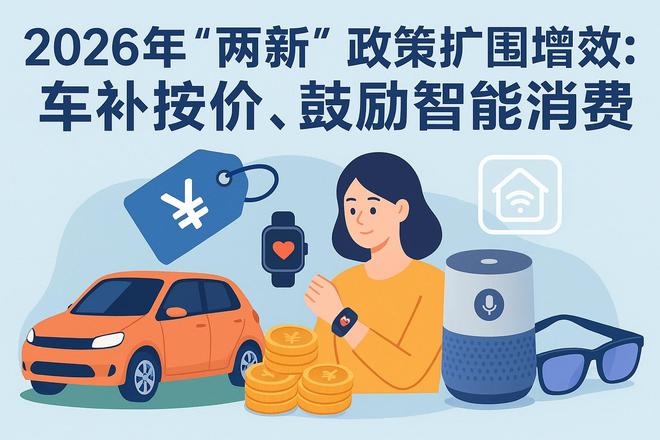
2026年“两新”政策扩围增效:车补按价、鼓励智能消费
Zhong Guo Jing Ying Bao· 2026-01-06 09:09
Core Viewpoint - The 2026 "Two New" policy aims to proactively address economic challenges and promote high-quality development through early implementation and expanded support for equipment updates and consumer goods replacement programs [2][8]. Group 1: Policy Implementation - The National Development and Reform Commission and the Ministry of Finance have issued a notice detailing the support scope and subsidy standards for the 2026 "Two New" policy [2]. - The policy is designed to maintain continuity with the 2025 economic work conference's emphasis on optimizing the "Two New" policy implementation [2]. Group 2: Coverage Expansion - The 2026 policy expands its coverage to include updates for old community elevators, equipment for elderly care institutions, and commercial facilities such as shopping centers and supermarkets [3]. - New subsidies for smart products have been introduced, covering smart watches, smart glasses, and smart home products, including those designed for elderly users [3]. Group 3: Structural Adjustments - The subsidy standards have been optimized, with a focus on electric vehicles and higher-priced consumer goods [6]. - The adjustment in subsidies for automobiles from fixed amounts to a percentage of the vehicle price indicates a shift towards supporting higher-value purchases [6]. Group 4: Funding and Timing - The first batch of 625 billion yuan in special long-term bonds for 2026 has been allocated earlier than in 2025, indicating a focus on quickly realizing policy effects [6][7]. - The total funding for the 2026 "old for new" program is estimated to be around 250 billion yuan, which is expected to generate approximately 625 billion yuan in consumption growth [7]. Group 5: Long-term Strategy - The policy aims to balance short-term economic support with long-term transformation by leveraging market forces to upgrade demand and innovate supply [8].