
硬科技

Search documents
创投行业当前市场现状分析及展望:科创类 IPO 增加,创投类企业业绩向好
GUOTAI HAITONG SECURITIES· 2026-03-02 13:38
Investment Rating - The report rates the industry as "Buy" [5] Core Insights - The venture capital industry is experiencing its first rebound in four years, with improvements in fundraising, investment, and exit channels, and an expected increase in technology IPOs in the future [2] - Venture capital firms are actively investing in hard technology sectors, indicating a positive outlook for industry performance [2] Summary by Sections 1. Overview of Venture Capital Firms - Venture capital firms focus on early-stage and growth-stage technology companies, acting as key financial intermediaries connecting social capital with these enterprises through a full cycle of fundraising, investment, management, and exit [9] - Their core business model relies on professional research to select targets and enhance post-investment growth, ultimately achieving capital appreciation through IPOs and mergers [9][10] 2. Recovery of the Primary Market - Fundraising: In 2025, the number of newly registered funds increased for the first time in four years, with a total registered capital of approximately 2.79 trillion yuan, a year-on-year growth of 15.49% [13] - Investment: The number of transactions in 2025 reached 9,058, surpassing 2024 and 2021 levels, indicating a significant recovery in market activity [20] - Exit: The number of IPOs and fundraising amounts for technology companies in A-shares and Hong Kong stocks saw substantial increases, with Hong Kong IPO fundraising rising over fourfold in 2025 [27] 3. Investment Recommendations - It is recommended to increase holdings in venture capital-related private equity investment management companies, particularly those with rich technology project reserves and state-owned backgrounds focused on hard technology sectors [39] - Notable companies include China Everbright Holdings and Sichuan Shuangma, with beneficiaries such as Yuexiu Capital and Luzhou Laojiao [39][41]


一级市场再迎活水!510亿元央企战新基金正式“开闸”
Shang Hai Zheng Quan Bao· 2026-02-28 02:58
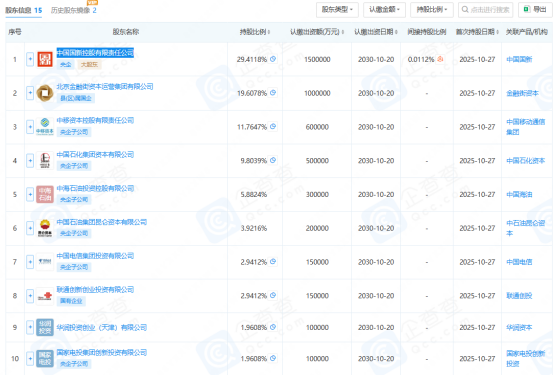
Group 1 - The core point of the article is the launch of the Central Enterprise Strategic Emerging Industry Development Fund, marking its transition to market-oriented investment operations [1][3] - The fund, initiated by the State-owned Assets Supervision and Administration Commission (SASAC), has a total scale of 51 billion yuan, with China Guoxin contributing approximately 15 billion yuan [3][5] - The fund's investment period is set for 5 years, with a total management and exit period of 8 years, extendable to 15 years [3] Group 2 - The fund will focus on investing in sectors such as new generation information technology, artificial intelligence, new energy, new materials, high-end equipment, biomedicine, and quantum technology [3] - At least 70% of the investments will target emerging and future industries, with a significant emphasis on early-stage technology companies and unicorns [3][10] - The fund aims to support key core technology breakthroughs and strengthen the industrial chain, with at least 50% of investments directed towards A-round financing and earlier projects [3] Group 3 - The article highlights the increasing concentration of state-owned capital in strategic emerging industries, as emphasized by national policies [7][9] - By 2025, state-owned fund management entities are projected to dominate the market, managing 70% of the total fund size, with a significant increase in the scale of state-owned funds since 2014 [10] - The government is shifting towards refined management of investment funds, aiming to enhance the role of state-owned capital in driving technological innovation and industrial development [10]

科创板指数将进行一季度样本调整
Zheng Quan Ri Bao· 2026-02-28 01:11
Group 1 - The core announcement is about the quarterly adjustment results of the Sci-Tech 50 and other indices, which will be implemented after the market closes on March 13 [1] - Three companies, including Keda Guandun Quantum Technology Co., Ltd., Shenzhen Zhongke Feimeng Technology Co., Ltd., and Zhongke Xingtai Co., Ltd., will be added to the Sci-Tech 50 Index, while ten other securities will be added to the Sci-Tech 100 Index [1] - After the adjustments, the total market capitalization of the Sci-Tech 50 Index will be 4.5 trillion yuan, covering 39% of the market, while the Sci-Tech 100 Index will have a total market capitalization of 2.7 trillion yuan, covering 24% of the market, resulting in a combined coverage of 63%, an increase of 1.1% [1] Group 2 - The Shanghai Stock Exchange has been enhancing its "one body, two wings" index system to improve the quality and diversity of indices, effectively supporting long-term capital inflow and national strategic initiatives [2] - The periodic adjustments of existing indices aim to optimize industry structures, with the weight of information technology and other "new economy" sectors increasing by 4.9% and 4.7% respectively by the end of 2024 [2] - The newly launched indices cover the entire market capitalization and industry chain of the Sci-Tech Board, guiding over 320 billion yuan into "hard technology" companies [2]



综艺股份:公司于2025年完成对功率半导体企业吉莱微的重大资产购买
Zheng Quan Ri Bao· 2026-02-27 12:06
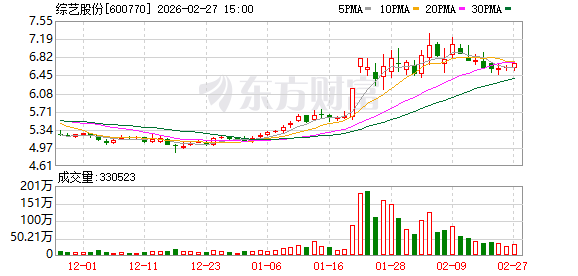
Core Viewpoint - The company is in a good operational state and is focusing on strategic investments in the semiconductor industry, particularly through the acquisition of a power semiconductor company, Jilaiwei, by 2025 [2] Group 1: Company Strategy - The company plans to complete a significant asset purchase of Jilaiwei, entering the research, production, and sales of power semiconductor chips and devices by 2025 [2] - The company’s investment platform, Jiangsu High-Tech Industry Investment Co., Ltd., is focusing on hard technology and new production capabilities, particularly in strategic emerging industries like semiconductors [2] - The management emphasizes the importance of shareholder interests and aims to enhance core competitiveness while concentrating resources on high-value, high-tech integrated circuit sectors [2] Group 2: Future Outlook - The company will disclose its operational performance for 2025 and its business plan for 2026 in the annual report for 2025 [2] - The company is committed to solidifying its core business and internal management to ensure sustainable growth and return on investment for shareholders [2]

长城基金:市场主线逐渐清晰,硬科技与顺周期机会凸显
Xin Lang Cai Jing· 2026-02-27 11:51
Core Viewpoint - The A-share market has shown a continuation of the risk appetite recovery observed before the Spring Festival, characterized by "increased volume and structural differentiation" in the first trading week after the holiday [1][3]. Market Performance - The overall market trend is influenced by rising overseas uncertainties, with geopolitical and tariff narratives resurfacing, leading to a pullback in the Hong Kong stock market while energy and resource sectors perform relatively well [1][3]. - A-shares exhibit a stronger internal momentum, maintaining high trading volumes with total turnover exceeding 2 trillion yuan [1][3]. Market Structure - The market style has shifted from a focus on "pure software/AI applications" to "hard technology + cyclical stocks" [1][3]. - The cyclical sector has shown a phase of strength, driven by geopolitical risk premiums pushing up energy prices and uncertainties around tariffs leading to "re-inflation trades" [1][3]. - The hard technology sector is characterized by a "discerning" approach, with funds favoring companies with verifiable orders and performance in the computing hardware chain (e.g., optical communication, PCB, liquid cooling), while being sensitive to AI software themes lacking performance validation [1][3]. Investment Strategy - The first week after the holiday has reinforced market risk appetite, but variables such as overseas geopolitical issues, tariffs, and interest rate expectations may amplify volatility [4]. - The current investment focus is clear, transitioning from narrative-driven to performance-driven, with attention on the following areas: - Emphasis on "performance verification" and "domestic substitution," particularly in AI computing hardware chains, semiconductor equipment, and materials, while avoiding high-volatility stocks without performance support [4]. - Focus on cyclical and resource sectors, leveraging the "hedging attributes" of geopolitical premiums and re-inflation, with potential value in energy, precious metals, and non-ferrous metals, while also considering traditional industries benefiting from "anti-involution" [4]. - Defensive and thematic directions, suggesting high-dividend sectors may offer some "anti-volatility" value amid increased fluctuations, with recommendations to base themes on policy documents and industry progress, avoiding purely conceptual extrapolations [4].
力合科创:公司投资孵化业务以科技成果转化项目投资为核心
Zheng Quan Ri Bao Wang· 2026-02-27 11:11
Core Viewpoint - The company focuses on investment incubation in technology transformation projects, adhering to a strategy of "early, small, and hard technology" to provide financial support for tech enterprises [1] Group 1: Investment Strategy - The investment incubation business targets "hard technology" sectors such as new generation information technology, advanced manufacturing, new energy materials, and biomedical [1] - The investment stages are primarily focused on angel, startup, and growth phases, extending coverage to the front end of the technology industry chain, including concept validation and pilot testing [1] - The approach encompasses the entire lifecycle of technology enterprise development [1]

AI话题引领“科创热” 鹏华“科创股债ETF大厂”全产品线布局硬科技新机遇
Cai Fu Zai Xian· 2026-02-27 04:30
Group 1 - The core highlight of the 2026 Spring Festival Gala is the integration of AI and humanoid robots, showcasing the fusion of technology and art, which draws national attention to the development of new productive forces [1] - Penghua Fund has established a comprehensive ETF matrix for the sci-tech sector, with 13 sci-tech themed ETFs totaling over 36 billion yuan, covering broad-based, industry, thematic, and bond types, making it a preferred tool for investors [1] - The AI-focused ETFs from Penghua Fund have shown significant performance, with the Penghua Sci-Tech AI ETF (589090) tracking the AI index rising by 35.52% in the past year, while the Penghua Sci-Tech Entrepreneurship AI ETF (588410) surged by 87.23% [2] Group 2 - Institutions have reached a consensus on the value of allocating to technology assets, with strong demand for computing power driven by advancements in AI models, indicating a shift towards monetization in the AI industry [3] - The market is expected to maintain a volatile upward trend post-holiday, with cyclical price increases and the expansion of AI themes as the main market drivers [3] - Penghua Fund continues to focus on the sci-tech investment ecosystem, offering standardized, low-cost ETF products that help investors capture sector benefits while mitigating individual stock selection risks [3]
2.27犀牛财经早报:IDC预计全球智能手机市场今年将萎缩13%
Xi Niu Cai Jing· 2026-02-27 01:31
Group 1 - The People's Bank of China has decided to lower the foreign exchange risk reserve ratio for forward foreign exchange sales from 20% to 0% starting March 2, 2026, to support enterprises in managing exchange rate risks and promote the development of the foreign exchange market [1] - The A-share merger and acquisition market has seen over 500 transactions since the beginning of the year, with a total value of approximately 130 billion yuan, marking a year-on-year increase in activity, particularly in the hard technology sector [1] Group 2 - In 2026, China plans to implement two manned spaceflight missions and one cargo supply mission, while also advancing the construction of lunar landing support facilities [2] - IDC forecasts a 12.9% decline in the global smartphone market in 2026 due to an unprecedented shortage of storage chips, which poses a significant threat to many smartphone manufacturers' business models [2] Group 3 - The cement industry is experiencing a positive start to 2026 with major projects commencing, although overall cement prices are expected to decline throughout the year [3] - The AI industry is entering a phase focused on commercial viability, with significant investment opportunities emerging in domestic AI chip development [3] Group 4 - Several domestic chip companies have announced price increases of at least 10% due to rising costs of upstream raw materials and key precious metals [5] - The controlled nuclear fusion sector is attracting significant investment from state-owned and industrial capital, indicating a growing interest in this technology as a potential solution to energy supply issues [5] Group 5 - Netflix has opted not to increase its bid for Warner Bros, allowing Paramount to win the acquisition, as Netflix deemed the deal financially unattractive [6] - Li Ka-shing's companies have agreed to sell their 100% stake in UK Power Networks for over 110 billion Hong Kong dollars, which will provide substantial accounting gains and cash for future investments [6] Group 6 - Stellantis reported a net loss of 22.3 billion euros for 2025, primarily due to restructuring costs, despite signs of recovery in the latter half of the year [7] - A dental robotics company, Shanghai Yangshan Medical Technology, has completed nearly 100 million yuan in Pre-A financing, led by a strategic investment from Aidi Tech [7] Group 7 - Jianghe Creation announced that an independent director is unable to perform duties due to involvement in a legal case, although it does not affect the company's operations [8] - Luyuan Energy reported a 20.49% decline in net profit for 2025, attributed to exchange rate fluctuations and increased management costs [12] Group 8 - The stock price of Beiliang Technology fell significantly due to a 28.94% decline in revenue and a net loss of approximately 89.3 million yuan for 2025 [14] - Teruide has submitted an application for H-share listing on the Hong Kong Stock Exchange [16]
安孚科技:以南孚电池筑基,撬动硬科技第二曲线-20260227
Guoxin Securities· 2026-02-27 00:45
Investment Rating - The report assigns an "Outperform" rating for the company [1]. Core Insights - The company has transformed from a retail business to a leader in the domestic small battery industry by acquiring a controlling stake in Nanfu Battery and divesting its original retail operations [3][15]. - Nanfu Battery is recognized for its high profit margins, strong return on equity (ROE), and robust cash flow, maintaining a leading market share in alkaline batteries for 32 consecutive years [6][47]. - The company is actively investing in high-tech sectors, including AI and semiconductor manufacturing, to establish a second growth curve alongside its core battery business [3][5]. Summary by Sections 1. Company Overview - The company, originally established in 1984, transitioned to focus on consumer batteries after acquiring a 51% stake in Yajing Technology in 2022, thus controlling Nanfu Battery [3][15]. - It primarily produces high-performance alkaline zinc-manganese batteries, with a significant market presence in various battery types [15]. 2. Control of Nanfu Battery - The company currently holds a 46% stake in Nanfu Battery and plans to acquire the remaining shares to enhance profitability [6]. - Nanfu Battery's revenue grew from 2.18 billion to 4.64 billion from 2016 to 2024, with a compound annual growth rate (CAGR) of 10% [6][53]. 3. Strategic Investment in Yilaimi - The strategic investment in Yilaimi aims to position the company in the next-generation optical chip technology, potentially opening new growth avenues [5][6]. 4. Profit Forecast and Valuation - Revenue projections for 2025-2027 are estimated at 4.82 billion, 5.31 billion, and 5.83 billion, with corresponding net profits of 235 million, 421 million, and 594 million [6]. - The stock's fair value range is estimated between 57.6 and 69.1 yuan, corresponding to a market capitalization of 14.85 billion to 17.81 billion [6].

一家硬科技企业的新春“加速跑”
Xin Lang Cai Jing· 2026-02-26 19:41
Core Insights - The article highlights the rapid development of Hefei Koshite Technology Co., Ltd. as a representative of the thriving hard technology sector in the Keda Silicon Valley, showcasing its successful recovery and growth post-COVID-19 [1][2]. Group 1: Company Overview - Koshite Technology has achieved an employee attendance rate of approximately 80% on its first day back to work, laying a solid foundation for a strong first quarter and ensuring order fulfillment for the year [1]. - The company specializes in ultra-precision cold processing technology using fine water flow to guide lasers, applicable in sectors such as semiconductors, aerospace, and medical devices [1]. - Koshite Technology has grown from a 10-person team to over 50 employees, with more than 80% being recent graduates, contributing to job creation in the supply chain [2]. Group 2: Ecosystem and Support - Keda Silicon Valley has attracted over 2,800 technology-based companies and more than 7,000 innovation and entrepreneurship service organizations since its inception, with nearly 80,000 innovative talents and over 200 funds totaling more than 2.5 trillion yuan [3]. - The ecosystem integrates innovation, industry, finance, and talent, creating a vibrant entrepreneurial environment where research and development centers and corporate headquarters are in close proximity [3]. - The Anhui provincial government has introduced a 2.0 version of the "Support for Upgrading Entrepreneurship in Anhui" policy, aimed at optimizing the entrepreneurial ecosystem to enhance talent attraction, industry growth, and employment [4].