
社会保障体系

Search documents
美最高法院发布紧急命令暂停全额发放食品救济金
Xin Hua Wang· 2025-11-08 05:41
Core Points - The U.S. Supreme Court temporarily blocked a lower court's order requiring the federal government to fully pay November's Supplemental Nutrition Assistance Program (SNAP) benefits [1] - The Rhode Island federal district court had mandated that the government must pay the full amount by November 7, but the Trump administration sought to partially pay the benefits instead [1] - The Supreme Court issued a two-day administrative stay to allow more time for the First Circuit Court of Appeals to review the government's request [1] Group 1 - The SNAP program has been suspended since November 1 due to depleted funds, with the USDA planning to use emergency funds to maintain 65% of the benefits for November [2] - SNAP is a crucial part of the U.S. social safety net, covering 42 million people, which is about one-eighth of the U.S. population, with most recipients living below the poverty line [2] - Monthly expenditures for the SNAP program exceed $8 billion, marking the first time in 60 years that benefits have been halted, even during federal government shutdowns [2]
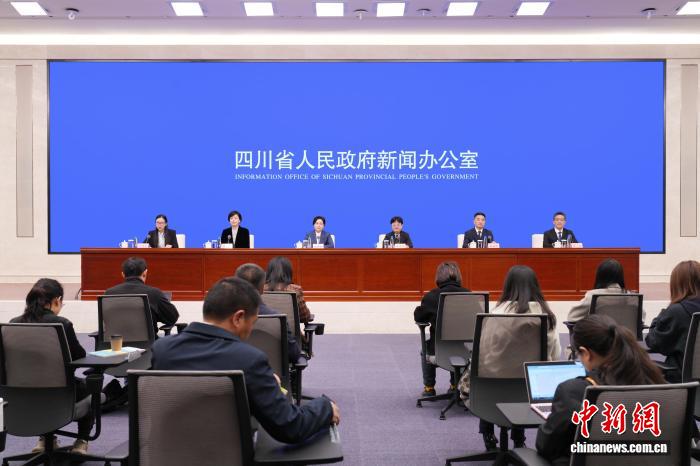
四川交出“十四五”民生答卷:就业稳、社保广、健康优
Zhong Guo Xin Wen Wang· 2025-11-07 08:29
Core Viewpoint - Sichuan Province has made significant progress in improving and guaranteeing people's livelihoods during the "14th Five-Year Plan" period, focusing on employment, social security, and health, with substantial investments leading to tangible results [1][2][3][4] Employment - Over 5 million new urban jobs were created in Sichuan over the past five years, with more than 1.45 million unemployed individuals finding re-employment [2] - A comprehensive employment stabilization policy was implemented, with over 20 billion yuan allocated for employment subsidies and over 9 billion yuan for job retention funds, effectively reducing the burden on enterprises [2] - An average of over 1.2 million market-oriented jobs were created annually in sectors such as artificial intelligence, cultural tourism, and modern logistics, supporting over 2.4 million jobs through entrepreneurship initiatives [2] Social Security - Sichuan has deepened social security system reforms, establishing a multi-tiered social security system that covers all citizens and ensures fairness and sustainability [3] - The number of participants in basic pension insurance reached 66.02 million, while basic medical insurance, unemployment insurance, and work injury insurance covered 81.23 million, 12 million, and 16.55 million individuals, respectively [3] - The minimum standards for urban and rural basic living allowances increased by 40% and 59% compared to the end of the "13th Five-Year Plan" period, enhancing the sense of security among the populace [4] Health - Significant improvements in public health were noted, with a decisive victory in COVID-19 prevention and a continuous decline in new AIDS cases over five years [4] - The average life expectancy in Sichuan reached 78.8 years, an increase of 1.24 years from the end of the "13th Five-Year Plan" [4] - The province has expanded high-quality medical resources and improved public health services for vulnerable groups, ensuring better access to healthcare [4]

【环球财经】美政府“停摆”将平纪录 食品救济金“减半”
Xin Hua She· 2025-11-04 01:52
Core Points - The U.S. federal government shutdown has reached its 34th day, just one day shy of the longest shutdown record of 35 days [1] - The Trump administration plans to use emergency funds to maintain half of the Supplemental Nutrition Assistance Program (SNAP) benefits for November, but some states may take weeks or months to resume payments [1] - SNAP, overseen by the U.S. Department of Agriculture (USDA), has suspended benefit disbursements since November 1 due to depleted funds, marking the first time in its 60-year history that benefits have been halted [1] Group 1 - The USDA will allocate $4.65 billion in emergency funds for November's SNAP benefits, which will only cover 50% of current needs [1] - The USDA will provide states with detailed plans for partial benefit disbursements, but due to procedural difficulties, some states may take weeks or months to implement these changes [1] Group 2 - SNAP serves 42 million people, approximately one-eighth of the U.S. population, with most recipients living below the poverty line [2] - Following the USDA's announcement of benefit suspension, 25 Democratic-led states and Washington D.C. filed lawsuits, asserting that the federal government has a legal obligation to ensure the program continues [2] - A federal judge in Rhode Island ruled that the federal government must use emergency funds to sustain SNAP and required a status update on funding by November 3 [2]
X @外汇交易员
外汇交易员· 2025-10-28 08:35
Employment & Income - Prioritizing employment with focus on new job creation, support for stable employment, and resolving structural employment issues [1] - Improving income distribution by increasing the proportion of residents' income in national income and labor compensation in primary distribution [2] - Implementing an income increase plan for urban and rural residents, effectively increasing the income of low-income groups, and steadily expanding the middle-income group [2] Education & Social Security - Expanding educational resources in towns with net population inflows of school-age children and steadily expanding the scope of free education [3] - Improving the national unified basic pension insurance system and developing a multi-level, multi-pillar pension insurance system [4] - Promoting high-quality development of real estate, optimizing the supply of affordable housing, and increasing the supply of improved housing according to local conditions [5] Healthcare & Population - Implementing a healthy China strategy, strengthening public health capabilities, and improving the disease control system to prevent major infectious diseases [5] - Advocating positive marriage and childbearing views, optimizing fertility support policies and incentive measures, and effectively reducing the cost of family birth, childcare, and education [6] - Improving the elderly care service network, strengthening the adaptation of public facilities for the elderly and barrier-free transformation, and developing medical care and nursing services [7] Green Development & Security - Promoting comprehensive green transformation of economic and social development, and building a beautiful China [8] - Accelerating the construction of a new energy system, continuously increasing the proportion of new energy supply, and promoting the safe, reliable, and orderly replacement of fossil energy [9] - Strengthening national security capabilities in key areas, ensuring the safety of food, energy resources, important industrial chains and supply chains, and major infrastructure [12]
二十届四中全会公报:健全社会保障体系 推动房地产高质量发展
Di Yi Cai Jing· 2025-10-23 09:26
Core Viewpoint - The Fourth Plenary Session of the 20th Central Committee of the Communist Party of China emphasizes enhancing and improving people's livelihoods, promoting common prosperity for all [1] Group 1: Social Welfare and Livelihood Improvement - The meeting calls for increased efforts to address urgent issues faced by the public, ensuring a focus on inclusive, foundational, and safety-net social welfare initiatives [1] - It highlights the importance of facilitating social mobility and improving the quality of life for citizens [1] Group 2: Employment and Income Distribution - The session stresses the need to promote high-quality and sufficient employment opportunities [1] - It advocates for the improvement of the income distribution system to ensure fairness and equity [1] Group 3: Education and Social Security - The meeting underscores the importance of providing satisfactory education for the people [1] - It calls for the establishment of a robust social security system to protect citizens [1] Group 4: Real Estate and Health Development - The session promotes high-quality development in the real estate sector [1] - It emphasizes the acceleration of building a healthy China and fostering high-quality population development [1] Group 5: Public Services - The meeting aims to steadily advance the equalization of basic public services across the country [1]
为增进人民福祉不懈努力
Ren Min Ri Bao· 2025-10-04 21:48
Core Points - The implementation of the "14th Five-Year Plan" in China emphasizes a people-centered development approach, significantly improving public welfare and living standards [1][2] Group 1: Public Services - Public services are being extended to benefit all citizens, with ongoing efforts in educational equity, balanced development of compulsory education, and improvements in healthcare services [1] - The construction of affordable housing and the renovation of shantytowns are positively impacting numerous households, ensuring that development outcomes are shared more equitably among the population [1] Group 2: Employment Strategy - The employment-first strategy has been effectively implemented, with over 12 million new urban jobs created annually since the "14th Five-Year Plan" began, and the total number of skilled workers exceeding 200 million [1] - The growth of new professions and business models, along with extensive vocational training initiatives, supports employment for key demographic groups [1] Group 3: Social Security System - A multi-tiered social security system is being rapidly constructed, covering all citizens and integrating urban and rural areas, with participation rates in basic pension and medical insurance exceeding 95% [1] - The expansion of unemployment and work injury insurance, along with more precise social assistance for vulnerable groups, strengthens the social safety net [1]
锐财经|就业稳,经济社会发展有支撑
Ren Min Ri Bao Hai Wai Ban· 2025-09-28 12:05
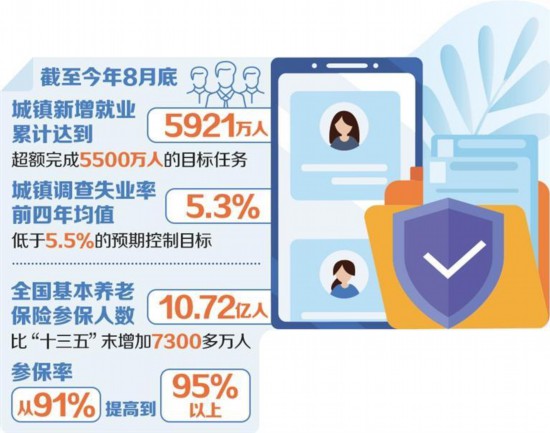
Employment and Social Security Achievements - As of the end of August this year, the cumulative number of new urban jobs created since the beginning of the "14th Five-Year Plan" reached 59.21 million, exceeding the target of 55 million [1] - The number of people covered by basic pension insurance reached 1.072 billion, an increase of over 73 million compared to the end of the "13th Five-Year Plan" [1] Employment Stability and Quality - The overall employment situation during the "14th Five-Year Plan" period has been stable, with an average urban survey unemployment rate of 5.3%, below the expected control target of 5.5% [2] - The government has implemented a series of employment support policies, with total employment subsidy expenditures exceeding 470 billion yuan and 138.9 billion yuan allocated for job retention [2] Targeted Support for Key Groups - The number of college graduates has been increasing annually, exceeding 10 million since 2022, highlighting the importance of this talent resource for employment efforts [3] - The scale of migrant workers remains above 30 million, providing strong support for economic and social stability [3] Social Security System Improvements - The national basic pension insurance coverage rate has increased to over 95%, with unemployment and work injury insurance coverage reaching 246 million and 302 million, respectively [4] - The social security system has seen significant reforms, with national coordination of basic pension insurance and provincial coordination for unemployment and work injury insurance [4] Financial Stability of Social Insurance Funds - As of the end of August, the cumulative balance of basic pension, unemployment, and work injury insurance funds reached 9.81 trillion yuan, with a positive cash flow [5] - The central government's financial subsidies for basic pension insurance are projected to exceed 730 billion yuan in 2024, with a gradual establishment of a long-term funding mechanism [5] Skills Development and New Occupations - Over 420 million people have received subsidized vocational skills training during the "14th Five-Year Plan" period, with a total of over 220 million skilled workers [8] - The introduction of 72 new occupations reflects the structural optimization of China's economy, driven by the development of new industries and services [8] Future Plans for Skills Workforce - The government plans to enhance policy support and optimize the development environment for skills workforce construction in the upcoming "15th Five-Year Plan" [9]
国家统计局:社会保障体系全球规模最大,保障水平不断提升
Bei Jing Shang Bao· 2025-09-28 02:20
Group 1: Pension Insurance - The number of participants in the basic pension insurance is projected to reach 1.07 billion by the end of 2024, with the average monthly pension for enterprise retirees increasing from approximately 2900 yuan in 2020 to 3162 yuan in 2023 [1] - The number of employees participating in enterprise annuities is expected to be 32.42 million by the end of 2024, with the accumulated fund scale of enterprise annuities reaching 3.6422 trillion yuan, representing growth of 19.3% and 61.9% respectively since the end of 2020 [1] Group 2: Medical Insurance - The number of participants in the basic medical insurance is anticipated to reach 1.33 billion by the end of 2024, maintaining a coverage rate of around 95% since 2018 [2] - The per capita financial subsidy standard for urban and rural residents' basic medical insurance has increased to 670 yuan, reflecting a growth of 21.8% since 2020 [2] - Policies such as basic medical insurance, serious illness insurance, and medical assistance are expected to benefit 220 million visits for low-income rural populations in 2024 [2] - The proportion of personal health expenses in total health expenditure has decreased from 27.7% in 2020 to 27.3% in 2023, indicating a reduction in the financial burden on individuals seeking medical care [2] Group 3: Social Assistance - By the end of 2024, the number of individuals receiving minimum living security in urban and rural areas is projected to be 6.25 million and 33.615 million respectively [2] - The average monthly minimum living security standards for urban and rural areas are expected to be 798.1 yuan and 593.9 yuan, showing increases of 17.8% and 19.5% respectively since 2020 [2]
各项民生事业取得长足发展
Jing Ji Ri Bao· 2025-09-28 01:17
Employment and Social Security - The employment situation in China during the "14th Five-Year Plan" period is generally stable, with a cumulative urban new employment of 59.21 million by the end of August, exceeding the target of 55 million [1] - The urban survey unemployment rate averaged 5.3% over the past four years, lower than the expected control target of 5.5% [1] - A comprehensive policy framework has been established, including fiscal incentives, tax reductions, and financial support, to enhance employment [1] Social Insurance Reform - The number of participants in the basic pension insurance reached 1.072 billion, an increase of over 73 million compared to the end of the "13th Five-Year Plan," with the participation rate rising from 91% to over 95% [2] - The total scale of the three social insurance funds reached 69.27 trillion, with a cumulative balance of 9.81 trillion, indicating a stable support capacity for social security [2] - The investment operation scale of the basic pension insurance fund is 2.6 trillion, doubling since the end of the "13th Five-Year Plan," with an average annual investment return rate of 5.15% [2] Talent Development - The gradual implementation of a delayed retirement age policy is underway to transform demographic dividends into talent dividends [3] - Over the past five years, 92 million people have received subsidized vocational skills training, and 72 new occupations have been introduced [3] - The total number of skilled workers exceeds 220 million, with over 72 million high-skilled talents, providing strong support for technological independence and modern industrial system construction [3]
失能的老人疲惫的子女,长护险终于来了
3 6 Ke· 2025-09-28 00:33
Core Viewpoint - The long-term care insurance (LTCI) system in China is transitioning from local trials to a national framework, aiming to provide essential support for families dealing with long-term care needs due to aging or disability [1][2][3] Group 1: Implementation Progress - The LTCI system has been piloted for nine years and is now set for nationwide implementation, with various regions like Guizhou and Tianjin actively developing operational guidelines [2][4] - The National Healthcare Security Administration has issued a service project directory for LTCI, clarifying the payment scope and enhancing the system's design [2][3] - Regions such as Ningxia and Guizhou are establishing timelines for full coverage, with Guizhou aiming for a phased rollout by the end of 2025 [6][7] Group 2: Coverage and Benefits - As of 2023, approximately 1.8 billion people are enrolled in LTCI, with over 200,000 individuals receiving benefits, indicating a growing demand for care services [9] - The average monthly benefit for home care under LTCI is approximately 1,080.75 yuan, which helps alleviate financial burdens on families [7][8] - The system aims to cover a broader demographic, including unemployed urban residents, with a gradual increase in coverage expected over the next five years [13][14] Group 3: Funding Mechanisms - The LTCI funding model involves contributions from individuals, employers, and government subsidies, with a proposed rate of around 0.3% of income for sustainable financing [10][11] - In cities like Jingmen, the funding standard is set at 0.4% of the previous year's disposable income, with a combination of personal contributions and government support [10][12] - The LTCI system is designed to maintain a balance between personal, employer, and government contributions to ensure long-term viability [11][12] Group 4: Service Scope and Payment - LTCI services include essential daily care and medical support, with benefits varying based on the level of disability, ranging from 800 to 1,700 yuan per month [15][16] - The system is moving towards a model where funds are primarily used to pay for approved care services rather than direct cash payments to beneficiaries [16][17] - Future expansions may include coverage for smart care services and assistive devices as the system evolves [16][17]