
私募信贷

Search documents
巨头“变着法子”表外融资!这三笔“AI巨额融资”如此“创新”,整个华尔街都盯着
华尔街见闻· 2025-11-12 10:12
Core Insights - The article discusses how tech giants are collaborating with Wall Street to secure unprecedented off-balance-sheet financing for the costly AI arms race [1][2] - Innovative financial arrangements are designed to transfer astronomical debt and risk away from balance sheets to alleviate investor concerns about an AI bubble [2][6] - Recent large-scale transactions involving Meta, OpenAI, and xAI reveal a trend of high-risk capital games surrounding AI infrastructure development [3][8] Group 1: Financing Trends - Meta's financing scheme for a massive data center in Louisiana, named Hyperion, is described as a "Frankenstein" financing model that combines elements of private equity, project financing, and investment-grade bonds [9] - Meta's urgent need for financing arose after its CEO Mark Zuckerberg warned of significant AI spending increases, leading to a market value loss of approximately $300 billion [5][4] - OpenAI's Stargate data center project, with a total cost of $38 billion, is challenging Wall Street's underwriting limits due to its unprecedented scale [13][14] Group 2: Specific Transactions - Meta's financing involves a joint venture where Blue Owl Capital invests $3 billion for 80% equity, while Meta retains 20% with a prior investment of $1.3 billion [10][11] - OpenAI's project financing is structured through a traditional loan model, with a five-year loan interest rate of approximately 6.4%, which is nearly two percentage points higher than similar bonds from Oracle [17][19] - xAI's financing plan aims to purchase chips for a super data center, with a total requirement of $18 billion for 300,000 NVIDIA chips, utilizing a high-leverage financing structure [20][21] Group 3: Market Implications - The AI industry's capital demands are immense, with estimates suggesting a $1.4 trillion funding gap even if all available credit markets are fully utilized [29] - JPMorgan's strategists warn that the construction boom for AI data centers could require at least $5 trillion over the next five years, potentially draining every credit market [29][31] - The emergence of these financing transactions indicates that tech giants are innovating in their funding strategies, which may just be the beginning of a broader trend [31]



政府停摆创纪录,股市为何创新高?美国经济神反转!真相扎心了
Sou Hu Cai Jing· 2025-11-12 07:53
Economic Overview - The U.S. economy is experiencing a stark divide, with the tech sector thriving while other industries face challenges [6][10] - The stock market is performing well, driven by strong earnings reports from major tech companies like Apple and Amazon, which are benefiting from AI advancements [12][14] Government and Policy - The ongoing "government shutdown" has reached a record length, with both parties engaged in a stalemate, but a resolution is expected around Thanksgiving due to mounting pressures [3][4] - The Federal Reserve's independence is under scrutiny, with political pressures potentially affecting its operations and market stability [12] Employment Trends - The job market is polarized, with top business school graduates facing a significant drop in job placement rates, now around 50%-60% [8] - Certain sectors, like biotechnology, are experiencing layoffs and salary cuts, while industries reliant on immigration, such as construction and agriculture, have numerous unfilled positions [8][10] Consumer Impact - Rising prices for food and everyday goods are straining consumers, with lower-priced items seeing price increases that outpace higher-priced goods [10] - There is a growing disconnect between official economic data and the public's perception of economic conditions, leading to skepticism about reported statistics [10][12] AI and Future Employment - The impact of AI on employment is a hot topic, particularly concerning entry-level positions that are at risk of being automated [14] - While AI may displace certain jobs, it could also create new opportunities, similar to past technological shifts [14]



流动性回流银行体系,美国私募信贷巨头估值受压
智通财经网· 2025-11-07 11:28
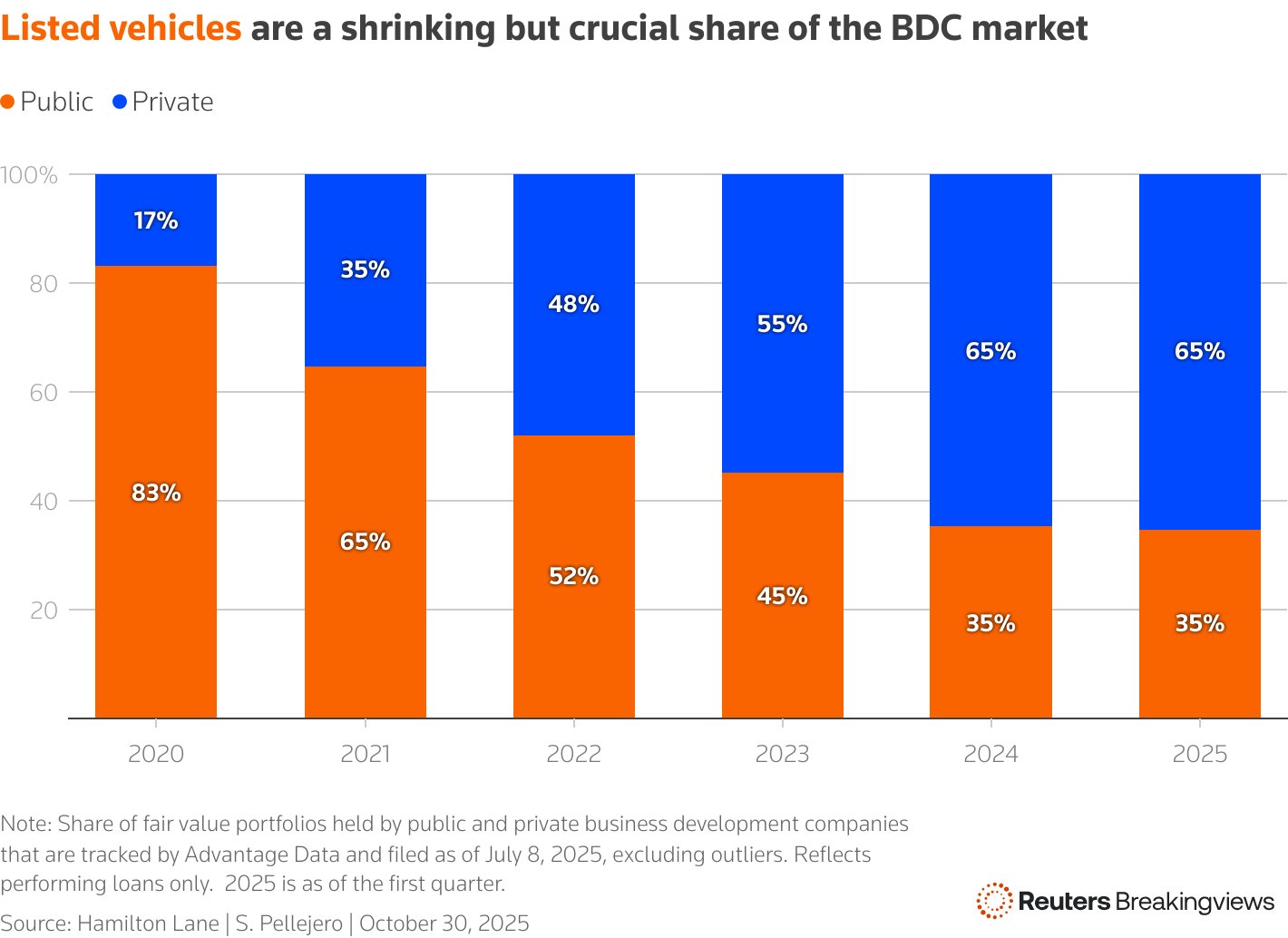
Core Insights - The liquidity debt market, previously closed to certain borrowers post-pandemic, is now becoming active again, with private credit no longer being the sole financing option for companies [1] - Major private credit firms like Apollo Global Management, Blackstone, and KKR have seen their stock prices drop over 14% in the last three months, while the S&P 500 has risen nearly 10% in the same period [1] - Concerns over credit quality have intensified following the bankruptcies of First Brands Group and Tricolor Holdings, leading to BDCs trading at discounts to their net asset values [2] Group 1: Market Dynamics - The average default rate for BDCs remains low at 1.3%, with borrowers able to cover their bills, averaging profits twice their interest expenses [5] - The competition in private credit is increasing as borrowers can now access cheaper financing options, with the spread between junk bonds and U.S. Treasuries narrowing to 2.9 percentage points [10] - The demand for loans has shifted, with approximately $25 billion moving from private to syndicated loans, reflecting a 25% increase in migration speed compared to last year [16] Group 2: Financial Performance - BDCs are experiencing pressure on their earnings and dividends due to declining new loan rates and a slowdown in income, with several BDCs cutting dividends by over 9% this year [16] - The overall yield for the Cliffwater BDC index is 10.8%, but its trading price is at an 8.1% discount to net asset value, indicating a market expectation of slowing profits [17] - The private credit sector is facing similar pressures, with the growth of credit funds outpacing reasonable investment opportunities, leading to a cautious market environment [18]
美股面临“灰犀牛”?AI债券爆发式增长,科技巨头疯狂加杠杆
Zhi Tong Cai Jing· 2025-11-05 14:09
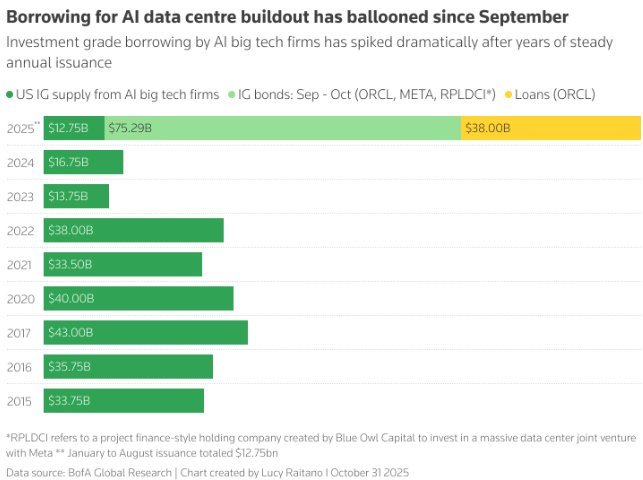
Core Insights - The AI investment boom is driving global stock markets to historic highs, but it increasingly relies on complex debt financing, raising concerns about financial sustainability and potential market bubbles [1] Group 1: AI Debt Financing Trends - AI-focused large tech companies issued $75 billion in U.S. investment-grade bonds in September and October, more than double the average annual issuance of $32 billion from 2015 to 2024 [2] - Debt financing is becoming crucial in the current AI boom, with a notable increase in the issuance of high-yield bonds related to AI, indicating a rise in credit risk [12] - Private credit is playing an increasingly significant role in financing AI data centers, with estimates suggesting a near doubling of AI-related private credit loans by early 2025 [15] Group 2: Market Dynamics and Risks - Oracle's stock surged by 54% in 2025, but the increase in credit default swaps indicates rising investor concerns about its debt levels [8] - The net debt-to-equity ratio of major tech companies is narrowing, suggesting a shift from cash-rich to leveraged positions, which could signal potential financial strain [6] - Asset-backed securities (ABS) are expected to support the growth of the AI industry, with the market for such securities projected to reach $115 billion by the end of next year, driven by data center construction [18]


美国信贷市场隐忧未消 BDC财报成风险“检验报告”
智通财经网· 2025-11-05 08:05
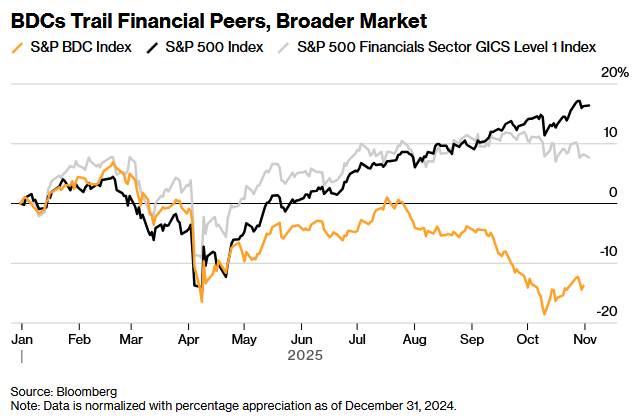
Core Viewpoint - Despite strong performances from major U.S. lending institutions, concerns about the stability of the credit market persist, drawing attention to upcoming earnings reports from lesser-known financial companies, particularly Business Development Companies (BDCs) [1] Group 1: Market Concerns and BDC Performance - The recent bankruptcies of First Brands Group and Tricolor Holdings, along with losses from two banks due to fraudulent loans, have heightened worries about credit quality, contributing to a decline in U.S. stocks in mid-October [2] - BDC earnings reports are seen as real-time stress tests for private credit, providing timely data on loan delinquencies, fair value measurements, and leverage costs compared to traditional banks [2] - Year-to-date, the S&P BDC Index has fallen by 14%, while the S&P 500 Index has risen by 16%, indicating underperformance of BDCs in the current market environment [2] Group 2: Interest Rate Impact and Investor Sentiment - Analysts attribute the recent weakness in BDC stock prices to expectations of interest rate cuts and ongoing credit concerns, which have drawn increased investor scrutiny [5] - Many BDCs hold significant floating-rate assets, making them more susceptible to the impacts of interest rate cuts [5] - The private credit market has expanded to a $1.7 trillion industry, with BDCs providing transparency in the opaque private loan sector, attracting retail investors during the Fed's rate hike period in 2022 [5] Group 3: Risk and Market Reactions - Critics express concerns about the risks associated with BDCs, particularly regarding their trading prices relative to book values, as highlighted by JPMorgan's CEO Jamie Dimon [6] - Short-selling activity has increased, with over $127 million in net gains from short trades on the top ten listed BDCs in the past 30 days, indicating a bearish sentiment [6] - However, early signals from major private credit institutions like Ares Capital Corp. suggest stable credit quality, which may alleviate some widespread concerns [6]
“最红PE”阿波罗三季度猛放750亿美元“私募贷款”
Xin Lang Cai Jing· 2025-11-05 00:41
Core Insights - Apollo has issued a total of $273 billion in loans to global corporate borrowers over the past year, marking a 40% increase in annual lending speed compared to the previous year [1] - The company's insurance business, Athene, reported a net interest margin profit of $871 million, the highest quarterly record in two years, contributing to an overall profit of $1.7 billion [1] - CEO Marc Rowan highlighted that funds are shifting from the stock market to private credit, with high-net-worth individuals viewing it as an alternative to overvalued stocks [2] Loan Issuance and Performance - Apollo issued $75 billion in new loans in the third quarter, a 21% year-over-year increase, with the total annual loan issuance expected to surpass the five-year target set for October 2024 [2][3] - The record loan issuance has alleviated concerns regarding the profitability of private credit, with Apollo's performance exceeding expectations despite pressures from declining interest rates and narrowing credit spreads [1][2] Insurance Business and Asset Growth - Apollo's insurance business, Athene, attracted $23 billion in net new funds, contributing to a total of $82 billion in new assets for the quarter, pushing managed assets above $900 billion [3] - The merger with Athene has raised investor concerns about the impact of declining private credit returns on the investment group, but the strategy of matching fixed annuities with higher-risk private loans has transformed Apollo into one of Wall Street's largest lending institutions [3] Market Sentiment and Stock Performance - Apollo's stock price has fallen by 25% this year, lagging behind competitors like Blackstone and Ares Management, partly due to not meeting ambitious net interest margin targets set a year ago [4] - The recent performance of Apollo and Ares Management, which saw stock price increases of approximately 5% and 4% respectively, indicates a recovering confidence in the private credit asset class [2] Credit Market Concerns - Concerns regarding the health of the private credit market have been fueled by isolated incidents of fraud leading to credit losses, as well as the Federal Reserve's interest rate cuts [5] - CEO Rowan defended the private credit sector, asserting that recent credit losses are not indicative of broader underwriting standards and that systemic risks are not present in the current environment [5] Future Outlook - According to Moody's, the private credit market is projected to reach $3 trillion by 2028, doubling its size from 2023, although it has yet to face a wave of defaults following its rapid growth [6]
“最红PE”阿波罗三季度猛放750亿美元“私募贷款”,同比激增21%!CEO:不想投高估值股票,就投PE吧
Hua Er Jie Jian Wen· 2025-11-05 00:17
Core Insights - Apollo Global Management is addressing concerns about the profitability of private credit by significantly increasing loan issuance, resulting in better-than-expected third-quarter performance [1][2] - The company issued $75 billion in new loans in Q3, a 21% year-over-year increase, contributing to a total of $273 billion in loans over the past 12 months, a 40% surge compared to the previous year [1][2] - CEO Marc Rowan defended the attractiveness of private credit despite declining yields, noting a shift of funds from the stock market to private credit as high-net-worth individuals seek alternatives to overvalued stocks [1][4] Loan Issuance Highlights - Apollo's loan issuance capacity is a key performance driver, with Q3's $75 billion in new loans being the second-highest on record, primarily funded by insurance premiums [2] - The annual loan issuance is on track to exceed the five-year target set for October 2024, positioning Apollo to compete with major investment banks like Citigroup [2] - Despite lower net interest margin profits from Athene's portfolio, the surge in new loans compensates for the decline in profitability [2] Asset Management Growth - Apollo gained $82 billion in new assets in Q3, with Athene contributing $23 billion in net new funds, leading to a 22% increase in fee-based revenue and surpassing $900 billion in managed assets [3] - Concerns about the merger between Apollo and Athene have been raised, particularly regarding the impact of declining private credit returns on the investment group [3] - Approximately half of Apollo's earnings now come from the spread between Athene's asset returns and policyholder contract payments, rather than traditional asset management fees [3] Market Health and Future Outlook - Recent discussions about the health of the private credit market have affected stock prices of major players, driven by concerns over credit losses from specific companies [4][5] - Rowan emphasized that recent credit losses are isolated incidents and do not reflect broader underwriting standards in the private credit sector [5] - Moody's forecasts that the private credit market will reach $3 trillion by 2028, doubling its size from 2023, indicating strong future growth potential [5]
海外高频 | 中美达成贸易协议,黄金连续两周回调(申万宏观·赵伟团队)
赵伟宏观探索· 2025-11-02 22:47
Group 1: Major Asset Classes & Overseas Events & Data - The Nasdaq index reached a new historical high, while gold experienced a decline for two consecutive weeks. The S&P 500 rose by 0.7%, and the Nasdaq increased by 2.2%. The 10-year U.S. Treasury yield rose by 9 basis points to 4.11%. The dollar index increased by 0.8% to 99.7, and offshore RMB appreciated to 7.12. WTI crude oil fell by 0.8% to $61.0 per barrel, while COMEX gold dropped by 2.6% to $3995.7 per ounce [2][4][72]. Group 2: U.S.-China Trade Agreement - On October 30, U.S. and Chinese leaders met in South Korea and reached a consensus. The U.S. will cancel the 10% "fentanyl tariff" on Chinese goods, and the 24% reciprocal tariff on Chinese products will remain suspended for another year. The U.S. will also pause the implementation of the 50% export control rule announced on September 29 for one year. In response, China will adjust its countermeasures accordingly [2][48][72]. Group 3: Federal Reserve Actions - The Federal Reserve lowered the federal funds rate by 25 basis points to a target range of 3.75%-4.00% during its October meeting. The Fed plans to end its balance sheet reduction in December. The European and Japanese central banks opted to maintain their current policies during their October meetings. The Eurozone's GDP growth rate for Q3 was 0.2%, exceeding market expectations of 0.1% [2][50][54][72].

海外高频 | 中美达成贸易协议,黄金连续两周回调(申万宏观·赵伟团队)
申万宏源宏观· 2025-11-02 11:04
Group 1: Major Assets & Overseas Events & Data - The Nasdaq index reached a new historical high, while gold experienced a decline for two consecutive weeks. The S&P 500 rose by 0.7%, and the Nasdaq increased by 2.2%. The 10-year U.S. Treasury yield rose by 9 basis points to 4.11%. The dollar index increased by 0.8% to 99.7, and offshore RMB strengthened to 7.12. WTI crude oil fell by 0.8% to $61.0 per barrel, while COMEX gold dropped by 2.6% to $3995.7 per ounce [2][4][72]. Group 2: U.S.-China Trade Agreement - On October 30, U.S. and Chinese leaders met in South Korea and reached a consensus. The U.S. will cancel the 10% "fentanyl tariff" on Chinese goods, and the 24% reciprocal tariff on Chinese products will remain suspended for another year. The U.S. will also pause the implementation of the 50% export control rule announced on September 29 for one year. In response, China will adjust its countermeasures accordingly [2][48][72]. Group 3: Federal Reserve Actions - The Federal Reserve lowered the federal funds rate by 25 basis points to a target range of 3.75%-4.00% during its October meeting. The Fed plans to end its balance sheet reduction in December. The European and Japanese central banks chose to maintain their current policies during their October meetings. The Eurozone's GDP growth rate for Q3 was 0.2%, exceeding the market expectation of 0.1% [2][50][54][72].

Jefferies之后贝莱德也遭殃?被爆卷入借贷方“惊天”欺诈案
Hua Er Jie Jian Wen· 2025-10-30 19:56
Core Insights - BlackRock's private credit division, HPS Investment Partners, is embroiled in a significant fraud case involving the alleged forgery of accounts receivable as loan collateral, with claims exceeding $500 million against Bankim Brahmbhatt, owner of Broadband Telecom and Bridgevoice [1][2][3] Group 1: Fraud Allegations - HPS Investment Partners has accused Bankim Brahmbhatt of systemic fraud, claiming that all customer emails used to verify invoices were forged, and that false customer contracts date back to 2018 [3][6] - The investigation revealed that emails purportedly from Carriox's clients were sent from fake domains, raising red flags about the legitimacy of the transactions [2][3] - Brahmbhatt's companies have filed for bankruptcy, and he has also filed for personal bankruptcy, indicating severe financial distress [4][6] Group 2: Market Impact - The incident has heightened concerns about the risks associated with asset-backed financing, particularly in the private credit market, which has seen significant growth but also recent failures [5][6] - The recent collapses of First Brands and Tricolor have led to increased scrutiny of risk management practices within the private credit sector, with Wall Street fearing these events may signal deeper issues in the U.S. credit market [1][6] - BlackRock's HPS manages $179 billion in assets, and while this incident is a small part of their portfolio, it has raised alarms about due diligence and risk controls in the broader $2 trillion private credit industry [6]
