网络效应

Search documents
冯卫东:当年投周黑鸭,拿到了20倍投资回报
创业家· 2025-10-25 10:38
Core Insights - The article emphasizes the importance of consumer-focused investments, highlighting that successful projects in the past have predominantly been in the consumer sector, as opposed to technology projects which may yield unpredictable results [1][2]. Group 1: Investment Focus - The company has concentrated on consumer investments since 2011, finding that these projects often meet expectations for success [1]. - A notable example is the investment in Zhou Hei Ya, which yielded a 20x return, demonstrating the existence of competitive advantages in consumer enterprises [2]. Group 2: Competitive Advantages - Consumer enterprises possess a complex and comprehensive set of competitive advantages, unlike technology firms that may rely on a single innovative idea or patent [4][5]. - There are eight critical aspects of competitive advantages identified, divided into demand-side and supply-side factors [6]. Group 3: Demand-Side Competitive Advantages - Four demand-side competitive advantages include: 1. Brand Effect: Particularly significant in specialized fields like healthcare and education, where decision-making costs are high [8]. 2. Network Effect: Larger user bases enhance value, leading to winner-takes-all scenarios, as seen with platforms like Xiaohongshu [8]. 3. Switching Costs: High costs associated with changing systems, such as operating systems, create loyalty among users [8]. 4. Economies of Scope: The ability to offer a wide range of products in one location, enhancing consumer convenience [8]. Group 4: Supply-Side Competitive Advantages - Four supply-side competitive advantages include: 1. Economies of Scale: Early entrants can leverage initial high prices to achieve cost advantages through increased sales volume [10]. 2. Learning Curve: Accumulated production knowledge creates barriers for new entrants, making it difficult to catch up [11]. 3. Resource Monopoly: Control over unique processes, licenses, or prime locations can provide significant advantages [12][13]. 4. Supply-Side Economies of Scope: Optimizing product supply through coordinated networks can lead to cost efficiencies [14]. Group 5: Entrepreneurial Characteristics - The characteristics of entrepreneurs in the consumer sector differ from those in technology, requiring a broader skill set rather than specialization [15][16]. - The company identifies key traits for successful entrepreneurs, summarized as "VISIBLE," which includes Visionary, Integrity, Sharing, Innovative, Branding, Learning, and Execution [17]. Group 6: Investment Preferences - The company prefers to invest in product-oriented founders over marketing-oriented ones, as the former tend to provide more stable growth despite slower initial progress [21]. - An example is the success of Bao Shifu pastries, which have outperformed many other trendy brands [22].


MercadoLibre, Inc. (MELI): A Bull Case Theory
Yahoo Finance· 2025-10-22 19:30
Core Thesis - MercadoLibre, Inc. (MELI) is positioned as a dominant e-commerce and fintech player in Latin America, leveraging an integrated ecosystem that enhances its competitive advantage and growth potential [2][4][5] Business Model - The company operates a highly integrated ecosystem that includes marketplace operations, payments (Mercado Pago), logistics (Mercado Envíos), and lending (Mercado Crédito), creating a self-reinforcing flywheel effect [2][3] - Each segment of the business utilizes shared data and technology to optimize operations, reduce costs, and improve service delivery [2][3] Growth Drivers - Mercado Crédito extends loans to users based on their platform activity, which lowers credit risk and encourages higher transaction volumes, further driving growth [3] - The interconnected nature of the services accelerates user acquisition and retention, as more buyers attract more sellers, leading to increased payments and deliveries [3][5] Competitive Advantage - The company boasts a high-quality, capital-efficient business model with strong competitive moats, allowing for continuous reinvestment in its platform and operations [4] - The combination of marketplace dominance and fintech integration positions MercadoLibre to capture multiple revenue streams while maintaining resilient unit economics [4][5] Long-term Outlook - The self-reinforcing flywheel, diverse revenue streams, and disciplined reinvestment strategy present a compelling long-term growth narrative, supported by structural tailwinds in e-commerce, digital payments, and online lending [5] - The business model creates a virtuous cycle that is challenging for competitors to replicate, indicating significant upside potential over the long term [5][6]

中泰资管天团 | 张亨嘉:关于商业模式,我的五道必答题
中泰证券资管· 2025-10-09 11:33
Core Viewpoint - The essence of investment research lies in understanding the business model itself rather than merely following market trends or popular stocks [1][12] Group 1: Business Model Evaluation - A good business model should be assessed through five critical questions to determine its sustainability and strength [1] - Companies that grow in scale may not necessarily become stronger; they can face diminishing returns beyond a certain critical point [2][3] - Business models that benefit from economies of scale, network effects, and scope economies are more likely to strengthen as they grow [3] Group 2: Impact of Adverse Conditions - Adverse market conditions can provide opportunities for leading companies to gain market share while weaker firms may suffer significantly [5][6] - Historical data shows that downturns can be advantageous for strong brands, as they can expand their customer base during price declines [6] Group 3: Efficiency vs. Value - Business models can be categorized as efficiency-driven or value-driven; efficiency models often lead to price wars, while value models offer differentiation and higher customer loyalty [7][8] - Value-driven businesses tend to have a more robust competitive advantage due to their unique offerings and customer retention [8] Group 4: Technological Change and Industry Dynamics - Rapid technological changes can disrupt industries, favoring newer entrants over established players, particularly in fast-evolving sectors like semiconductors and renewable energy [10] - Industries with slower technological changes are preferable for investment, as they allow established companies to maintain their competitive edge [10] Group 5: Long-term Viability - The ability of a business to sustain its strength over time is crucial; companies that can withstand competition and market changes are more desirable for investment [11] - The "Lindy Effect" suggests that the longer a business has existed, the more likely it is to continue existing, which can be a useful consideration in investment decisions [11] Group 6: Comparative Analysis of Business Models - Understanding the core essence and contradictions of a business is essential for effective investment research, as competition increasingly revolves around business models rather than products [12] - The book "Business Model Generation" is recommended for insights into various business models and their frameworks [12]

“你的Agent,我一周末就能做出来!” AI时代的护城河:Cursor 卷每日迭代速度,DeepSeek 用技术撕大厂规模优势
AI前线· 2025-10-08 05:30
Core Insights - The concept of "moat" has become increasingly important in the AI startup landscape, as many new AI applications appear to have low barriers to entry, leading to concerns about competition and sustainability [2][3][5] - Founders are now more frequently discussing how to establish lasting business models rather than just focusing on short-term gains, especially in light of easily replicable products like "ChatGPT shell applications" [3][5][6] Group 1: Importance of Moat - The essence of a moat is a defensive strategy that protects a business from competitors, akin to a castle surrounded by a moat [2] - Founders are advised to focus on identifying real pain points and solving user needs, allowing the moat to develop organically through customer interactions and product iterations [6][17] Group 2: Key Strategies for Building Moats - Speed is identified as the most crucial moat for startups, enabling them to iterate and deliver features faster than larger competitors [8][9] - Process power can serve as a moat by creating complex business systems that are difficult to replicate, exemplified by companies like Case Text and Greenlight [10][19] - Monopolistic resources, such as proprietary data and specialized models, can provide a competitive edge, as seen with Character AI [11][24] - High switching costs can deter customers from moving to competitors, particularly through deep customization and integration into existing workflows [12][26] Group 3: Competitive Positioning - Reverse positioning strategies can help startups differentiate themselves from traditional companies, which often rely on outdated pricing models [13][29] - Network effects in AI are primarily data-driven, where increased user engagement leads to improved model performance, creating a self-reinforcing cycle [14][39] - Scale economies are more pronounced at the model level, where significant capital investment is required to train advanced models, limiting competition [16][42] Group 4: Recommendations for Founders - Founders should prioritize addressing specific user pain points that are critical for survival, rather than getting bogged down in predicting long-term moats [44] - The focus should be on rapid execution and the ability to adapt to market needs, as speed is a fundamental advantage in the AI landscape [44]


零营收!估值 90 亿美金独角兽 - Prediction Markets 炸裂硅谷
创业邦· 2025-10-08 01:08
Group 1 - The core concept of Prediction Market is its potential to reshape how people acquire truth and price the future, leveraging user growth and a vast Total Addressable Market (TAM) [9][11][28] - Prediction Markets are gaining traction in various sectors beyond politics, allowing bets on events like Tesla's earnings and Federal Reserve interest rate changes, indicating a broadening of their application [14][18] - The rise of Prediction Markets is driven by multiple factors, including the decline of mainstream media credibility and the increasing desire for tools that provide closer access to truth [28][25] Group 2 - The technology investment landscape focuses on identifying high-speed and sustainable growth, often found in disruptive companies that challenge the status quo [8][12] - Successful new entities in the market typically exhibit three characteristics: self-sustaining growth engines, vast TAM, and favorable timing and conditions [13][23] - The current market dynamics show that Prediction Markets are experiencing significant growth, with Kalshi's trading volume reaching a run rate of nearly $40 billion, indicating a shift towards mainstream acceptance [18][20] Group 3 - Prediction Markets differ from traditional sports betting by covering a wider range of events and being regulated at the federal level, allowing for broader participation [26][21] - The valuation of Polymarket is approximately $9 billion, while Kalshi is valued at around $5 billion, highlighting the competitive landscape between decentralized and centralized platforms [22] - The introduction of features like the Parlay function by Kalshi has the potential to disrupt existing sports betting markets, as evidenced by the immediate impact on competitor stock prices [27][30] Group 4 - The future of Prediction Markets is envisioned as a new generation of knowledge platforms, transcending traditional betting to become a marketplace for information [31][32] - The integration of Prediction Markets into mainstream financial platforms, such as Robinhood, enhances their visibility and user engagement, further solidifying their market position [20][18]

零营收!估值 90 亿美金独角兽 - Prediction Markets 炸裂硅谷
投资实习所· 2025-10-06 04:12
Group 1 - The core viewpoint of the article emphasizes the rapid growth and potential of Prediction Markets, particularly in the context of the upcoming 2024 U.S. elections, highlighting their ability to provide real-time insights into public sentiment and event probabilities [2][10][29] - Altimeter Capital, a leading tech investment fund, has recognized the disruptive potential of Prediction Markets, which are gaining traction in Silicon Valley and beyond, with significant valuations for platforms like Polymarket and Kalshi [2][16][21] - The article outlines the characteristics of successful disruptive companies, noting that Prediction Markets exhibit user growth, a vast total addressable market (TAM), and alignment with current social and regulatory trends [6][7][12] Group 2 - Prediction Markets are defined as platforms where users can bet on the outcomes of various events, with prices reflecting the market consensus on probabilities, thus providing a more accurate gauge than traditional polls [8][9] - The rise of Prediction Markets is attributed to several factors, including the decline of mainstream media trust, the desire for tools that reveal truth, and the increasing participation of retail investors in the market [25][22] - The article compares Prediction Markets to traditional sports betting, highlighting their broader scope, regulatory advantages, and innovative pricing mechanisms that enhance user engagement [26][29] Group 3 - The article discusses the differences between Polymarket and Kalshi, noting their distinct approaches to market structure and regulatory compliance, with Polymarket being more decentralized and Kalshi focusing on compliance and partnerships with established platforms like Robinhood [21][24] - It highlights the significant growth in trading volumes for Prediction Markets, with Kalshi experiencing an 80% quarter-over-quarter increase, indicating a shift towards mainstream acceptance [16][20] - The introduction of new features, such as the Parlay function by Kalshi, is seen as a strategic move to compete with established sports betting platforms, further blurring the lines between different types of betting and trading [27][28]

谁是2025年度最好的编程语言?
量子位· 2025-10-01 01:12
Core Viewpoint - Python continues to dominate as the most popular programming language, achieving a remarkable lead over its competitors, particularly Java, in the IEEE Spectrum 2025 programming language rankings [2][4][5]. Group 1: Python's Dominance - Python has secured its position as the top programming language for ten consecutive years, marking a significant achievement in the IEEE Spectrum rankings [6]. - This year, Python has not only topped the overall ranking but also led in growth rate and employment orientation, making it the first language to achieve this triple crown in the 12-year history of the IEEE rankings [7]. - The gap between Python and Java is substantial, indicating Python's strong growth trajectory [4][5]. Group 2: Python's Ecosystem and AI Influence - Python's rise can be attributed to its simplicity and the development of powerful libraries such as NumPy, SciPy, matplotlib, and pandas, which have made it a favorite in scientific, financial, and data analysis fields [10]. - The network effect has played a crucial role, with an increasing number of developers choosing Python and contributing to its ecosystem, creating a robust community around it [11]. - AI has further amplified Python's advantages, as it possesses richer training data compared to other languages, making it the preferred choice for AI applications [12][13]. Group 3: Other Languages' Challenges - JavaScript has experienced the most significant decline, dropping from the top three to sixth place in the rankings, indicating a shift in its relevance [15]. - SQL, traditionally a highly valued skill, has also faced challenges from Python, which has encroached on its territory, although SQL remains a critical skill for database access [18][21][23]. Group 4: Changes in Programming Culture - The community culture among programmers is declining, with a noticeable drop in activity on platforms like Stack Overflow, as many now prefer to consult AI for problem-solving [25][26]. - The way programmers work is evolving, with AI taking over many tedious tasks, allowing developers to focus less on programming details [30][31]. - The diversity of programming languages may decrease as AI supports only mainstream languages, leading to a stronger emphasis on a few dominant languages [37][39]. Group 5: Future of Programming - The programming landscape is undergoing a significant transformation, potentially leading to a future where traditional programming languages may become less relevant [41]. - While high-level languages like Python have simplified programming, the ultimate goal may shift towards direct interaction with compilers through natural language prompts [46]. - The role of programmers may evolve, focusing more on architecture design and algorithm selection rather than maintaining extensive source code [49][50].

Prediction: SoFi Will Be 1 of the Largest Banks in the U.S. in 10 Years
The Motley Fool· 2025-10-01 00:43
Core Viewpoint - SoFi Technologies is rapidly growing and aims to become a top-10 U.S. financial institution within the next decade, with its stock having increased over 450% in the past three years [1]. Group 1: Company Growth and Ambitions - SoFi has $36 billion in assets, which is less than one-tenth the size of the 10th-largest bank in the U.S. [2] - The company added a record 850,000 new members in the second quarter, representing a 34% year-over-year increase [3]. - Revenue growth accelerated to 44% year-over-year in the second quarter, driven by strong network effects as new customers are attracted to the platform [5]. Group 2: Target Market and Services - SoFi targets students and young professionals with an all-online platform that offers essential banking services tailored to a digital-first generation [3]. - The company is continuously adding new services, including cryptocurrency trading and blockchain-based solutions, to appeal to its target clientele [4]. - Currently, 90% of SoFi Money deposits are set up through direct deposit, indicating strong engagement with its platform [7]. Group 3: Competitive Landscape - The largest U.S. banks have trillions in assets, with JPMorgan Chase leading at $3.8 trillion, while SoFi is significantly smaller at $36 billion [6]. - As SoFi continues to grow and attract more customers, it has already surpassed several banks in its rankings and aims to jump over approximately 45 banks to reach the top 10 [10].


“旧经济”,正在缓缓落幕
Hu Xiu· 2025-09-30 01:27
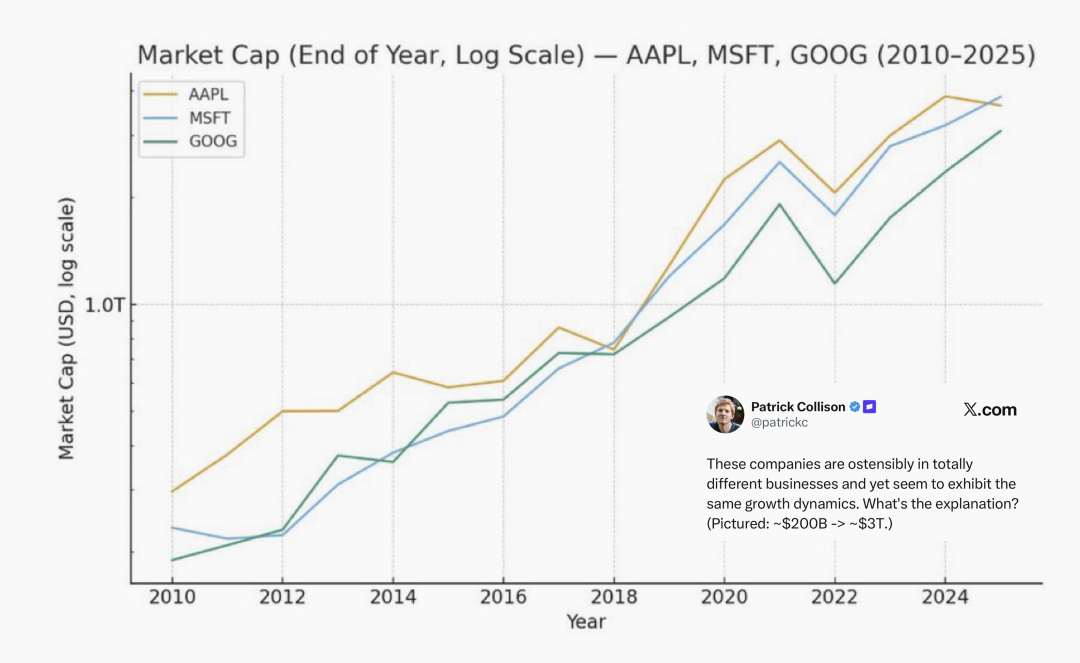
Core Insights - The growth trajectories of Apple, Microsoft, and Google from 2010 to 2025 show a parallel increase in market value, suggesting a unified growth dynamic despite their different business models [2][3] - Balaji Srinivasan posits that the traditional economy is fading while the internet economy is emerging, marking a significant economic shift [6][10] Group 1: Decline of the Traditional Economy - The traditional economy is characterized by physical entities and linear growth, heavily reliant on capital expenditure and regulatory frameworks [11][12][13] - Key sectors like manufacturing and energy are experiencing stagnation, with U.S. manufacturing worker productivity growth at approximately 2% since 2018, compared to 7% in the tech sector [17][16] Group 2: Rise of the New Economy - The internet economy exhibits exponential growth potential and is driven by network effects, allowing companies like Google and Meta to dominate their markets [20][22] - AI enables small teams to create significant value, with the potential for "one-person companies" to reach valuations of $1 billion [25][26] - The cost of adding users in digital services is negligible, allowing for global scalability without physical constraints [27][28] Group 3: Magnificent Seven as New Productivity Leaders - The "Magnificent Seven" (Apple, Microsoft, Alphabet, Amazon, Nvidia, Meta, and Tesla) now account for about 34% of the S&P 500's market capitalization, up from 12% in 2015 [31] - In 2023, these companies achieved a collective return rate of 75.71%, significantly outperforming the S&P 500's 24.23% [32] - Their platforms are integral to modern business activities, positioning them as infrastructure builders in the new economy [37] Group 4: Societal and Market Implications - The transition from traditional to new economy is reshaping societal structures and investment landscapes, presenting both opportunities and risks [40][41] - The concentration of wealth in technology sectors raises concerns about inequality and job losses in traditional industries [42] - The concept of "network states" may emerge, where communities based on shared values operate with their own currencies and governance, potentially replacing traditional nation-states [44][45]




数百万网约车司机,给平台出了一道平衡难题
吴晓波频道· 2025-09-29 00:29
Core Viewpoint - The ride-hailing industry has evolved from merely transporting passengers to becoming a super infrastructure that reassembles "scattered time, vehicles, and labor" into a cohesive employment reservoir, significantly impacting various demographics and employment patterns [2][6]. Group 1: Employment Dynamics - As of 2024, the number of licensed ride-hailing drivers in China reached 7.483 million, a 159% increase from 2020 [2]. - The average age of ride-hailing drivers is around 40 years, with a notable trend of increasing participation from middle-aged and female drivers [6]. - Approximately 80% of drivers face cash flow pressures, and over 1.05 million female drivers rely solely on ride-hailing income [6][10]. Group 2: Income and Economic Impact - The average monthly income for ride-hailing drivers is 7,623 yuan, with those in first-tier cities earning an average of 11,557 yuan per month [8]. - The ride-hailing industry serves as a buffer for employment, particularly for those affected by industrial upgrades, with nearly 70% of surveyed drivers coming from traditional blue-collar sectors [6][10]. Group 3: Platform Dynamics and Challenges - The growth of drivers has outpaced the increase in ride-hailing demand, with a 38.3% rise in average monthly orders compared to the 159% increase in driver numbers since 2020 [27]. - The average daily order volume for ride-hailing drivers in cities like Suzhou and Zhuhai is low, leading to reduced earnings for many drivers [27]. - The platform's commission structure is a significant concern for drivers, with an average commission of 15.3% reported, although many drivers overestimate their commission rates [14][17]. Group 4: Future Directions and Strategies - The industry may not return to previous high-earning conditions due to increased competition and a larger number of drivers [28]. - Future strategies may involve refined operations, such as improving order efficiency and diversifying service offerings to meet consumer demands [30][35]. - Platforms are increasingly focusing on enhancing labor welfare and transparency to build trust with drivers, including initiatives like the "Transparent Bill" feature [35][36].