自动驾驶

Search documents
小马智行2025年营收6.29亿元
Bei Jing Shang Bao· 2026-03-26 12:49
Core Insights - The company reported a revenue of 629 million yuan for 2025, representing a 20% increase compared to 2024 [1] - The net loss under non-GAAP standards for 2025 was 1.217 billion yuan, which is an increase of 31.5% from 2024 [1] Revenue Breakdown - The revenue from autonomous driving ride-hailing services reached 116 million yuan in 2025, a significant increase of 128.6% from 73 million yuan in 2024 [1] - Passenger fare revenue surged nearly 400%, driven by increased demand from first-tier cities, ongoing fleet optimization, and a rise in order volume since the launch of the seventh-generation autonomous taxi [1] - Revenue from autonomous truck services was 284 million yuan, showing a modest growth of 0.6% compared to 2024 [1] - Revenue from technology licensing and applications amounted to 229 million yuan, reflecting a 19.7% increase from 2024, primarily due to rising demand for autonomous driving domain controllers (ADC) in low-speed unmanned delivery, cleaning vehicles, logistics, and humanoid robotics [1]
全球代工第二、产能破百万片|中芯国际2025年报解读
是说芯语· 2026-03-26 12:42
Core Viewpoint - SMIC's 2025 annual report highlights the company's commitment to deepening reforms and promoting high-quality development as it celebrates its 25th anniversary, achieving significant operational milestones and revenue growth [1][3]. Revenue and Performance - In 2025, SMIC achieved a sales revenue of $9.327 billion, representing a year-on-year increase of 16.2%, solidifying its position as the second-largest pure-play foundry globally [3]. - The capacity utilization rate increased to 93.5%, up by 8 percentage points year-on-year, while the gross margin rose to 21%, an increase of 3 percentage points despite significant depreciation [3]. - The company is expanding its production capacity, with a monthly capacity exceeding 1 million 8-inch wafers [3]. Market Dynamics - The smartphone market showed steady growth, and the personal computer market entered a replacement cycle, contributing to increased sales [5]. - Demand for foundry services is returning to domestic markets due to geopolitical factors and the recovery of emerging markets, with a strong focus on localized supply chains [5][6]. Technological Advancements - SMIC is committed to high R&D investment, with $774 million allocated, accounting for 8.3% of sales revenue, to enhance its technology innovation system and respond to customer needs [6]. - The company is actively collaborating with industry partners and academic institutions to foster innovation and talent development [6][10]. Project Developments - SMIC is advancing multiple R&D projects, including 28nm ultra-low leakage technology and embedded flash memory platforms, aimed at enhancing product performance and market applications [9]. - The company has made significant progress in developing new platforms for various applications, including IoT, automotive, and consumer electronics [9]. Talent and Corporate Culture - SMIC emphasizes talent development as a core competitive advantage, focusing on recruiting young professionals and enhancing employee retention through diverse compensation strategies [10]. - The company promotes a culture of care for employees, the environment, and society, reinforcing its commitment to sustainable development [10]. Future Outlook - Looking ahead to 2026, SMIC anticipates continued growth driven by the return of the supply chain to domestic markets and the strong demand for storage chips in AI applications [10][11]. - The company aims to maintain a sales revenue growth rate above the industry average, with capital expenditures expected to remain stable compared to 2025 [11].


小马智行Q4首现季度盈利,Robotaxi商业化提速,目标年底覆盖20城 | 财报见闻
Hua Er Jie Jian Wen· 2026-03-26 11:46
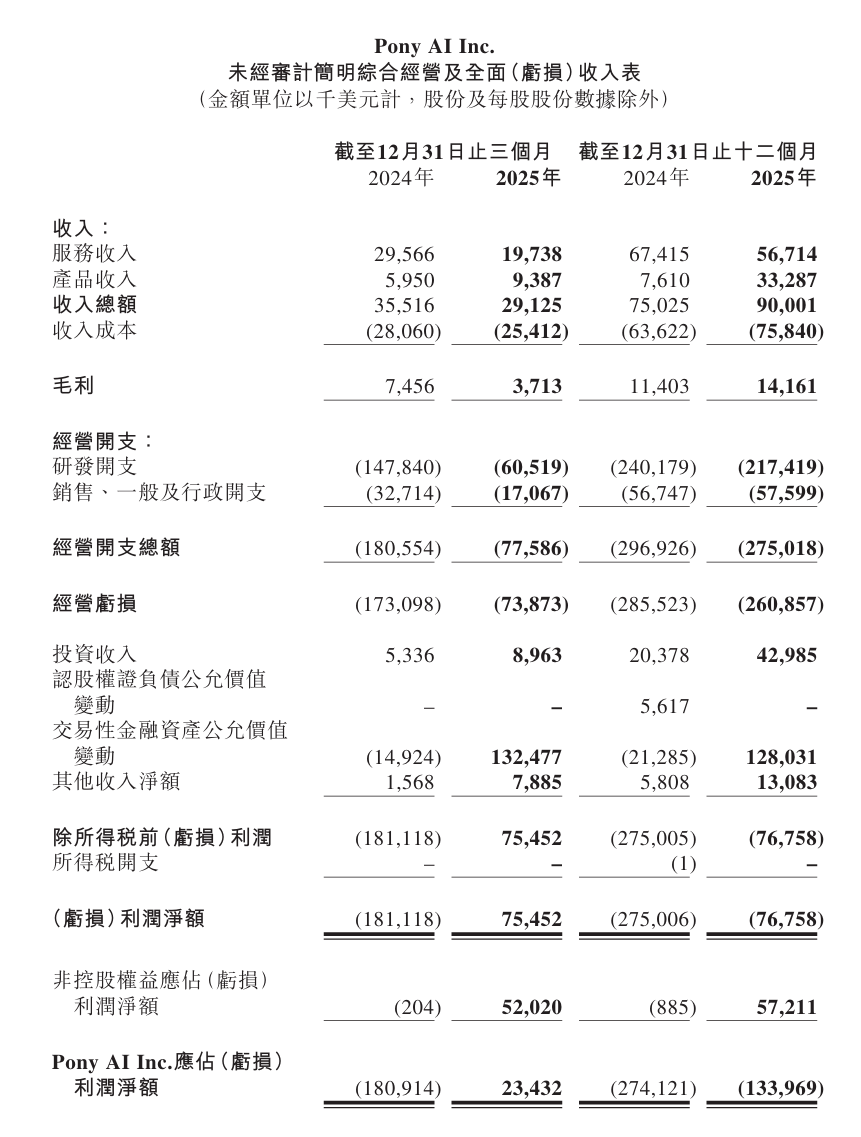
Core Insights - Xiaoma Zhixing achieved its first-ever quarterly net profit, driven by significant gains from early investments, and plans to expand its autonomous taxi service to over 20 cities globally by the end of the year [1][4] - The company reported a net profit of $75.5 million for Q4 2025, a substantial turnaround from a net loss of $181.1 million in the same period last year, primarily due to a $132.5 million gain from the fair value change of its investment in Moole Technology [1][4] - Despite the profit, the core business showed a non-GAAP net loss of $49 million, widening from a loss of $41.3 million year-over-year, indicating ongoing challenges in operational profitability [1][5] Financial Performance - Total revenue for Q4 2025 was $35.5 million, down from $29.1 million in Q4 2024, with service revenue increasing by 160% and passenger fare revenue surging over 500% [1][3] - The company’s operating expenses for 2025 were $180.6 million, with R&D expenses rising by 42.5% to $19.6 million, reflecting a strategic focus on expanding its R&D team and developing the seventh-generation vehicle [5][9] - The overall operating loss for 2025 was $260.9 million, compared to $285.5 million in 2024, indicating a slight improvement in operational efficiency [3][5] Business Expansion - Xiaoma Zhixing's Robotaxi business saw a 129% increase in revenue, reaching $16.6 million for the year, with significant growth in passenger fare revenue [6][9] - The company has successfully achieved single-vehicle profitability for its seventh-generation Robotaxi in Guangzhou and Shenzhen, with a record daily net income of 394 RMB per vehicle [6][9] - The company aims to expand its fleet to over 3,000 vehicles, having already surpassed 1,400 vehicles, and is deepening partnerships with Toyota and local firms to support this growth [8][9] Global Strategy - Xiaoma Zhixing is actively expanding its global footprint, with plans to enter over 20 cities by the end of 2026, including new markets in Croatia, Singapore, and Qatar [1][7] - The company is collaborating with Uber and local startups to launch Robotaxi services in Zagreb, which is expected to become the first city in Europe to offer paid autonomous taxi operations [7][8] - In the Middle East, Xiaoma Zhixing has launched commercial autonomous taxi services in Doha and is preparing for testing in Dubai [7][8]
斯柯达将退出中国,大众中国回应:销售到年中,持续提供售后;新加坡迎来首辆中国造自动驾驶公交巴士丨汽车交通日报
创业邦· 2026-03-26 10:09
Group 1 - Hyundai plans to launch 36 new models in North America by 2030 [2] - The Citroën C5X, a model from the French automotive brand, has seen a price drop of nearly 30,000 yuan, now starting at 110,000 yuan, while its sales have declined from 36,000 units in 2022 to an expected 16,000 units by 2025 [2] - Singapore has welcomed its first Chinese-made autonomous bus, MOGOBUS, which is set to operate on two bus routes by the second half of 2026, marking a significant entry of Chinese autonomous vehicles into developed markets [2] - Skoda will continue sales in China until mid-2026, after which it will focus on high-growth markets like India and ASEAN, while still providing after-sales support [2] - Alibaba's AI assistant, Qianwen, has been integrated into Hongqi vehicles, allowing users to complete multiple tasks with a single command [2][3]

小马智行-W(02026)2025年实现收入9000万美元,同比增加20.0%
智通财经网· 2026-03-26 09:44
Core Viewpoint - The company reported significant growth in revenue and profitability for the fourth quarter of 2025, driven by strong demand for its autonomous ride-hailing services and strategic partnerships [1][2]. Financial Performance - Total revenue for Q4 2025 reached $29.1 million, with autonomous ride-hailing service revenue at $6.7 million, a year-on-year increase of 159.5% [1]. - The net profit for Q4 2025 was $75.5 million, marking a turnaround from losses, primarily due to gains from the fair value changes of trading financial assets [1]. - For the full year 2025, total revenue was $90 million, a 20% increase year-on-year, with autonomous ride-hailing service revenue at $16.6 million, up 128.6% [1]. Operational Highlights - Passenger fare revenue increased by over 500% year-on-year, attributed to strong order growth since the launch of the seventh-generation model [1]. - The company’s technology licensing and application revenue reached $32.8 million in 2025, a 19.7% increase from 2024, driven by rising demand for autonomous domain controllers [1]. Strategic Initiatives - The company aims to expand its fleet to over 3,000 vehicles and extend operations to more than 20 cities domestically and internationally by 2026 [2]. - A strategic partnership with Toyota has facilitated the mass production of the seventh-generation autonomous taxis, securing an order for 1,000 vehicles [2]. - The company is focused on enhancing its artificial intelligence capabilities to improve user experience and operational efficiency [2].
小马智行2025年Robotaxi营收增129%
Huan Qiu Wang· 2026-03-26 09:43
【环球网财经综合报道】3月26日,小马智行发布2025年第四季度及全年财报。2025年公司总营收达 6.29亿元,同比增长20%,连续四年保持增长;Robotaxi业务全年收入1.16亿元,同比增长129%。第四 季度Robotaxi业务收入4660万元,同比增长160%,乘客车费收入同比增长超500%。截至2025年底,现 金等价物、长短期理财及投资总额达105.93亿元。 2025年11月,小马智行第七代Robotaxi开始规模投放市场,目前已在广州和深圳实现单车运营盈利转 正,成功验证商业模式。2026年,小马智行启动双擎战略,加深国内布局,加速国际扩展,将Robotaxi 核心成功经验快速复制到海内外超20个城市中。截至2026年3月,小马智行Robotaxi车队规模超1400 辆,预计年底前车队规模超3000辆。(旺旺) ...
小马智行-W2025年实现收入9000万美元,同比增加20.0%
Zhi Tong Cai Jing· 2026-03-26 09:42
Core Insights - The company reported a total revenue of $29.1 million for Q4 2025, with autonomous driving service revenue reaching $6.7 million, a year-on-year increase of 159.5% [1] - The net profit for Q4 2025 was $75.5 million, marking a turnaround from losses, primarily due to gains from the fair value changes of trading financial assets [1] - For the full year 2025, total revenue was $90 million, a 20% increase year-on-year, driven by strong growth in autonomous driving services and technology licensing [1] Revenue Breakdown - Autonomous driving service revenue for 2025 was $16.6 million, up 128.6% year-on-year, with passenger fare revenue increasing nearly 400% due to rising demand in first-tier cities and the successful launch of the seventh-generation autonomous taxi [1] - Technology licensing and application revenue reached $32.8 million in 2025, a 19.7% increase from 2024, driven by growing demand for autonomous driving domain controllers in various sectors [1] Profitability and Losses - The gross profit for 2025 was $14.2 million, reflecting a year-on-year increase of 24.2% [2] - The net loss for 2025 was narrowed to $76.8 million, a reduction of approximately 72% year-on-year, mainly due to increases in the fair value of trading financial assets [2] Strategic Outlook - The CEO highlighted 2025 as a year of significant performance, with scalable growth in revenue, fleet size, operational footprint, and user base [2] - The company aims to accelerate growth in 2026, with plans to expand its fleet to over 3,000 vehicles and operations to more than 20 cities domestically and internationally [2] - The CTO emphasized the company's leading position in driving capabilities, leveraging AI technologies to enhance user experience and profitability [2]
小马智行2025年Robotaxi收入翻番,双城单车盈利转正,2026年加速海内外超20城落地
Xin Lang Cai Jing· 2026-03-26 09:11
Core Insights - The company reported total revenue of 629 million yuan for 2025, marking a 20% year-on-year increase and achieving growth for four consecutive years [1][6] - The Robotaxi business is entering a phase of explosive growth, with annual revenue reaching 116 million yuan in 2025, a 129% increase, and passenger fare revenue increasing nearly 400% [1][6] - The company aims to expand its Robotaxi fleet to over 3,000 vehicles and deploy in more than 20 cities globally by the end of 2026 [1][6] Revenue and Growth - Total revenue for 2025 was 629 million yuan, with a 20% increase year-on-year [1][6] - Robotaxi revenue for 2025 was 116 million yuan, up 129% from the previous year, with Q4 revenue of 46.6 million yuan accounting for 40% of the annual total [1][6] - The company achieved its first quarterly profit in Q4 2025, with a net profit of 528 million yuan [10] Robotaxi Business Expansion - The seventh-generation Robotaxi began commercial operations in November 2025, achieving single-vehicle profitability in Guangzhou [2][7] - By early 2026, the Robotaxi operations in Shenzhen saw record-breaking performance, with paid order volume surpassing the total for 2025 [2][7] - The company has initiated a dual-engine strategy to ensure growth momentum in the Robotaxi business, focusing on expanding into over 20 cities by the end of 2026 [2][8] Fleet and Technology Development - The company is utilizing a co-built fleet model to rapidly expand its Robotaxi fleet, partnering with companies like Toyota and Verne [3][8] - As of now, the Robotaxi fleet has exceeded 1,400 vehicles, with plans to add 1,000 units of the seventh-generation Toyota model by the end of the year [3][8] - The company’s self-developed technology enhances user experience and operational efficiency, contributing to the growth of the Robotaxi business [9] Robotruck and Other Revenue Streams - The Robotruck business generated 284 million yuan in revenue for 2025, with ongoing expansion into various commercial applications [4][9] - Revenue from technology licensing and application services reached 229 million yuan, a 19.7% increase year-on-year, driven by a fivefold increase in the delivery of autonomous driving domain controllers [5][10] - The company maintains a strong financial position with cash and investments totaling 10.593 billion yuan as of December 31, 2025, supporting its growth initiatives [10]
小马智行2025年Robotaxi营收增129%,2026年启动双擎战略,驶向海内外20+城
Ge Long Hui· 2026-03-26 09:05
Core Insights - The company reported a total revenue of 629 million yuan for the fourth quarter of 2025, marking a 20% year-on-year growth and maintaining growth for four consecutive years [1] - The Robotaxi business generated an annual revenue of 116 million yuan, showing a significant year-on-year increase of 129% [1] - In Q4 2025, Robotaxi revenue reached 46.6 million yuan, reflecting a 160% year-on-year growth, with passenger fare revenue increasing by over 500% [1] Financial Performance - Total cash equivalents, short-term investments, and long-term investments amounted to 10.593 billion yuan by the end of 2025 [1] - The company successfully achieved single-vehicle operational profitability in Guangzhou and Shenzhen with its seventh-generation Robotaxi launched in November 2025 [1] Strategic Initiatives - In 2026, the company plans to implement a dual-engine strategy to deepen its domestic presence and accelerate international expansion, aiming to replicate its successful Robotaxi model in over 20 cities worldwide [1] - As of March 2026, the Robotaxi fleet exceeded 1,400 vehicles, with expectations to surpass 3,000 vehicles by the end of the year [1]
广汽领程达成重磅合作 将改写无人物流车行业格局?
第一商用车网· 2026-03-26 06:59
Core Viewpoint - GAC Aion and New Stone Technology have signed a strategic cooperation agreement to collaborate in the field of unmanned logistics vehicles, aiming to enhance technology, manufacturing, and market expansion in this sector [1][3]. Group 1: Strategic Cooperation Details - The cooperation will involve comprehensive collaboration on the production of New Stone's existing unmanned vehicle products and the joint development of next-generation fully vehicle-grade unmanned logistics vehicles [2][3]. - Both companies will explore innovative business models and market expansion paths to accelerate the deployment of unmanned vehicles in various scenarios, while also promoting industry standards and ecosystem development for high-quality growth [3]. Group 2: Company Profiles and Market Position - New Stone Technology is a leading player in the unmanned logistics vehicle industry, focusing on L4-level autonomous vehicle development, manufacturing, and services, with over 16,000 unmanned vehicles deployed globally across 15 countries and more than 300 cities [5]. - The company has achieved a cumulative driving distance of over 100 million kilometers with L4 autonomous vehicles and operates the world's largest L4-level unmanned delivery fleet in Qingdao [5]. - GAC Aion serves as the core platform for GAC Group in the new energy commercial vehicle sector, with strong manufacturing capabilities and a comprehensive R&D system, particularly in smart vehicle hardware development [5]. Group 3: Market Outlook and Future Prospects - The unmanned logistics vehicle industry is entering a new development phase, with the market expected to reach 150,000 units by 2026 and potentially form a trillion-yuan market by 2030 [7]. - The collaboration aims to leverage each company's strengths in industry resources, manufacturing capabilities, and operational systems to create competitive unmanned logistics vehicle products and accelerate their deployment in the Guangdong-Hong Kong-Macao Greater Bay Area and nationwide [7]. - This strategic partnership signifies a significant step towards the commercialization of autonomous vehicles, transitioning from demonstration applications to large-scale commercial use, thereby contributing to the development of smart transportation systems [7].