
通胀控制

Search documents
美元逆势走强和美元化态势
Sou Hu Cai Jing· 2025-11-19 08:26
Group 1 - The Federal Reserve's interest rate cut in late October did not weaken the US dollar, which instead reversed its declining trend, with the ICE dollar index reaching a high of 100.25 points, the highest since early August [1][2] - The increase in US Treasury yields across the board, with the 10-year yield rising to 4.1046% and the 30-year yield to 4.6879%, indicates a shift in market sentiment towards the dollar [1][2] - The ongoing US government shutdown has significantly impacted market liquidity, with the secured overnight financing rate (SOFR) surging by 18 basis points, the largest single-day increase since March 2020 [3] Group 2 - The trade "truce" between the US and China is expected to support the dollar by stabilizing trade policies and tariffs for at least a year, which may help control inflation [4] - The economic challenges faced by the Eurozone and Japan, including low growth and internal political issues, limit their currencies' ability to compete with the dollar [5] - The Trump administration's focus on maintaining the dollar's international status includes providing liquidity support to countries like Argentina and encouraging the use of the dollar in Latin America [6][7]
原油日报:美沙会晤后预计欧佩克将维持现有产量计划-20251119
Hua Tai Qi Huo· 2025-11-19 02:32
Group 1: Market News and Important Data - As of the close, the December light crude oil futures price on the New York Mercantile Exchange rose 83 cents to $60.74 per barrel, a 1.39% increase; the January Brent crude oil futures price rose 69 cents to $64.89 per barrel, a 1.07% increase; the SC crude oil main contract closed up 0.74% at 466 yuan per barrel [1] - For the week ending November 14 in the US, API crude oil inventories were 4.448 million barrels (previous value: 1.3 million barrels), API crude oil throughput was 303,000 barrels per day (previous value: 502,000 barrels per day), API gasoline inventories were 1.546 million barrels (previous value: -1.385 million barrels), and API refined oil inventories were 577,000 barrels (previous value: 944,000 barrels) [1] - Goldman Sachs expects that by 2026/27, TTF natural gas prices will be 29/20 euros per megawatt - hour, JKM natural gas prices will be $10.50/7.30 per million British thermal units; by 2028/2029, TTF natural gas prices will reach 12/12 euros per megawatt - hour, JKM natural gas prices will reach $4.40/4.45 per million British thermal units, and Henry Hub natural gas prices will reach $2.70/2.75 per million British thermal units [1] - The Israeli Defense Forces submitted a position paper opposing the possible US sale of F - 35 fighter jets to Saudi Arabia, warning it could weaken Israel's air superiority in the Middle East [1] - Turkey's state - owned energy company TPAO plans to issue up to $4 billion in Islamic bonds by the end of this year to boost its expanding oil and gas production [1] - The Director - General of the International Atomic Energy Agency said that Ukraine's Khmelnytskyi and Rivne nuclear power plants have been operating at reduced power for the past ten days due to military attacks on substations [1] Group 2: Investment Logic - After the meeting between the Saudi Crown Prince and Trump, the US - Saudi relationship remains close. Trump emphasized a gasoline price of $2 per gallon. Under the current political situation, Saudi Arabia is more likely to cooperate with Trump to lower oil prices and control inflation, and is unlikely to return to production - cut to support prices unless oil prices drop significantly. Trump also doesn't want OPEC to implement production - cut plans again. So, OPEC's production policy is not expected to change significantly in the short term [2] Group 3: Strategy - Oil price has strong short - term drivers. Short - term strategy is to go long on diesel cracking (event - driven), and medium - term strategy is to take a short position [3] Group 4: Risks - Downside risks include the US relaxing sanctions on Russian oil and macro black - swan events; upside risks include tightened supply of sanctioned oil (from Russia, Iran, Venezuela) and large - scale supply disruptions due to Middle East conflicts [4]
布米普特拉北京投资基金管理有限公司:穆萨勒姆预测美国经济明年初强劲回升
Sou Hu Cai Jing· 2025-11-11 14:14
Core Viewpoint - The President of the St. Louis Federal Reserve, Alberto Musalem, predicts a significant rebound in the U.S. economy in the first quarter of next year, driven by several positive factors including the end of government shutdowns, gradual implementation of fiscal support measures, the effects of previous interest rate cuts, and a moderately relaxed regulatory environment [1] Economic Outlook - Musalem emphasizes that the anticipated economic activity boost is expected to accelerate growth [1] - He notes that the current monetary policy is nearing a level where it no longer exerts downward pressure on inflation, indicating limited room for further rate cuts without risking economic imbalance [3] Inflation Concerns - Musalem reaffirms a strong commitment to restoring the inflation rate to the 2% target, highlighting that approximately 40% of current inflation is driven by tariff factors [4] - He points out persistent challenges from rising service prices and increasing financial pressure on middle- and low-income households, evidenced by a rise in reliance on food assistance and utility bill aid [4] Employment Market - Despite a slowdown in labor conditions and a potential temporary rise in unemployment due to government shutdowns, Musalem expects overall employment to remain stable near "full employment" levels [5] - Concerns are raised regarding high asset valuations, with reference to the Federal Reserve's recent Financial Stability Report indicating that U.S. housing prices and financial markets remain elevated compared to historical standards [5] Policy Balance - Musalem's statements highlight the challenge faced by the Federal Reserve in balancing economic growth support with inflation control, suggesting that policymakers will need to carefully assess data to ensure decisions promote recovery while maintaining price stability [6]


12月还会降息吗?美联储戴利:关税影响有限,应以“开放心态”迎接
Hua Er Jie Jian Wen· 2025-11-10 13:40
Core Viewpoint - The President of the San Francisco Federal Reserve, Mary Daly, suggests that the U.S. economy may be experiencing a demand slowdown, but inflation related to tariffs appears to be under control. She emphasizes the need for an "open mindset" in discussions about potential further interest rate cuts this year [1]. Group 1: Economic Analysis - Daly analyzes the current economic situation, indicating that slowing wage growth points to a "negative demand shock." Despite high price growth, overall inflation levels are manageable, and import tariffs have not broadly increased price levels [1]. - She specifically highlights that the impact of tariffs on inflation is limited, primarily affecting goods rather than services, and inflation expectations remain anchored near target levels [2]. Group 2: Historical Context - Daly draws important historical comparisons, likening the current situation to the 1970s and 1990s. She warns against repeating the mistakes of the 1970s while also recognizing the potential benefits of the balanced policies of the 1990s, stressing the importance of not stifling economic growth and job creation [3]. - As a future voting member of the Federal Open Market Committee (FOMC), Daly's policy views will gain more influence, although she currently does not have voting power [3].
Crypto’s Next Rally on Hold as BoJ and Federal Reserve Stay Hawkish on December Outlook
Yahoo Finance· 2025-10-31 11:17
Core Insights - The anticipated rebound in the crypto market has not occurred, with Bitcoin (BTC) and Ethereum (ETH) facing pressure due to macroeconomic uncertainties [1][6] - Recent policy announcements from the Federal Reserve and the Bank of Japan have created a cautious environment, delaying expectations for global monetary easing [2][4] Group 1: Central Bank Actions - The Federal Reserve's October rate cut of 0.25% was its second easing this year, but the outlook for future cuts was reduced from four to two by 2026, indicating a "higher for longer" interest rate environment [3][4] - The Bank of Japan maintained steady rates but expressed concerns over global inflation and U.S. trade policies, prioritizing inflation control over growth [4] Group 2: Market Reactions - Following the Fed's remarks, the crypto market experienced significant sell-offs, with Bitcoin dropping below $107,000 and Ethereum falling into the $3,600 range, resulting in over $700 million in liquidations across major exchanges [5][6] - The crypto market's stagnation followed a mid-October flash crash that wiped out over $19 billion in leveraged positions, with altcoins plummeting up to 60% [7] Group 3: Investor Sentiment - The renewed hawkish stance from central banks has led to increased caution among investors, pushing many traders to the sidelines as ETF inflows decreased by nearly $1 billion [7][8] - As November approaches, the crypto market remains in a holding pattern due to mixed signals from central banks and resurfacing global trade tensions [8]
欧元区经济迎健康检查!GDP与通胀数据发布在即 复苏之路仍显坎坷
智通财经网· 2025-10-27 06:59
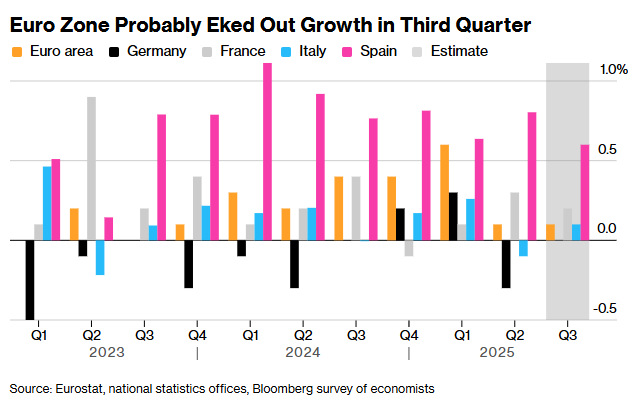
Core Viewpoint - The upcoming economic data releases in Europe, including GDP and inflation figures, are crucial for assessing the impact of U.S. tariffs on economic growth and inflation, with expectations of minimal growth in the Eurozone [1][4]. Economic Indicators - The Eurozone's Q3 GDP is expected to show a slight growth of 0.1%, with significant economic reports from major economies providing further insights [1]. - October inflation data is anticipated to decrease from 2.2% in September to 2.1%, indicating a potential easing of price pressures [4]. - A bank lending survey will be released, which will help evaluate the transmission of monetary policy to the real economy [4]. Economic Activity and Consumer Confidence - Recent corporate surveys indicate a potential recovery in the Eurozone economy, driven primarily by Germany's infrastructure and defense spending [6]. - Despite a strong labor market, consumer confidence remains low, raising concerns about the sustainability of private consumption recovery [4][6]. - The economic outlook for Germany is cautious, with warnings of potential stagnation and the risk of recession if negative growth persists [6][7]. Inflation Trends - The expected slowdown in inflation supports the European Central Bank's assertion that price growth is currently near target levels, with indications that inflation may remain below target in the coming months [9]. - There is a prevailing market sentiment that inflation risks are skewed to the downside, with potential implications for future interest rate discussions [9].
美联储官员或支持月底降息 警告关税和就业压力
Sou Hu Cai Jing· 2025-10-19 08:40
Core Viewpoint - The President of the St. Louis Federal Reserve, Alberto Musalem, indicated potential support for a rate cut by the Federal Reserve at the end of the month, while emphasizing the need for cautious decision-making [1] Summary by Relevant Sections Interest Rate Decisions - Musalem stated that he could support a further reduction in policy interest rates if there are additional risks in the labor market and inflation remains under control [1] - The Federal Open Market Committee is scheduled to meet on October 28-29, with market expectations leaning towards another 25 basis point cut following the previous cut on September 17 [1] Economic Outlook - There are expectations that the Federal Reserve may lower rates again by the end of the year, but Musalem cautioned against making premature predictions about future actions [1] - He highlighted that the task of controlling inflation is not yet complete and that the Federal Reserve must avoid any potential persistent inflation, which could arise from factors such as tariff pressures, reduced labor supply, and economic slowdown [1] Price Pressures - Musalem noted that tariffs are currently increasing price pressures and are expected to impact the economy over the next two to three quarters [1] - He also mentioned that the labor market may face greater pressures moving forward [1]
美联储巴尔金:消费者支出仍稳健但趋谨慎 高收入群体成需求主力
Xin Hua Cai Jing· 2025-10-16 13:46
Core Insights - The financial condition of American consumers has weakened compared to the peak during the pandemic, leading to more cautious spending behavior despite ongoing consumer expenditure supported by low unemployment and wage growth [1][2] - There is a structural shift in the labor market where companies are neither hiring nor laying off, indicating a significant change in the supply-demand relationship for labor [1] - The rapid adoption of artificial intelligence (AI) in sectors like coding and call centers is driving productivity growth, which may help alleviate some cost pressures and support inflation control [1] Consumer Spending - Consumers are making trade-offs in their spending, indicating a shift from the more generous spending patterns observed in 2022 [1] - The spending capacity of households is increasingly constrained, particularly among middle and lower-income groups, while demand remains strong among higher-income individuals [1] Labor Market - The labor market is experiencing a notable change, with a high number of job seekers for each position, reflecting a significant shift in the dynamics of labor supply and demand [1] - Companies are facing a situation where labor demand and supply are shrinking at the same rate [1] Productivity and AI - The integration of AI technologies is seen as a factor that could significantly improve productivity, potentially offsetting some of the cost pressures faced by businesses [1] External Policy Uncertainty - Businesses are planning to pass on tariffs to consumers, indicating that trade policies are beginning to affect price transmission [1] - The current decision-making environment is complex, with the Federal Reserve facing higher uncertainty in monetary policy formulation due to fluctuating high-frequency data and accelerated structural changes [2]
英国失业率升至4.8% 劳动力市场疲软引爆降息预期
Xin Hua Cai Jing· 2025-10-15 14:02
Core Points - The UK unemployment rate has increased from 4.7% to 4.8%, indicating clear signs of weakness in the labor market [1] - This change is rapidly influencing monetary policy expectations, significantly increasing market bets on a potential interest rate cut by the Bank of England within the year [1] - Analysts from TwentyFour Asset Management suggest that the weak labor data provides the Bank of England with more room to initiate a rate cut sooner than previously anticipated [1] - Following the data release, the probability of a rate cut in December surged from 33% to 47%, reflecting investors' reassessment of the UK's monetary policy trajectory [1] - Despite the Bank of England's long-standing emphasis on prioritizing inflation control, the cooling labor market may weaken wage growth momentum, thereby alleviating core inflation pressures [1] - Policymakers may face a re-evaluation between maintaining high rates to combat inflation and mitigating economic downturn risks [1] - Currently, the Bank of England has not provided clear signals regarding the December meeting, but ongoing weakness in employment data could be a critical trigger for a policy shift [1]
美联储“三把手”:美国劳动力市场或进一步放缓 支持年内继续降息
智通财经网· 2025-10-09 15:03
Core Viewpoint - The Federal Reserve's Vice Chairman and New York Fed President Williams supports further interest rate cuts this year due to a potential slowdown in the U.S. labor market, but he emphasizes that current employment cooling does not indicate an imminent recession [1][2] Group 1: Interest Rate Policy - Williams believes there will be further interest rate cuts this year, contingent on future data, particularly if inflation rises slightly to around 3% and unemployment increases moderately [1] - The Federal Reserve's current monetary policy stance is described as "slightly restrictive," aimed at bringing inflation back to the 2% target while avoiding excessive shocks to the labor market [1] - The Fed announced a 25 basis point rate cut during the September 16-17 meeting, with the majority of officials supporting this move due to rising employment risks, despite concerns over persistent high inflation [1] Group 2: Inflation and Economic Factors - Williams estimates that the impact of President Trump's tariffs on overall price levels is lower than market expectations, contributing only 0.25 to 0.5 percentage points to inflation [2] - Core inflation is gradually returning to around 2%, with no signs of secondary effects from tariffs, and structural changes in the economy are reducing upward inflationary pressures [2] - Rising employment risks are partially offsetting price increase momentum, indicating a complex interplay between labor market conditions and inflation [2] Group 3: Federal Reserve Independence - Williams emphasizes the importance of the Federal Reserve's independence in the face of political pressure for deeper rate cuts and attempts to replace Fed officials [2]