
金融合规

Search documents
三季度金融机构被罚没超10亿,四家机构收超6000万大罚单
2 1 Shi Ji Jing Ji Bao Dao· 2025-10-11 15:02
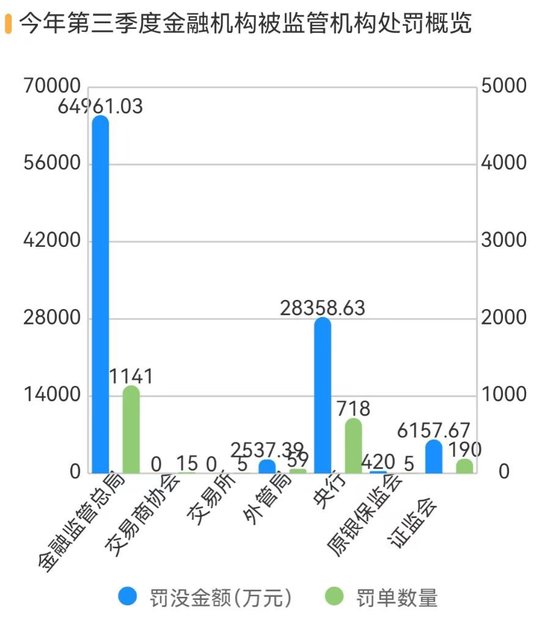
Core Points - In the third quarter of this year, financial institutions received a total of 2,133 fines, amounting to 1.024 billion yuan, representing significant increases of 36.12% and 190.91% respectively compared to the previous quarter, and a notable rise compared to the same period last year [1] Summary by Sections 1. Penalty Situation of Different Types of Institutions in Q3 - The National Financial Regulatory Administration issued 1,141 fines to financial institutions in Q3, totaling 650 million yuan, with a slight decrease of 20.82% in the number of fines year-on-year, but an increase of 46.4% in the total amount [3] - The central bank's penalties increased significantly, with 718 fines issued, a year-on-year increase of 357.32%, and a total penalty amount of 284 million yuan, up 353.34% year-on-year [3] 2. Overall Penalty Situation in the First Three Quarters - The penalty intensity was high in Q1, decreased in Q2, and increased again in Q3 [4] 3. Penalty Breakdown by Institution Type in Q3 - Banks received 1,448 fines, an increase of 18.3% year-on-year, with a total penalty amount of 829 million yuan, up 84.63% year-on-year [8] - Insurance companies received 471 fines, a slight increase of 7.29%, with a total penalty amount of 93.86 million yuan, up 41.57% year-on-year [8] - Securities firms received 45 fines, a decrease of 30.77% year-on-year, but an increase of 40.63% compared to the previous quarter [8] 4. Major Penalties in Q3 - Four fines exceeding 60 million yuan were issued, with Huaxia Bank receiving the largest fine of 87.25 million yuan for imprudent management of loans and related business [13][14] - Other significant fines included 66.70 million yuan for Guangfa Bank and 61.50 million yuan for Hengfeng Bank, both for similar violations [14] 5. Compliance Characteristics in Q3 - There was a notable increase in penalties for internet business violations, with 15 fines issued, a 275% increase from Q2, involving institutions like Postal Savings Bank and Zhejiang Merchants Bank [19] - Loan misappropriation issues were prominent, with 60 related fines issued, a 130.77% increase, primarily involving funds misused for repaying bad loans or investment [21] 6. Penalty Rankings of Financial Institutions in Q3 - Huaxia Bank ranked first in total penalties with 91.62 million yuan, followed by Guangfa Bank with 72.84 million yuan and Hengfeng Bank with 65.55 million yuan [23] - Among non-bank institutions, Donghai Securities topped the list with 60 million yuan in penalties, followed by two wealth management companies, Huaxia Wealth Management and Guangyin Wealth Management [25]




三季度金融机构被罚没超10亿,四家机构收超6000万大罚单
21世纪经济报道· 2025-10-11 14:05
Core Viewpoint - The article highlights a significant increase in penalties imposed on financial institutions in the third quarter, with a total of 2,133 fines amounting to 1.024 billion yuan, marking substantial year-on-year and quarter-on-quarter growth [1]. Group 1: Penalty Overview - In the third quarter, the National Financial Regulatory Administration issued 1,141 fines totaling 650 million yuan, showing a 46.4% increase in penalty amounts year-on-year despite a 20.82% decrease in the number of fines [3]. - The People's Bank of China significantly increased its penalties, issuing 718 fines with a total amount of 284 million yuan, representing a year-on-year increase of 357.32% in the number of fines and 353.34% in penalty amounts [4]. - Overall, the penalty intensity increased in the third quarter after a decline in the second quarter, indicating a trend of heightened regulatory scrutiny [7]. Group 2: Penalty Distribution by Institution Type - Banks received 1,448 fines in the third quarter, an 18.3% increase year-on-year, with total penalties amounting to 829 million yuan, a substantial year-on-year increase of 84.63% [10]. - Insurance companies faced 471 fines, with a slight year-on-year increase of 7.29%, and total penalties of approximately 93.86 million yuan, reflecting a 41.57% increase [10]. - Securities firms received 45 fines, showing a 30.77% decrease year-on-year but a 40.63% increase quarter-on-quarter [10]. Group 3: Major Penalties - Four fines exceeded 60 million yuan in the third quarter, with Huaxia Bank facing the largest penalty of 87.25 million yuan for improper management of loans and regulatory non-compliance [14]. - Guangfa Bank received the second-largest fine of 66.70 million yuan for similar violations, while Hengfeng Bank was fined 61.50 million yuan for issues related to both loan management and wealth management [14]. Group 4: Compliance Cases - Huaxia Securities was penalized for promoting false financial products, resulting in significant client losses, leading to administrative measures against the responsible employee [16][17]. - Donghua Futures faced penalties for improper procurement practices involving funds from its parent company, highlighting internal control deficiencies [18]. Group 5: Compliance Trends - There has been a notable increase in penalties related to internet business violations, with 15 fines issued in the third quarter, a 275% increase from the previous quarter, involving institutions like Postal Savings Bank and Zhejiang Merchants Bank [20]. - Loan misappropriation issues have become prominent, with 60 related fines issued in the third quarter, primarily for using loan funds to repay bad debts or for investment purposes [22][23]. Group 6: Penalty Rankings - In the third quarter, Huaxia Bank led in total penalties with 91.62 million yuan, followed by Guangfa Bank with 72.84 million yuan and Hengfeng Bank with 65.55 million yuan [25]. - Among non-bank institutions, Donghai Securities topped the list with a penalty of 60 million yuan, while two wealth management companies, Huaxia Wealth and Guangyin Wealth, ranked second and third with penalties of 12 million and 11.60 million yuan, respectively [28].

三季度金融机构被罚没超10亿 四家机构收超6000万大额罚单
2 1 Shi Ji Jing Ji Bao Dao· 2025-10-11 07:54
Core Insights - In the third quarter of this year, financial institutions received a total of 2,133 fines, amounting to 1.024 billion yuan, representing significant increases of 36.12% and 190.91% respectively compared to the previous quarter, and a notable rise compared to the same period last year [1] Summary by Sections 1. Penalty Situation in Q3 - The National Financial Regulatory Administration issued 1,141 fines to financial institutions in Q3, totaling 650 million yuan, with a slight decrease of 20.82% in the number of fines year-on-year, but a 46.4% increase in the total amount [2] - The central bank significantly increased its penalties, issuing 718 fines, which is a year-on-year increase of 357.32%, with a total penalty amount of 284 million yuan, also up 353.34% year-on-year [2] 2. Overall Penalty Trends - The overall penalty situation for financial institutions in the first three quarters shows a strong enforcement in Q1, a slight decline in Q2, and a resurgence in Q3 [4] 3. Breakdown by Institution Type - Banks received 1,448 fines in Q3, an increase of 18.3% year-on-year, with penalties totaling 829 million yuan, a year-on-year increase of 84.63% [7] - Insurance companies received 471 fines, with a slight increase of 7.29% year-on-year, and penalties amounting to 93.86 million yuan, up 41.57% [7] - Securities firms received 45 fines, a decrease of 30.77% year-on-year, but an increase of 40.63% compared to the previous quarter [7] 4. Major Penalties - In Q3, there were four penalties exceeding 60 million yuan, with Huaxia Bank receiving the largest fine of 87.25 million yuan for improper management of loans and regulatory data reporting [11] - Guangfa Bank received the second-largest fine of 66.70 million yuan for similar violations [12] - Hengfeng Bank was fined 61.50 million yuan for issues related to loan management and investment [13] 5. Compliance Cases - Huaxia Securities faced penalties for promoting false financial products, resulting in significant client losses [15] - Donghua Futures was penalized for improper procurement processes involving funds [14] 6. Compliance Characteristics - There has been an increase in penalties related to internet business violations, with 15 fines issued in Q3, a 275% increase from Q2 [15] - Loan misappropriation issues were prominent, with 60 related fines issued, a 130.77% increase from the previous quarter [17] 7. Penalty Rankings - In Q3, Huaxia Bank had the highest total penalty amount of 91.62 million yuan, followed by Guangfa Bank at 72.84 million yuan, and Hengfeng Bank at 65.55 million yuan [19] - Among non-bank institutions, Donghai Securities led with a penalty of 60 million yuan, followed by Huaxia Wealth Management and Guangyin Wealth Management [21]



收购牌照 同程旅行进军支付
Bei Jing Shang Bao· 2025-09-25 16:53
Core Viewpoint - Tongcheng Group's subsidiary, eLong, has acquired 100% of Newborn Payment Co., Ltd., gaining a payment license to capitalize on opportunities in cross-border trade and cultural tourism in the Hainan Free Trade Port [1][3][4] Group 1: Acquisition Details - The acquisition of Newborn Payment was executed through a full acquisition by eLong, which is a subsidiary of Tongcheng Group [3] - Newborn Payment, established in 2008 with a registered capital of 100 million RMB, was previously under HNA Group and has held a payment business license since 2011 [3][4] - The payment license allows Newborn Payment to conduct various payment services, including internet payment, prepaid card issuance, and bank card acceptance, with a license validity until May 2026 [3][4] Group 2: Strategic Considerations - The acquisition aligns with Tongcheng's strategy to leverage the development of the Hainan Free Trade Port, enhancing its capabilities in cross-border commerce and cultural tourism [1][6] - Newborn Payment is the only licensed payment institution in Hainan, positioning it to benefit from the region's favorable policies as it approaches the 2025 deadline for becoming a high-level free trade port [4][5] Group 3: Industry Context - The payment industry is transitioning into a phase where acquiring licenses through acquisition is becoming a common strategy due to regulatory constraints on new applications [3][7] - The importance of having a complete payment license is emphasized, as it allows companies to reduce costs associated with partnering with external licensed payment institutions [6][8] Group 4: Future Opportunities - The acquisition is expected to enhance Tongcheng's service offerings, allowing for better integration of financial services within its existing travel platform [8][9] - The move is seen as a step towards building a comprehensive financial ecosystem, which is crucial for maintaining competitiveness in the digital economy [9][10]

8家银行被罚1.487亿元!多张罚单,集中公布……
券商中国· 2025-09-13 05:16
Core Viewpoint - Multiple financial institutions have been fined by regulatory authorities for various compliance and operational deficiencies, highlighting the need for improved risk management and compliance systems across the sector [2][3][4]. Group 1: Penalties Overview - On September 12, the National Financial Regulatory Administration disclosed penalties against several financial institutions, with a total of 148.7 million yuan (approximately 21.1 million USD) imposed on 8 banks, 14.2 million yuan (approximately 2 million USD) on 2 wealth management companies, and 2.825 million yuan (approximately 400,000 USD) on 1 insurance company [2]. - The penalties stem from issues such as deficiencies in information technology and system management, weak risk management and internal controls, violations in investment and wealth management operations, and problems with data governance and reporting [2]. Group 2: Specific Violations by Banks - Several banks, including Guangfa Bank, Hengfeng Bank, Minsheng Bank, and others, received fines exceeding 1 million yuan for violations related to regulatory data misreporting and improper management of loans and wealth management [3]. - Guangfa Bank was fined 66.7 million yuan (approximately 9.5 million USD) for improper management of loans and regulatory data misreporting, with two responsible individuals fined a total of 100,000 yuan (approximately 14,000 USD) [3]. - Hengfeng Bank faced a fine of 61.5 million yuan (approximately 8.7 million USD) for similar violations, with four responsible personnel fined a total of 250,000 yuan (approximately 35,000 USD) [3]. Group 3: Wealth Management and Investment Violations - Wealth management and investment operations were significant areas of concern, with institutions like Huaxia Wealth Management fined 12 million yuan (approximately 1.7 million USD) for non-compliance in investment operations and data reporting [4]. - Citic Bank was fined 5.5 million yuan (approximately 780,000 USD) for inaccurate risk classification in wealth management assets, while its subsidiary, Xinyin Wealth Management, was fined 2.2 million yuan (approximately 310,000 USD) for regulatory non-compliance in product naming and investment ratios [4]. - In the insurance sector, Hengda Life Insurance faced penalties for severe non-compliance in fund utilization and management, resulting in fines totaling 2.825 million yuan (approximately 400,000 USD) for 20 responsible personnel [4]. Group 4: Policy Bank Penalties - The only policy bank involved in this round of penalties was the China Export-Import Bank, which was fined 1.3 million yuan (approximately 180,000 USD) for inadequate country risk management and salary payment management [5].




8月3张千万级罚单 有大行支行因贷款资金、信用卡资金入市被罚
2 1 Shi Ji Jing Ji Bao Dao· 2025-09-03 11:06
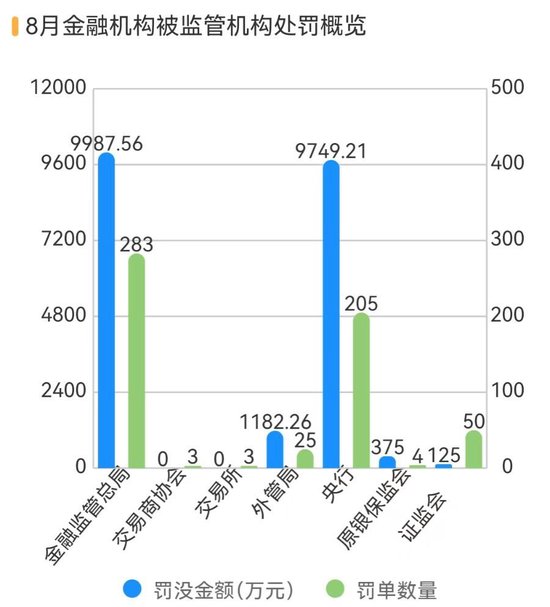
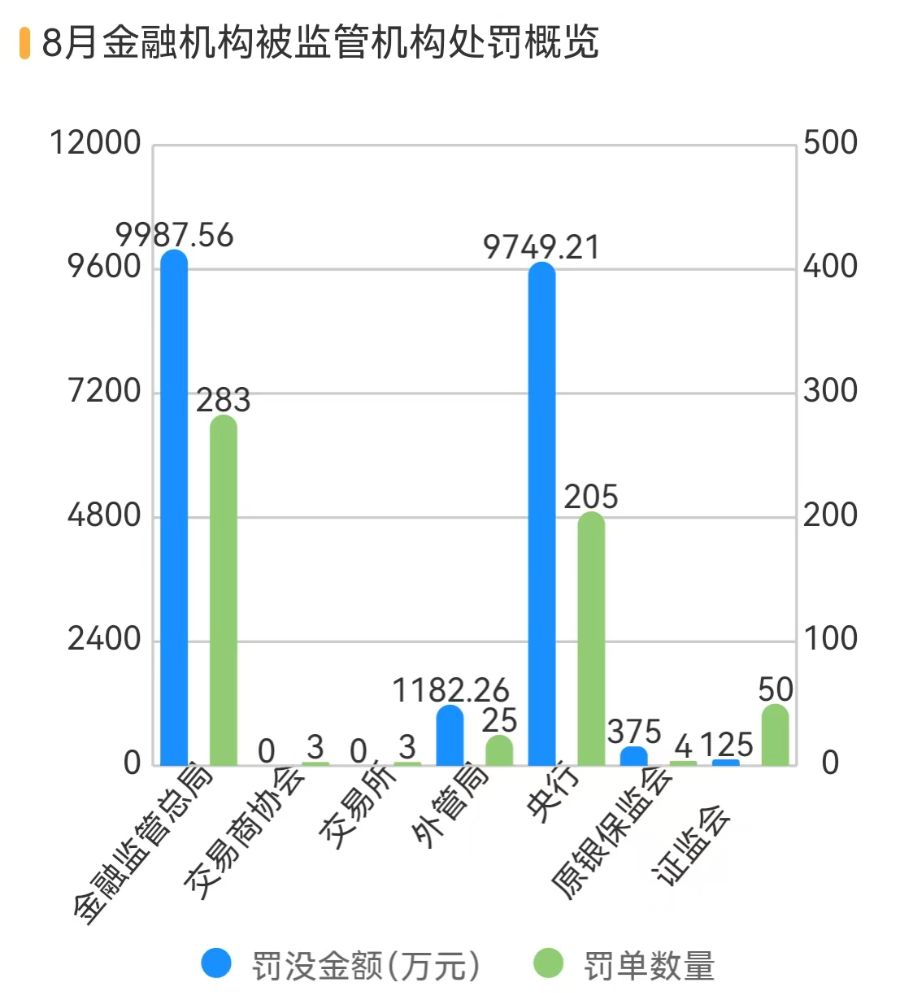
Core Viewpoint - In August, financial institutions received 573 penalties totaling 214 million yuan, indicating a decrease in regulatory intensity compared to July, although certain sectors still experienced high penalty frequencies [1][7]. Group 1: Penalty Overview - The total number of penalties in August decreased by 37.99% from July, while the total penalty amount decreased by 33.74% [7]. - The banking sector faced the most significant drop, with 361 penalties and a total of 167 million yuan in fines, reflecting decreases of 46.68% and 22.18% respectively [7]. - The insurance sector received 158 penalties totaling 34.62 million yuan, with reductions of 14.13% and 20.86% [7]. Group 2: Regulatory Agency Actions - The State Administration of Foreign Exchange (SAFE) issued 25 penalties totaling 11.82 million yuan, marking a significant increase from July [4]. - The People's Bank of China (PBOC) maintained a strong regulatory stance with 205 penalties totaling 97.49 million yuan, focusing on anti-money laundering and credit information management violations [4]. - The China Securities Regulatory Commission (CSRC) maintained the same number of penalties as July, targeting issues like inadequate internal controls and violations in fund sales [4]. Group 3: Major Penalties - Shanghai Bank received the largest penalty of 29.21 million yuan from the PBOC for violations related to credit information management and anti-money laundering responsibilities [12]. - Guangyin Wealth Management was fined 11.59 million yuan for non-compliant investment operations and data management [12]. - The Agricultural Development Bank of China was penalized 10.2 million yuan for non-compliance in credit fund allocation and post-loan management [12]. Group 4: Compliance Trends - There was a 73.08% increase in penalties related to false financial/business data, with 45 penalties issued in August, primarily against insurance companies [16]. - A significant rise of 133.33% in penalties related to inadequate internal controls was noted, with 28 penalties issued [17]. - The banking sector saw penalties for internal control failures leading to economic losses, with some individuals facing bans from the industry [17]. Group 5: Penalty Rankings - Shanghai Bank topped the penalty rankings with a total of 33.32 million yuan from three penalties, primarily due to anti-money laundering violations [20]. - The Agricultural Development Bank ranked second with 10.95 million yuan from four penalties, focusing on credit fund compliance issues [20]. - Non-bank institutions, particularly insurance and wealth management companies, dominated the penalty rankings, with Guangyin Wealth Management leading at 11.59 million yuan [22].

8月3张千万级罚单,有大行支行因贷款资金、信用卡资金入市被罚
2 1 Shi Ji Jing Ji Bao Dao· 2025-09-03 11:01
Core Viewpoint - In August, financial institutions received 573 penalties totaling 214 million yuan, indicating a decrease in regulatory intensity compared to July, although certain sectors still experienced high penalty frequencies [1][7]. Summary by Sections 1. Penalty Situation in August - Regulatory penalties in August showed an overall decrease compared to July, with the foreign exchange administration increasing both the number and amount of penalties year-on-year and month-on-month [2][4]. - The central bank issued 205 penalties totaling 97.49 million yuan, focusing on anti-money laundering and credit information management violations [4][7]. 2. Penalty Amounts and Types - The total number of penalties in August was 573, a 37.99% decrease from July's 924 penalties, and the total amount was 214 million yuan, down 33.74% [7]. - Banks received 361 penalties totaling 166.7 million yuan, marking significant decreases of 46.68% and 22.18% respectively [7]. - Insurance companies faced 158 penalties totaling 34.62 million yuan, with notable issues including false financial data and improper use of insurance terms [7][15]. 3. Major Penalties - Three penalties exceeded 10 million yuan, with Shanghai Bank receiving the largest fine of 29.22 million yuan from the central bank for violations related to credit information and anti-money laundering [11][12]. - The second-largest penalty was against Guangjin Wealth Management for 11.59 million yuan, focusing on investment operation irregularities [12]. 4. Compliance Characteristics - There was a 73.08% increase in penalties related to false financial/business data, primarily affecting insurance companies [15]. - A significant rise of 133.33% in penalties related to inadequate internal controls was noted, affecting various financial institutions [16][17]. 5. Penalty Rankings - Shanghai Bank topped the penalty rankings with 33.32 million yuan from three penalties, largely due to anti-money laundering violations [21]. - The Agricultural Development Bank of China ranked second with 10.95 million yuan in penalties, focusing on credit fund misallocation [21][23].
香港数字资产上市公司联合会成立 华兴资本控股董事会主席许彦清受聘名誉会长引领合规化进程
Cai Fu Zai Xian· 2025-08-28 02:08
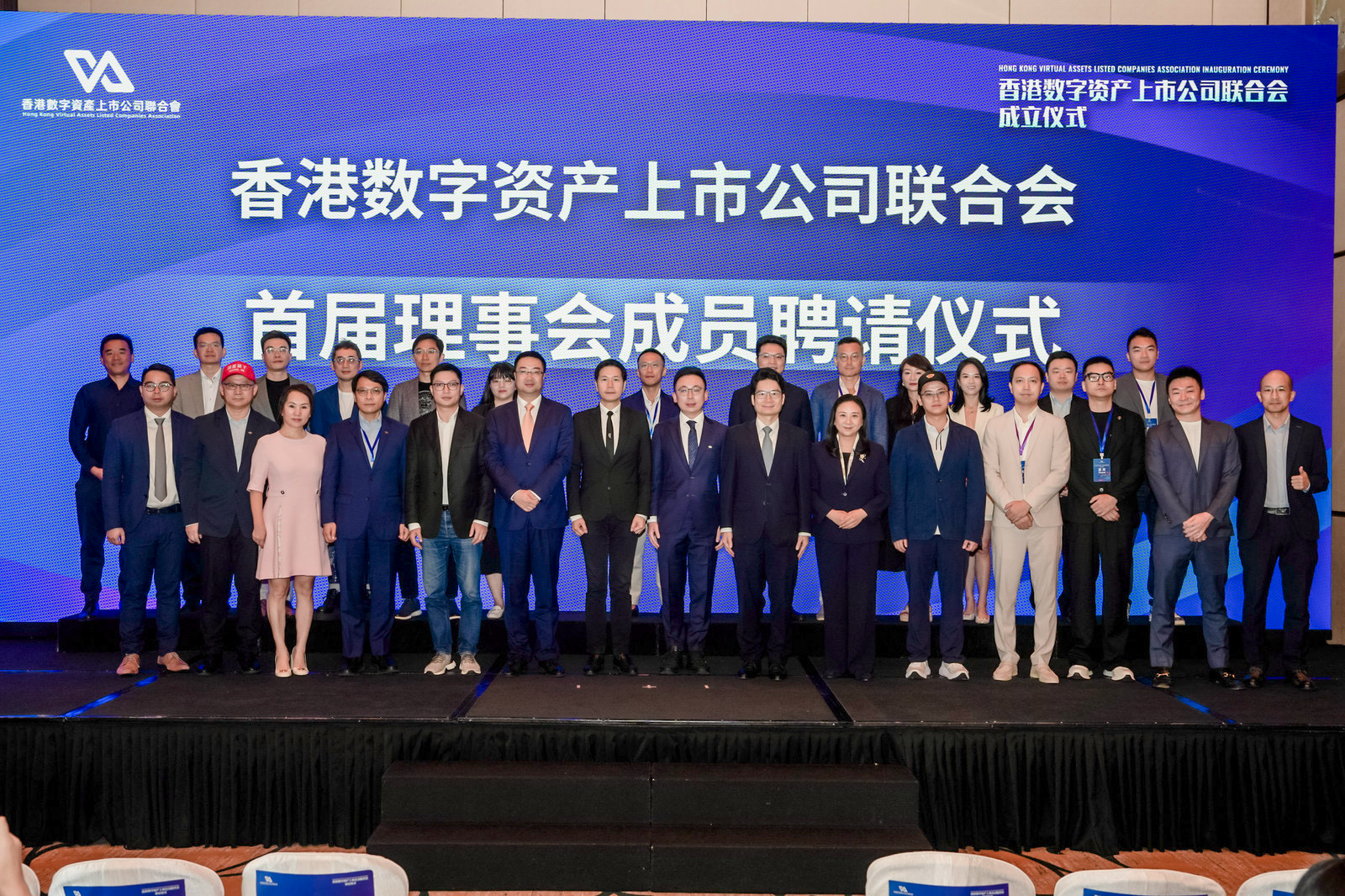
Group 1 - The Hong Kong Virtual Asset Listed Companies Association (HKVALA) has been officially established, marking a new phase of "regulatory leadership and self-discipline" in the digital asset industry in Hong Kong [1][3] - The association was initiated by over 50 listed companies from Hong Kong, the US, and China, covering the entire industry chain including finance, technology, and real economy [3] - HKVALA aims to promote compliance innovation and large-scale application in frontier areas such as stablecoins and Real World Asset (RWA) tokenization, while establishing a long-term self-regulatory governance mechanism [3] Group 2 - Huaxing Capital is recognized for its expertise in the new economy and digital asset sectors, with its chairman, Xu Yanqing, appointed as the honorary president of HKVALA [1][3] - Huaxing Capital has announced a special budget of $100 million to fully enter the stablecoin and RWA sectors, and has formed a strategic partnership with YZi Labs to allocate $100 million in BNB [3] - Xu Yanqing emphasized that digital assets represent a historical opportunity for the restructuring of the global financial system, and Huaxing Capital will continue to uphold compliance and long-term value [3]
金融观察员|九台农商银行上半年预亏近9亿;商业银行并购贷款管理办法公开征求意见
Guan Cha Zhe Wang· 2025-08-25 08:42
Group 1 - The Financial Regulatory Authority released a draft for the "Commercial Bank M&A Loan Management Measures," aiming to increase the upper limit of M&A loans as a percentage of transaction value and extend the maximum loan term to better meet corporate financing needs [1] - The draft specifies that controlling M&A loans cannot exceed 70% of the transaction value, while equity funding must be at least 30%. For participatory M&A loans, the limits are 60% and 40% respectively [1] - The maximum term for controlling M&A loans is set at ten years, while participatory loans are capped at seven years [1] Group 2 - Several banks, including Xinyi Rural Commercial Bank and Yunnan Maguan Rural Commercial Bank, issued statements denying any collaboration with credit card intermediaries, warning consumers against fraudulent practices [2] - The newly appointed president of Zijin Bank, Que Zhenghe, has extensive experience in banking management, having worked in various rural credit institutions [2] - Bohai Bank faced a fine of 1.65 million yuan due to inadequate credit investigation and post-loan management, accumulating over 5 million yuan in penalties this year [2] Group 3 - Hengfeng Bank's Chongqing branch was fined 2.6 million yuan for multiple violations, including concealing non-performing loans and inadequate loan reviews [3] - Despite efforts to reduce non-performing loans, Hengfeng Bank's major shareholder recently took over approximately 5.465 billion yuan in non-performing assets, indicating ongoing challenges in asset management [3] Group 4 - Mianyang Rural Commercial Bank was fined 1.477 million yuan for various financial violations, including breaches of financial statistics and account management regulations [4] - Starting September 1, several banks plan to implement a subsidy policy for personal consumption loans, potentially lowering actual interest rates to around 2% [4] - Jiu Tai Rural Commercial Bank anticipates a net loss of approximately 898 million yuan for the first half of 2025, primarily due to increased asset impairment losses [4]

基金销售部门负责人未取得基金从业资格便履职!晋商银行被警示
Bei Ke Cai Jing· 2025-08-09 03:49
Core Points - Jinshang Bank has been issued a warning letter by the Shanxi Securities Regulatory Bureau due to violations related to the qualifications of its fund sales department personnel and failure to submit necessary documentation for personnel changes [1][2] - The regulatory body emphasized the need for Jinshang Bank to take immediate corrective actions, enhance internal control systems, and improve compliance management in fund sales [1] - In addition to the recent violations, Jinshang Bank has previously faced penalties for allowing personnel to perform duties without proper approval, resulting in a fine of 300,000 yuan [3]