
资产荒

Search documents
债市持续释放强监管信号
Zhong Guo Zheng Quan Bao· 2025-08-08 07:28
有债市交易员表示,持续释放的强监管信号,引导收益率近日连续上行,目前10年期和30年期国债收益 率的阶段性底部基本确定,市场继续关注人民银行等管理部门的动态。 流动性方面,Wind数据显示,上周央行公开市场净回笼7597.6亿元,净回笼量为3月初以来单周新高。 截至8月9日收盘,DR001(银行间市场存款类机构隔夜质押式回购利率)加权平均利率上行约10基点报 1.79%。 8月9日,债券市场继续下跌,长债价格跌幅更大。Wind数据显示,截至当日收盘,30年期国债期货主 力合约跌0.21%,10年期国债期货主力合约跌0.20%,5年期、2年期国债期货主力合约分别跌0.11%、 0.04%。 银行间主要利率债收益率全线上行。截至8月9日收盘,30年期国债活跃券"230023"收益率上行2.5基点 成交在2.38%,10年期国债活跃券"240004"收益率上行3基点成交在2.20%,10年期国债"240011"收益率 上行2.5基点成交在2.20%,备受关注的7年期国债"240013"收益率上行5.4基点成交在2.07%。 在市场人士看来,最近债市转为连续下跌,与相关部门的监管态度和出台举措不无关系。 交易商协会8 ...
今年以来长债收益率持续下行 短期或维持区间震荡格局
Zheng Quan Ri Bao· 2025-08-08 07:28
Core Viewpoint - The continuous influx of funds into the bond market has led to a sustained decline in long-term government bond yields in China, with the 10-year government bond yield dropping from 2.5601% at the beginning of the year to 2.1547% by August 23, indicating a significant downward trend [1]. Group 1: Market Trends - The 10-year government bond yield has been fluctuating within a range of 2.1% to 2.3% since early August, with a low of 2.1277% on August 2 and a peak of 2.2508% on August 12, reflecting a state of "volume contraction and price stability" [1]. - The phenomenon of "asset shortage" in the financial market has contributed to the decline in yields, as deposit rates continue to decrease and the supply of interest-bearing bonds is insufficient, leading to a scarcity of attractive investment targets [1]. Group 2: Central Bank Actions - The People's Bank of China (PBOC) has expressed concern over long-term yields and has been conducting flexible open market operations to address potential financial risks, particularly regarding the mismatch of duration and interest rate risks held by non-bank entities [2]. - The PBOC's second-quarter monetary policy report indicated that the 10-year government bond yield had reached a 20-year low, deviating significantly from reasonable central levels, which has raised concerns about accumulating financial risks [2]. Group 3: Future Outlook - The bond market is expected to maintain a range-bound pattern, with a low probability of a unilateral decline in government bond yields, as the market awaits changes in supply and demand dynamics [3]. - In the short term, increased volatility in the bond market is anticipated, but a balanced supply-demand structure is expected to emerge in the long term, supported by steady economic recovery and effective policy implementation [3].
短债锁利权益突围 理财公司应对降息策略曝光
Zhong Guo Zheng Quan Bao· 2025-08-08 07:23
"就目前来看,本轮降准降息落地后,理财产品资产端利率在短期内未出现明显下降,反而有所回 升。实际上,今年市场上资产供给有所增加,理财公司'资产荒'的现象并未显著加剧,只能说是高收益 资产遭遇了激烈拼抢。"某股份行理财公司投研业务负责人告诉记者。 从短期来看,央行降准降息政策对理财产品资产端收益率的影响相对有限,近期长债利率震荡回 升,同业存单利率有所上行。但从长期来看,理财产品底层资产收益率下行趋势明确,理财公司的"资 产荒"局面难以改变。 在资产配置方面,不少理财公司投研人士表示,将优先布局同业存单、短期信用债等短债资产,以 锁定当前高利率。此外,在低利率环境下,为增厚收益,理财公司将优化投资组合,通过增加多元资产 配置,分散投资于不同的资产类别,降低对单一资产的依赖,以平衡风险和收益。 资产端收益率影响有限 从短期来看,央行降准降息政策对理财产品资产端收益率影响有限,上周存款降息、LPR下调等操 作落地,长债利率震荡回升。 "从2023年以来存款利率下降后的债券走势来看,1年期和10年期国债收益率的表现不一,存款降息 并不一定会带来债券收益率快速下行,更多需要考虑当时的基本面、政策环境和交易情绪。债券收益 ...
逆袭!创十年新高
Zhong Guo Ji Jin Bao· 2025-08-08 06:37
Group 1 - The convertible bond market has reached a ten-year high, with the China Convertible Bond Index hitting 469.56 points and a year-to-date increase of 12.74% [2] - More than ten convertible bond funds have seen net value growth rates exceeding 15% this year, with the top performer, Southern Changyuan Convertible Bond A, achieving 24.78% [2][3] - The strong performance of convertible bonds is attributed to a supply-demand imbalance and a robust equity market, making them an attractive investment option due to their debt protection and equity-like characteristics [1][2] Group 2 - The current valuation of convertible bonds is considered to be at a relatively high level within a 3-4 year range, with potential opportunities for accumulation if valuations decline [3] - The convertible bond market is expected to experience three phases: initial price recovery, balanced valuation expansion, and high volatility/high return phase [3] - The market is currently characterized by limited downward space, with a focus on sectors like photovoltaic and pig farming for risk-controlled investments [4]
农行登顶A股“市值之王”?大行AH股分布比例差异大:农行91%股本在A股,建行92%股本在港股
Di Yi Cai Jing Zi Xun· 2025-08-07 07:03
8月6日,A股三大指数录得三连涨,全市场超3300股上涨。在市场一片大好中,有两个信号被格外关 注:一是融资余额时隔10年再度突破2万亿元;二是农业银行(601288.SH)首次登顶A股市值之最,工 商银行(601398.SH)"让位"。 截至当日收盘,农业银行A股总市值为2.11万亿元,超过工商银行的2.09万亿元,这在历史上是首次。 目前,A股市值前三排位是:农业银行、工商银行、贵州茅台(600519.SH);今年年初这一排位是: 贵州茅台、工商银行、农业银行。但从总市值来看,工商银行仍以2.57万亿元居首,农业银行、建设银 行分别以2.26万亿元、1.94万亿元位居第二位、第三位。 有市场人士提示,农业银行年内涨势稳定且持续,在国有大行中表现亮眼。不过,考虑到各家大行上市 总股本在A股和H股的分布比例差异较大,单纯比较A股市值的参考意义有限。Wind数据显示,目前国 有大行中A股占总股本比例最高的为农业银行(约91%),最低的为建设银行(约为8%),后者因为 股本大头在港交所,A股市值低于部分股份行甚至城商行。 截至7日13:45,农业银行A股涨1.51%,工商银行A股涨0.90%,农业银行A股市值仍然 ...



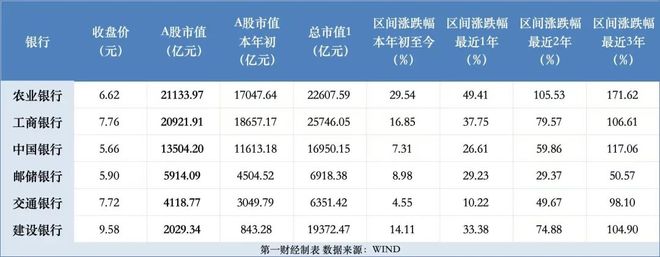
农业银行亮了!回调半个多月的银行股反弹,对债券替代性如何?
第一财经· 2025-08-06 06:05
Core Viewpoint - The recent rebound in A-share bank stocks is attributed to the attractive and stable dividends amidst an "asset shortage" environment, with many stocks becoming more cost-effective after a period of correction [3][10]. Group 1: Market Performance - On August 5, the A-share market saw a rise, with the Shanghai Composite Index increasing by 0.96%, surpassing 3600 points, and the China Securities Bank Index rising by 1.6% to 8087.4 points [5]. - Agricultural Bank of China (ABC) reached a new high, closing at 6.54 yuan per share, while several other banks also saw significant gains, with Shanghai Pudong Development Bank leading with a 4.72% increase [5][6]. - From July 11 to the end of July, the China Securities Bank Index fell by 7.27%, while ABC was the only bank stock to rise during this period, increasing by 1.95% [6]. Group 2: Financial Performance - Preliminary reports indicate that three out of five regional banks that disclosed their half-year results achieved double-digit growth in net profit attributable to shareholders [3][12]. - The median dividend yield for A-share bank stocks remains around 4%, with nearly 90% of stocks yielding over 3% [11]. Group 3: Regulatory Changes and Impact - Starting August 8, new regulations will impose a value-added tax on interest income from newly issued government bonds, local bonds, and financial bonds, which may enhance the relative attractiveness of bank stocks compared to bonds [10][11]. - The new tax regulations are expected to create an incremental tax burden for institutional investors, with projected additional tax revenues of approximately 321 billion yuan, 648 billion yuan, and 988 billion yuan for the years 2025 to 2027, respectively [10]. Group 4: Institutional Investment Trends - Insurance funds have shown a strong interest in increasing their holdings in bank stocks, with over 20 instances of shareholding increases this year, surpassing the total for the previous year [11][12]. - The implementation of new accounting standards for the insurance industry has led to a significant increase in bank stock purchases, as these stocks are often priced below their net asset value [13].
难寻“代餐”!中小行做债热情再升温,7月城农商行现券交易额创年内新高
Sou Hu Cai Jing· 2025-08-05 16:16
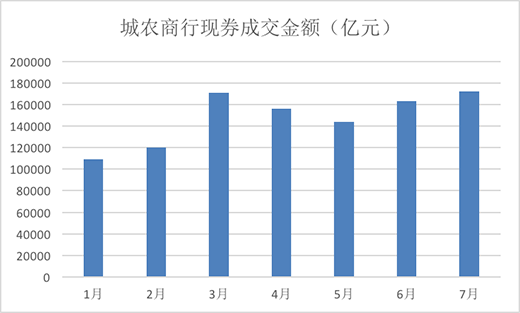
不过,进入二季度,中小行做债热情突然转"冷"。银行间同业拆借中心数据显示,来到4、5月份,中小行交易热 情连续两个月下降,城农商行现券合计成交金额分别环比下滑8.6%、7.9%。特别是在5月份,城农商行现券合计 成交笔数出现大幅下降,环比减少9.5%。 本报(chinatimes.net.cn)记者李明会 北京报道 "资产荒"困局之下,债市成为中小行资产配置的主战场。 近日,《华夏时报》记者梳理今年以来银行间同业拆借中心的现券买卖月报数据发现,今年4月、5月,城农商行 现券成交金额连续两个月环比下滑;不过,在经历两个月的短暂调整后,城农商行加大现券交易力度,6 月、7 月 现券成交金额分别环比增长13.5%、5.7%。其中,7月份现券成交金额达17.24万亿元,再次突破17万亿元大关,创 年内新高。 同时,央行数据显示,今年以来,中资中小银行债券投资金额逐月增加,截至今年6月末,相关投资金额达46.44 万亿元。 "城农商行现券交易频繁的背后驱动因素主要是有效贷款需求不足、信贷投放缩量、大行下沉挤压、跨区展业受限 等。"东方金诚金融业务部高级副总监鲁金飞在接受《华夏时报》记者采访时表示,当前市场环境下,利率债 ...

难寻“代餐”!中小行做债热情再升温 7月城农商行现券交易额创年内新高
Hua Xia Shi Bao· 2025-08-05 15:04
Core Viewpoint - The bond market has become the main battlefield for asset allocation among small and medium-sized banks amid the "asset shortage" dilemma, with significant fluctuations in trading volumes observed throughout the year [1][2][4]. Trading Activity - In March, the total trading volume of bonds by city and rural commercial banks exceeded 17 trillion yuan, marking a 42% month-on-month increase, with nearly 350,000 transactions, a 30% increase [2]. - However, trading enthusiasm cooled in April and May, with trading volumes declining by 8.6% and 7.9% respectively, and a notable 9.5% drop in transaction counts in May [4][5]. - By July, trading volumes rebounded, reaching 17.24 trillion yuan, surpassing the trading volumes of larger banks [7]. Investment Trends - The bond investment amount of Chinese small and medium-sized banks has been steadily increasing, reaching 46.44 trillion yuan by the end of June, with a year-to-date increase of 3.6 trillion yuan [5][11]. - Despite the overall decline in trading enthusiasm, city and rural commercial banks have shown a strong demand for bond investments, driven by insufficient loan demand and a shrinking credit supply [1][10]. Market Dynamics - The concentration of quality credit resources in larger banks has limited the opportunities for small and medium-sized banks to secure quality corporate loans, prompting them to favor liquid and low-risk bonds [7]. - The bond market has experienced a bull market trend, making bond trading and investment a rational choice for small banks [7][10]. Future Outlook - The trend of small and medium-sized banks increasing bond investments is expected to continue, with a focus on enhancing asset-liability management and exploring opportunities in specialized financial services [10][12]. - The People's Bank of China has acknowledged the stabilizing role of small banks in the bond market, emphasizing the need for a balanced approach to investment returns and risk [11].
农业银行亮了!回调半个多月的银行股反弹,对债券替代性如何?
Di Yi Cai Jing· 2025-08-05 12:35
5日,A股市场全天震荡走高,沪指收涨0.96%重回3600点上方,再创年内收盘新高,全市场超3900只个 股上涨。银行板块在当天午后震荡走强,中证银行指数全天涨1.6%,报8087.4点,个股全线飘红。 其中,浦发银行以4.72%涨幅领涨,齐鲁银行涨幅接近3%,常熟银行、浙商银行、江阴银行、民生银 行、青岛银行、农业银行等10余只个股涨幅超过2%。其中,农业银行A股股价续创新高,收报6.54元/ 股。 债券利息恢复征税,如何影响机构对银行股的配置策略? 8月5日,A股银行板块再度震荡走强,尤其随着农业银行股价续创新高,市场上不乏"银行股又行了"的 调侃。在此之前,银行股经历了半个多月的回调,中证银行指数在7月中下旬累计跌超7%,后市分歧加 大。 对于近期银行股反弹,有机构人士对第一财经表示,"资产荒"背景下,银行股的稳定分红依然具有较强 吸引力,高位回调让不少个股性价比提升。"国债、地方债、金融债利息收入恢复征税,比价效应下, 非银机构尤其保险资金长期增配银行股的动力可能会更强。"该人士表示。 另从业绩快报和机构预测来看,银行业今年上半年业绩较一季度大概率会略有改善。目前披露上半年业 绩快报的5家区域性银行中 ...
债市周观察:债市短暂触及1.7%以下
Great Wall Securities· 2025-08-05 08:07
1. Report Industry Investment Rating No relevant content provided. 2. Core Viewpoints of the Report - The current VAT policy on bonds is short - term positive and long - term neutral. In the short term, it is beneficial to existing bonds, potentially triggering a pre - layout market for "snapping up old bonds." However, the expected continued decline in interest rates on Monday did not occur, as the improvement in the stock market weakened the bond market, and the "rumor" of the China Development Bank bonds drove up the long - term Treasury bond rates. In the medium term, the policy impact on the bond market tends to be neutral. Despite the intention to divert funds to the stock market, the trend of funds chasing the bond market is difficult to completely reverse due to the "asset shortage" and loose liquidity [2][3][21][22] 3. Summary by Relevant Catalogs 3.1 Interest Rate Bonds Data Review for Last Week - **Funds Interest Rates**: In the week of August 1st, after a slight increase at the end of July, the funds interest rates started to decline. DR001 reached 1.46% on July 28th and then fluctuated down to 1.31%, with a weekly fluctuation of 15BP; R001 rose to 1.56% on July 31st and dropped to 1.35% on August 1st, with a weekly fluctuation of 21BP. DR007 fell from 1.58% on July 28th to 1.42% on August 1st, a decline of 16BP; FR007 dropped from 1.64% to 1.50%, a weekly decline of 14BP [8] - **Open Market Operations**: The central bank's reverse repurchase volume increased slightly to 1.66 trillion yuan, with a similar total maturity volume. The net capital injection was small, and the daily net injection decreased gradually [8] - **Sino - US Market Interest Rate Comparison**: The inversion of the Sino - US bond yield spread slightly decreased. The US 6 - month SOFR rate rose from 4.20% on July 28th to 4.24% on August 1st; the Chinese 6 - month SHIBOR rate remained stable at 1.61%. As of August 1st, the 6 - month interest rate spread between China and the US was - 263BP, with a slightly wider inversion; the 2 - year and 10 - year bond yield spreads were - 227BP and - 252BP respectively, with a slight reduction in the long - and short - term spreads [13] - **Term Spreads**: The term spread of Chinese bonds slightly contracted, while that of US bonds slightly expanded. The 2 - year Chinese bond yield was 1.43%, and the 10 - year was 1.71%, with the 10 - 2 year spread narrowing from 30BP to 28BP. The US bond yield slightly declined, with the 2 - year yield rising to 3.94% and then dropping 25BP to 3.69% on August 1st, and the 10 - year yield dropping 19BP to 4.23%. The 10 - 2 year term spread of US bonds widened 3BP to 54BP [16] - **Interest Rate Term Structure**: The yield curve of Chinese bonds steepened, while that of US bonds flattened and shifted downward. The overall change in the Chinese bond yield curve was small, with the 3 - month yield dropping 2BP and the 3 - 5 year yields dropping about 1 - 2BP. Except for the 3 - month yield, the overall US bond yields dropped about 20BP [16] 3.2 Key Bond Market Events Last Week - **New Policy on Bond Interest Taxation**: On August 1st, the Ministry of Finance and the State Taxation Administration announced that starting from August 8th, the interest income from newly issued national bonds, local government bonds, and financial bonds will be subject to VAT. The interest income from bonds issued before August 8th and the continued issuance after that date will remain VAT - exempt until maturity [23][24] - **Weak PMI Data**: The National Bureau of Statistics data showed that the manufacturing PMI in July was 49.3%, a 0.4 - percentage - point decrease from the previous month, indicating a decline in manufacturing prosperity. In July, the manufacturing industry entered the traditional off - season, and factors such as high temperatures and floods in some areas led to the decline of PMI data [24]