
资产证券化

Search documents
“底层资产”扩围 特色不断涌现
Jin Rong Shi Bao· 2025-08-08 07:52
Core Insights - The asset securitization market is experiencing a decline in both existing and new issuance volumes, yet the number of trust companies participating in this sector continues to grow, indicating a shift in focus towards asset securitization as a mainstream business for the trust industry [1][2] Group 1: Knowledge Property Securitization - In April 2023, a significant knowledge property securitization project led by China Foreign Trade Trust was successfully issued, with a total framework size of 1 billion yuan, marking it as the largest project in Chongqing covering nine high-tech enterprises [2][3] - From 2018 to August 2024, a total of 153 knowledge property securitization products have been issued in China, with a cumulative scale of 29.148 billion yuan, highlighting the growing interest in this area despite overall market adjustments [3][4] Group 2: Asset Types and Regulations - The implementation of the "Three Classification New Regulations" in 2023 has diversified the types of assets that can be securitized, including loans, receivables, and royalties, which can generate predictable cash flows [4][5] - The green asset securitization market has seen significant growth, with a scale reaching 90.947 billion yuan, reflecting the industry's commitment to supporting green initiatives [4] Group 3: Challenges and Opportunities - Trust companies face increasing competition in the asset securitization space, necessitating improvements in their full-chain service capabilities and professional expertise to enhance their market position [6][7] - There is a growing trend for trust companies to explore personal consumption loan asset securitization, driven by the demand from internet platforms for new issuance opportunities [5][6]
保险资管机构加速布局“保险版ABS”
Zheng Quan Ri Bao· 2025-08-08 07:26
Core Viewpoint - The progress of asset-backed plan business by insurance asset management institutions is accelerating, with a significant increase in the number and scale of registered plans in 2023 compared to the previous year [1][2]. Group 1: Asset-Backed Plans Overview - As of April 17, 2023, 10 insurance asset management institutions have registered 19 asset-backed plans with a total scale of 769.41 billion yuan, representing a 57% year-on-year increase [1][2]. - Asset-backed plans are financial products where insurance asset management institutions act as custodians, raising funds from investors to invest in low liquidity but predictable cash flow underlying assets, often referred to as "insurance version ABS" [2]. Group 2: Advantages for Insurance Asset Management Institutions - Insurance asset management institutions have a dual role: they allocate assets on behalf of insurance funds and also act as investment banks to package assets, allowing them to access new investable assets beyond traditional debt and equity products [3]. - The fixed income characteristics and diversified cash flow sources of asset-backed plans align with the risk preferences of insurance funds, providing new investment avenues amid an "asset shortage" environment [3]. Group 3: Diversification of Underlying Assets - The underlying asset categories for asset-backed plans have expanded to include green assets, small consumer loans, and financing leases, driven by the need for liquidity and the demand to revitalize existing assets [4]. - Insurance companies can achieve better asset-liability matching and risk diversification through the multi-allocation of asset-backed plans, optimizing investment returns and cash flow [4]. Group 4: Support for Real Economy - Asset-backed plans offer channels for insurance funds to strengthen the construction of technology financial product systems and support the development of the real economy [5]. - The emergence of asset securitization products signifies a mature financial system, providing enterprises with financing channels beyond equity and debt, particularly beneficial for managing risks associated with extended accounts receivable cycles [5]. Group 5: Future Outlook - The asset-backed plan business is expected to continue growing, with a trend towards diversification in the types of underlying assets and an increase in the number and scale of plans [6].
突破2000亿!公募REITs四年“蝶变”
Zhong Guo Zheng Quan Bao· 2025-08-08 07:17
Core Insights - The public REITs market has experienced significant growth, with a total market value reaching approximately 206.6 billion yuan as of June 2025, nearly doubling from the previous year [4] - The unique dividend mechanism of public REITs has provided substantial returns to investors, with total dividends approaching 22 billion yuan since 2021 [6] - The market is currently in a policy dividend period, with new regulations and guidelines expected to further enhance the growth and sustainability of public REITs [2][7] Market Development - Since the first batch of 9 public REITs was listed in June 2021, the number of listed products has increased to 66, indicating a robust development trend [1][4] - The expansion of underlying asset categories to 13 major types, including transportation, energy, and cultural tourism, is expected to support sustainable growth in the public REITs market [2] - The introduction of new asset types, such as data center REITs, reflects the diversification of the market and increasing investor interest [5] Investor Dynamics - The investor base for public REITs has become increasingly diverse, including institutional investors such as banks, insurance companies, and private equity, which enhances market liquidity [5] - The recent accounting policy changes have reduced the short-term performance pressure on institutional investors, allowing for a focus on long-term holding and dividend income [3][6] Performance Metrics - Public REITs have shown a consistent increase in annual dividends, with figures rising from 6.92 million yuan in 2021 to 44.12 million yuan in 2025 [6] - The market has seen a significant rise in prices, with the CSI REITs total return index increasing by 16.2% year-to-date as of June 20, 2025 [6] - The demand for stable dividend-yielding assets has increased, with public REITs offering dividend rates between 3% and 5%, attracting more investment [6] Future Outlook - The public REITs market is expected to maintain high valuations in the next 1 to 2 years, driven by ongoing policy support and investor demand [7] - The market is anticipated to continue evolving, with potential for greater investment value as it matures [7]
公募REITs四年蝶变 构建基础设施投融资新生态
Zhong Guo Zheng Quan Bao· 2025-08-08 07:17
Group 1 - The public REITs market in China has rapidly developed, with a total market value exceeding 200 billion yuan and 66 products listed, making it the largest in Asia [1][4] - Since 2021, the total dividend amount from public REITs has approached 22 billion yuan, reflecting strong institutional demand and a diverse investor structure [1][7] - The market is currently in a policy dividend period, with new regulations expanding the underlying asset categories for REITs, which is expected to sustain growth [2][3] Group 2 - The introduction of new accounting guidelines has allowed investors to treat REITs as equity instruments, potentially increasing long-term investment from institutions [3] - The diversity of underlying assets has increased, with new types such as data center REITs being approved, indicating a trend towards more varied investment opportunities [5][6] - The attractiveness of public REITs is rising due to their stable dividend yields of 3%-5%, especially in a low-interest-rate environment [8]
南方润泽科技数据中心REIT今日上市
Zhong Guo Zheng Quan Bao· 2025-08-08 04:33
Core Viewpoint - The successful listing of the Southern Runze Technology Data Center REIT marks a significant expansion of public REITs' underlying assets in China, particularly in the data center sector, providing an innovative financing model for the industry [1][2]. Group 1: REIT Overview - The Southern Runze Technology Data Center REIT is one of the first data center REIT products in China, with its underlying asset being the A-18 data center located in Langfang, Hebei Province [1]. - The A-18 data center has a total of 5,794 standard cabinets with a power capacity of 7.04 kW, 100 high-power cabinets at 16.5 kW, and 3 ultra-high-power cabinets at 30.36 kW, offering integrated server hosting services [1]. - The REIT raised 4.5 billion yuan by issuing 1 billion shares, with the funds primarily allocated for the construction of the Chongqing Runze (Southwest) International Information Port project [1]. Group 2: Investor Interest and Market Response - The REIT received significant interest from investors, with over 40,000 effective subscriptions during the issuance period, leading to a sell-out of the public offering portion in one day [2]. - Institutional investors held 93.94% of the fund's shares, with Runze Technology being the largest holder, owning over 30% of the shares [2]. - The issuance process was supported by favorable policies from the China Securities Regulatory Commission aimed at promoting REITs in technology and infrastructure sectors [2][3]. Group 3: Industry Implications - The issuance of the Southern Runze Technology Data Center REIT is expected to enhance the company's financing channels and reinvestment capabilities, providing a solid financial foundation for long-term development [3]. - The successful launch of this REIT is anticipated to lead to a broader trend in the industry, transitioning from mere scale expansion to value creation within the data center sector, thereby injecting sustainable financial resources into the digital economy [4].

国内首批数据中心公募REITs 8月8日登陆深交所 润泽科技拔得头筹开启行业新纪元
Zheng Quan Ri Bao Wang· 2025-08-08 03:44
Core Insights - The Southern Runze Technology Data Center REIT, a significant milestone in China's data center industry, will be listed on the Shenzhen Stock Exchange on August 8, 2025, with a total issuance of 1 billion shares and a fundraising scale of 4.5 billion yuan, marking a new phase of asset securitization in the sector [1] - The A-18 data center, located in Langfang, Hebei, serves as the underlying asset for the REIT, benefiting from its strategic location and achieving a 100% signing rate and over 99% shelf rate since its operation began in December 2020 [2] Asset Logic - The core value of the Southern Runze Technology REIT lies in the A-18 data center, which has a unique geographical advantage, fulfilling the high demands for low latency and reliability from clients in the Beijing area [2] - The A-18 data center features 5,897 cabinets and a total power of 42.5 MW, positioning it as a leading project in the domestic market [2] Innovative Model - The REIT's success is attributed to its unique "data center + green electricity" model, which addresses the funding challenges faced by traditional heavy asset models in the data center industry [3] - By securitizing the A-18 data center at a valuation of 3.725 billion yuan, the company has created a virtuous cycle of investment, operation, securitization, and reinvestment, allowing for accelerated national computing network layout without significantly increasing debt [3] Industry Significance - The introduction of REITs provides a solution to the long-standing dilemma of "scale expansion vs. funding constraints" in the data center industry, enabling the transformation of illiquid fixed assets into tradable standardized products [4] - The company's practices offer a replicable model for the industry, with plans for further asset securitization of its upcoming projects [4] Policy and Market Resonance - The successful listing of the Southern Runze Technology REIT is supported by a favorable policy environment, including recent measures from the National Development and Reform Commission and the China Securities Regulatory Commission to promote REITs in the technology sector [5] - The REIT's launch enhances the multi-tiered capital market system in China, with a total of 68 public REITs issued by mid-2025, expanding the asset spectrum to include technology-intensive assets [6] Valuation Logic Transformation - The emergence of REITs introduces a shift in valuation methods for data center companies from PE (Price-to-Earnings) to NAV (Net Asset Value), promoting a focus on asset operational efficiency and cash flow stability [7] New Opportunities in Asset Securitization - The listing of the Southern Runze Technology REIT signifies the beginning of data center asset securitization, facilitating a capital cycle that supports the construction of digital infrastructure in China [8] - The successful issuance of data center REITs is expected to foster healthy development across the industry, with companies possessing core location advantages and technological leadership likely to achieve higher asset premiums [9]
杨涛:新形势下RWA产业需在创新与规范中寻找平衡|金融与科技
清华金融评论· 2025-08-07 11:41
Core Viewpoint - The report highlights the rapid expansion of the Real World Assets (RWA) market, emphasizing the need for clear theoretical frameworks and regulatory guidelines to manage the associated risks and innovations [3]. Financial Function Perspective on RWA Market - RWA provides new financing channels for illiquid assets, addressing traditional financing challenges [5]. - It lowers investment barriers, allowing ordinary investors to access high-value projects previously available only to institutional investors [5]. - RWA initiators benefit from flexible financial management, improving asset-liability management [5]. - The market enhances transaction efficiency and transparency, enabling global access and reducing fraud risks [5]. - RWA contributes to the stability of on-chain financial activities by providing quality underlying assets for DeFi protocols [5]. Challenges in RWA Market Development - The complexity of modern financial markets increases risks associated with structured financial products [8]. - Historical asset securitization has evolved, but the combination of structured financial derivatives and securitization raises systemic risks [10]. - RWA encompasses both financial and non-financial assets, inheriting risks from traditional financial innovations [11]. Strategies for Healthy RWA Market Development - Identifying RWA-related risk characteristics is crucial, ensuring asset ownership clarity and value stability [13]. - Regulatory frameworks need to evolve, establishing a classification system based on asset attributes and market circulation [14]. - Standardization of RWA is essential, focusing on asset mapping, data interfaces, and regulatory compliance [15]. - Encouraging innovation that serves the real economy is vital, with a focus on high-value scenarios and sandbox testing mechanisms [16].


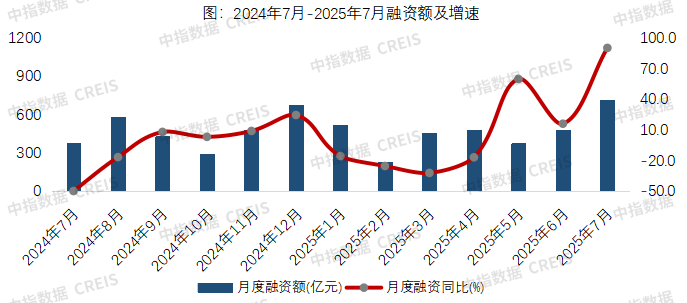
中指研究院:7月房地产行业债券融资总额为713.9亿元 同比增长90.3%
智通财经网· 2025-08-07 07:35
Core Viewpoint - The real estate industry in China is experiencing significant growth in bond financing, with a total of 71.39 billion yuan in July 2025, marking a year-on-year increase of 90.3% due to a low base effect from the previous year [1] Financing Overview - The total bond financing in the real estate sector reached 71.39 billion yuan in July 2025, with a year-on-year growth of 90.3% [1] - From May to July, the monthly financing totals have consistently increased [1] - The financing structure shows that credit bond financing accounted for 45.65 billion yuan, up 104.8% year-on-year, representing 64.0% of the total, while ABS financing was 25.74 billion yuan, up 90.0%, making up 36.0% [1] Interest Rates - The average bond financing interest rate in July was 2.54%, down 0.24 percentage points year-on-year and down 0.51 percentage points month-on-month [6] - The average interest rate for credit bonds was 2.32%, a year-on-year decrease of 0.21 percentage points, while ABS had an average rate of 2.92%, down 0.11 percentage points year-on-year [6] Major Issuers - Major issuers of credit bonds in July included state-owned enterprises such as Jinmao, Poly Developments, and China Resources, with Jinmao issuing the highest amount at 4 billion yuan [3][6] - Private and mixed-ownership enterprises like Greentown, Binjiang, and New Town successfully issued credit bonds totaling approximately 3.01 billion yuan [3] ABS Market - The ABS issuance scale reached 25.74 billion yuan in July, showing significant growth compared to previous months [4] - CMBS/CMBN products dominated the ABS market with a 41.5% share, followed by REITs at 36.8% [4] Capital Market Dynamics - Key real estate companies have disclosed new financing, including China Resources Land securing a 2 billion yuan loan and Vanke receiving 1.681 billion yuan from its major shareholder [9] - Several companies are undergoing debt restructuring, with over ten firms having their plans approved, involving a total debt of approximately 1 trillion yuan [9]
Willis Lease(WLFC) - 2025 Q2 - Earnings Call Transcript
2025-08-05 15:00
Financial Data and Key Metrics Changes - The company achieved record quarterly total revenue of $195.5 million, an increase of 29.4% year-over-year [3][16] - Earnings before taxes (EBT) for the quarter were $74.3 million, up 28.3% from the same period in 2024 [16][27] - Net income attributable to common shareholders was $59 million, reflecting a 41.5% increase from the prior year [16][28] - Average portfolio utilization increased to 87.2% for the quarter, compared to 83% in the same period last year, ending the quarter at 88.3% [18][32] Business Line Data and Key Metrics Changes - Core lease rent revenue was $72.3 million, up 29.4% from the prior year [17] - Interest revenue increased by 59.8% to $3.6 million, driven by growth in long-term loan-like financings [17] - Maintenance reserve revenues were $50.7 million, down from $62.9 million in the prior year, with short-term maintenance reserve revenues increasing by 9.5% [19][24] - Fair parts and equipment sales surged by 391% to $30.4 million, attributed to the sale of one engine [20] Market Data and Key Metrics Changes - The company noted a positive trend in the aviation marketplace, with airlines increasingly relying on leasing and maintenance solutions to avoid costly engine shop visits [4][9] - The leasing rates have increased by approximately 9% year-over-year, indicating stability in the market [35] Company Strategy and Development Direction - The company aims to leverage its differentiated asset portfolio and integrated maintenance capabilities to drive growth [5][14] - The launch of the SOAR lean business system is intended to improve operational efficiency and service quality [9] - The company is focused on maintaining a strong cash flow while returning capital to shareholders through dividends [4][31] Management's Comments on Operating Environment and Future Outlook - Management expressed confidence in the operational excellence and innovation driving future growth [14] - The company anticipates no negative pressure on lease rates in the near term, supported by a significant portion of its portfolio in next-generation equipment [36] - Management highlighted the positive impact of recent agreements between the US and EU regarding zero tariffs on aircraft and parts [13][14] Other Important Information - The company completed its largest engine ABS transaction to date, reflecting strong market confidence [14] - The sale of the consulting business to a joint venture is expected to enhance capital for core leasing growth while maintaining access to consulting capabilities [12][27] - The company received over $6 million in grant proceeds from the UK government for staff initiatives [8][62] Q&A Session Summary Question: Impact of OEM production on lease rates - Management noted lease rates have increased about 9% year-over-year and expect stability in rates despite improvements in OEM production [35][36] Question: Parting out of young aircraft - Management acknowledged the trend of airlines parting out younger aircraft for engines, indicating strong demand for engines in the market [39][40] Question: Average utilization rate for the quarter - The average utilization rate for the quarter was reported at 87.2%, with an end-of-quarter rate of 88.3% [44][46] Question: Employee count and impact of consulting business sale - The employee count was approximately 420, and the sale of the consulting business is expected to positively impact operating income through additional equity [49][50] Question: Maintenance service revenues and costs - Management clarified that the maintenance service revenues were impacted by increased labor costs associated with new contracts, affecting margins [51][53] Question: Timing of grant revenue recognition - Management confirmed that grant proceeds received in the second quarter would be recognized in the P&L, with additional grants expected to be recognized upon receipt [62][63]

上市数量增至71只 公募REITs持续扩容
Bei Jing Shang Bao· 2025-08-03 15:43
Group 1 - The core viewpoint of the news is the successful listing of the Huaxia Huadian Clean Energy REIT on the Shanghai Stock Exchange, marking the 71st public REIT in China's infrastructure market and expanding the number of clean energy REITs to 8 [1][2] - The total issuance scale of the 73 established public REITs has reached 190.852 billion yuan, covering various asset types including industrial parks, warehousing logistics, and affordable rental housing [1][3] - The Huaxia Huadian Clean Energy REIT has an issuance scale of 1.8945 billion yuan, with over 170 billion yuan in cumulative subscription funds, setting new records for clean energy REITs [1][2] Group 2 - The current public REITs market has expanded to include diverse energy categories such as solar, wind, hydropower, and natural gas, forming a green asset matrix [2] - In 2023, 13 public REITs have successfully listed, with notable issuances from Zhongyin Zhongwai Logistics REIT and Chuangjin Hexin Shounong REIT [2] - Experts predict that the categories of REITs may expand to include elder care and cultural tourism, reflecting the diversification of the new economy [2][3] Group 3 - The continuous growth of public REITs is significant for the market, as it can activate existing assets and create a closed-loop financing model for infrastructure investment [3] - The public REITs market currently exhibits institutional investment characteristics, and there is a need to lower subscription thresholds to attract more individual investors [4] - Future development of REITs is expected to be vast, especially in the context of a stock economy, but achieving further asset securitization and cash flow activation is crucial [4]