
社会融资规模

Search documents
8月居民存款“搬家”入市!M1-M2剪刀差收窄
Hua Xia Shi Bao· 2025-09-13 09:48
Core Insights - The financial data for August indicates a significant recovery in new credit growth, reflecting strong support from the financial sector for the real economy [2][3][4] Credit Growth - In August, new RMB loans amounted to 590 billion yuan, a month-on-month increase of 640 billion yuan, but a year-on-year decrease of 310 billion yuan [3][4] - The total RMB loans for the first eight months reached 13.46 trillion yuan, indicating a recovery in credit demand, particularly in corporate and personal loans [3][4] Social Financing - The social financing scale as of the end of August was 433.66 trillion yuan, with a year-on-year growth of 8.8%. However, the new social financing in August was 2.57 trillion yuan, a year-on-year decrease of 463 billion yuan [5][6] - The decline in social financing is attributed to a reduction in RMB loans to the real economy and the high base effect from last year’s government bond issuance [5][6] Monetary Supply - As of the end of August, M2 (broad money) stood at 331.98 trillion yuan, growing by 8.8% year-on-year, while M1 (narrow money) grew by 6% [6][7] - The M1 growth rate reached its highest in nearly 35 months, indicating increased liquidity and a shift of deposits from fixed to more liquid forms for consumption or investment [7][8] Future Outlook - The monetary policy is expected to remain supportive, focusing on reducing financing costs for enterprises and households, and enhancing credit accessibility [8] - There is potential for the introduction of policy financial tools to stimulate broad credit expansion and boost infrastructure investment, particularly in sectors like technology innovation and urban renewal [8]


8月社融新增2.57万亿元,信贷环比多增6400亿
2 1 Shi Ji Jing Ji Bao Dao· 2025-09-13 04:00
Group 1: Financial Data Overview - As of the end of August 2025, the total social financing scale reached 433.66 trillion yuan, with a year-on-year growth of 8.8%, maintaining a high growth trend since the beginning of the year [1] - In the first eight months of 2025, the cumulative increase in social financing was 26.56 trillion yuan, with an additional 2.57 trillion yuan in August, which was 4.63 billion yuan less than the previous year but significantly increased by 1.44 trillion yuan month-on-month [1] - The broad money supply (M2) stood at 331.98 trillion yuan at the end of August, also growing by 8.8% year-on-year, while the narrow money supply (M1) was 111.23 trillion yuan, with a year-on-year growth of 6% [1] Group 2: Credit and Loan Dynamics - In August, the balance of domestic and foreign currency loans reached 273.02 trillion yuan, with a year-on-year increase of 6.6%, while the balance of RMB loans was 269.1 trillion yuan, growing by 6.8% year-on-year [2] - The increase in RMB loans for the first eight months of 2025 was 13.46 trillion yuan, with August alone seeing a new addition of 590 billion yuan, which was 3.1 billion yuan less than the previous year but 6.4 trillion yuan more than the previous month [2] - The recovery in credit growth in August was attributed to improved macroeconomic conditions, reduced overdraw effects from previous loan disbursements, and a decrease in the downward pressure from hidden debt replacement [2][3] Group 3: Government and Corporate Bonds - By the end of August, the balance of corporate bonds reached 33.47 trillion yuan, growing by 3.7% year-on-year, while government bonds increased significantly by 21.1% to 91.36 trillion yuan [6] - In the first eight months of 2025, net financing from corporate bonds was 1.56 trillion yuan, a decrease of 2.21 trillion yuan year-on-year, while government bonds saw net financing of 10.27 trillion yuan, an increase of 4.63 trillion yuan [6] - The issuance of local government bonds was robust, with 7.68 trillion yuan issued nationwide, including 3.26 trillion yuan in new special bonds, completing 74% of the annual quota [6][7] Group 4: Economic and Sectoral Insights - The advanced manufacturing sector, particularly high-tech and equipment manufacturing, showed strong demand for financing, supporting credit growth [4] - Personal loans in August saw a slight increase, with short-term loans adding 10.5 billion yuan and medium to long-term loans increasing by 20 billion yuan [5] - The issuance of special bonds for land reserves has accelerated since June, contributing to stabilizing the real estate market [7] Group 5: Monetary Policy and Future Outlook - The M1-M2 spread narrowed to its lowest level in nearly four years, indicating increased monetary activity and potential for funds to flow into consumption and investment [8] - The current monetary policy is expected to remain supportive, with room for further easing given the low domestic price levels [9] - Financial institutions are encouraged to adapt to changing credit demands due to economic structural transformations, focusing on effective demand in emerging sectors [9]
8.8%,较高增速!政策合力持续显效 金融对实体经济支撑更稳
Yang Shi Wang· 2025-09-13 02:46
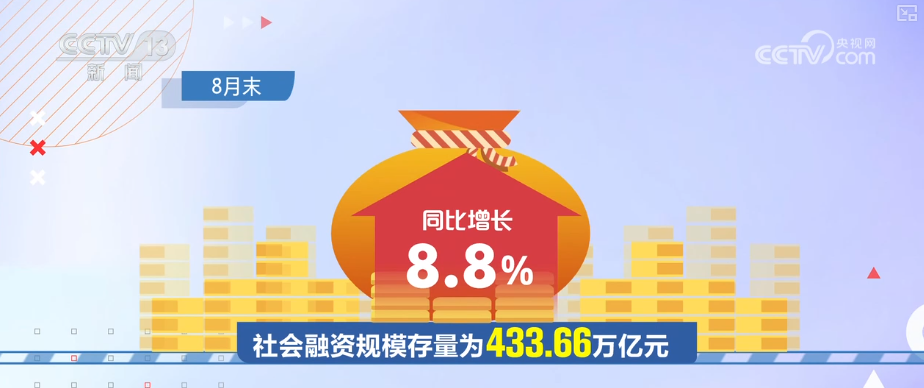
Group 1 - The core viewpoint is that the social financing scale has maintained a high growth rate, indicating strong financial support for the real economy, with a year-on-year growth of 8.8% as of the end of August [1][3] - As of the end of August, the total social financing scale was 433.66 trillion yuan, with the balance of RMB loans to the real economy at 265.42 trillion yuan, reflecting a year-on-year growth of 6.6% and accounting for 61.2% of the total social financing scale [3] - In the first eight months, the increment of social financing was 26.56 trillion yuan, which is an increase of 4.66 trillion yuan compared to the same period last year [5] Group 2 - The broad money (M2) balance reached 331.98 trillion yuan at the end of August, with a year-on-year growth of 8.8%, while the narrow money (M1) balance was 111.23 trillion yuan, growing by 6% [7] - The chief economist of Minsheng Bank noted that since 2025, a combination of proactive fiscal policy and moderately loose monetary policy has effectively supported the real economy, with cumulative financing increments consistently exceeding the previous year's levels [9] - The convergence of the M1 and M2 scissors difference indicates that more funds are being converted into demand deposits, which is beneficial for consumption and investment activities [9]
财经聚焦|社融保持较高增速 信贷支持力度稳固——透视8月金融数据
Xin Hua She· 2025-09-13 01:56
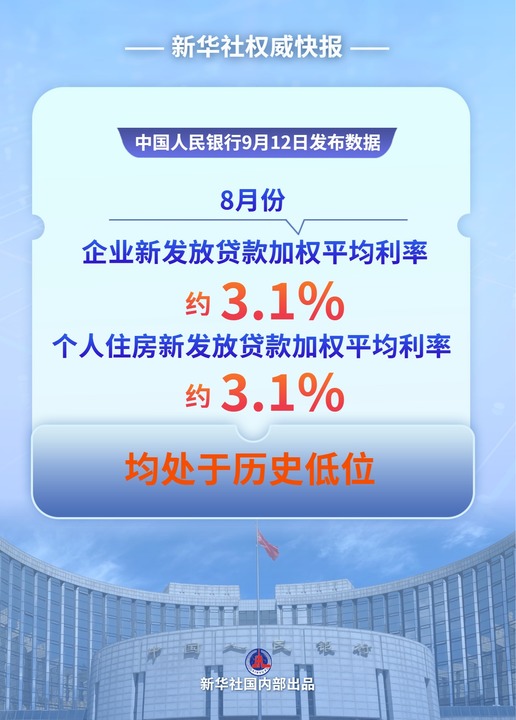
Core Viewpoint - The People's Bank of China reported that the social financing scale increased by 8.8% year-on-year as of the end of August, indicating sustained financial support for the real economy [1]. Group 1: Financial Support and Growth - As of the end of August, the total social financing scale reached 433.66 trillion yuan, with a year-on-year growth of 8.8%. The balance of RMB loans to the real economy was 265.42 trillion yuan, reflecting a 6.6% increase [1]. - The broad money supply (M2) grew by 8.8% year-on-year, while the narrow money supply (M1) increased by 6%, indicating a narrowing "scissors difference" that suggests more funds are being converted into demand deposits for consumption and investment [1]. - In the first eight months, net financing through corporate bonds reached 1.56 trillion yuan, and net financing through government bonds was 10.27 trillion yuan, supporting the growth of social financing [2]. Group 2: Credit Structure and Quality - In the first eight months, RMB loans increased by 13.46 trillion yuan, with enterprise loans accounting for a significant portion, particularly medium- and long-term loans which increased by 7.38 trillion yuan [3]. - Notably, credit growth was strong in the manufacturing sector and for small and micro enterprises, with manufacturing loans making up 53% of new corporate loans, a significant increase from the previous year [4]. - The balance of medium- and long-term loans in the manufacturing sector reached 14.87 trillion yuan, growing by 8.6% year-on-year, while loans to small and micro enterprises reached 35.2 trillion yuan, up by 11.8% [4]. Group 3: Consumer Loans and Interest Rates - Short-term loans for residents increased by over 100 billion yuan, supported by policies promoting consumption, leading to a rise in mortgage loan inquiries and agreements in major cities [5]. - The average interest rate for newly issued corporate loans was approximately 3.1%, down 40 basis points year-on-year, while the rate for personal housing loans was also around 3.1%, down 25 basis points year-on-year, both at historical lows [6][8]. - The continuous low interest rates are expected to reduce the financial burden on enterprises and residents, thereby enhancing consumption and investment potential [8].
8月份金融数据显示:广义货币增速保持在较高水平
Zhong Guo Zheng Quan Bao· 2025-09-13 01:16
Group 1 - The People's Bank of China reported that as of the end of August, both M2 and social financing growth rates remained high, creating a favorable monetary environment for economic recovery [1] - Experts predict that macro policies will maintain continuity and stability, with moderately loose monetary policy continuing to support the real economy [1] - In the first eight months, RMB loans increased by 13.46 trillion yuan, with household loans rising by 711 billion yuan and corporate loans increasing by 12.22 trillion yuan [2] Group 2 - The increase in loans is supported by factors such as industry recovery, resilient exports, summer consumption peaks, and real estate support policies [2] - Manufacturing loans accounted for 53% of new corporate loans, a significant increase of 33 percentage points compared to the previous year, indicating strong financing demand in advanced manufacturing sectors [2] - Personal loan growth was boosted by traditional summer consumption and policies promoting consumption, with significant increases in mortgage loan inquiries and signings following new real estate policies in major cities [3] Group 3 - As of the end of August, the total social financing stock was 433.66 trillion yuan, with a year-on-year growth of 8.8%, reflecting strong financial support for the real economy [4] - The M2 balance reached 331.98 trillion yuan, also growing by 8.8% year-on-year, supported by active fiscal policies and reasonable growth in social financing and loans [4] - The M1 balance was 111.23 trillion yuan, with a year-on-year growth of 6%, leading to a narrowing of the M1 and M2 gap to 2.8%, the lowest since June 2021 [5] Group 4 - The monetary policy is supportive, with M2 and social financing growth rates maintaining between 8% and 9% [6] - Structural monetary policy tools have been implemented across key financial sectors, with significant year-on-year growth in technology loans, green loans, and inclusive small and micro loans [6] - Future structural guidance will focus on enhancing the efficient allocation of resources in the market and increasing financial institutions' support for key areas [6]
社融保持较高增速 信贷支持力度稳固——透视8月金融数据
Xin Hua She· 2025-09-13 00:26
Core Insights - The social financing scale in China grew by 8.8% year-on-year as of the end of August, indicating strong financial support for the real economy [1] - The increase in credit supply remains robust, with a notable rise in loans to the manufacturing sector and small and micro enterprises [3][4] Group 1: Financing Growth - As of the end of August, the total social financing scale reached 433.66 trillion yuan, with a year-on-year growth of 8.8% [1] - The balance of RMB loans to the real economy was 265.42 trillion yuan, reflecting a 6.6% year-on-year increase [1] - In the first eight months, corporate bond net financing reached 1.56 trillion yuan, while government bond net financing was 10.27 trillion yuan, supporting social financing growth [2] Group 2: Credit Structure Optimization - In the first eight months, RMB loans increased by 13.46 trillion yuan, with enterprise loans accounting for a significant portion [3] - The manufacturing sector saw a substantial increase in loans, with new manufacturing loans making up 53% of new corporate loans, a rise of over 30 percentage points from the previous year [4] - The balance of medium and long-term loans in the manufacturing sector was 14.87 trillion yuan, growing by 8.6% year-on-year [4] Group 3: Consumer Loan Trends - Short-term loans for residents increased by over 100 billion yuan, driven by policies promoting consumption [5] - Recent housing market policies in major cities have led to a noticeable increase in mortgage loan inquiries and signings [5][6] Group 4: Interest Rate Environment - In August, the average interest rate for newly issued corporate loans was approximately 3.1%, slightly down from the previous month and 40 basis points lower than the same period last year [7] - The average interest rate for new personal housing loans was also around 3.1%, 25 basis points lower than the previous year, indicating a supportive monetary policy environment [7] - The People's Bank of China has initiated a pilot program to enhance transparency in corporate loan costs, aiming to further reduce financing costs [7]
8月份金融数据显示 广义货币增速保持在较高水平
Zhong Guo Zheng Quan Bao· 2025-09-12 23:14
Group 1 - The People's Bank of China reported that as of the end of August, both M2 and social financing growth rates remained high, creating a favorable monetary environment for economic recovery [1] - The macroeconomic policy is expected to maintain continuity and stability, with moderately loose monetary policy continuing to support the real economy [1] - In the first eight months, RMB loans increased by 13.46 trillion yuan, with household loans rising by 711 billion yuan and corporate loans increasing by 12.22 trillion yuan [2] Group 2 - Factors supporting credit growth include industry recovery, resilient exports, summer consumption peaks, and real estate support policies [2] - The manufacturing sector saw a significant increase in loan demand, with new manufacturing loans accounting for 53% of new corporate loans, up 33 percentage points from the previous year [2] - Personal loan growth was boosted by traditional summer consumption and policies promoting consumption, particularly in real estate [3] Group 3 - As of the end of August, the social financing scale stood at 433.66 trillion yuan, with an annual growth rate of 8.8% [4] - The net financing scale of government bonds reached 10.27 trillion yuan in the first eight months, an increase of 4.63 trillion yuan year-on-year [4] - M2 balance was 331.98 trillion yuan, with an annual growth rate of 8.8%, supported by fiscal policy and reasonable growth in social financing and loans [5] Group 4 - M1 balance was 111.23 trillion yuan, with a year-on-year growth of 6%, leading to a narrowing of the M1 and M2 gap to 2.8%, the lowest since June 2021 [5] - The monetary policy has been supportive, with M2 and social financing growth rates maintaining between 8% and 9% [6] - Structural monetary policy tools have been implemented across key financial sectors, with significant growth in technology, green, and inclusive small and micro loans [6]
前8个月人民币贷款增加13.46万亿元——金融支持实体经济稳固有力
Sou Hu Cai Jing· 2025-09-12 22:48
Group 1 - The People's Bank of China reported that as of the end of August, the broad money supply (M2) reached 331.98 trillion yuan, with a year-on-year growth of 8.8%, indicating a moderately loose monetary policy that supports the real economy [2] - The total social financing stock was 433.66 trillion yuan, also growing by 8.8% year-on-year, reflecting strong financial support for economic stability [2] - The net financing scale of government bonds for the first eight months of the year was 1.027 trillion yuan, an increase of 463 billion yuan year-on-year, demonstrating the effectiveness of proactive fiscal policies [2] Group 2 - As of the end of August, the narrow money supply (M1) was 111.23 trillion yuan, with a year-on-year growth of 6%, indicating a narrowing gap between M1 and M2, which is beneficial for consumption and investment [3] - The increase in RMB loans for the first eight months was 1.346 trillion yuan, showing strong credit support for the real economy [3] - The issuance of special refinancing bonds has provided significant funding support for resolving hidden local government debts, with 190 billion yuan issued for this purpose by the end of August [3] Group 3 - The proportion of direct financing channels, such as corporate bonds and government bonds, has steadily increased from 26.7% at the end of 2018 to 31.6% by the end of August 2025, indicating a diversification in financing sources for the real economy [4] - Factors such as industry recovery, resilient exports, and supportive real estate policies have contributed to credit growth in August [4] - Manufacturing loans have seen a significant increase, with new manufacturing loans accounting for 53% of new corporate loans in the first eight months, reflecting a recovery in production [4] Group 4 - High demand for financing has been observed in industries such as textiles, specialized equipment, and computer communications, driven by seasonal factors and market expansion efforts [5] - Personal loan growth has been stimulated by traditional summer consumption peaks and supportive consumption policies, with cities implementing measures to meet housing demand [5] - The continuous reduction in reserve requirements and interest rates by the People's Bank of China has resulted in lower financing costs for the real economy [6] Group 5 - Since 2020, the People's Bank of China has cut policy rates nine times, leading to a significant decline in loan rates for both enterprises and personal housing loans, enhancing the financing environment for the real economy [6] - The macroeconomic policies are expected to remain consistent and stable, with a focus on addressing deeper structural issues and promoting key sector reforms [6]
前8个月人民币贷款增加13.46万亿元—— 金融支持实体经济稳固有力
Jing Ji Ri Bao· 2025-09-12 22:03
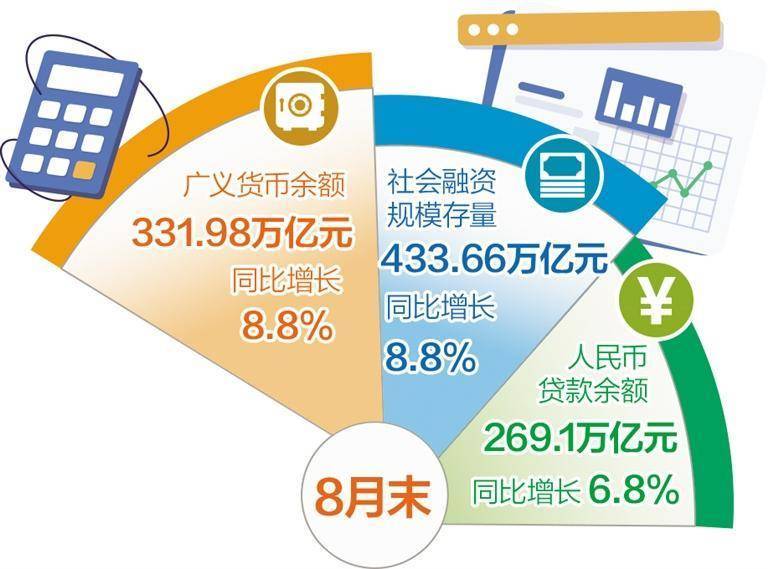
Monetary Policy and Financial Statistics - As of the end of August, the broad money supply (M2) reached 331.98 trillion yuan, with a year-on-year growth of 8.8% [1] - The total social financing stock was 433.66 trillion yuan, also reflecting a year-on-year increase of 8.8% [1] - The balance of RMB loans stood at 269.1 trillion yuan, showing a year-on-year growth of 6.8% [1] - The government bond net financing scale for the first eight months of the year was 1.027 trillion yuan, an increase of 463 billion yuan compared to the previous year [1] Credit and Loan Growth - RMB loans increased by 1.346 trillion yuan in the first eight months, indicating strong support for the real economy [2] - The issuance of special refinancing bonds has accelerated, providing significant funding support for resolving hidden debts [2] - The growth rate of loans, after adjusting for the impact of replacing local government hidden debts, was estimated to be around 7.8% in August [2] Economic Activity and Sector Performance - The proportion of direct financing through corporate bonds, government bonds, and non-financial corporate domestic stock financing has steadily increased from 26.7% at the end of 2018 to 31.6% by the end of August 2025 [3] - Manufacturing loans have seen a significant increase, with new manufacturing loans accounting for 53% of new corporate loans in the first eight months, a rise of 33 percentage points from the previous year [3] - High demand for financing has been noted in sectors such as textiles, specialized equipment, and computer communications, driven by seasonal demand and market expansion efforts [4] Consumer Loans and Housing Market - Personal loan growth has been boosted by traditional summer consumption peaks and policies promoting consumption [4] - Recent real estate regulatory policies in major cities have aimed to better meet diverse housing needs, contributing to increased loan demand [4] Interest Rates and Economic Outlook - Since 2020, the People's Bank of China has cut policy rates nine times, leading to a decrease in loan rates for both enterprises and personal housing loans [5] - The macroeconomic policy is expected to maintain continuity and stability, with a supportive monetary policy aiding the real economy [5] - Long-term economic structural transformation and industrial upgrading are anticipated to lead to a more balanced supply-demand relationship in the economy [5]
前8月社融存量保持高增 货币政策逆周期调节持续发力
Zheng Quan Shi Bao· 2025-09-12 19:00
Group 1 - The People's Bank of China reported that in the first eight months, RMB loans increased by 13.46 trillion yuan, and the social financing scale increased by 26.56 trillion yuan, indicating strong financial support for the real economy [1] - Both the social financing stock growth rate and the broad money (M2) growth rate remained high at 8.8% as of the end of August, reflecting a relatively loose financial environment [1] - The weighted average interest rate for newly issued corporate loans in August was approximately 3.1%, down about 40 basis points year-on-year, while the rate for personal housing loans was also around 3.1%, down about 25 basis points year-on-year [1] Group 2 - The analysis of financial support for the real economy should not rely solely on credit channels, as recent fluctuations in financial data are influenced by seasonal factors and hidden debt replacement [2] - The M2 growth rate remained stable, supported by accelerated fiscal spending and a decrease in fiscal deposits year-on-year [2] - The narrow money (M1) growth rate increased by 0.4 percentage points to 6%, serving as an important indicator of corporate investment willingness and consumer spending tendencies [2] Group 3 - The narrowing of the "scissors difference" between M1 and M2 in August reached its lowest level since June 2021, driven by the increase in M1 growth [3] - The liquidity absorption effect of fiscal policies weakened in August, and the pace of wealth management product expansion slowed compared to July, reducing the diversion of deposits [3] - Ongoing debt reduction policies have also contributed to the improvement of corporate funding conditions, supporting M1 growth [3]