
国内大循环

Search documents
中国央行:推动产业加快迈向中高端,防止“内卷式”竞争
Hua Er Jie Jian Wen· 2025-08-05 08:07
市场有风险,投资需谨慎。本文不构成个人投资建议,也未考虑到个别用户特殊的投资目标、财务状况或需要。用户应考虑本文中的任何 意见、观点或结论是否符合其特定状况。据此投资,责任自负。 中国人民银行等七部门联合印发《关于金融支持新型工业化的指导意见》,《意见》要求,强化产业政 策和金融政策协同,为推进新型工业化、加快发展新质生产力提供高质量金融服务,坚持分类施策、有 扶有控,推动产业加快迈向中高端,防止"内卷式"竞争。推动金融资源向产业集群聚集和专业化发展, 推进贸易结算、资金管理、投融资等一系列跨境金融服务便利化举措,支持产业合理布局和拓展发展空 间,促进做强国内大循环。 风险提示及免责条款 ...
内需结构升级,家电、白酒等低位行业向上突破
Mei Ri Jing Ji Xin Wen· 2025-08-05 06:49
Group 1 - The market showed a mixed performance on August 5, with the Shanghai Composite Index fluctuating around 3600 points and the ChiNext Index showing weakness. AI hardware opened strongly but saw profit-taking, while funds shifted from high to low sectors within TMT, with PEEK materials and consumer electronics gaining traction. Low-position industries like home appliances and liquor continued to rotate, resulting in more gainers than losers among individual stocks. The Food and Beverage ETF (515170) rose over 1% at the close, with constituent stocks like Dongpeng Beverage (605499) and Yanjinpuzi (002847) increasing by over 3% [1][1][1] - In the medium to long term, the policy framework continues to strengthen the "domestic circulation" strategy through targeted measures such as consumption subsidies and tax incentives to promote the upgrade of domestic demand structure. Current policies focus on the connection between the "external demand easing period" and the "internal demand cultivation period," allowing for rapid policy activation to counter external impacts if future U.S. tariff policies fluctuate. This indicates that China is accelerating the construction of a more resilient economic development system [1][1][1] Group 2 - The Food and Beverage ETF (515170) tracks the CSI segmented food and beverage industry theme index, focusing on high-barrier and resilient sectors such as liquor, beverages, dairy products, and seasoning fermentation products. The top ten constituent stocks include "Moutai, Wuliangye, Luzhou Laojiao, and Yanghe," providing investors with a convenient tool for one-click allocation of core assets in the "food and beverage sector." Compared to the minimum investment thresholds of tens of thousands or hundreds of thousands for its constituent stocks, the Food and Beverage ETF serves as an accessible investment option for smaller capital [2][2][2]
宏观政策持续发力、适时加力 下半年中国经济这么干
Zhong Guo Qing Nian Bao· 2025-08-05 03:40
Group 1: Economic Policy and Performance - The central government emphasizes the need for sustained macroeconomic policy efforts, including proactive fiscal and moderately loose monetary policies to enhance policy effectiveness [1] - In the first half of the year, China's GDP grew by 5.3%, showing an increase of 0.3 percentage points compared to the same period last year [2] - The unemployment rate in urban areas averaged 5.2% in the first half of the year, a decrease of 0.1 percentage points from the first quarter, with 6.95 million new urban jobs created [2] Group 2: Consumer Trends - Social retail sales increased by 5% in the first half of the year, with a growth rate improvement of 0.4 percentage points from the first quarter and 1.3 percentage points from the previous year [3] - Final consumption contributed 52% to economic growth in the first half of the year, with a contribution rate of 52.3% in the second quarter, up 0.6 percentage points from the first quarter and 4.4 percentage points from the previous year [3] Group 3: Challenges and Risks - The economy faces several risks, including potential consumption downturns due to high base effects and falling housing prices, which may reduce consumer wealth [4] - The ongoing U.S.-China trade tensions may lead to a volatile economic environment, impacting consumer confidence and spending [4] Group 4: Domestic Circulation and Market Development - The government aims to strengthen domestic circulation as a strategic response to external uncertainties, focusing on expanding domestic demand and optimizing supply structures [5] - The ratio of social logistics costs to GDP decreased by 0.2 percentage points in the first half of the year, indicating improved market efficiency [6] Group 5: Market Regulation and Competition - The government is working on a plan to address issues of disorderly competition and low-price dumping, which can harm market integrity and consumer rights [7] - The upcoming revision of the pricing law will clarify standards for identifying unfair pricing practices, particularly those aimed at eliminating competition [8]
提升消费环境 优化消费供给 扩内需促消费增量政策加快出台
Zhong Guo Chan Ye Jing Ji Xin Xi Wang· 2025-08-04 23:06
Group 1: Consumption Policy and Economic Support - The government has allocated 300 billion yuan in special bonds to support the consumption of old goods, aiming to stimulate consumer potential [1] - As of now, 231 billion yuan has been distributed in three batches, with the remaining funds expected to be released in October [1] - The Ministry of Finance plans to accelerate the introduction of policies to boost consumption and improve the consumption environment [1][6] Group 2: Fiscal Revenue and Expenditure - In the first half of the year, the national general public budget revenue was 1,155.66 billion yuan, a slight decrease of 0.3% year-on-year, while government fund budget revenue was 194.42 billion yuan, down 2.4% [2] - General public budget expenditure increased by 3.4% year-on-year to 1,412.71 billion yuan, with significant growth in social security, education, and environmental protection expenditures [2] - The fiscal policy is focused on maintaining expenditure growth despite a slight contraction in revenue, indicating a proactive fiscal stance to counter economic pressures [2][3] Group 3: Special Bonds and Investment - The issuance of new local government special bonds reached 2.16 trillion yuan in the first half of the year, a 45% increase year-on-year [4] - Special bonds are being used to support project capital, with 191.7 billion yuan allocated for this purpose, marking a 16% increase [4] - The implementation of debt replacement policies has alleviated liquidity pressures and reduced interest expenses for local governments [4] Group 4: Consumer Goods Sales Performance - The "old-for-new" consumption initiative has led to significant sales in various sectors, with total sales reaching 1.6 trillion yuan [5] - Retail sales of home appliances and other consumer goods have seen substantial year-on-year growth, with increases of 30.7% for home appliances and 25.4% for audio-visual equipment [5] - Overall, the social retail sales total increased by 5% year-on-year, surpassing the previous year's growth rate [5] Group 5: Future Consumption Strategies - The Ministry of Finance aims to enhance consumption through new business models and urban development, particularly in major cities [6] - The focus is on building international consumption centers and improving consumer experience to stimulate domestic demand [6] - The dual-track strategy for consumption policies aims to foster both immediate consumption boosts and long-term market resilience [6]
把发展主动权牢牢掌握在自己手中
Ren Min Ri Bao· 2025-08-04 22:39
近6000个快递进入寄递渠道,超过143万GB的数据在云端传输……这是中国市场1秒钟的强劲脉动。 14亿多人口、全球最大规模中等收入群体、超过1.91亿户经营主体、社会消费品零售总额今年有望超过 50万亿元……这是中国市场的超大体量。 市场是最稀缺的资源,市场资源是我国的巨大优势。 习近平总书记指出:"建设全国统一大市场是构建新发展格局、推动高质量发展的需要,要认真落实党 中央部署,加强协调配合,形成推进合力。" 今年7月30日召开的中共中央政治局会议提出:"纵深推进全国统一大市场建设,推动市场竞争秩序持续 优化。" 当前,世界百年变局加速演进,我国发展面临的外部环境发生深刻复杂变化,以国内大循环的内在稳定 性和长期成长性对冲国际循环的不确定性,全国统一大市场建设的重要性更加凸显。 在以习近平同志为核心的党中央坚强领导下,各地方各部门齐心协力,坚定不移办好自己的事,坚定不 移推进高水平对外开放,纵深推进全国统一大市场建设,筑牢构建新发展格局的基础支撑,把未来发展 的主动权牢牢掌握在自己手中。 完善顶层设计—— "建立全国统一的市场制度规则" 建设全国统一大市场,是以习近平同志为核心的党中央从全局和战略高度作出 ...


中国经济向新向好
Jing Ji Ri Bao· 2025-08-03 22:00
Core Viewpoint - China's economy demonstrates strong resilience and vitality in the first half of 2025, achieving stable growth amidst complex challenges, with a focus on high-quality development [1][2][3] Group 1: Economic Stability - China's GDP grew by 5.3% year-on-year in the first half of 2025, an increase of 0.3 percentage points compared to the same period last year [1] - The country has implemented proactive macro policies to stabilize employment, businesses, markets, and expectations, with 6.95 million new urban jobs created, achieving 58% of the annual target [1] Group 2: Economic Dynamics - The added value of the equipment manufacturing industry and high-tech manufacturing industry increased by 10.2% and 9.5% year-on-year, respectively, surpassing the overall industrial growth by 3.8 and 3.1 percentage points [2] - The digital product manufacturing sector saw a year-on-year growth of 9.9%, maintaining a growth rate above the industrial average for 23 consecutive months [2] - The green industries, represented by new energy vehicles, lithium batteries, and solar cells, continue to experience high growth rates [2] Group 3: Resilience and Future Outlook - Despite a slow global economic recovery and disruptions in international trade, China emphasizes strengthening domestic circulation while deepening reforms and expanding high-level openness [2] - The import and export scale reached a historical high for the same period, showcasing China's ability to withstand short-term fluctuations and pursue long-term development [2][3]
不出中国所料:特朗普对全球征税后,高兴不到一天,噩耗就来了
Sou Hu Cai Jing· 2025-08-02 05:42
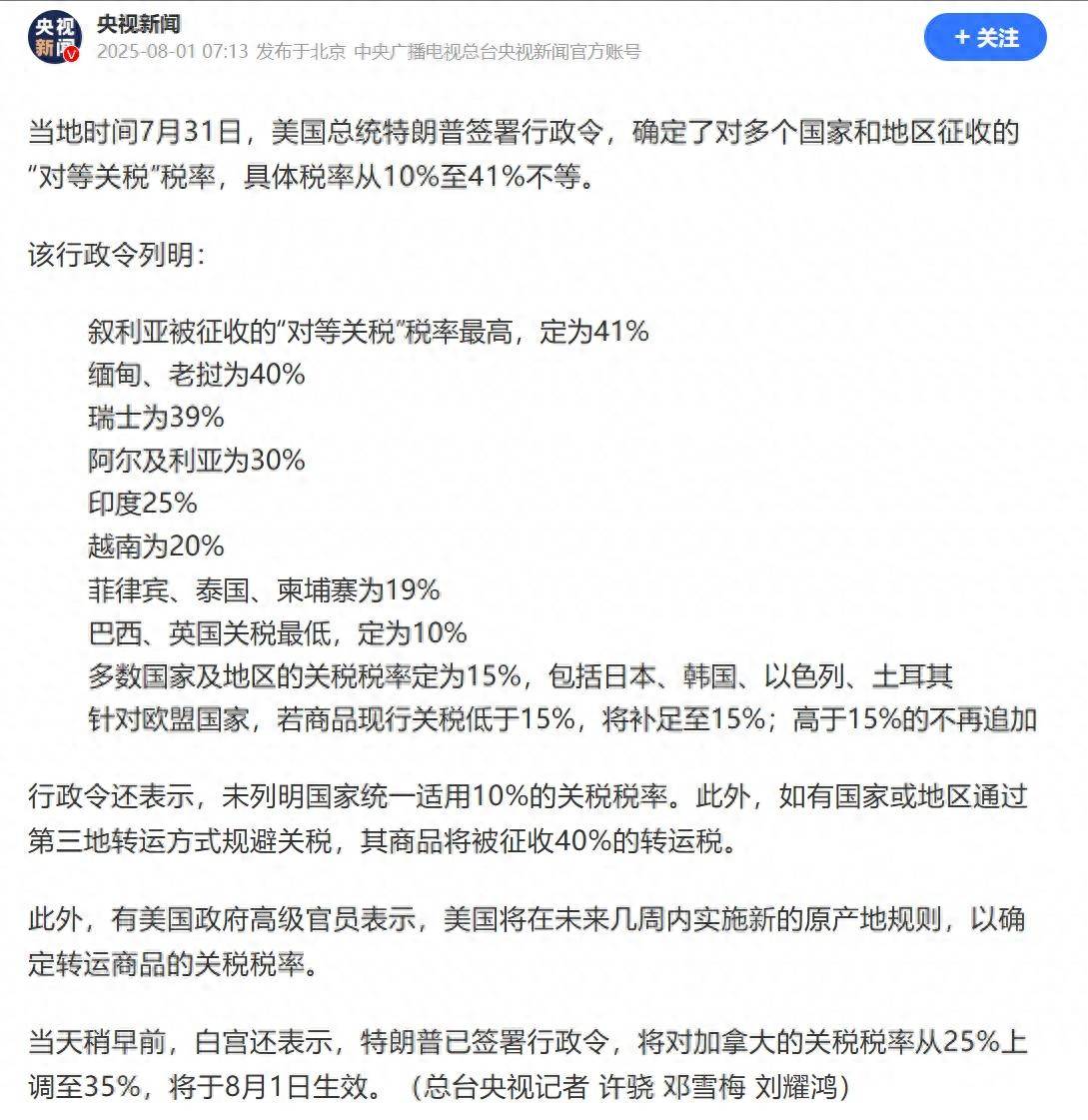
Group 1 - The implementation of "reciprocal tariffs" by the Trump administration, with rates ranging from 10% to 41% on key goods such as automobiles, machinery, electronics, and textiles, aims to retaliate against countries imposing tariffs on U.S. products [1] - The immediate market reaction was negative, with major U.S. stock indices experiencing significant declines: Dow Jones down 1.6%, Nasdaq down over 2.3%, and S&P 500 down 1.8%, resulting in a loss of over a trillion dollars in market value for companies like Amazon [1][3] - The policy has sparked widespread criticism from economists, including Nobel laureate Paul Krugman, who labeled it as a foolish approach that ultimately harms American citizens [3][6] Group 2 - The automotive industry is facing severe challenges due to rising costs of steel and aluminum, leading to profit declines for major companies like General Motors and Ford, which may resort to layoffs and production cuts [8] - Retail giants such as Walmart and Target are considering price increases to cope with rising input costs and inflation, which will ultimately burden American consumers [8] - The overall economic environment is deteriorating, with rising living costs exacerbating existing issues like high rents and inflation, contradicting the intended goal of economic recovery [8][15] Group 3 - China has prepared for potential repercussions from the U.S. tariff policy, emphasizing that trade wars yield no winners and are detrimental to the populace [10] - The Chinese government is actively reducing reliance on the U.S. market while enhancing trade relations with ASEAN, Africa, and the Middle East, indicating a strategic pivot in its economic partnerships [10] - The U.S. is facing increasing isolation as traditional allies express concerns over the unilateral tariff actions, with countries like Germany and France warning of potential retaliatory measures [12][13] Group 4 - The overarching sentiment is that the tariff policy is not a sustainable solution for economic issues, as it leads to market chaos rather than recovery, with consumers ultimately bearing the costs of increased tariffs [15] - The approach of using tariffs as a tool for economic negotiation is criticized as short-sighted and detrimental to long-term economic stability [15]
经济回升向好基础不断夯实
Jing Ji Ri Bao· 2025-08-02 03:40
Economic Overview - The National Development and Reform Commission (NDRC) reported that the construction project list for this year, amounting to 800 billion yuan, has been fully allocated, and the central budget investment of 735 billion yuan has been largely distributed [1] - In the first half of the year, China's economy showed resilience and performed better than expected, with major macro indicators indicating positive trends [1][2] - The contribution rate of final consumption to economic growth reached 52%, with retail sales of consumer goods increasing by 5% year-on-year [1] Consumer Market Dynamics - The "old-for-new" consumption initiative has driven sales exceeding 1.7 trillion yuan, with significant growth in retail sales of home appliances and communication equipment [1] - The NDRC emphasized the importance of enhancing consumer capacity and willingness, alongside high-quality supply to stimulate new demand [2] - The logistics cost as a percentage of GDP decreased to 14%, the lowest on record, saving over 130 billion yuan in logistics expenses [2] Unified National Market Development - The establishment of a unified national market is progressing, with a focus on optimizing resource allocation and reducing market transaction costs [3] - The NDRC plans to implement measures to strengthen domestic circulation and ensure economic stability amid external uncertainties [3][4] - The government aims to enhance employment stability, boost consumption, and expand effective investment as part of its economic strategy [4] Policy and Regulatory Framework - The NDRC has initiated a mechanism for regular communication with private enterprises to gather insights for policy formulation [4] - Ongoing efforts include addressing "involution" competition through legal revisions and policy adjustments [4] - The NDRC is committed to maintaining policy continuity and flexibility to adapt to external pressures while ensuring economic stability [4]
经济新方位|稳经济促改革,不断完善政策工具箱
Ren Min Ri Bao· 2025-08-02 03:35
Economic Overview - China's GDP grew by 5.3% year-on-year in the first half of the year, exceeding initial market expectations and improving by 0.3 percentage points compared to the same period last year [2] - The production and business activity expectation index for July was 52.6%, indicating stable and optimistic market confidence among manufacturing enterprises [2] - The urban unemployment rate averaged 5.2%, a decrease of 0.1 percentage points from the first quarter, with 6.95 million new urban jobs created, achieving 58% of the annual target [2] Domestic Demand and Resilience - Domestic demand contributed 68.8% to economic growth, highlighting its role as the main driver [2] - The total import and export scale reached 20 trillion yuan, with exports increasing by 7.2% [2] - High-tech manufacturing value added grew by 9.5%, outpacing overall industrial growth by 3.1 percentage points [3] Policy and Strategic Focus - The National Development and Reform Commission (NDRC) plans to implement policies to expand domestic demand and promote high-level technological self-reliance [3] - Emphasis on strengthening the domestic circulation to mitigate external shocks and uncertainties [4] - The NDRC aims to enhance the effectiveness of domestic circulation by optimizing supply structures and increasing investment returns [6][7] Market and Investment Environment - The proportion of inter-provincial trade sales to total sales increased to 40.4%, up 0.6 percentage points year-on-year [7] - Logistics costs as a percentage of GDP decreased, saving over 130 billion yuan in logistics expenses [7] - The NDRC is focused on improving the market environment for new industries and enhancing the competitiveness of state-owned enterprises [9][11] Reform Initiatives - The NDRC is set to deepen reforms to stimulate consumption and expand effective investment [9] - Plans to standardize government investment behaviors and address issues of disorderly competition in various sectors [10] - The NDRC will promote policies to facilitate market access for new business models and enhance the flow and allocation of production factors [11]
中国经济新看点丨地区经济发展稳中有进
Jing Ji Ri Bao· 2025-08-02 00:29
Economic Performance Overview - All 31 provinces in China have reported their economic data for the first half of the year, showing resilience and steady growth despite a complex environment, with 22 provinces achieving growth rates at or above the national average of 5.3% [1][2] - Tibet led the growth with a rate of 7.2%, while several provinces such as Gansu (6.3%), Hubei (6.2%), and Zhejiang (5.8%) also showed strong performance [2] Regional Economic Contributions - The top ten provinces by GDP in the first half of the year include Guangdong (68,725.4 billion), Jiangsu (66,967.8 billion), and Shandong (50,046 billion), with Guangdong maintaining its position as the largest economy [3] - The total import and export value of Guangdong, Jiangsu, Zhejiang, Shanghai, and Shandong accounted for 64.1% of the national total, reflecting a year-on-year growth of 4.8% [3] Policy and Investment Trends - Policies aimed at boosting domestic demand and technological upgrades have been implemented, with significant increases in equipment investment in Beijing (99% growth) and retail sales in Zhejiang showing over 60% growth in certain categories [4][5] - The manufacturing sector has seen robust growth, with high-tech manufacturing in Fujian growing by 16.8%, and significant contributions from the aerospace and electronics sectors in Jiangsu [5] Industrial Development and Innovation - In the Northeast, traditional industries are transforming, with significant growth in the manufacturing of transportation equipment in Liaoning [6] - Modern service industries are also thriving, with information technology services in Beijing growing by 11.1% [6] Future Economic Strategies - Provinces are focusing on expanding domestic demand, developing new productive forces, and enhancing reforms to ensure sustainable economic growth in the second half of the year [7][8] - Specific strategies include Guangdong's emphasis on consumption, investment, and export, and Jiangsu's focus on building a unified market and enhancing technological innovation [8][9]