新发展格局

Search documents
新发展格局激发新活力
Jing Ji Ri Bao· 2025-09-26 21:57
Core Points - The new development pattern emphasizes domestic circulation as the mainstay while promoting mutual reinforcement between domestic and international circulation, leading to higher quality, efficiency, fairness, sustainability, and security in China's economic development [1] Group 1: Domestic Demand as a Driving Force - China's market is characterized by nearly 50 trillion yuan in consumption, over 50 trillion yuan in investment, and over 20 trillion yuan in imports, making it the most promising market globally [2] - Domestic demand contributed an average of 86.4% to economic growth over the past four years, highlighting its role as the main driver and stabilizing anchor of the economy [2] - The contribution of final consumption to economic growth during the first four years of the 14th Five-Year Plan reached 56.2%, an increase of 8.6 percentage points compared to the previous five-year period [2] Group 2: Investment and Supply Structure Optimization - Investment in high-tech industries has consistently outpaced overall investment growth, with the contribution of investment accumulation to economic growth averaging 30.2% during the first four years of the 14th Five-Year Plan [3] - The focus on enhancing development momentum and improving people's livelihoods has led to significant investment growth in social welfare sectors [3] Group 3: Safety and Innovation - The emphasis on balancing development and safety has led to a strengthened national security system and enhanced capabilities to maintain safety, promoting high-quality development [4] - R&D investment is projected to exceed 3.6 trillion yuan in 2024, with an intensity of 2.68%, surpassing the average level of EU countries [4] - China ranks first globally with 24 innovation clusters in the 2025 Global Top 100 Innovation Clusters ranking by the World Intellectual Property Organization [4] Group 4: Open Economy and International Cooperation - China has expanded its visa-free "circle" and promoted tax refund services, with over 19 million foreign visitors entering the country in the first half of the year, a 30% increase year-on-year [6] - The total value of China's goods trade has remained the highest in the world for eight consecutive years, with exports accounting for over 14% of the global total [6] - China has actively aligned with international high-standard trade rules, reducing foreign investment restrictions and encouraging investment in advanced manufacturing and high-tech sectors [7]
五年再造“杭台”之和 浙江经济体量逼近9.5万亿
2 1 Shi Ji Jing Ji Bao Dao· 2025-09-26 15:42
Group 1 - Zhejiang's economic total is expected to reach approximately 9.5 trillion yuan this year, contributing to about 6.7% of the national economy [1] - The per capita GDP in Zhejiang is projected to rise from $14,600 in 2020 to $19,000 by 2024, with an expectation to exceed $20,000 this year [1] - Strategic emerging industries in Zhejiang account for one-third of the industrial output, with five trillion-level industrial clusters formed, including modern textiles, green petrochemicals, high-end software, smart IoT, and new energy vehicles [1] Group 2 - Zhejiang is advancing the construction of a new energy system, establishing a leading national new energy equipment manufacturing industry cluster and initiating the first deep-sea wind power mother port in the country [2] - The province has 47,000 high-tech enterprises and 233 national manufacturing champions, with significant growth in private enterprises [2] - Zhejiang aims to achieve high-level modernization and common prosperity by 2035, addressing challenges such as resource shortages and development momentum [2]
21评论|广东外资三重跃迁背后的开放进阶
2 1 Shi Ji Jing Ji Bao Dao· 2025-09-26 11:51
Core Viewpoint - Guangdong province is demonstrating strong foreign investment growth despite a global decline in foreign direct investment (FDI), with new foreign enterprises increasing by 34% and actual utilized FDI reaching 70.87 billion yuan, a 9.4% increase year-on-year [2][3]. Group 1: Foreign Investment Growth - Guangdong has established itself as a favored destination for foreign investment, with significant increases in new foreign enterprises and actual FDI, outperforming national averages [2][3]. - The province's strategic position in the new development pattern of China is enhancing its attractiveness to foreign investors [4][6]. Group 2: Historical Context of Foreign Investment - The evolution of foreign investment in Guangdong can be divided into three significant phases, each reflecting changes in national development and global industrial patterns [3][4]. - The initial phase focused on labor-intensive industries, while the second phase saw diversification and growth in technology-intensive sectors following China's WTO accession [4][5]. Group 3: Current Trends and Future Outlook - Guangdong is transitioning from a manufacturing base to a hub for innovation, with a focus on high-tech industries such as semiconductors, robotics, and biomedicine [6][7]. - Major foreign companies are increasingly investing in R&D and local supply chains, indicating a shift from mere manufacturing to collaborative innovation [8][9]. Group 4: Policy and Strategic Initiatives - The provincial government has implemented a series of policies to attract and retain foreign investment, including measures for investment promotion and protection of foreign enterprises [11][12]. - Guangdong's proactive approach in organizing investment activities and enhancing the business environment is contributing to its status as a leading investment destination [11][12]. Group 5: Regional and Global Integration - Guangdong's geographical advantages and its role in the Belt and Road Initiative are strengthening its regional supply chain networks, attracting significant foreign investment in various sectors [10][12]. - The province is positioned as a key player in the global supply chain, with major projects supporting local industries and meeting the growing demand from ASEAN markets [10][12].


广东外资三重跃迁背后的开放进阶
2 1 Shi Ji Jing Ji Bao Dao· 2025-09-26 11:47
Core Insights - Guangdong is experiencing significant growth in foreign direct investment (FDI) despite a global decline, with new foreign enterprises increasing by 34% and actual FDI amounting to 70.87 billion yuan, a 9.4% increase year-on-year [1][2] - The province's ability to attract foreign investment is attributed to its strategic role in China's new development pattern and its transformation from a manufacturing base to a global innovation hub [4][11] Summary by Stages of Foreign Investment Utilization - **Initial Stage (Early Reform to Mid-1990s)**: Guangdong integrated into the international market, attracting capital primarily from Hong Kong, Macau, and Taiwan, focusing on labor-intensive industries like toys and garments, establishing a foundation for market-oriented manufacturing [2][3] - **Expansion Stage (Mid-1990s to 2010)**: Following China's WTO accession, FDI diversified, with significant investments from developed countries in technology-intensive sectors, solidifying Guangdong's status as a global manufacturing hub [2][3] - **Current Stage (Post-2010)**: The focus has shifted towards high-quality FDI, with an emphasis on innovation and integration into local supply chains, reflecting a structural change in foreign investment patterns [3][4] Transformation of Guangdong's Economic Landscape - Guangdong is transitioning from a "world factory" to a "global innovation highland," with foreign investments increasingly directed towards high-tech industries such as semiconductors, robotics, and biomedicine [5][6] - The province has become the largest hub for intelligent robotics in China, accounting for 44% of the national output, and is attracting major international firms to invest in R&D and manufacturing [5][6] Regional and Global Market Influence - Guangdong's large population and consumer market are driving foreign companies to shift their strategies from manufacturing for international markets to catering to domestic demand [7][8] - The province's geographical advantages and strategic initiatives, such as the Belt and Road Initiative, are enhancing its regional supply chain networks and attracting significant foreign investment in various sectors [8][9] Investment Environment and Policy Framework - Guangdong has implemented a comprehensive policy framework to attract foreign investment, including measures for investment promotion, rights protection, and incentives for multinational corporations [9][10] - The province's continuous improvement in the investment environment is reflected in surveys indicating a high percentage of foreign enterprises planning to expand their operations in the region [10][12] Conclusion - Guangdong's evolution in foreign investment reflects a broader trend of integrating into global innovation networks, with a focus on high-quality development and collaboration in technology and manufacturing [11][12]
为什么要纵深推进全国统一大市场建设?
Sou Hu Cai Jing· 2025-09-21 21:18
Core Viewpoint - The construction of a unified national market is essential for building a new development pattern and promoting high-quality development in China [1][3][4] Group 1: Economic Context - China is undergoing a critical period of transforming its development model, optimizing economic structure, and shifting growth drivers amid profound changes in the global environment [1] - The current economic cycle in China faces several bottlenecks and fragmentation, necessitating the establishment of a unified national market to facilitate the orderly flow and efficient allocation of resources [3] Group 2: Market Development - The unified national market aims to create a competitive environment that fosters innovation and efficient market order, enhancing the internal dynamics and innovative vitality of China's economy [3] - There are existing issues in the market system, such as distorted mechanisms and disrupted competition, which need to be addressed through the establishment of a unified market [3] Group 3: Strategic Importance - The initiative to deepen the construction of a unified national market is a strategic measure to effectively respond to external risks and challenges, enhancing China's competitive edge in the international arena [4] - By leveraging its position as the largest physical consumption market, China can tap into domestic demand potential and mitigate uncertainties in the international market [4]
“稳”“进”“新”!多维度透视关键词 解码新疆发展诸多历史性突破
Yang Shi Wang· 2025-09-20 04:48
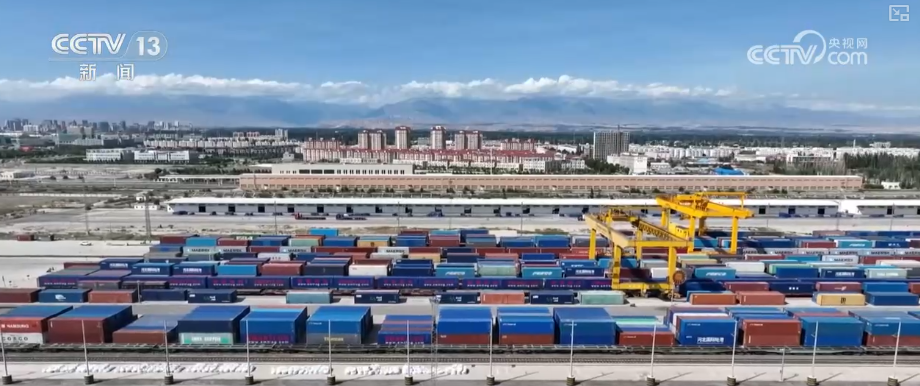
Core Viewpoint - The white paper titled "Successful Practices of the Party's Governance Strategy in the New Era" highlights Xinjiang's economic and social development, emphasizing its integration into national strategies and high-quality growth driven by improved living standards [1][3]. Economic Performance - In 2024, Xinjiang's GDP is projected to exceed 2 trillion yuan for the first time, with a total import and export volume reaching a historical high of 434.16 billion yuan [3]. - The GDP growth rate for Xinjiang in 2024 is expected to be 6.1%, with fixed asset investment increasing by 6.9%, and industrial added value rising by 8% [5]. Infrastructure Development - Xinjiang has strengthened its infrastructure, with the number of transportation airports reaching 28, and a comprehensive transportation system being developed to enhance connectivity [7]. - The "Third Channel" for electricity export has been put into operation, and the construction of the "Fourth Channel" is accelerating, contributing to the formation of a robust power grid structure [7]. Modern Industrial System - The modern industrial system in Xinjiang is showing significant cluster effects, with total grain production reaching a historical high of 46.6 billion jin and cotton production at 5.68 million tons, achieving a mechanization rate of 97% [11]. - By the first half of 2025, Xinjiang's total retail sales of consumer goods are expected to reach 189.36 billion yuan, with a year-on-year growth of 7.5%, ranking third in the nation [11].
新疆紧贴民生推动高质量发展 多项指标实现历史性突破
Zhong Guo Xin Wen Wang· 2025-09-19 07:59
Core Viewpoint - Xinjiang is focusing on high-quality economic development, achieving historical breakthroughs in multiple indicators, including GDP and trade volume, while enhancing infrastructure and modern industrial systems [1][2][3][4]. Group 1: Economic Performance - Xinjiang's GDP surpassed 2 trillion yuan for the first time last year, with a total import and export volume reaching 434.16 billion yuan, marking three consecutive years of crossing three hundred billion yuan thresholds from 2022 to 2024 [1]. - In 2022, Xinjiang's GDP grew by 6.1%, fixed asset investment increased by 6.9%, industrial added value rose by 8%, and public budget revenue grew by 10.5%. In the first half of this year, GDP increased by 5.7%, fixed asset investment rose by 13%, import and export volume grew by 28%, and public budget revenue increased by 12% [1]. Group 2: Infrastructure Development - Comprehensive strengthening of infrastructure has been achieved, focusing on the construction of a "ten-network" system and major projects worth hundreds of billions, enhancing connectivity and supporting high-quality development [2]. - New airports and railways have been completed, with the total number of transportation airports reaching 28 and significant progress made in highway construction, improving the overall transportation system [2]. Group 3: Industrial Growth - A modern industrial system is emerging, with stable agricultural production, optimized industrial structure, and expanding service sectors. In 2024, grain production is expected to reach 46.6 billion jin, and cotton production is projected at 5.68 million tons, with a mechanization rate of 97% [3]. - Energy resource bases are being developed, with oil and gas equivalent production reaching 66.64 million tons and coal production at 541 million tons last year. By July this year, installed power capacity reached 220 million kilowatts, with renewable energy accounting for 132 million kilowatts [3]. Group 4: Innovation and Talent Development - Implementation of innovation-driven strategies has led to significant advancements in productivity, with an annual increase of 2 billion yuan in fiscal science and technology funding to support innovation [4]. - A talent development fund of 10 billion yuan has been established to attract high-level talent, and various technological advancements have been made, including breakthroughs in deep drilling and renewable energy technologies [4].
总书记治国理政故事|行稳致远
Xin Hua She· 2025-09-18 12:31
Group 1 - The core viewpoint emphasizes the resilience and strength of China's economy, with a GDP of 66,053.6 billion yuan in the first half of 2025, reflecting a year-on-year growth of 5.3% at constant prices [2] - In 2014, China's economic growth rate dropped to 7.4%, the lowest in 24 years, leading to the concept of "new normal" to clarify the economic phase [3] - The focus on innovation, coordination, green development, openness, and shared development signifies a profound transformation in China's overall development strategy [4] Group 2 - Since 2025, efforts have been made to develop new productive forces, explore new fields, and strengthen the foundation of the real economy, all under the guidance of leadership aimed at high-quality economic development [5]

时代专论丨因地制宜发展新质生产力 实现高质量发展学习《习近平谈治国理政》第五卷
Zhong Yang Ji Wei Guo Jia Jian Wei Wang Zhan· 2025-09-18 00:56
Group 1 - High-quality development is the primary task for building a modern socialist country, as emphasized in the reports of the 19th and 20th National Congresses of the Communist Party of China [2][3] - The concept of "new quality productivity" is essential for promoting high-quality development, characterized by innovation, high technology, and efficiency [7][8] - The focus on expanding domestic demand and modernizing the industrial system is crucial for addressing current economic challenges [3][4] Group 2 - The government aims to implement a series of policies to stimulate economic growth, including fiscal and monetary measures, and support for key demographics such as recent graduates and migrant workers [5][6] - The emphasis on balancing effective markets with proactive government intervention is vital for maintaining economic order [6] - The development of a modern financial system is necessary to support high-quality economic growth and ensure financial stability [17][19] Group 3 - The agricultural sector is identified as foundational for national strength, with a focus on rural revitalization and modernization [11][12] - The construction of a new development pattern that emphasizes domestic circulation is critical for enhancing economic resilience [13][14] - The role of private enterprises in driving economic growth is acknowledged, with calls for improved support and an enabling environment for their development [15][16]
榜单见证中国大企业发展态势向好
Ren Min Ri Bao· 2025-09-17 08:46
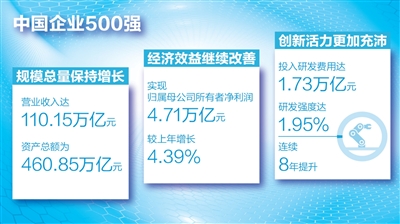
Core Viewpoint - Since the "14th Five-Year Plan," China's top 500 enterprises have made new strides in seeking progress while maintaining stability, enhancing development momentum, and playing a significant role in industrial upgrading, innovation capability enhancement, and international competition [1][2]. Group 1: Performance Metrics - The threshold for entering the "2025 China Enterprise 500" list has increased for 23 consecutive years, reaching 47.96 billion yuan, up by 579 million yuan from the previous year [1]. - The top 500 enterprises achieved a total operating income of 11.015 trillion yuan, an increase from the previous year, and a net profit attributable to the parent company of 471 billion yuan, growing by 4.39% [2]. - The number of enterprises with revenues exceeding 100 billion yuan increased from 222 in 2020 to 267 in 2024, an increase of 45 [2]. Group 2: International Engagement - The entry threshold for the "2025 China Top 100 Multinational Companies" list is 22.173 billion yuan, up by 2.333 billion yuan or 11.76% from the previous year [2]. - Total overseas assets reached 11.96 trillion yuan, with an average multinational index of 15.56%, an increase of 0.21 percentage points from the previous year [2]. Group 3: Innovation and R&D - The threshold for the "2025 China Top 100 Leading Enterprises in Strategic Emerging Industries" is 45.921 billion yuan, up by 6.407 billion yuan from the previous year [3]. - Revenue from strategic emerging businesses reached 14.31 trillion yuan, growing by 11.88%, with total assets of 22.41 trillion yuan, an increase of 20.29% [3]. - R&D expenditure by the top 500 enterprises reached 1.73 trillion yuan, with an R&D intensity of 1.95%, marking a new high and an increase for eight consecutive years [3][4]. Group 4: Structural Optimization - The operating income of the top 500 enterprises grew from 89.83 trillion yuan in 2020 to 110.15 trillion yuan in 2024, a growth of 22.62% [4]. - The total assets increased from 343.58 trillion yuan to 460.85 trillion yuan, a growth of 34.13% [4]. - The contribution to total revenue growth from manufacturing, services, and other sectors was 40.48%, 40.29%, and 19.23%, respectively [6]. Group 5: Future Directions - Chinese enterprises are encouraged to increase long-term stable investments in basic research and key common technologies, leveraging the country's vast application scenarios to break through critical core technologies [7][8]. - A new collaborative innovation system that integrates market orientation and deep integration of industry, academia, and research is recommended to enhance the competitiveness of Chinese enterprises [8].