指数化投资

Search documents
一图看懂沪AAA科创债指数
中国基金报· 2025-08-06 10:37
Core Viewpoint - The article emphasizes the rapid development and increasing acceptance of index investment in China, particularly focusing on the growth of technology innovation bonds (科创债) and the introduction of related indices to facilitate investment opportunities [7][11]. Group 1: Index Investment Trends - The index system has been rapidly improved, leading to a growing recognition in the market and accelerating the trend of index-based investment [7]. - The Shanghai Stock Exchange, together with China Fund News and China Securities Index Company, launched an educational series titled "Understanding Index Investment at a Glance" to provide comprehensive insights into index investment [7]. Group 2: Technology Innovation Bonds (科创债) - As of now, there are 356 issuers of technology innovation bonds in the market, with a total issuance of 1,360 bonds amounting to 1.95 trillion yuan. The Shanghai and Shenzhen stock exchanges have issued 935 bonds, totaling 1.23 trillion yuan, representing a growth of approximately 14.7 times and 13 times compared to the end of 2022, respectively [8][10]. - Since 2025, policies supporting the issuance of technology innovation bonds have been frequently introduced, enhancing long-term capital investment in hard technology [11]. Group 3: Index Development and Performance - In August 2023, the Shanghai Stock Exchange and China Securities Index Company launched the Shanghai AAA Technology Innovation Company Bond Index, which reflects the overall performance of technology innovation company bonds on the exchange [13]. - The current outstanding technology innovation bonds on the Shanghai Stock Exchange total 795, with a combined scale of 1,100.4 billion yuan, and the AAA technology innovation bond index includes 785 bonds, accounting for 88% of the total market scale [14][15]. Group 4: Investment Opportunities - The bonds included in the index are all rated AAA, ensuring high credit quality, and the index covers a wide range of issuers, including central and local enterprises as well as technology innovation private enterprises [17][18]. - In the current low-interest-rate environment, technology innovation bonds offer higher annualized returns compared to government bonds and money market funds, providing investors with a new asset allocation option that combines stable returns and policy benefits [19][20]. - Since the base date of June 30, 2022, the Shanghai AAA Technology Innovation Bond Index has outperformed the benchmark corporate bond index and the 5-year government bond index, with a cumulative increase of 14.4% and an annualized return of 4.3% as of July 31, 2025 [20]. Group 5: ETF Products - As of July 31, 2025, there are three domestic ETFs tracking the Shanghai AAA Technology Innovation Bond Index, which have quickly reached their fundraising limits since their public offering on July 7, with a total scale of 28.6 billion yuan [23].


走进上证180ETF成分股紫金矿业活动成功举办
Xin Lang Ji Jin· 2025-08-05 09:43
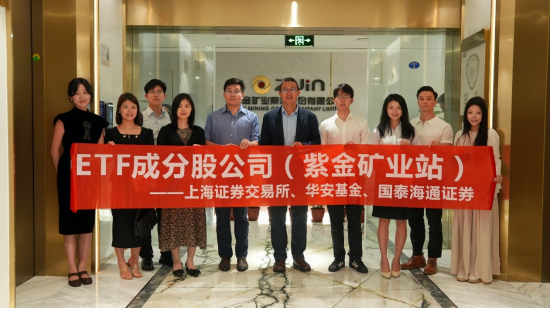
Group 1 - The event "Walking into ETF Component Companies: Zijin Mining Station" was successfully held in Xiamen and Shanghang, focusing on investor education and understanding of modern mining technology and ETF investment targets [1][2] - Zijin Mining aims to become a "green, high-tech, top-tier international mining group," with significant resources in copper, gold, zinc, lithium, silver, and molybdenum across 17 countries and 17 provinces in China [2] - As of the end of 2024, Zijin Mining's total resources include 11,037 million tons of copper, 3,973 tons of gold, 1,298 million tons of zinc, 31,836 tons of silver, and 1,788 million tons of lithium (LCE) [2] Group 2 - The Shanghai Stock Exchange (SSE) emphasized the importance of ETFs as efficient, transparent, and low-cost investment products, which have become core tools for asset allocation [3] - Zijin Mining is a key component of the SSE 180 ETF and has maintained a strong growth trend in recent years [3] - SSE plans to enhance investor education and promote long-term, value, and rational investment concepts through various activities [3] Group 3 - Guotai Junan Securities analyzed the changing gold pricing mechanism, highlighting that gold's value is supported by central bank purchases and its role as a hedge against inflation [5] - The report indicates that the influence of U.S. Treasury issues on gold prices will persist, and investors can leverage gold ETFs for investment opportunities [5] Group 4 - Huazhong Fund discussed the investment value of the SSE 180 ETF and gold ETF, noting that the SSE 180 index aims to capture emerging industry opportunities [6] - The gold ETF is positioned as an efficient tool for investors to allocate gold assets, especially in the context of ongoing central bank gold purchases [6] Group 5 - The event included a field visit to Zijin Mining's museum and production base, allowing participants to gain firsthand experience of mining operations and the company's resource reserves and green mining achievements [9] - SSE aims to continue promoting investor understanding of index products and fostering long-term investment concepts through similar ETF-themed activities [9]

攻守双衡平涛浪 价值精粹觅真金
Zhong Zheng Wang· 2025-08-04 07:57
当银行理财收益"破3"、权益市场波动不断,越来越多的投资者开始寻找"第三种选择"——既不想忍受低 利率环境下的收益下降,又害怕股票/基金账户大开大合。这种考虑正在推动更多的投资者 在"稳"与"进"之间寻找平衡点。与此同时,政策方向清晰指引:公募基金高质量发展明确要求加大力度发 展含权中低波动型产品,为投资者提供"压舱石";指数化投资在高质量发展背景下被置于重要位置,其透 明、高效、低成本的特性契合长期资金需求。在这多重背景下,兼具债性保护与股性弹性的可转债及其 指数化工具,正迎来进一步的关注。 可转债:低利率下的"缓冲垫"与弹性源 可转债"下有债底支撑,上有转股弹性"的独特基因,使其天然具备应对市场波动的潜力。在利率下行、传 统债券收益吸引力下降时,其债底提供了基础保护;而当权益市场回暖,它又能分享正股上涨收益。虽然可 转债市场存量规模从2023年高峰回落至近期约6500亿元,但日均600亿元-700亿元的活跃成交,凸显了其深 受投资者青睐。而这个市场中另一个显著趋势是——被动投资正在超越主动管理。目前市场上可转债 ETF规模已突破430亿元,较2021年底激增40倍,去年底首次超越主动管理的可转债基金规模。 ...
ETF规模飙升分化加剧 头部机构强者更强
Zhong Guo Jing Ying Bao· 2025-08-01 19:02
Group 1 - The core viewpoint of the articles highlights the significant growth of the ETF market in China, with total assets reaching 4.66 trillion yuan as of July 30, 2023, marking a nearly 25% increase since the beginning of the year [1][2] - The top ten ETF providers account for nearly 80% of the total ETF market size, indicating a pronounced "Matthew Effect" where leading firms like Huaxia Fund and E Fund dominate the growth [2][3] - The bond ETF segment has seen remarkable growth, increasing from 1739.73 billion yuan to 5122.4 billion yuan, a growth rate of 194.44%, while stock ETFs grew by approximately 10% [2][3] Group 2 - The rapid expansion of the ETF market is attributed to favorable policies, regulatory support, and a shift in market demand, with institutional investors increasing their allocation to ETFs [5][6] - The year 2025 is anticipated to be a milestone for index-based investments, with innovations such as the first batch of science and technology innovation index ETFs emerging [6][7] - ETFs are increasingly viewed as essential investment tools due to their transparency, low fees, and risk diversification, making them a standard component in investment portfolios [6][7] Group 3 - The industry is witnessing a transformation where public funds need to evolve from "product designers" to "ecosystem builders," enhancing investor experience through low-cost and transparent services [4][5] - Some firms, despite slower growth, are focusing on thematic products to capture structural market opportunities, indicating a strategic shift in product offerings [4][5] - The expansion of ETFs reflects a maturation of investor sentiment, with passive investment tools becoming a significant indicator of market professionalism [7]
ETF对话录|多只主题ETF年内翻倍 创新药行情走到哪了?
Sou Hu Cai Jing· 2025-08-01 04:25
Core Insights - The innovative drug sector has experienced significant growth in 2023, with related indices outperforming major market indices, indicating a new phase of high-quality development in index investment [1][2]. Group 1: Market Performance - The innovative drug sector indices have shown remarkable performance, with the Guozhen Hong Kong Stock Connect Innovative Drug Index rising by 105.61% and the CSI Innovative Drug Industry Index increasing by 31.79% year-to-date as of August 1 [2]. - Over 30 innovative drug stocks have doubled in value this year, with some individual stocks seeing increases exceeding 600% [2]. - Several innovative drug ETFs have also seen substantial growth, with three ETFs surpassing 10 billion yuan in scale [2]. Group 2: Growth Drivers - The growth of the innovative drug sector is attributed to both policy support and industry dynamics, including significant licensing deals with foreign pharmaceutical companies [3][4]. - Major licensing agreements have been established, such as a $60.5 billion deal between 3SBio and Pfizer, and a $120 billion collaboration between Hengrui Medicine and GlaxoSmithKline [3]. Group 3: Future Outlook - The innovative drug sector is expected to continue its upward trajectory, transitioning from a phase of broad revaluation to one focused on actual performance and business development [7]. - There is optimism regarding specific segments such as orthopedics and upstream innovative drugs, as well as medical devices that may see improved performance [7]. - New technologies like AI and brain-machine interfaces are anticipated to transform the healthcare system, although immediate financial impacts on listed companies may be limited [7].
广发证券(000776):跟踪分析报告:被低估的广发证券
Huachuang Securities· 2025-07-29 12:03
Investment Rating - The report maintains a "Buy" rating for GF Securities with a target price of 26.25 CNY [1] Core Views - GF Securities is considered undervalued, with significant potential for earnings recovery and valuation expansion in the context of the growing ETF market and the company's strategic positioning [6][39] - The company has a stable governance structure and a professional management team, which enhances its long-term strategic execution [9][12] - The report highlights the company's strong performance in the investment banking sector, with a projected net profit growth of 38% in 2024, significantly outperforming the industry average [34] Financial Summary - Total revenue projections for GF Securities are as follows: - 2024: 27,199 million CNY - 2025: 33,517 million CNY (23% YoY growth) - 2026: 35,280 million CNY (5% YoY growth) - 2027: 37,867 million CNY (7% YoY growth) [1] - Projected net profit figures are: - 2024: 9,637 million CNY - 2025: 11,014 million CNY (14% YoY growth) - 2026: 11,801 million CNY (7% YoY growth) - 2027: 12,795 million CNY (8% YoY growth) [1] - Earnings per share (EPS) estimates are: - 2024: 1.15 CNY - 2025: 1.45 CNY - 2026: 1.55 CNY - 2027: 1.68 CNY [1] Governance Structure - GF Securities has a stable and decentralized ownership structure with no controlling shareholder, which has remained consistent since its listing in 2010 [9][12] - The top three shareholders collectively hold approximately 40% of the shares, providing a stable foundation for the company's governance [9] ETF Market Positioning - The report emphasizes GF Securities' strategic positioning in the ETF market, highlighting its three-dimensional approach: 1. Issuing and managing ETFs through its public fund subsidiaries [15] 2. Participating in ETF market-making, ranking second in the industry [29] 3. Utilizing ETFs as a core tool for investment advisory services, enhancing asset allocation efficiency [33] - The ETF market in China has seen explosive growth, with total assets reaching 4.31 trillion CNY in mid-2025, reflecting a 74% YoY increase [15][21] Investment Management Contribution - The investment management segment is a significant revenue contributor, accounting for nearly 30% of GF Securities' total revenue [21][25] - The company has maintained a strong market position in asset management, with its public fund subsidiaries holding substantial market shares [21][27] Valuation and Market Outlook - The current price-to-book (PB) ratio for GF Securities is significantly lower than the industry average, with H-shares at 0.98x and A-shares at 1.26x [39] - The report suggests that GF Securities has considerable room for valuation recovery, especially in light of the ongoing trends in passive investment and the anticipated recovery in its investment banking business [39]

“投资者零距离”走进北证50成份股系列活动——民士达专场圆满落幕
天天基金网· 2025-07-29 11:13
Core Viewpoint - The event organized by the Beijing Stock Exchange Investor Education Base and Dongcai Fund highlighted the growth potential and market value of innovative enterprises listed on the Beijing Stock Exchange, particularly focusing on the company Minshida, which is recognized as a national-level "little giant" enterprise in the high-performance aramid paper sector [2][5]. Group 1: Company Insights - Minshida is a leading player in the aramid paper industry, having broken international monopolies and achieved import substitution, currently holding the second-largest global market share [2]. - The company showcased its innovative capabilities during the on-site visit, emphasizing its operational status, technological breakthroughs, and future plans [2]. Group 2: Market and Economic Analysis - The seminar discussed macroeconomic trends and investment strategies, emphasizing the importance of the Beijing Stock Exchange in supporting innovative small and medium-sized enterprises as a core engine for China's economic transformation [2][3]. - The analysis of the "anti-involution" policy indicated a shift towards high-quality development, aiming to enhance overall profitability in the industry [3]. Group 3: Investment Strategies - The Dongcai Fund's quantitative investment director highlighted the investment value of the North Exchange 50 Index, discussing its valuation advantages, improved liquidity, and policy benefits, positioning index investment as an effective tool for ordinary investors to share in the growth of quality enterprises [3]. - The fixed income investment director proposed strategies to enhance the activity of the bond market on the North Exchange through innovative tools like bond ETFs [4]. Group 4: Industry Opportunities - The chief analyst for light industry at Dongcai Securities analyzed the specialty paper industry's characteristics, emphasizing the acceleration of import substitution and structural opportunities within niche markets, identifying potential "hidden champion" investment values [4]. - The interactive session allowed investors to engage with experts on macroeconomic trends and specific industry research, fostering a collaborative environment for knowledge sharing [4]. Group 5: Educational Initiatives - The event served as a practical example of building an educational ecosystem between the Beijing Stock Exchange and Dongcai Fund, facilitating communication between investors, listed companies, and professional institutions [5]. - Dongcai Fund aims to continue enhancing its educational ecosystem to help investors effectively seize opportunities in the North Exchange market and share in the dividends of China's economic innovation [5].
【财经分析】债市“科技板”落地生花 企业融资生态持续优化
Xin Hua Cai Jing· 2025-07-29 09:11
政策"组合拳"赋能发展 2025年以来,科技创新领域支持政策密集出台,债市明确将科技创新作为融资支持的重点方向之一,从 政策层面强化预期引导。 随着债券市场"科技板"的正式落地,目前金融机构、科技型企业、私募股权投资机构三类主体发行科技 创新债券(以下简称"科创债")获得了有力支撑。记者还注意到,在发行主体范围得以拓宽的同时,科 创债的发行流程、交易、增信及配套机制等也获得了进一步优化,政策一致性和可操作性明显增强。 "现阶段,在政策倾斜的大背景下,科创债发行热度明显提升(2025 年上半年科创债的发行规模约为1 万亿元),较去年同期增长86%。其中,金融机构发行规模约达2500亿元,后续有望继续扩容。"中诚 信国际研究院分析师卢菱歌表示。 记者也注意到,"科技板"落地之后,科创债发行明显提速,5月至6月,科创债的发行规模为6000亿元, 而在金融机构启动科创债发行后,市场明显扩容,这与银行科创债单只债券发行规模较大有关;截至7 月16日,科创债的存量规模升至2.5万亿元,较年初增加9000亿元以上。 另有公开数据显示, 2025年上半年,科创债承销规模延续了自2020年以来的高速增长态势,合计承销 金额同比 ...
无限光年可信AI方案亮相WAIC,四大方案激活金融效能
Guan Cha Zhe Wang· 2025-07-29 06:06
在人工智能技术飞速发展的当下,各行业对智能应用的需求正从"能用"迈向"好用""精准用"。通用大语言模型虽在泛化任务中表现出色,但在特定领域场景 下,常因缺乏深度行业知识,难以满足企业对精准性与效率的更高要求。领域特定模型应运而生,这类聚焦于垂直行业、业务职能或细分任务的智能模型, 通过整合专属数据、领域知识与专家经验,为解决具体问题提供了更精准的支撑。 在2025年世界人工智能大会(WAIC)上,金融科技企业无限光年首次公开展示了其可信AI金融创新解决方案矩阵,涵盖股票指数动态定制、智能信贷分析、 金融专业培训及AI投研助手四大领域。这些方案针对金融行业的核心痛点,旨在通过技术手段提升效率与合规性。 AI动态指数定制:从赛事夺冠到商业落地 当前,指数化投资已成为资管行业的核心趋势,作为金融市场定价体系的关键基础设施,指数编制的效率与精度对于资产配置效能至关重要。然而,传统模 式受限于人工处理机制,存在覆盖不足、调仓周期滞后等瓶颈,难以动态捕捉市场结构演变,倒逼AI驱动的实时指数引擎需求激增。 2024年,恒生银行、恒生指数公司联合数码港发起"恒生指数创新挑战赛",依托全球知名机器学习竞赛平台Kaggle,发布 ...

活跃行情下的基金投资基金投资众生相
Shang Hai Zheng Quan Bao· 2025-07-28 18:58
Group 1: Market Overview - The public fund scale has reached a new high of 34.39 trillion yuan as of the end of June, marking the first time it has surpassed this threshold [3][4] - The stock market is steadily rising, with the Shanghai Composite Index approaching 3600 points, indicating a vibrant market environment [2][12] Group 2: Public Fund Trends - The growth of public funds is driven by the acceleration of index investment, a surge in demand for "fixed income plus" products, and a restoration of trust in actively managed equity funds [3][9] - The number of public fund products has rapidly increased, reaching 12,905 by the end of June, with projections indicating it has surpassed 13,000 [5][6] Group 3: Fund Performance - Bond funds have emerged as the main attraction, with a monthly scale increase of 507.87 billion yuan in June, while equity funds also saw significant growth due to market rebounds [5][6] - The top fund companies are expanding their market share, with E Fund leading at 2.16 trillion yuan in management scale, followed by Huaxia Fund surpassing 2 trillion yuan [6][7] Group 4: ETF Development - ETFs are becoming a competitive advantage for leading fund companies, with several achieving substantial growth in management scale [7][8] - New players are entering the ETF market, indicating a competitive landscape with ongoing innovation and product development [9][10] Group 5: Private Fund Strategies - Private funds are adopting offensive strategies focused on new trends in consumption, technology, and economic changes while maintaining defensive measures [12][18] - Optimism among large private funds is growing, with many increasing their positions significantly in the current market [13][17] Group 6: Investor Behavior - Investor behavior is showing signs of divergence, with some actively buying into rising funds while others remain cautious due to past experiences of losses [22][23] - Frequent trading and chasing high returns are identified as detrimental behaviors that can erode long-term returns for investors [24][25] Group 7: Future Outlook - The future growth of public funds is expected to be driven by index investment, the rise of "fixed income plus" products, and a potential rebound in actively managed equity funds [10][11] - The industry is encouraged to innovate in product offerings and focus on performance to meet investor demands and enhance competitiveness [11][26]