具身智能

Search documents
英伟达GTC2026分析总结
2026-03-18 02:31
Key Points Summary of NVIDIA GTC 2026 Analysis Industry and Company Overview - The conference focuses on NVIDIA's advancements in AI infrastructure and GPU technology, particularly the Vera Rubin platform and its implications for the AI industry [1][2]. Core Insights and Arguments - **Vera Rubin Platform**: Scheduled for mass production in H2 2026, featuring a single card performance exceeding 50 PFLOPS and HBM4 bandwidth of 1.2 TB, equipped with full liquid cooling [1]. - **LPU Chip**: Expected to ship in Q3 2026, designed for low-latency inference tasks with a first token delay of less than 0.1 seconds, supporting real-time applications [1][3]. - **Market Demand**: Global demand for GPUs and computing devices is projected to exceed $1 trillion by 2027, significantly up from the previous estimate of $500 billion [1][6]. - **AI Factory Concept**: The AI industry is transitioning from training to inference, with NVIDIA's AI factory concept dividing the industry into architecture, chips, systems, software models, and applications [2]. Product Releases and Technical Specifications - **Chip Releases**: Key products announced include: - **Vera Rubin Platform**: Mass production in 2026, with samples delivered to major clients like Adobe and Microsoft [2]. - **Feiman Architecture Chip**: Expected in 2028, utilizing 1.6 nm technology and designed for physical AI applications [2]. - **LPU**: Focused on real-time applications, featuring 230 MB SRAM and 80 TB bandwidth [3]. Innovative Workflows and Applications - **Dynamic Software Solution**: The LPU chip implements a new workflow by splitting the inference process into prefill and decode stages, enhancing efficiency in real-time applications [4]. - **Integration with Vera Rubin**: LPU can be deployed alongside Vera Rubin GPUs in a 75:25 ratio to balance high-throughput and low-latency tasks [4]. Future Product Roadmap and Technological Evolution - **Upcoming Products**: The roadmap indicates that the Rubin Ultra cabinet will be released in 2027, featuring a new design to improve density and reduce latency [5]. - **CPO and Liquid Cooling**: The introduction of CPO technology and full liquid cooling in new cabinets is expected to drive significant demand in the coming years [6]. Investment Implications and Industry Outlook - **AI Infrastructure Demand**: The demand for AI infrastructure is expected to grow substantially, with implications for related industries such as optical communication and liquid cooling [6]. - **Liquid Cooling Market**: The penetration rate of liquid cooling in new platforms is projected to reach 100%, indicating strong growth potential in this sector [6][7]. - **Valuation Opportunities**: Companies in the optical communication sector are seen as having attractive valuations, with significant upside potential as demand increases [6]. Additional Important Insights - **ASIC Liquid Cooling Supply Chain**: Progress in the supply chain for ASIC liquid cooling has been noted, with domestic manufacturers securing orders from major clients like Google [1][6]. - **Performance Enhancements**: The efficiency of AI factories has improved dramatically, with token generation capabilities increasing from 2 million to 700 million per second over two years [6].

独家|40家机构抢一个天使轮
投中网· 2026-03-18 01:52
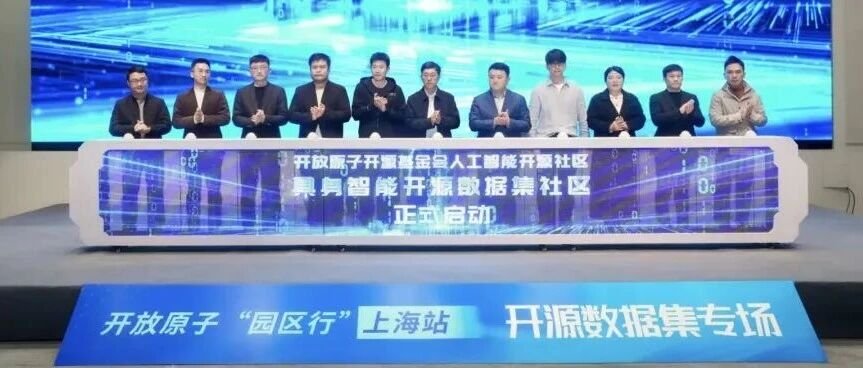
Core Viewpoint - The article discusses the rapid growth and investment in the robotics industry, particularly focusing on the robot rental platform, Qingtian Rental, which has achieved a valuation of 3 billion yuan within three months of its establishment [2][8]. Investment and Financing - The robotics industry has seen over 20 billion yuan in financing since the beginning of the year, with valuations frequently reaching new heights, making a 10 billion yuan valuation almost a starting point [4]. - Qingtian Rental completed two rounds of angel financing, raising over 100 million yuan, with notable investors including publicly listed companies and various venture capital firms [5]. - Despite the rapid decision-making process, there are concerns about the future of robot rentals, with over 40 investment institutions expressing interest, indicating a competitive investment landscape [6]. Business Model and Operations - Qingtian Rental focuses on the entertainment sector, with a significant portion of its orders during the Spring Festival related to entertainment performances and commercial marketing, accounting for 70% of its business [6]. - The platform has successfully processed over 1,000 orders during the Spring Festival, indicating strong demand, although it faces challenges in fulfilling orders due to staffing shortages and geographic coverage limitations [10][12]. - The company has initiated a "City Partner" recruitment program to enhance local service delivery, receiving over 16,000 applications, which suggests a higher-than-expected demand for its services [12]. Market Dynamics and Future Outlook - The robotics rental market is characterized by intense competition, with various players entering the space, including manufacturers and logistics companies [10]. - Qingtian Rental has a competitive edge in financing, brand partnerships, and operational capabilities, with plans to increase its robot fleet from over 3,000 to potentially over 10,000 by 2026 [10]. - The company aims to create a robust operational model that connects asset providers with rental partners, positioning itself as a key player in the emerging robotics rental market [15][17].


观众报名启动!4月北京,第三届中国具身智能与人形机器人产业大会,一站式参与论坛、展会、供需对接、人才招聘
机器人大讲堂· 2026-03-18 00:00
Core Insights - The article emphasizes that embodied intelligence and humanoid robots are not distant future concepts but are currently unfolding in the present moment [2][3] - The industry is experiencing rapid growth, with 18 financing events and over 13 billion yuan invested in just the first two months of 2026 [4] Event Overview - The Third China Embodied Intelligence and Humanoid Robot Industry Conference will take place on April 28-29, 2026, in Haidian, Beijing, focusing on the theme "Competing for the Trillion-Yuan Track of Embodied Humanoids: Reshaping the New Era of Future Industries" [6] - The conference aims to gather key players from the entire industry chain, including researchers, entrepreneurs, industry practitioners, and job seekers, to explore opportunities [6] Key Highlights - The conference will feature six core highlights: trend insights, comprehensive agenda, real-world demonstrations, authoritative reports, recognition of industry leaders, and talent recruitment [7] - A main forum will host over 30 top experts and executives from leading companies to discuss the latest industry dynamics, technology trends, and core strategies [8] - The event will provide a platform for addressing common challenges faced by industry chain enterprises, investment research groups, entrepreneurs, and industry observers [9] Comprehensive Agenda - The agenda is designed to connect top-level insights with precise resource matching, covering everything from industry trends to practical applications [12] - An exhibition will showcase the latest research and development achievements in embodied intelligence and humanoid robots, allowing attendees to interact with cutting-edge products and teams [12] - Authoritative research reports will be released to analyze industry trends and opportunities, aiding companies in decision-making [13] Recognition and Awards - The conference will unveil the "LeadeRobot" authoritative rankings, recognizing benchmark companies and innovative products in the industry [14][25] - The event aims to highlight industry innovation and provide a reference for high-quality development [25] Networking and Recruitment - The conference will facilitate high-level exchanges to connect supply and demand in the industry, promoting collaboration [17] - A dedicated talent recruitment session will create a platform for matching talent with core positions across the industry chain [17] Participation and Registration - Early bird tickets are available, offering access to the conference, meals, and a printed copy of the 2026 industry report [27][28] - The event encourages participation from various stakeholders to foster collaboration and resource sharing in the embodied intelligence sector [30]

影响市场重大事件 | 英伟达CEO黄仁勋:太空计算已到来 发布Vera Rubin太空模块
Mei Ri Jing Ji Xin Wen· 2026-03-17 22:57
Group 1 - NVIDIA launched the Vera Rubin space module designed for real-time processing of large data streams from space instruments, boasting AI computing capabilities 25 times that of the H100 [1] - The Chinese Ministry of Finance announced a continuation of a more proactive fiscal policy in 2026, focusing on expanding fiscal expenditure, optimizing government bond tools, and enhancing transfer payment efficiency [1] Group 2 - Murata, the world's largest MLCC supplier, announced a price increase of 15%-35% for AI server and high-end automotive MLCC products, effective April 1, marking the first large-scale price adjustment in three years [2] - Beijing's government plans to promote the circulation and use of data elements, including the establishment of a diverse public data product and service system to support AI model training and application [4][7] Group 3 - Alibaba introduced the "Wukong" enterprise-level AI native work platform, enabling teams to have a 24/7 operational capability, integrated with DingTalk for over 20 million enterprises [5] - The establishment of a national-level open-source dataset community for embodied intelligence was announced, aimed at providing institutional support and resource collaboration for data infrastructure [3] Group 4 - Beijing's government is focusing on key areas such as robotics, brain-computer interfaces, and smart terminals, aiming to create a friendly ecosystem for industrial development [7] - The Beijing government is reforming the ownership rights of scientific research achievements, enhancing the efficiency of technology transfer and establishing a one-on-one service mechanism for universities and research institutions [8] Group 5 - The Beijing Municipal Science and Technology Commission emphasized the importance of leading enterprises collaborating with universities to address national needs and promote deep integration of technological and industrial innovation [9]
腾讯研究院AI速递 20260318
腾讯研究院· 2026-03-17 16:03
Group 1: Nvidia Developments - Nvidia launched the Vera Rubin platform with 5 rack-level systems and 7 mass-produced chips, reducing the GPU requirement for training large MoE models to 1/4 of Blackwell, improving inference throughput by 10 times, and lowering token costs to 1/10 [1] - The Groq 3 LPU, with 150TB/s SRAM bandwidth, complements Rubin GPUs, enhancing trillion-parameter model throughput by 35 times per megawatt; mass production by Samsung is expected to ship in Q3 [1] - Additional releases include the NemoClaw safety framework, DGX Spark/Station local deployment devices, and Nemotron 3 Ultra open models, with predictions of orders doubling to a trillion dollars by 2027 [1] Group 2: Manus Desktop App - Manus, acquired by Meta, launched a Desktop App allowing AI to execute commands, read/write files, and utilize GPU on local macOS/Windows terminals, breaking cloud sandbox limitations [2] - The app focuses on "full local resource access + cloud intelligence planning," requiring explicit user approval for each command, differentiating it from OpenClaw's open-source approach and Claude Cowork's collaborative sessions [2] - Four major products, including Perplexity Computer and Claude Cowork, have been updated within three weeks, intensifying the competition for intelligent operating systems [2] Group 3: Tencent's ima Skills - Tencent's ima launched the ima skills feature, initially offering a note-taking skill that allows users to query, read, and write content in the notes module; a knowledge base skill is also set to launch soon [3] - The feature is fully compatible with multiple Claw products, enabling users to integrate by copying prompts and obtaining API keys from the ima center [3] - Users with access to WeChat, QQ, and other messaging tools can initiate requests directly from their mobile devices, allowing the dragonfly to automatically utilize ima skills for task completion, facilitating cross-platform collaboration [3] Group 4: Baidu's AI Day - Baidu's AI Day introduced a suite of products including the desktop intelligent agent DuMate, mobile RedClaw, cloud DuClaw, and home assistant Xiaodu, covering PC, mobile, and smart home scenarios [4] - The Baidu Search Skill has been downloaded over 45,000 times from the OpenClaw official skill store, making it the top official skill plugin for search engines globally; the company aims to establish it as the foundational infrastructure for intelligent applications [4] - A robust security mechanism is emphasized, covering data layers to system layers, with a focus on environmental isolation, permission control, and memory management, alongside the release of additional skills [4] Group 5: Alibaba's Wukong Agent - Alibaba's DingTalk completed a comprehensive CLI transformation, allowing the Wukong Agent to operate core capabilities natively rather than simulating GUI clicks [5] - Alibaba established the Token Hub business unit, planning to gradually integrate B-end capabilities from Taobao, 1688, and Alipay into skill formats, aiming to create a B2B skill market [5] Group 6: MIT's WebAssembly Interpreter - MIT's team implemented a WebAssembly interpreter within Transformer weights, enabling any C code to be compiled into token sequences executed internally, with full transparency and no external calls [7] - The attention head limitation to 2D and convex hull queries reduced decoding time complexity from Θ(t) to O(log t), achieving over 30,000 tokens per second throughput with 100% accuracy on Sudoku tests [7] - The execution trajectory is part of the forward propagation, allowing future programs to be directly compiled into weights, making the weights themselves a target for software deployment [7] Group 7: Nvidia's DLSS 5 - Nvidia's DLSS 5 features real-time neural network rendering, allowing AI to dynamically re-render game visuals, including effects like subsurface scattering and fabric gloss that are challenging for traditional rendering [8] - The output is anchored to source 3D content with high frame consistency, enabling developers to finely adjust lighting and masks while maintaining unique artistic styles of games, with minimal integration costs [8] - The initial games include a significant number from China, such as "Delta Force," "Reverse Water," and "Sixteen Sounds of Yan Yun," with a formal launch scheduled for this fall [8] Group 8: Wang Xing's Predictions - Wang Xing defined the embodied intelligent ChatGPT moment as robots completing 80% of tasks in 80% of unfamiliar scenarios solely through verbal instructions, expected to be realized in 1-2 years [9] - Three major bottlenecks need addressing: model action expression capabilities and generalization, efficiency in utilizing diverse data, and scalable effects of reinforcement learning; the focus is on world models and video generation routes [9] - The Spring Festival robot utilized a pre-trained full-body RL model instead of a single-action strategy, supporting stable transitions between actions; exploration of humanoid robots for factory production is ongoing [9] Group 9: Harvard Study on AI Overuse - A Harvard study found that 14% of nearly 1,500 surveyed employees experienced cognitive overload due to excessive AI use, leading to decreased attention and decision-making abilities; high-intensity AI users expended 14% more mental effort, with a 19% increase in information overload likelihood [10] - Productivity significantly increased when using 1-2 AI tools, but declined after the fourth tool; cognitive overload also raised the error rate by 39% and increased turnover intention from 25% to 34% [10] - The study recommends limiting the number of agents managed by an individual to three, strategically deploying human attention resources similar to managing computing power [10]

2026年春季北交所人形机器人行业投资策略:商业化进程加速,聚焦优质零部件供应商
Shenwan Hongyuan Securities· 2026-03-17 15:10
Group 1 - The humanoid robot industry is approaching a "singularity" in 2025, marking the year of mass production and the establishment of hardware pathways [6][8] - The global landscape of the robot industry shows that the US leads in underlying technology and consumer ecosystems, while China is catching up with a complete industrial chain and application scenarios [8][12] - Major tech companies from sectors like electric vehicles, consumer electronics, and the internet are entering the robot industry, injecting vitality into its development [9][12] Group 2 - The year 2026 is expected to focus on capacity release and cost reduction as core elements for the humanoid robot industry [5][28] - The report highlights the importance of small but high-quality suppliers in the North Exchange market, indicating a forward-looking layout [5][28] - The commercial application of robots is diversifying, with emotional interaction and experience upgrades becoming key breakthroughs [14][16] Group 3 - The report outlines the production capacity and mass production plans of major humanoid robot manufacturers, with Tesla aiming for a million-unit production line by 2026 [61][63] - The production timeline for various companies indicates a strong focus on scaling up production capabilities and meeting delivery schedules in 2026 [64][63] - The report emphasizes that the delivery rhythm of leading manufacturers will determine the industry's beta in 2026, focusing on the trifecta of capacity, orders, and cost reduction [64][65] Group 4 - The report discusses the evolution of key components and suppliers in the humanoid robot industry, highlighting advancements in technologies such as planetary roller screws and harmonic reducers [18][20] - The shift towards electric drive solutions and modular joint packaging is becoming a consensus among manufacturers, facilitating standardized production and maintenance [20] - The integration of large models as the "brain" of robots is identified as a critical factor for scaling, with software increasingly determining operational capabilities [21][27] Group 5 - The report notes that the humanoid robot sector has seen significant stock price movements since September 2024, driven by various market catalysts [28][30] - The emotional and interactive capabilities of robots are improving, as demonstrated in performances that reflect their potential in real-world applications [65][73] - The report highlights the increasing international exposure and technological breakthroughs of domestic companies like Zhiyuan Robotics, which is focusing on platformization and global deployment [51][52]


MindVLA-o1发布会提了一个指引理想未来十年做什么的问题
理想TOP2· 2026-03-17 14:51
Core Viewpoint - The article discusses the vision of building a digital brain for machines that can operate in the real world, with a focus on the next ten years of development led by Li Xiang [1][3]. Group 1: Autonomous Driving and AI Development - The main line of the first decade for the company is that autonomous driving represents the ultimate goal for smart vehicles, with all efforts before 2025 aimed at achieving a competitive vehicle for this purpose [4]. - Initially, Li Xiang was uncertain about how to achieve autonomous driving but believed in its feasibility, focusing first on range-extended vehicles until the industry matured enough to support pure electric vehicles [5]. - It wasn't until 2023 that the company began to invest significant resources into autonomous driving, emphasizing the importance of timing and the right actions at each stage [6]. - By March 2026, the company clarified that autonomous driving is not the end goal but a necessary step, with many other opportunities to pursue afterward [8]. Group 2: Evolution of Autonomous Driving - The evolution path for the company's autonomous driving includes improving perception and setting human prior rules, mimicking learning and language processing, and integrating reinforcement learning for smarter decision-making [9]. - The organization aims to create a silicon-based brain that can be transferred to other physical entities, starting with achieving autonomous driving, with aspirations for humanoid robots capable of household tasks within three years, although this may take longer [9]. Group 3: Product Development and Market Response - The success of the first two generations of vehicles is attributed to effective product definition, particularly in hardware aspects, while the software interface remains less imitable by competitors [10]. - The company plans to focus on integrated experiences of embodied intelligence, similar to how Apple differentiated itself in the smartphone era through hardware and operating systems [11]. - The market response to the first generation of embodied intelligence products remains highly uncertain, and the company's competitive success will heavily depend on Li Xiang's intelligence, decision-making quality, and evolution speed [11].


地瓜机器人完成1.2亿美元B1轮融资,加速打造具身智能原生技术底座
机器人圈· 2026-03-17 14:02
Core Insights - Digua Robot recently completed a $120 million B1 round of financing, bringing the total funding to $220 million after the $100 million A round in 2025 [4] - The financing attracted top industry investors, including Synstellation Capital, Didi, and Meituan Longzhu, along with various strategic and financial institutions [4] - The funds will be used to support the development and iteration of Digua Robot's full-stack software and hardware technology, aiming to enhance its embodied intelligence technology base [4] Group 1 - Digua Robot is recognized as a core enterprise covering all categories of robots, addressing differentiated market demands for mass-produced robot products and innovative applications [5] - The company has achieved complete coverage of computing power from 5 to 560 TOPS, catering to various robotic applications, including humanoid robots and logistics AMRs [5] - Over the past year, Digua Robot has collaborated with leading industry clients to create benchmark products, such as the AI dual-camera sweeping robot and the world's first panoramic drone [5] Group 2 - The robotics industry is currently experiencing rapid technological iteration and accelerated mass production, with deep penetration into niche markets [6] - Digua Robot maintains a strategic partnership with Horizon, focusing on providing optimal solutions for robotic intelligence development [6] - The company aims to lower industry development barriers and accelerate the evolution and large-scale deployment of robotics through a comprehensive development platform [6]

GTC2026智元携手英伟达,共建物理AI标准生态加速全球部署
Yang Zi Wan Bao Wang· 2026-03-17 13:31
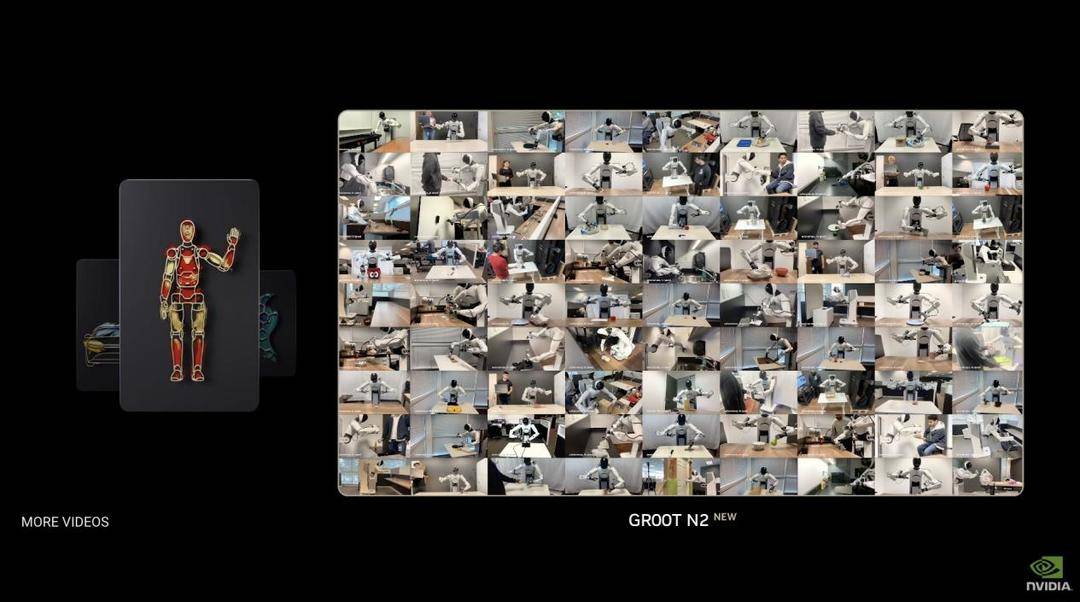
Core Insights - The GTC2026 conference highlighted NVIDIA's collaboration with global robotics leaders, including Zhiyuan Robotics, to advance the deployment of physical AI across various sectors such as manufacturing, logistics, transportation, healthcare, and infrastructure [1][3]. Group 1: Collaboration and Technology Development - NVIDIA's CEO Jensen Huang emphasized the deep partnership with Zhiyuan Robotics, showcasing their achievements in commercializing robotics for real-world applications and establishing a standardized closed-loop from R&D to deployment [3][6]. - The collaboration focuses on hardware platforms, edge-cloud computing, pre-training of the GR00T embodiment model, and industrial-scale production, aiming to define industry standards for physical AI [3][5]. Group 2: Product and Model Innovations - The introduction of the next-generation GR00T N2 embodiment model and the demonstration of the Spirit G1 as a hardware platform for model training were key highlights of Huang's presentation [3][5]. - Zhiyuan Robotics is working on joint hardware adaptations to support billion-parameter VLA models and world models for precise operations in electronic manufacturing, automotive assembly, and logistics [5]. Group 3: Standardization and Global Impact - Zhiyuan Robotics was recognized as a leading partner in global physical AI, establishing a value closed-loop with standardized capabilities across hardware, software, and deployment [6]. - The company aims to transform Chinese practical scenarios into internationally recognized standards, facilitating China's transition from technology follower to standard setter in the field of physical AI [6].
国家出手,这个具身开源数据集社区,为什么让乐聚、蚂蚁、宇树都来了?
机器人大讲堂· 2026-03-17 11:56
Core Insights - The article emphasizes that 2026 is expected to be a pivotal year for humanoid robots and embodied intelligence, with a projection that by 2060, the global number of humanoid robots could reach 3 billion, surpassing the current number of cars per capita [1] - A significant challenge remains in the industry, where advancements in humanoid robots are hindered by a lack of high-quality operational data and the difficulty in replicating human-like dexterity and adaptability [4] Data Collection and Challenges - The humanoid robot industry faces a core contradiction where the physical capabilities of robots are maturing, but the cognitive aspects (the "brain") are lagging, limiting large-scale applications [4] - The need for real machine data is critical as it serves as the fuel for the evolution of the robot's cognitive capabilities, with current global open-source embodied datasets being insufficient [5] - Three data collection routes have emerged: real machine data, UMI teleoperation data, and synthetic data, with real machine data being the optimal solution for bridging the Sim2Real gap [5][6] National Initiatives and Community Development - The establishment of a national-level open-source data community aims to address the systemic risks associated with uncoordinated data infrastructure development in the industry [7] - The Open Atom Open Source Foundation is spearheading this initiative, focusing on creating a unified data governance framework and quality assessment standards [7][9] - The community's goals include developing an open data platform, establishing a data trading ecosystem, and promoting deep integration of technology and industry [17] Key Players and Strategic Moves - Leading companies like Leju Robotics, Ant Financial, and Yushu are participating in the community, each bringing unique strengths to the collaborative effort [11] - Leju Robotics has established the largest real machine data collection network in China, producing 25 million data entries annually and facilitating a complete data commercial chain [12][14] - The involvement of these companies signifies a strategic consensus in the humanoid robot industry regarding the necessity of building data infrastructure collaboratively [21] Future Implications - The competition in embodied intelligence will increasingly focus on data accumulation and ecosystem development rather than solely on algorithmic and hardware capabilities [19] - The establishment of a national-level open-source data community is seen as a transformative event that could accelerate the transition from proprietary data to open-source sharing, enhancing the competitive landscape of the industry [18][22]