自由现金流

Search documents
周期类价值风格强势回归,不含银行地产的自由现金流ETF备受关注
Xin Lang Cai Jing· 2025-08-12 03:19
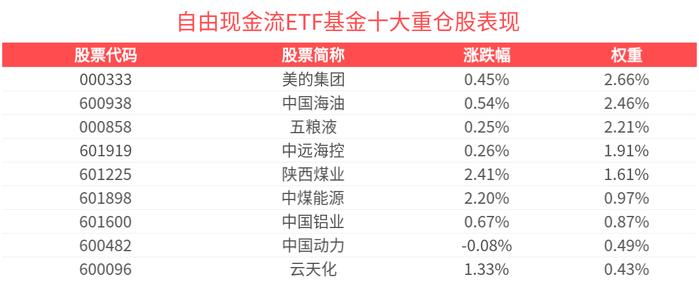
Core Insights - The CSI All Share Free Cash Flow Index (932365) has shown a positive performance, with a 0.42% increase as of August 12, 2025, and notable gains in constituent stocks such as Xinpeng Co., Ltd. (10.02%) and Feiyada (10.01%) [1][2] - The Free Cash Flow ETF (159233) has also performed well, rising 0.56% and achieving an 8-day consecutive increase, with a latest price of 1.08 yuan [1] - The Free Cash Flow ETF has demonstrated strong liquidity, with a turnover rate of 3.68% and a total transaction volume of 566.95 million yuan on August 11, 2025 [1] - The ETF has shown a historical average monthly return of 2.20% since inception, with a maximum monthly return of 4.04% and a winning percentage of 88.89% [1][2] Performance Metrics - The maximum drawdown for the Free Cash Flow ETF since inception is 3.28%, with a relative benchmark drawdown of 0.16% [2] - The management fee for the Free Cash Flow ETF is set at 0.50%, while the custody fee is 0.10% [2] - The CSI All Share Free Cash Flow Index tracks 100 high free cash flow rate listed companies, reflecting the overall performance of companies with strong cash flow generation capabilities [2] Top Holdings - As of July 31, 2025, the top ten weighted stocks in the CSI All Share Free Cash Flow Index account for 57.53% of the index, including China National Offshore Oil Corporation (2.46%), COSCO Shipping Holdings (1.91%), and Wuliangye (2.21%) [2][4] - The detailed performance of selected stocks includes Midea Group (0.45%), Shaanxi Coal and Chemical Industry (2.41%), and China Aluminum (0.67%) [4]

A股市场“回购热”仍在继续,自由现金流稳定的公司适合实施回购
Mei Ri Jing Ji Xin Wen· 2025-08-12 02:13
Group 1 - The A-share market shows mixed performance with the free cash flow strategy leading, as evidenced by the Guozheng Free Cash Flow Index rising by 0.66% [1] - Nearly 400 A-share companies have disclosed share buyback progress since July, involving over 60 billion yuan, indicating a continued trend of "buyback heat" in the market [1] - Companies suitable for buybacks include those with surplus cash beyond operational needs and stable free cash flow, particularly leading consumer goods companies [1] Group 2 - The Cash Flow 500 ETF focuses on sectors such as non-ferrous metals, basic chemicals, transportation, machinery, and pharmaceuticals, combining growth and quality with a small and mid-cap style [2] - The Cash Flow 500 ETF conducts quarterly evaluations and profit distributions, allowing for potential profit sharing if conditions are met [2]
Mercury Systems(MRCY) - 2025 Q4 - Earnings Call Transcript
2025-08-11 22:02
Financial Data and Key Metrics Changes - Q4 bookings reached a record of $342 million, with a book-to-bill ratio of 1.25, resulting in a record backlog of $1.4 billion, up 6% year over year [8][19] - Q4 revenue was $273 million, reflecting a 9.9% increase year over year, while full-year revenue was $912 million, up 9.2% year over year [8][22] - Q4 adjusted EBITDA was $51 million, with an adjusted EBITDA margin of 18.8%, and full-year adjusted EBITDA was $119 million, with a margin of 13.1% [8][24] - Free cash flow for Q4 was $34 million, contributing to a record full-year free cash flow of $119 million [8][24] Business Line Data and Key Metrics Changes - Significant contract awards in Q4 included $36.9 million for ground-based radar programs and a $22 million contract for sensor processing subsystems [10][11] - The company recognized $4.7 million of net adverse EAC changes, indicating maturing capabilities in program management and operations [9] Market Data and Key Metrics Changes - The company noted strong demand across various end markets, including land, sea, and space, with positive conversations with domestic and European primes [100][101] - The backlog margin is expected to improve as lower-margin programs are executed and replaced with new bookings aligned with targeted margins [12][17] Company Strategy and Development Direction - The company focuses on four priorities: performance excellence, driving organic growth, expanding margins, and improving free cash flow [6][8] - The strategic emphasis is on accelerating customer deliveries and improving operational efficiencies to enhance margins and cash flow [9][12] Management's Comments on Operating Environment and Future Outlook - Management expressed optimism about the market backdrop and the company's ability to deliver results in line with targeted profiles of above-market growth and improved margins [16][18] - For FY 2026, the company anticipates low single-digit revenue growth, with the first half expected to be relatively flat year over year [16][17] Other Important Information - The company ended Q4 with $309 million in cash, reflecting strong cash generation from operations [25] - Net working capital decreased by $90 million year over year, demonstrating improved efficiency [27][28] Q&A Session Summary Question: Regarding factory capacity allocation tied to unbilled receivables - Management indicated that while unbilled balances will improve cash flow, they have little impact on revenue, as most revenue has already been recognized [34][56] Question: On net working capital levels - Management stated that a normalized level for the business could be in the 35% range, with ongoing efforts to reduce working capital further [36] Question: On revenue pull-forward and execution - Management explained that improved execution and customer demand have allowed for the acceleration of deliveries, contributing to strong Q4 results [44][46] Question: On margin expectations - Management expects gross margins to continue increasing over time, although there may be fluctuations in individual quarters [72] Question: On annual guidance rationale - Management refrained from providing specific annual guidance due to uncertainties in delivery acceleration and market conditions, but remains positive about the outlook [78][80]

AI投资的“长坡厚雪”
Sou Hu Cai Jing· 2025-08-11 11:39
Group 1 - Major U.S. tech companies have reported strong earnings while embracing artificial intelligence (AI), but significant investments in AI infrastructure are rapidly depleting cash reserves and putting pressure on capital markets [2][3] - Since Q1 2023, U.S. investment in information processing equipment has increased by 23% (adjusted for inflation), while GDP growth was only 6%, indicating that AI-related investments are supporting fragile economic growth [3] - The shift from a "light asset" model to heavy investments in AI infrastructure is changing the financial dynamics of major tech firms, with free cash flow declining despite rising net profits [3] Group 2 - AI's economic potential is clear, but short-term financial returns remain uncertain, as companies like OpenAI and Anthropic are still operating at a loss [3] - Major tech companies are viewing AI hardware investments as strategic for future competitiveness, with Meta's capital expenditures expected to double by 2025, despite a decline in free cash flow [3] - Historical parallels are drawn to the late 1990s internet bubble, suggesting that while current players are established firms, overly optimistic revenue and profit expectations could lead to unsustainable high levels of investment [3] Group 3 - The current high-interest rate environment poses additional risks for tech companies, which previously benefited from low rates, as their cumulative free cash flow relative to GDP has decreased significantly since 2020 [3] - The combination of high fiscal deficits, inflation above the Federal Reserve's target, and increased spending pressures from AI investments may lead to higher interest rates in the coming years, presenting financial challenges for tech giants [3]

同类规模最大的自由现金流ETF(159201)小幅震荡,迎低位布局机会
Mei Ri Jing Ji Xin Wen· 2025-08-11 02:41
Core Viewpoint - The article discusses the performance of the National Free Cash Flow Index and highlights the investment opportunities in the Free Cash Flow ETF (159201), emphasizing the importance of free cash flow in assessing company quality and growth potential [1]. Group 1: Market Performance - On August 11, the three major indices opened higher, with the National Free Cash Flow Index experiencing a slight adjustment, down approximately 0.1% [1]. - Key stocks such as Weichai Heavy Machinery reached the daily limit, with other companies like Longi Machinery, Jinyi Industrial, and Huaren Health also seeing gains [1]. Group 2: Investment Strategy - Shenwan Hongyuan Securities notes that free cash flow yield reflects a company's actual cash flow situation and better indicates operational quality and future growth potential [1]. - The Free Cash Flow ETF (159201) focuses on industry leaders with abundant free cash flow, covering sectors such as home appliances, automotive, non-ferrous metals, power equipment, and oil and petrochemicals, thus effectively mitigating single-industry volatility risks [1]. Group 3: Fund Management - The Free Cash Flow ETF (159201) has a management annual fee rate of 0.15% and a custody annual fee rate of 0.05%, both of which are the lowest in the market [1].
流动性领先,同类规模最大的自由现金流ETF(159201)日均成交额排名可比基金第一
Xin Lang Cai Jing· 2025-08-11 02:22
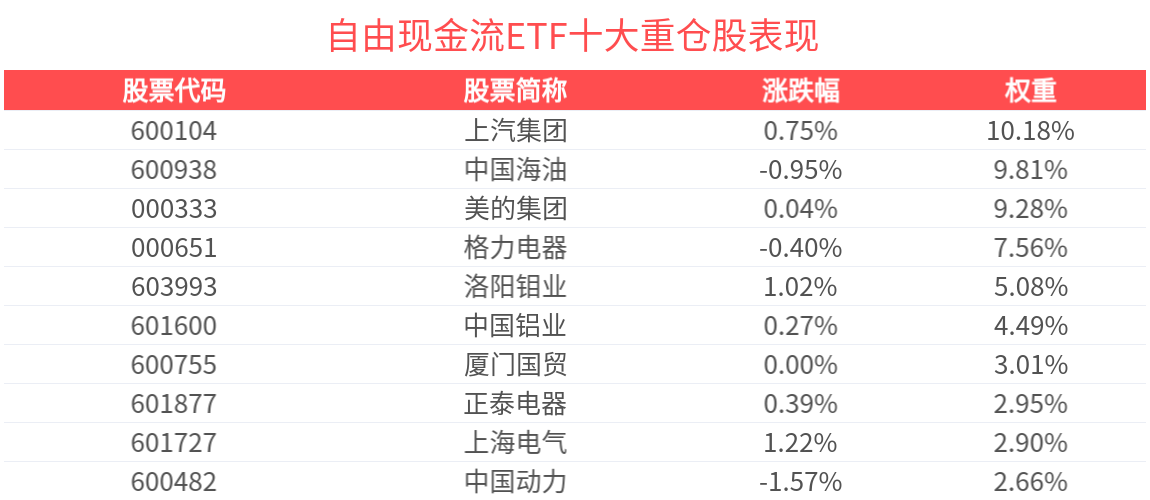
Group 1 - The Guozheng Free Cash Flow Index increased by 0.04%, with Weichai Heavy Machinery hitting the daily limit, and companies like Longi Machinery, Huaren Health, Jinyi Industrial, and Tailong Co. also seeing gains [1] - The Free Cash Flow ETF (159201) rose by 0.19%, with the latest price at 1.07 yuan, and it has accumulated a 2.10% increase over the past week as of August 8, 2025 [1] - The average daily trading volume of the Free Cash Flow ETF reached 328 million yuan over the past week, ranking first among comparable funds [1] Group 2 - As of July 31, 2025, the top ten weighted stocks in the Guozheng Free Cash Flow Index accounted for 57.66% of the index, including SAIC Motor, China National Offshore Oil Corporation, Midea Group, and Gree Electric Appliances [2] - The top ten stocks by weight are: - SAIC Motor: 10.18% - China National Offshore Oil Corporation: 9.81% - Midea Group: 9.28% - Gree Electric Appliances: 7.56% - Luoyang Molybdenum: 5.08% - China Aluminum: 4.49% - Xiamen International Trade: 3.01% - Chint Electric: 2.95% - Shanghai Electric: 2.90% - China Power: 2.66% [4] Group 3 - The current market rally is supported by various sources of incremental capital, including insurance, pension funds, public funds, private equity, and retail investors, indicating a recovery in consumer and investment sentiment [1] - The balance of margin trading has reached a ten-year high, reflecting a rising risk appetite among individual investors [1] - The shift in asset allocation towards equity assets is being driven by a "slow bull" market mentality, with increased retail investor participation expected to be a key driver for the A-share market in the second half of the year [1]
自由现金流指数基金大爆发 七月以来已成立四十一只
Zheng Quan Shi Bao· 2025-08-10 17:37
Core Viewpoint - The market for free cash flow index funds is experiencing a significant surge in new fund establishments, with a total of 41 funds launched since July, bringing the total number of such funds to 73 as of August 8 [1][2]. Fund Establishment Trends - As of August 8, 2023, 41 new free cash flow index funds have been established since July, marking the highest establishment peak since their inception [1][2]. - The first free cash flow index fund was established in February 2023, with a smaller peak of 19 funds in April. The number of new funds decreased in May and June but surged to 32 in July [2]. - The variety of indices tracked by these funds has also expanded, now including six different indices, such as the CSI 500 Free Cash Flow Index [2]. Fund Size and Performance - Among the 73 free cash flow index funds, 12 have raised over 1 billion yuan, with seven of these being established since July. Notable funds include the Huabao CSI 300 Free Cash Flow ETF with 1.689 billion yuan and the Jiashi National Index Free Cash Flow ETF with 1.436 billion yuan [3]. - The average return of free cash flow index funds that have been operating for over three months is approximately 4.05%, with several funds exceeding 10% returns [5]. Market Dynamics and Investment Strategy - The free cash flow index emphasizes the cash flow attributes of constituent stocks, focusing on companies that generate substantial cash flow after necessary expenses, thus avoiding high-leverage financial risks [4]. - Over 35 public funds have already entered the free cash flow index fund space, indicating a growing trend in this investment strategy [4]. - The current inflow of funds into free cash flow ETFs has not significantly impacted the prices of underlying stocks, suggesting that there is still room for market allocation without causing excessive trading or price distortion [6][7].
中证全指自由现金流指数,投资价值如何?|第399期直播回放
银行螺丝钉· 2025-08-08 14:05
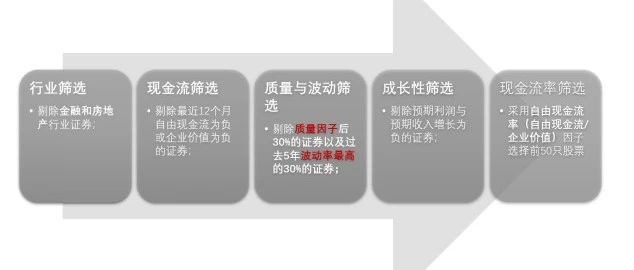
Group 1 - The core viewpoint of the article discusses the significance and characteristics of the Free Cash Flow Index, its historical performance, and its current valuation compared to other indices like dividends and value indices [1][27][35] - The article outlines four common types of indices in the A-share market: broad-based indices, strategy indices, industry indices, and thematic indices [5][6][7][8][9] - It highlights six major strategy indices, including Free Cash Flow, which is closely related to the investment philosophies of Warren Buffett and Benjamin Graham [10][11][12][13][14] Group 2 - The Free Cash Flow Index is defined as the cash available to a company after it has paid for its operating expenses and capital expenditures, emphasizing its importance in assessing a company's financial health [18][20] - The Free Cash Flow Rate is introduced as a key metric, calculated as Free Cash Flow divided by Enterprise Value, which helps in selecting stocks with the highest Free Cash Flow Rate [21][22][23] - The article differentiates the Free Cash Flow Index from dividend and value indices, noting that it includes companies with strong cash flows that may not pay high dividends, thus providing a broader investment opportunity [24][25][26] Group 3 - The article lists four significant Free Cash Flow indices currently in the market, including the FTSE China A-Share Free Cash Flow Focus Index and the CSI 800 Free Cash Flow Index [27][28] - It provides detailed information about the CSI All Index Free Cash Flow Index, including its launch date, weighted methodology, and selection rules, which exclude financial and real estate stocks [29][30] - The industry distribution and top holdings of the CSI All Index Free Cash Flow Index are presented, showing a focus on sectors like industrials and materials, contrasting with the higher financial sector representation in dividend indices [32][34] Group 4 - Historical performance data indicates that the CSI All Index Free Cash Flow Index achieved an annualized return of 14.12% from December 31, 2013, to August 6, 2025, significantly outperforming the broader index [35][51] - The article discusses the valuation metrics of the Free Cash Flow Index, noting that it is essential to consider multiple factors when evaluating its performance [39][40] - The article concludes with insights on the potential of the Free Cash Flow Index as a valuable investment strategy, particularly in conjunction with dividend and value indices that have a higher financial sector exposure [54][55]

Sabre Stock Plunges 36% on Q2 Loss and Revenue Decline
ZACKS· 2025-08-08 12:16
Core Insights - Sabre Corporation (SABR) shares fell nearly 35.7% following weaker-than-expected Q2 2025 results, missing all prior management guidance [1][9] - The company reported an adjusted loss of 2 cents per share, compared to a Zacks Consensus Estimate of break-even earnings, although the loss narrowed from 6 cents in the previous year [1][2] Financial Performance - Sabre's Q2 2025 revenues were $687.2 million, missing the Zacks Consensus Estimate of $705.3 million and reflecting a 1% year-over-year decline [2][9] - Distribution revenues decreased by 1% to $546 million, impacted by lower air bookings and a slight decrease in average booking fees, partially offset by increased hotel distribution bookings [3] - IT Solutions revenues were $141 million, down 2% year-over-year, attributed to customer demigrations, though offset by increased license fee revenues [4] - Normalized adjusted EBITDA was $127.2 million, improving from $120 million year-over-year but falling short of the previous guidance of approximately $140 million [5] Cash Flow and Balance Sheet - As of the end of June, Sabre had cash, cash equivalents, and restricted cash totaling $447 million, down from $672 million in the previous quarter [6] - Cash used in operating activities during Q2 amounted to $218 million, resulting in negative free cash flow of $240 million [6] Updated Guidance - For FY25, Sabre now expects pro-forma revenues to grow in the low single-digit percentage range, a reduction from earlier expectations of double-digit growth [7] - Pro-forma adjusted EBITDA is now forecasted between $530 million and $570 million, down from approximately $630 million previously [8] - The company anticipates generating pro-forma free cash flow in the range of $100-$140 million, a decrease from earlier forecasts of over $200 million [8] Q3 Outlook - Sabre has initiated guidance for Q3, expecting pro-forma revenue growth in the low-to-mid single-digit percentage range and pro-forma adjusted EBITDA between $140 million and $150 million [10]


各现金流指数差异在哪?哪种指数与传统资产相关性更低?——A股自由现金流指数比较
申万宏源金工· 2025-08-08 08:03
Group 1 - The core viewpoint of the article emphasizes that free cash flow has become a high-potential investment direction in the domestic ETF market, with significant growth observed in overseas markets [1] - The development of cash flow ETFs in overseas markets is mature, with the largest US free cash flow ETF, COWZ, exceeding $20 billion in size as of April 25, 2025 [1][5] - Various index compilation schemes for overseas free cash flow products exist, with a focus on selecting stocks with the highest free cash flow yield [3][4] Group 2 - Domestic cash flow strategies are expected to be effective in the long term, as companies shift from growth-oriented to cash flow-focused management strategies [7] - The performance of large-cap stocks has outperformed small-cap stocks in the US cash flow products, with COWZ showing a widening lead over CALF since 2024 [6] - The domestic cash flow index has seen steady growth since 2014, with a focus on companies with high cash flow returns, leading to significant excess returns compared to broad market indices [7] Group 3 - The FTSE China A-Share Free Cash Flow Focus Index has a larger average market capitalization compared to other domestic cash flow indices, indicating a focus on large and mid-cap stocks [19][21] - The FTSE cash flow index has a higher dividend yield and lower valuation compared to its peers, making it an attractive investment option [33] - The FTSE cash flow index has shown a strong risk-return profile, outperforming traditional dividend indices since 2014 [36][37] Group 4 - The FTSE cash flow index benefits from a dual filtering approach that includes quality and low volatility factors, enhancing its risk management and long-term value [50][55] - The index's composition is heavily weighted towards consumer and cyclical sectors, with significant allocations in household appliances, non-ferrous metals, and food and beverage industries [26][27] - The index has a high overlap with major broad-based indices, which positions it well to benefit from future market management policies [31][32]