
AIoT

Search documents
天宝集团净利同比增长20.4%至211.7百万港元,稳健派息率30.2% 推出AI算力电源及拓展高端智能控制器,抢占AIoT时代商机
Cai Fu Zai Xian· 2025-08-22 01:34
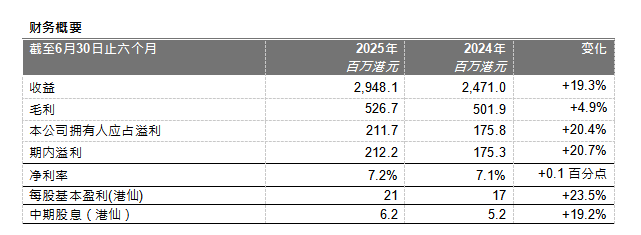
Core Viewpoint - The company reported a significant increase in revenue and profit for the first half of 2025, driven by growth in industrial power and new energy sectors, despite challenges from global inflation and geopolitical tensions [1][3]. Financial Performance - Revenue for the six months ended June 30, 2025, reached HKD 2,948.1 million, a year-on-year increase of 19.3% [1][3]. - Gross profit rose to HKD 526.7 million, reflecting a 4.9% increase, while the net profit margin improved slightly to 7.2% [1][3]. - Profit attributable to shareholders increased by 20.4% to HKD 211.7 million, with basic earnings per share rising 23.5% to HKD 0.21 [1][3]. - The interim dividend was declared at HKD 0.062 per share, up 19.2% from the previous year [1][3]. Business Highlights - The company is capitalizing on the growing demand for high-end intelligent controllers, particularly in the context of rapid AI development [4]. - New energy business revenue grew by 33.6%, contributing 19.1% to total revenue, driven by storage and automotive electronic products [5]. - The company is expanding its product offerings in AI power supply solutions, including a new 3,500W power supply for servers [7]. Strategic Initiatives - The company has diversified its market presence across Southeast Asia, Europe, North America, and China to mitigate risks associated with reliance on a single market [2][3]. - It is actively involved in the development of renewable energy infrastructure in Southeast Asia, including projects related to electric vehicle charging [5][9]. - The company is enhancing its global production capabilities, with new facilities in Vietnam and Mexico, to ensure flexible and resilient operations [8][10]. Future Outlook - The company aims to leverage trends in AI and green energy to drive future growth, focusing on energy storage solutions and electric vehicle charging equipment [9][10]. - The Southeast Asian two-wheeler electric vehicle market is projected to grow significantly, providing opportunities for the company to expand its market share [9].

中报观察 亏损收窄 小米汽车要盈利了吗?
Jin Rong Jie· 2025-08-21 19:25
Core Viewpoint - Xiaomi Group reported strong Q2 results, with significant revenue and profit growth despite market challenges [1][2][3] Financial Performance - Q2 total revenue reached 1159.56 billion RMB, a year-on-year increase of 30.5% [1] - Adjusted net profit for Q2 was 108 billion RMB, up 75.4% year-on-year [1] - For the first half of the year, total revenue was 2272.49 billion RMB, growing 38.2% year-on-year, with adjusted net profit of 215.06 billion RMB, a 69.8% increase [1] Business Segments - Smartphone revenue in Q2 was 455 billion RMB, accounting for 39.3% of total revenue, with global smartphone shipments of 42.4 million units, a 0.6% year-on-year increase [1][2] - IoT and lifestyle products revenue reached 387 billion RMB, a 44.7% year-on-year increase, with a gross margin of 22.5% [3][4] - Smart home appliances saw a revenue increase of 66.2%, with air conditioner shipments exceeding 5.4 million units, a 60% year-on-year rise [4] Market Position - Xiaomi ranked first in Southeast Asia with a market share of 18.9% and second in Europe with a 23.4% market share [2] - In the high-end smartphone segment in mainland China, Xiaomi's sales accounted for 27.6%, a 5.5 percentage point increase year-on-year [2] Automotive Business - Revenue from the smart electric vehicle and AI innovation segment was 213 billion RMB, with automotive revenue at 206 billion RMB [5] - Operating loss for the automotive segment was reduced to 3 billion RMB from 11.2 billion RMB year-on-year [6] - In Q2, Xiaomi delivered 81,302 vehicles, a 7.16% increase from the previous quarter [6][7] Future Outlook - Xiaomi aims to achieve profitability in its automotive business in the second half of the year, with expectations of surpassing competitors in the electric vehicle market [7][8] - The company plans to continue its transformation focusing on technology, brand enhancement, global market expansion, and ecosystem development [8]

万物云(2602.HK):高股息回馈股东 科技应用提效降费
Ge Long Hui· 2025-08-21 19:25
Group 1 - The company proposed a mid-term dividend of 1.1 billion yuan, with a per-share dividend of 0.951 yuan, resulting in a dividend yield of 4.3% for the first half of 2025 [1] - Revenue for the first half of 2025 reached 18.14 billion yuan, a year-on-year increase of 3.1%, while gross profit was 2.49 billion yuan, up 3.8% [1] - The company's profit for the first half of 2025 was 840 million yuan, a 5.4% increase year-on-year, with core net profit rising by 10.8% to 1.32 billion yuan [1] Group 2 - The community space residential consumption service segment generated 11.32 billion yuan in revenue, a year-on-year increase of 11.8%, accounting for 62.4% of total revenue [2] - The commercial and urban space comprehensive service segment saw a revenue decline of 5.2% to 5.75 billion yuan, primarily due to the company's strategic decision to reduce developer-related business [2] - The AIoT and BPaaS solution service segment experienced a significant revenue drop of 23.6% to 1.06 billion yuan, attributed to external pressures and increased market competition [2] Group 3 - The company has completed efficiency upgrades for 300 butterfly cities, covering 1,688 projects, which is 38.3% of the total managed projects, resulting in an efficiency gain of 230 million yuan [3] - The company acquired 114 residential property projects in the stock market, generating an annualized saturated income of 670 million yuan, a year-on-year increase of 31.5% [3] - Administrative expenses for the first half of 2025 were 890 million yuan, reflecting an 8.0% reduction due to efficiency improvements driven by AI applications [3]
小米集团-W(01810):2025H1业绩点评:汽车毛利率再创新高,手机高端化持续推进
Soochow Securities· 2025-08-21 13:51
Investment Rating - The report maintains a "Buy" rating for Xiaomi Group-W (01810.HK) [1] Core Views - The company reported a revenue of 115.96 billion yuan in Q2 2025, representing a year-on-year increase of 30.5% and a quarter-on-quarter increase of 4.2%. The adjusted net profit was 10.83 billion yuan, up 75.4% year-on-year and 1.5% quarter-on-quarter, with a gross margin of 22.5% [8] - The automotive segment achieved a record high gross margin of 26.4% in Q2 2025, with revenue of 21.26 billion yuan, a quarter-on-quarter increase of 14.4%. The company aims to achieve profitability in its automotive business by the second half of 2025 [8] - The smartphone market share continues to rise, with Q2 2025 smartphone revenue at 45.52 billion yuan, a year-on-year decrease of 2.1%. The global market share increased by 0.6 percentage points to 14.7% [8] - The IoT segment generated revenue of 38.71 billion yuan in Q2 2025, with a gross margin of 22.5%. The company has expanded its new retail stores to 17,000, with approximately 200 stores overseas [8] Financial Summary - The total revenue forecast for Xiaomi Group is projected to reach 491.83 billion yuan in 2025, with a year-on-year growth of 34.41% [1] - The net profit attributable to the parent company is expected to be 39.60 billion yuan in 2025, reflecting a year-on-year increase of 67.40% [1] - The earnings per share (EPS) is forecasted to be 1.52 yuan in 2025, with a price-to-earnings (P/E) ratio of 32.11 based on the closing price on August 20, 2025 [1]
亿道信息2025年上半年归母净利润增长96.02% AI驱动多业务亮点纷呈
Zheng Quan Shi Bao Wang· 2025-08-21 12:55
Core Insights - Company achieved a robust performance in a complex market environment, with significant revenue and profit growth in the first half of 2025 [1] - Revenue reached 1.52 billion yuan, a year-on-year increase of 19.24%, while net profit attributable to shareholders was 11.41 million yuan, up 96.02% [1] - The company is focusing on three main areas: smart hardware, rugged smart terminals, and AIoT, driven by technological innovation [1][3] Revenue Breakdown - Smart hardware business generated 1.08 billion yuan in revenue, reflecting a growth of 16.27%, serving as a core engine for the company's performance [1][2] - Rugged smart terminal business saw revenue of 173 million yuan, a year-on-year increase of 24.71%, with the "ONERugged" brand achieving 29.93 million yuan in revenue, up 69.35% [3] - AIoT business exhibited strong growth with revenue increasing by 65.94%, focusing on smart health, smart control, and mobile screens [3] Strategic Initiatives - The company is enhancing its sales network and optimizing customer structure to deepen market coverage [2] - It is advancing its "AI+" strategy by integrating cutting-edge technologies into product innovation, significantly increasing product value [2] - The company is diversifying its product offerings to meet various scene demands across user lifestyles and work environments [2] Future Prospects - The XR business, through its subsidiary, is focusing on XR and AI wearable products, with a strong order backlog of approximately 140 million yuan [4] - The company is transitioning its AI glasses from the R&D phase to mass delivery, indicating positive momentum in product development [4]
A股民营上市公司2025年上半年业绩亮眼 八成实现盈利
Huan Qiu Wang· 2025-08-21 02:12
Group 1 - As of August 20, 623 private enterprises in the A-share market have disclosed their semi-annual performance reports for 2025, with 528 companies achieving profitability, accounting for over 80% [1] - Among the profitable private enterprises, leading companies like CATL, Industrial Fulian, WuXi AppTec, and Great Wall Motors reported net profits exceeding 5 billion yuan in the first half of the year, with CATL leading at 304.85 billion yuan in net profit, a year-on-year increase of 33.33% [3] - The electronic, basic chemicals, and machinery equipment industries are the main profit drivers, with 67, 66, and 62 companies respectively achieving profitability [3] Group 2 - In the 318 companies with positive performance growth, small and medium-sized enterprises showed remarkable results, with 59 companies experiencing net profit growth exceeding 100%, and 17 companies with a market value below 5 billion yuan achieving profit doubling [3] - Continuous R&D investment and innovation capability are identified as key drivers for performance growth, with 125 companies having R&D expenditure accounting for over 5% of revenue, and 92 companies increasing their R&D intensity compared to the previous year [3] Group 3 - Seizing opportunities in emerging industries has become a significant engine for performance growth among private enterprises, with companies like Zhenlei Technology capitalizing on commercial aerospace and low-altitude economy, transitioning products from experimental to mass delivery [4] - Industrial Fulian and Weicai Technology are benefiting from the global surge in computing power demand, while Rockchip has seen a 191.61% year-on-year increase in net profit due to its AIoT product line's wide application in automotive electronics and robotics [4]





小米单季营收再破千亿净利超百亿 汽车交付超30万台下半年有望盈利
Chang Jiang Shang Bao· 2025-08-20 23:44
Core Viewpoint - Xiaomi Group has reported record-high financial results for Q2 2025, showcasing significant growth in revenue and profit across its main business segments [2][4][5]. Financial Performance - In Q2 2025, Xiaomi achieved revenue of 1159.56 billion yuan, a year-on-year increase of 30.45%, marking the third consecutive quarter with revenue exceeding 100 billion yuan [4][6]. - The adjusted net profit for Q2 2025 was 108.31 billion yuan, up 75.4% year-on-year, with the company surpassing 100 billion yuan in profit for two consecutive quarters [4][6]. - For the first half of 2025, Xiaomi's total revenue reached 2272.49 billion yuan, reflecting a 38.2% year-on-year growth, while the adjusted net profit was 215.06 billion yuan, up 69.80% [6]. Business Segments Performance - Xiaomi's smartphone and AIoT business generated revenue of 947 billion yuan in Q2 2025, a 14.8% increase, with smartphone revenue at 455 billion yuan and IoT and lifestyle product revenue at 387 billion yuan, which grew by 44.7% [7]. - Smartphone shipments reached 42.4 million units in Q2 2025, marking an 8-quarter streak of year-on-year growth and maintaining a global market share of 14.7% [8]. - The IoT segment saw significant growth, with smart home appliance revenue driven by a 66.2% increase in smart appliance sales [7][8]. Automotive Business - Xiaomi delivered 81,300 vehicles in Q2 2025, with total deliveries exceeding 300,000 units by July 10 [10]. - The automotive business reported a reduced loss of 300 million yuan in Q2, with expectations of profitability in the second half of the year [10][11]. R&D Investment - Xiaomi increased its R&D investment to 78 billion yuan in Q2 2025, a 41% year-on-year rise, with a total of approximately 22,600 R&D personnel as of June 30, 2025 [11][12]. - The company has committed over 30 billion yuan to innovative businesses, including electric vehicles and AI, from 2022 to mid-2025 [11]. Brand Recognition - Xiaomi's global brand influence continues to grow, ranking second in the "2025 Kantar BrandZ Top 50 Globalization Brands" and improving its position in the Fortune Global 500 list to 297th, up 100 places from 2024 [12].
【招商电子】小米集团:Q2业绩再创新高,关注手机大盘及汽车产能释放
招商电子· 2025-08-20 12:14
Core Viewpoint - The company reported record high revenue and adjusted net profit for Q2 2025, driven by strong performance in various business segments, particularly in IoT and automotive sectors [1][2][3]. Automotive - Q2 2025 revenue from smart electric vehicles and AI-related businesses reached 213 billion, with a sequential increase of 14.4%, while operating losses narrowed from 5 billion to 3 billion [2] - The gross margin improved to 26.4%, attributed to lower core component costs and increased deliveries of the SU7 Ultra model [2] - The company plans to accelerate production capacity in the second half of 2025 and aims to enter the European market by 2027, enhancing its global brand influence [2] IoT - Q2 2025 IoT business revenue was 387 billion, marking a year-on-year growth of 44.7% and a sequential increase of 19.7%, driven by strong sales in smart home appliances and wearables [3] - The gross margin for IoT was 22.5%, with a year-on-year increase of 2.8 percentage points, reflecting improved product mix [3] - The company is expanding its retail strategy, increasing the number of offline stores in mainland China from approximately 16,000 to over 17,000 [3] Mobile Phones - Q2 2025 mobile phone revenue was 455 billion, showing a year-on-year decline of 2.1% and a sequential decline of 10.1% [4] - The average selling price (ASP) decreased to 1,073, with a gross margin of 11.5%, impacted by fluctuations in component prices [4] - Despite a challenging domestic market, the company achieved a 3.6% year-on-year increase in its smartphone sales [5] Internet Services - Q2 2025 internet services revenue was 91 billion, reflecting a year-on-year growth of 10.1% [6] - The gross margin for internet services was 75.4%, with a slight decline compared to the previous year [6] - The global monthly active user count reached 730 million, marking a year-on-year increase of 8.2% [6] Investment Outlook - The company is positioned as a leading player in the global smartphone market and the largest AIoT hardware platform, with positive long-term growth prospects across its business segments [6] - The automotive sector is expected to benefit from the expansion of its vehicle lineup and ecosystem synergies, aiming to rank among the top five global automakers by 2025-2027 [6]

小米集团-W(01810):Q2业绩再创新高,关注手机大盘及汽车产能释放
CMS· 2025-08-20 12:05
Investment Rating - The report maintains a "Strong Buy" investment rating for Xiaomi Group [8] Core Views - Xiaomi Group achieved record high revenue and adjusted net profit in Q2 2025, with revenue reaching 116 billion CNY, a year-on-year increase of 30.5% and a quarter-on-quarter increase of 4.2% [5][8] - The company is focusing on its "New Decade Goal," with significant investments in core technologies and a record high of 78 billion CNY in R&D spending in Q2 2025, reflecting a year-on-year increase of 41.2% [5][8] - The automotive segment is expected to see accelerated capacity release in the second half of 2025, with a narrowing of operating losses from 5 billion CNY to 3 billion CNY in Q2 2025 [5][8] - The IoT business continues to show strong growth, with revenue of 387 billion CNY in Q2 2025, a year-on-year increase of 44.7% [5][8] - The smartphone segment experienced a slight decline in revenue, with Q2 2025 revenue at 455 billion CNY, a year-on-year decrease of 2.1% [5][8] - The internet services segment reported steady growth, with revenue of 91 billion CNY in Q2 2025, a year-on-year increase of 10.1% [6][8] Summary by Sections Financial Performance - Q2 2025 total revenue was 116 billion CNY, with a gross margin of 22.5% and an adjusted net profit of 108 billion CNY, marking a year-on-year increase of 75.4% [5][8] - The company expects total revenue for 2025 to reach 489.9 billion CNY, with adjusted net profit projected at 43.1 billion CNY [8] Automotive Segment - Revenue from smart electric vehicles and AI-related businesses reached 213 billion CNY in Q2 2025, with a gross margin of 26.4% [5][8] - The company plans to enter the European market in 2027, which is expected to enhance its global brand influence [5][8] IoT Segment - The IoT business achieved a record revenue of 387 billion CNY in Q2 2025, driven by strong sales in smart home appliances [5][8] - The gross margin for IoT was 22.5%, reflecting improvements in product mix [5][8] Smartphone Segment - The smartphone business reported revenue of 455 billion CNY in Q2 2025, with a gross margin of 11.5% [5][8] - The company adjusted its annual shipment target to 175 million units, focusing on high-end and global market expansion [5][8] Internet Services - Internet services revenue reached 91 billion CNY in Q2 2025, with a gross margin of 75.4% [6][8] - The global monthly active user count reached 730 million, marking a year-on-year increase of 8.2% [6][8]
小米:预计全年整体收入增长超30% 汽车业务有望下半年实现单季盈利
Zhong Zheng Wang· 2025-08-20 11:12
Core Insights - Xiaomi Group reported a total revenue of 116 billion yuan for Q2 2025, representing a year-on-year growth of 30.5% [1] - The revenue from the "mobile × AIoT" segment was 94.7 billion yuan, up 14.8% year-on-year, while the revenue from "smart electric vehicles and AI innovation businesses" reached 21.3 billion yuan [1] - Operating profit for Q2 2025 was 13.4 billion yuan, a significant increase of 128.2% year-on-year, and adjusted net profit grew by 75.4% to 10.8 billion yuan [1] - For the first half of 2025, total revenue reached 227.2 billion yuan, up 38.2% year-on-year, with operating profit nearing 26.6 billion yuan, a 177.5% increase [1] - The company aims for overall revenue growth of over 30% for the full year 2025 and anticipates that its electric vehicle segment will achieve quarterly profitability in the second half of the year [1] Segment Performance - In the smart electric vehicle sector, Xiaomi's SU7 Ultra has sold over 10,000 units within four months of its launch, with Q2 revenue from smart electric vehicles reaching 20.6 billion yuan, a year-on-year increase of 230.3% [2] - The gross margin for the smart electric vehicle segment improved from 15.4% in the previous year to 26.4% [2] - Despite significant investments exceeding 30 billion yuan in innovative businesses from 2022 to the first half of 2025, the new business segment still reported substantial losses, although Q2 losses narrowed to 300 million yuan [2] - In the home appliance sector, Xiaomi experienced both volume and price increases, with revenue from major appliances growing by 66% and air conditioning average selling price (ASP) increasing by approximately 10% [2]