
储能

Search documents
碳酸锂行情“V型反转”2026年能否继续“狂飙”?
Zhong Guo Jing Ying Bao· 2026-01-12 08:13
Group 1: Market Trends - The lithium carbonate market is expected to experience a rebound in 2025, with prices initially fluctuating around 75,200 CNY/ton and dropping to a low of 59,000 CNY/ton by June, before surging to over 130,000 CNY/ton by December, marking an increase of over 120% from the low [1][2] - The price trajectory of lithium carbonate in 2025 is characterized by a typical V-shaped curve, with a significant drop in early months followed by a strong recovery in the latter half of the year [1][2] - By December 2025, the price of lithium carbonate futures reached 134,500 CNY/ton, despite a slight pullback afterward, indicating a robust market recovery [2] Group 2: Industry Dynamics - The demand for lithium carbonate is supported by the growth in the energy storage market and the increasing orders from battery manufacturers, which have led to a reduction in market inventory [3][4] - The new energy storage capacity in China has exceeded 100 million kilowatts, representing a growth of over 30 times compared to the end of the 13th Five-Year Plan, accounting for over 40% of the global total [4] - The performance of lithium battery companies has improved significantly, with companies like Tianqi Lithium and Ganfeng Lithium seeing stock price increases of over 160% and 173% respectively from their lows in 2025 [3] Group 3: Future Outlook - The lithium market is expected to face uncertainties in 2026, with potential price fluctuations influenced by supply and demand dynamics, as well as the impact of futures trading [6][7] - The global demand for lithium is projected to reach 2 million tons of lithium carbonate equivalent by 2026, driven by the growth in electric vehicles and energy storage sectors [7] - The development of alternative technologies, such as sodium batteries, may introduce new variables into the market, potentially exerting downward pressure on lithium carbonate prices [9]




指数又双叒叕上涨了!市场躁动期开始,还有哪些投资机会?
Sou Hu Cai Jing· 2026-01-12 08:07
Group 1 - The article emphasizes three main investment themes: 1) Economic growth in AI technology, with a focus on domestic opportunities in computing power, optical modules, and cloud computing infrastructure, as well as applications in robotics, consumer electronics, intelligent driving, and software [1] - 2) External demand opportunities, particularly in sectors like home appliances, engineering machinery, commercial buses, power grid equipment, and non-ferrous metals, which are expected to benefit from overseas expansion [1] - 3) Cyclical reversal, suggesting attention to sectors like chemicals, aquaculture, and new energy that are nearing improvement points in supply and demand or receiving policy support [1] Group 2 - The trend of share buybacks and increases in holdings by listed companies is expected to continue until 2026, with companies like Dongcheng Pharmaceutical and Century Huatong announcing buyback plans, reinforcing confidence in company valuations [3] - The domestic tourism market is projected to perform well in 2026, with a significant increase in travel during the New Year holiday, indicating a positive outlook for the tourism sector [3] Group 3 - Copper prices are experiencing the largest annual increase since 2009, with a 44% rise this year, driven by expectations of supply shortages due to increased demand for electrification [5] - The strong performance of copper is expected to continue into 2026, supported by macroeconomic conditions and supply-demand dynamics [5] Group 4 - The A-share market is showing a strong upward trend, attracting external capital, with expectations of a structural market rally supported by policy and industry trends [11] - The focus is on technology leaders with performance delivery capabilities and cyclical sectors benefiting from price recovery expectations [11]


开年首周 两融资金持续入场!
Zheng Quan Shi Bao· 2026-01-12 07:52
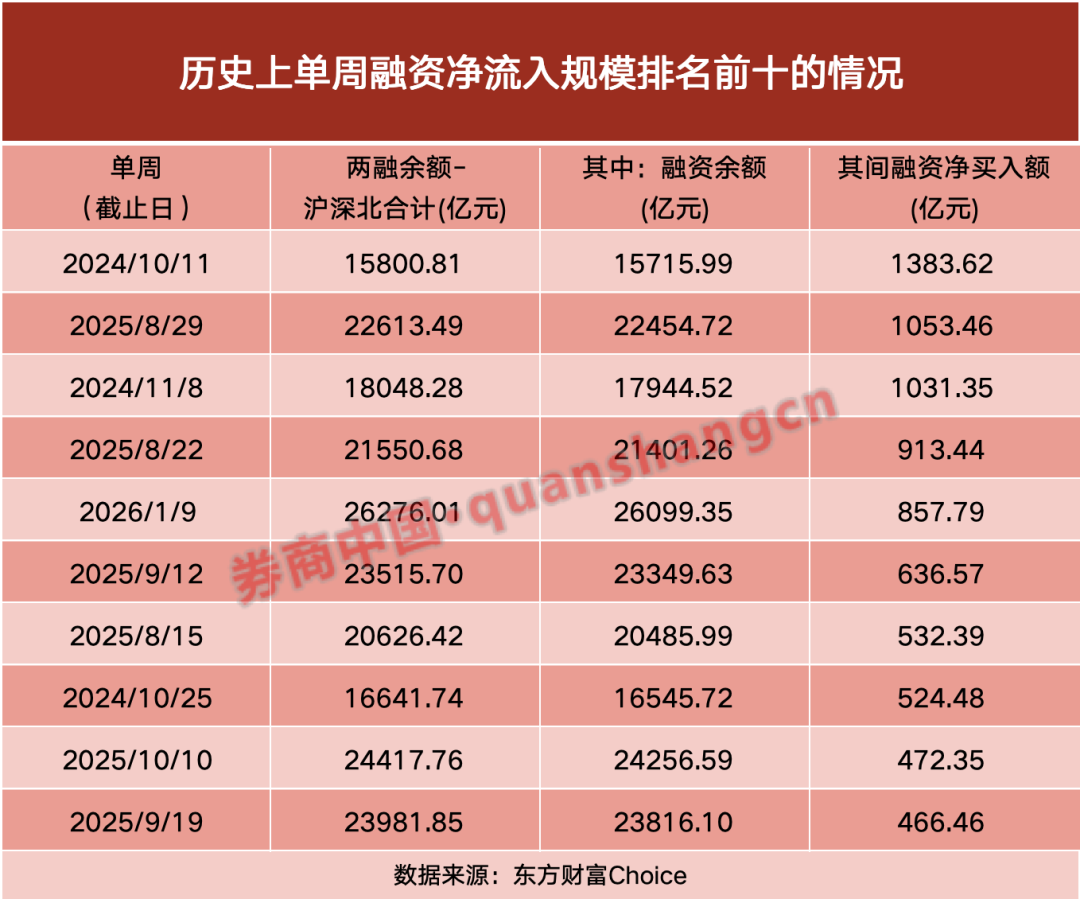
Core Viewpoint - The A-share market experienced a strong start in the first week of 2026, with significant inflows of leveraged funds, indicating a positive market sentiment and potential for continued investment activity [1][3]. Group 1: Market Performance - In the first week of 2026, the A-share market saw a net inflow of financing funds amounting to 857.79 billion yuan, ranking as the fifth largest weekly net inflow in A-share history [1][3]. - The total trading volume in the A-share market exceeded 30 trillion yuan on January 9, 2026, reflecting heightened market activity and investor interest [3]. Group 2: Fund Inflows - The first four days of the week recorded daily net inflows exceeding 100 billion yuan, with figures of 192.66 billion yuan, 188.87 billion yuan, 249.02 billion yuan, and 159.44 billion yuan, indicating a strong acceleration of fund entry [3]. - The electronic sector attracted the most attention from financing clients, with a net inflow of 158.12 billion yuan, significantly higher than other sectors [8]. - Non-bank financials and the computer sector also received substantial net inflows, each exceeding 60 billion yuan [9]. Group 3: Investor Behavior - Many existing clients increased their positions, primarily focusing on short-term operations and chasing market hotspots, while new account openings were not yet evident [6]. - Over 70% of the stocks saw net buying from financing clients, with seven stocks exceeding 1 billion yuan in net buying, including XW Communication and China Ping An [10]. Group 4: Future Market Outlook - Analysts suggest that the current market momentum is supported by multiple liquidity factors, including significant inflows into A500 ETF and a strengthening yuan, which reflects international confidence in China [12]. - The spring market is expected to have further room for growth, with technology sectors likely to remain a long-term focus, while value sectors may also present opportunities [12][13].
又一储能公司冲刺IPO!
鑫椤锂电· 2026-01-12 07:37
关注公众号,点击公众号主页右上角" ··· ",设置星标 "⭐" ,关注 鑫椤锂电 资讯~ 本文来源:储能前沿 1月9日, 深圳市远信储能技术股份有限公司正式向港交所主板递交上市申请 ,由招银国际担任独家保荐人。 资料显示, 远信储能创立于2019年,专注于新型电力系统与综合能源方案的开发,以及可持续的新能源解决方案和可靠的储能产品的研发和推广应用。 远信储能的业务覆盖新能源发电、风光柴储一体化、微电网、电力储能以及工商业和家庭储能等多元应用场景,其解决方案包括大型储能、工商业储能和 构网型储能。 2023年、2024年及2025年前三季度,远信储能分别实现收入4.35亿元、11.44亿元及8.81亿元;同期利润为4074.1万元、9626.5万元、7089.2万 元。 1月9日,远信储能还宣布完成数亿元人民币股权融资。本轮融资由知名投资机构同创伟业领投,正海资本、卓源蓝图等机构跟投。 鑫椤报告预售: 2025-2029年全球储能市场运行趋势及竞争策略研究报告 根据弗若斯特沙利文的资料, 远信储能于2025年前三季度新增独立储能装机容量1.3GWh , 在全球储能资产全生命周期解决方案提供商中排名第一。 20 ...
新中港涨9.58%,成交额4.09亿元,近3日主力净流入4670.19万
Xin Lang Cai Jing· 2026-01-12 07:33
Core Viewpoint - The company, Zhejiang Xinhong Port Thermal Power Co., Ltd., is focusing on becoming a regional comprehensive energy supply center and carbon neutrality center, with significant investments in carbon reduction technologies and energy efficiency improvements [2]. Group 1: Company Developments - The company aims to enhance its carbon reduction efforts through efficiency improvements and coupling reduction strategies, including the production of RDF and the modification of biomass fuel boilers [2]. - As of September 30, the company reported a revenue of 529 million yuan, a year-on-year decrease of 18.48%, while the net profit attributable to shareholders increased by 2.51% to 91.83 million yuan [8]. - The company has a total market capitalization of 4.078 billion yuan, with a trading volume of 409 million yuan and a turnover rate of 10.21% on January 12 [1]. Group 2: Financial Analysis - The company has seen a net inflow of 29.51 million yuan from major investors, with a ranking of 9 out of 102 in its industry [4]. - The average trading cost of the company's shares is 9.23 yuan, with the stock price approaching a resistance level of 10.22 yuan, indicating potential for upward movement if this level is surpassed [6]. - The company has distributed a total of 344 million yuan in dividends since its A-share listing, with 204 million yuan distributed over the past three years [9]. Group 3: Industry Context - The company operates in the public utility sector, specifically in power and thermal services, with its main business revenue derived from combined heat and power (95.17%), followed by energy storage (4.73%) [7]. - The company is involved in several key industry concepts, including carbon neutrality, energy storage, and small-cap investments [7].

开年首周,两融资金持续入场!
Zheng Quan Shi Bao· 2026-01-12 07:30
Group 1 - The A-share market experienced a strong start in the first week of 2026, with a net inflow of margin financing reaching 857.79 billion yuan, ranking fifth in A-share history for single-week net inflows [1][2] - The first four days of the week saw daily net inflows exceeding 100 billion yuan, indicating a rapid influx of funds, although the fifth day showed a significant slowdown with a net inflow of only 67.81 billion yuan [2] - The electronic industry was particularly favored by margin investors, attracting a net inflow of 158.12 billion yuan, significantly higher than other sectors [5][6] Group 2 - Other sectors that received notable net inflows included non-bank financials and computers, each exceeding 60 billion yuan in net buying [6] - Over 70% of margin trading stocks experienced net buying, with seven stocks seeing net inflows exceeding 10 billion yuan, including XW Communication and China Ping An [7] - Analysts suggest that the strong performance in the A-share market is driven by multiple liquidity factors, including abnormal inflows into A500 ETF and the continuous appreciation of the yuan, reflecting international capital's restored confidence in China [8][9]
26年全国长协电价分析与展望
2026-01-12 01:41
Summary of Key Points from the Conference Call Industry Overview - The conference call discusses the electricity pricing landscape in China for 2026, highlighting a general decline in electricity prices across the country, with an average decrease of 3 to 4 cents per kilowatt-hour. Some provinces, such as Jiangsu, Zhejiang, and Liaoning, experience declines exceeding 6 cents per kilowatt-hour due to the full implementation of the spot market mechanism and aggressive pricing strategies by electricity sales companies [1][10]. Core Insights and Arguments - **Long-term Contract Pricing Disparities**: There are significant differences in long-term contract prices across provinces, with thermal power typically priced higher than wind power due to its larger volume and stronger negotiation position. Thermal power prices are usually about 30% higher than long-term base prices, while wind and solar may have discounts [1][17]. - **Arbitrage in Thermal Power**: Thermal power companies engage in arbitrage by signing long-term contracts for specific periods and purchasing low-cost renewable energy from the spot market [1][19]. - **Regional Performance of Renewable Projects**: Renewable project returns are notably higher in economically developed eastern regions like Beijing and Tianjin due to intense competition and fewer projects. In contrast, regions like Ningxia and Xinjiang see higher returns on new projects compared to existing ones due to higher auction pricing [1][14][15]. - **Storage Participation in Market Transactions**: The participation of energy storage in provincial market transactions is gradually advancing, with regions like Shanxi and Shandong benefiting from high benchmark values and significant peak-valley cycles [1][24]. - **Electricity Market Dynamics**: The ability of electricity companies to navigate policy interpretation, supply-demand forecasting, and market analysis is crucial. Accurate short-term weather predictions have become a competitive advantage, but long-term weather forecasting is increasingly necessary [1][25]. Additional Important Insights - **Price Trends and Future Projections**: Coal prices are expected to rise steadily in the coming years, but significant short-term increases are unlikely. The comprehensive actual price of thermal power is projected to decline less than long-term contract prices, with potential increases in competitive bidding scenarios [1][4][22]. - **Impact of Marketization on Demand-side Users**: The marketization of electricity has significantly impacted demand-side users, with many provinces implementing retail price reductions while increasing capacity charges. Future plans include the introduction of full monthly time-of-use retail pricing, allowing users to reduce costs by using electricity during off-peak hours [1][31]. - **Challenges in Weather Forecasting**: The current weather forecasting capabilities are limited to short-term predictions, while the electricity market requires longer-term forecasts, creating a mismatch that relies heavily on national data [1][26]. This summary encapsulates the critical aspects of the electricity market in China as discussed in the conference call, providing insights into pricing trends, regional performance, and the implications of market dynamics.
南华期货:基本面支撑依旧稳固 当前依然看好碳酸锂需求
Cai Jing Wang· 2026-01-12 01:26
Core Viewpoint - The report from Nanhua Futures indicates an expected surge in lithium battery exports before the end of April, maintaining a positive outlook on lithium carbonate demand [1] Industry Summary - The long-term growth logic for lithium carbonate demand in three key downstream application areas—energy storage, new energy passenger vehicles, and commercial vehicles—remains fundamentally unchanged [1] - The industry fundamentals continue to support the long-term value of lithium carbonate [1] Price Dynamics - There is a need to be cautious about the rapid increase in lithium carbonate prices and related non-ferrous metal prices, as this may erode the economic viability in the energy storage and commercial vehicle sectors [1] - Such price increases could potentially suppress the elasticity of downstream demand in the short term [1]

杭州铂科电子股份有限公司(H0304) - 申请版本(第一次呈交)
2026-01-11 16:00
香港聯合交易所有限公司與香港證券及期貨事務監察委員會對本申請版本的內容概不負責,對其準確性或 完整性亦不發表任何意見,並明確表示概不就因本申請版本全部或任何部分內容而產生或因倚賴該等內容 而引致的任何損失承擔任何責任。 Hangzhou BOCO Electronics Co., Ltd. 杭州鉑科電子股份有限公司 (於中華人民共和國註冊成立的股份有限公司) 的申請版本 警告 本申請版本乃根據香港聯合交易所有限公司(「交易所」)及香港證券及期貨事務監察委員會(「委 員會」)的要求而刊發,僅用作提供資訊予香港公眾人士。 本申請版本為草擬本,當中所載資訊並不完整,亦可能會作出重大變動。 閣下閱覽本文件, 即代表 閣下知悉、接納並向本公司、其獨家保薦人、顧問或包銷銀團成員表示同意: 倘於適當時候向香港公眾人士提出要約或邀請,有意投資者務請僅依據與香港公司註冊處處長 註冊的本公司招股章程作出投資決定;招股章程的文本將於發售期內向公眾派發。 (a) 本文件僅為向香港公眾人士提供有關本公司的資料,概無任何其他目的。投資者不應根據 本文件中的資料作出任何投資決定; (b) 在交易所網站登載本文件或其補充、修訂或更換附頁,並 ...
供需紧平衡,铝价仍具上行潜力
Hua Lian Qi Huo· 2026-01-11 15:30
1. Report Industry Investment Rating No information provided in the content. 2. Core Viewpoints of the Report - The aluminum market is in a tight supply - demand balance, and aluminum prices still have upward potential under the support of global wide - policy and the tight supply - demand balance. The traditional consumption areas have a slowdown in growth, and exports are restricted by US tariff policies, but emerging areas such as artificial intelligence, energy storage, and robotics show clear incremental demand. The "aluminum substituting for copper" trend will continue due to the high copper - aluminum price ratio. [7] - The raw material bauxite supply is expected to remain loose, but policy changes in Guinea need attention. Alumina supply pressure exists with large - scale new production capacity, and policy adjustments in the domestic industry should be closely watched. Domestic electrolytic aluminum production capacity expansion channels are basically closed, and overseas supply growth in 2026 is limited. [7] - The strategy is to hold medium - term long positions and buy on dips. The medium - term support range for Shanghai Aluminum 2603 is 23,000 - 23,300 yuan/ton. [7] 3. Summary by Relevant Catalogs 3.1 Week - ly Views and Strategies - **Macro**: Geopolitical events such as the US military action in Venezuela, the US - EU tension, and the uncertainty in the Middle East have increased market concerns. The US employment growth in December 2025 was still sluggish with 50,000 new non - farm jobs and a 4.4% unemployment rate. [7] - **Supply**: Bauxite supply is expected to be loose, but Guinea's policy changes are a risk. Alumina supply pressure persists with large new - capacity projects, and cost provides some price support. Domestic electrolytic aluminum production capacity is relatively stable, and the expansion channel is basically closed. Overseas supply growth in 2026 is limited. [7] - **Demand**: Traditional consumption areas have a slowdown, and exports are affected by US tariffs. However, emerging areas like AI, energy storage, and robotics will drive demand growth, and the "aluminum substituting for copper" trend will continue. [7] - **Inventory**: Domestic consumption has entered the traditional off - season, social inventory is increasing, and the spot discount is widening. [7] - **Strategy**: Hold medium - term long positions and buy on dips. The medium - term support range for Shanghai Aluminum 2603 is 23,000 - 23,300 yuan/ton. [7] 3.2 Futures and Spot Markets - The report presents figures on domestic aluminum futures and spot prices, A00 aluminum ingot spot premiums and discounts, LME aluminum prices, and the Shanghai - LME aluminum ratio, but no specific analysis is provided other than the data sources. [11][15] 3.3 Supply and Inventory - **Bauxite**: In November 2025, China imported 15.11 million tons of bauxite, a 22.50% year - on - year increase. From January to November 2025, the cumulative import was 187 million tons, a 29.61% year - on - year increase. In 2024, the cumulative import was 158.767 million tons, a 12.3% year - on - year increase. Guinea was the main source, accounting for 69.41%. Domestic bauxite production from January to October 2025 was 50.5155 million tons, a 5.19% year - on - year increase, but in October, it decreased by 6.96% year - on - year. Since July, domestic bauxite port inventory has declined. [25][31] - **Alumina**: In November 2025, the weighted average full cost of domestic alumina was 2,870 yuan/ton, a 4 - yuan/ton month - on - month decrease. The spot price dropped to 2,869 yuan/ton, a 2.6% month - on - month decrease. The industry was near the break - even point with an average loss of 1 yuan/ton. In November 2025, China's alumina production was 8.138 million tons, a 7.6% year - on - year increase; from January to November, the cumulative production was 84.657 million tons, an 8.4% year - on - year increase. From January to November 2025, the cumulative import was 970,300 tons, a 30.92% year - on - year decrease, and the cumulative export was 2.3433 million tons, a 46.7% year - on - year increase. The net export was 1.373 million tons, a 612.58% year - on - year increase. In 2025, it was a year of large - scale capacity investment, and there are still many projects to be put into production in 2026 and later. [39][41] - **Electrolytic Aluminum**: In November 2025, the electrolytic aluminum industry showed "increasing cost and growing profit". The weighted average full cost was 16,297 yuan/ton, a 1.9% month - on - month increase. The average profit was about 5,400 yuan/ton. The domestic aluminum smelting enterprise's built - in capacity was 45.158 million tons, and the operating capacity was estimated to be 43.479 million tons, with an operating rate of 96.28%. In November 2025, the global primary aluminum production was 6.086 million tons, a 0.5% year - on - year increase. From January to November 2025, the global primary aluminum production was 64.93 million tons. From January to November 2025, domestic electrolytic aluminum production was 40.172 million tons, a 2% year - on - year increase. In November 2025, domestic primary aluminum imports were about 1.47 million tons, a 2.44% year - on - year decrease; from January to November, the cumulative import was about 23.578 million tons, a 19.35% year - on - year increase. From January to November, the domestic primary aluminum export was about 5.83 million tons. As of January 8, 2026, the LME futures inventory was 501,800 tons, and the domestic electrolytic aluminum social inventory was 718,000 tons. [55][61][62][68][72][73] 3.4 Primary Processing and Terminal Markets - **Aluminum Alloys**: In November 2025, China's aluminum alloy production was 1.739 million tons, a 17.0% year - on - year increase; from January to November, the cumulative production was 17.456 million tons, a 15.8% year - on - year increase. In 2024, the cumulative production was 16.141 million tons, a 9.6% year - on - year increase. [81] - **Aluminum Products and Bars**: In November 2025, China's aluminum product production was 5.931 million tons, a 0.4% year - on - year decrease; from January to November, the cumulative production was 61.511 million tons, a 0.1% year - on - year decrease. In 2024, the national aluminum product production was 67.8311 million tons, a 7.7% year - on - year increase. [88] - **Aluminum Imports and Exports**: In November 2025, China's imports of un - wrought aluminum and aluminum products were 240,000 tons, a 14.0% year - on - year decrease; from January to November, the cumulative import was 3.6 million tons, a 4.4% year - on - year increase. In November 2025, the export was 570,000 tons, a 14.8% year - on - year decrease and a 13.3% month - on - month increase; from January to November, the cumulative export was 5.589 million tons, a 9.2% year - on - year decrease. [94] - **Downstream Demand**: In real estate, from January to November 2025, the national real estate development investment was 7.8591 trillion yuan, a 15.9% year - on - year decrease. In 2026, building aluminum consumption is expected to decline by 5% to 9.088 million tons, and its proportion in the overall electrolytic aluminum downstream demand will drop to 21%. In the transportation industry, the demand for aluminum in the automotive sector is expected to increase, with new energy vehicle aluminum demand reaching 4.373 million tons in 2026. In the power industry, the growth of photovoltaic aluminum consumption will slow down, while energy - storage aluminum demand is expected to increase significantly, with a 60% year - on - year increase in global energy - storage battery shipments in 2026, driving an 815,000 - ton increase in aluminum demand. [105][109] 3.5 Supply - Demand Balance Sheet and Industrial Chain Structure - **Supply - Demand Forecast**: Domestically, the decline in real - estate aluminum consumption in 2025 will be offset by the growth of new demand in photovoltaic and new - energy vehicles, and domestic electrolytic aluminum is expected to maintain a tight balance in 2026. Globally, the global primary aluminum production in 2026 is expected to be 75.4 million tons, a 2.2% year - on - year increase. The global aluminum demand is expected to increase by 2.7%, and the supply - demand will be in a tight balance. After 2027, as China's electrolytic aluminum production capacity reaches its peak, the supply increment will mainly come from overseas, and the demand from new energy and AI will continue to grow, leading to an expanding supply - demand gap. [112] - **Industrial Chain Structure**: No specific content analysis is provided other than the data source. [116]