成本控制

Search documents
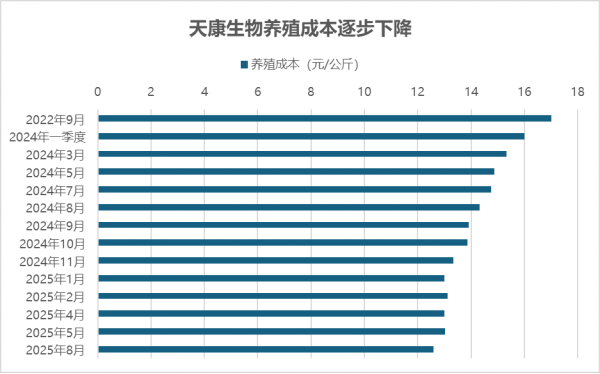
天康生物8月生猪销量同比环比双增长,成本控制助力穿越周期,三年养殖成本下降逾30%
Zheng Quan Shi Bao Wang· 2025-09-10 12:39
Core Viewpoint - TianKang Biological has shown significant growth in pig sales and revenue, while emphasizing cost control measures to enhance competitiveness in a challenging market environment [1][2][4] Company Performance - In August 2025, TianKang Biological sold 263,800 pigs, representing a month-on-month increase of 18.03% and a year-on-year increase of 10.15%, with sales revenue reaching 380 million yuan, up 13.43% from the previous month [1] - From January to August 2025, the company sold a total of 2.0155 million pigs, an increase of 8.24% compared to the same period last year [1] Cost Control Measures - The company has successfully reduced pig farming costs to 12.6 yuan/kg in August 2025, with self-bred and self-raised pig costs dropping to 11.8 yuan/kg [1][2] - The cost of pig farming has decreased significantly from approximately 17 yuan/kg in September 2022 to 12.6 yuan/kg in August 2025, reflecting a reduction of over 30% in three years [2] Market Environment - The average pig-to-grain price ratio in China fell below 6:1, indicating a downward trend in pig prices, which has led to the importance of cost control becoming more pronounced [1][4] - The pig farming industry is experiencing new characteristics, including shorter cycles and increased short-term volatility, which necessitates strong cost control capabilities for survival and growth [4] Competitive Strategy - TianKang Biological is enhancing its competitiveness and risk resistance through refined breeding management, improved production efficiency, and cost control measures, including the use of hedging tools to manage market price fluctuations [2][4] - The company anticipates further cost reduction potential as the prices of purchased piglets decline, indicating room for continued improvement in cost management [4]


Bioceres Crop Solutions (BIOX) - 2025 Q4 - Earnings Call Transcript
2025-09-09 13:32
Financial Data and Key Metrics Changes - In Q4 2025, the company reported revenues of $74.7 million, a 40% decline year-over-year, primarily due to a winding down of the seed business and reduced demand for crop inputs in Argentina [6][7][8] - For the full fiscal year, revenues totaled $335.3 million, down 28% year-over-year, with declines across all segments [8][12] - Adjusted EBITDA for Q4 was -$4.5 million, down from $19.9 million the previous year, largely due to a $22.7 million reduction in gross profit [13][15] - Full-year EBITDA was $28.3 million, down from $81.4 million in FY24, reflecting a $54.6 million decline in gross profit [15][18] Business Line Data and Key Metrics Changes - In the seed segment, revenues were $63.9 million for the year, a reduction of 34%, attributed to the transition to a royalty-based model [9][12] - Crop protection revenues for the full year were $181.9 million, down 20%, with a strong decline in Argentina offset by growth in bioprotection in the U.S. and adjuvants in Brazil [8][12] - Crop nutrition revenues were $89.5 million, down 37% year-over-year, driven by lower microbiota fertilizer sales in Argentina [8][12] Market Data and Key Metrics Changes - The company experienced a significant decline in sales in Argentina due to adverse on-farm economics and reduced spending on agricultural inputs [5][6] - International sales of core technologies grew, with adjuvant sales in Brazil almost doubling and bioprotection products in the U.S. growing nearly 40% [7][8] Company Strategy and Development Direction - The company is focusing on cash generation and improving working capital management, targeting a running rate of 5 to 6 months of sales [19][20] - Cost structure adjustments are being accelerated, with targeted operating expense savings of around 10% to 12% [19][20] - The company aims to scale up biological initiatives and support key partners in Latin America while onboarding new partnerships in the U.S. and Australia [21][22] Management's Comments on Operating Environment and Future Outlook - Management acknowledged the challenges faced in fiscal 2025, attributing them to a combination of macroeconomic shifts in Argentina and changes in the HB4 seed business strategy [4][5] - The company expects to improve EBITDA margins and progress towards a more robust balance sheet with a normalized agricultural input market in Argentina and continued growth in the U.S. and Brazil [20][22] Other Important Information - Total financial debt stood at $255.5 million, slightly lower than the previous quarter, reflecting repayments of unsecured public bonds and working capital loans [17][18] - Cash and cash equivalents totaled $34.6 million, resulting in a net financial debt of $220.8 million as of June 30, 2025 [18] Q&A Session Summary Question: What metrics should be focused on in the next six to nine months? - Management emphasized cash generation and profitability expansion as key metrics, with less priority on top-line growth under current circumstances [24][25] Question: Can you elaborate on cost savings initiatives? - Management indicated that cost savings of $3 to $3.5 million per quarter are expected, achieved through workforce streamlining and right-sizing capacities [29][31] Question: What was the gross profit from the Syngenta agreement in fiscal 2025? - Management clarified that the gross profit from Syngenta for the fiscal year was approximately $18 million, with no upfront payment recognized this year [34][36] Question: What is the outlook for the HB4 product? - Management highlighted a significant agreement with GDM to reposition HB4 technology for weed control, which is expected to generate revenues in the upcoming fiscal year [42][43] Question: How is the inventory situation in Argentina? - Management noted that inventory levels have been almost depleted, indicating a potential recovery in sales as planting needs arise [60][61]

三次赴美IPO都成功了,这位退休的CFO是怎么做到的?
Xin Lang Cai Jing· 2025-09-07 10:25
Group 1 - The article highlights the successful IPO journey of Hesai Technology, which became the first Chinese lidar company to list on NASDAQ on February 9, 2023, raising $190 million at an initial price of $19 per share [2][12]. - The key figure behind this success is Xie Dongying, a retired CFO known for his pivotal role in multiple IPOs, including New Oriental in 2006 and NIO in 2018 [2][4][9]. - Xie Dongying's educational background includes a Bachelor's degree in Engineering from Stanford, an MBA from Harvard, and a Law Doctorate from UC Berkeley, equipping him with a unique skill set for navigating complex financial landscapes [5][6]. Group 2 - Hesai Technology's IPO was preceded by significant funding rounds, including over $300 million in Series D financing in June 2021, led by prominent investors such as Hillhouse Capital and Xiaomi [2][11]. - The company faced challenges during its IPO, including being listed as a military-related entity by the U.S. Department of Defense, which raised concerns among investors. Xie led a legal team to clarify the company's core technologies were not military-related, stabilizing investor sentiment [12][13]. - During Xie's tenure, Hesai improved its gross margin to 53% in 2023, while reducing losses by 33% year-over-year, demonstrating effective cost control and operational efficiency [14]. Group 3 - Xie Dongying's financial strategy focused on two main areas: cost control through optimized R&D expenditure and cash flow management, which included a price reduction strategy that increased delivery volumes significantly [14][15]. - The company achieved a 73.5% year-over-year revenue growth by collaborating with 11 automotive manufacturers, despite reducing the price of its products from 35,000 yuan to 3,000 yuan [15]. - Xie emphasized the importance of risk management and compliance, ensuring that the company maintained a buffer against market uncertainties while building a robust operational framework [15]. Group 4 - Xie summarized the key factors for a successful IPO as a rapidly growing market, a sustainable business model, a strong management team, and precise timing [16]. - The article suggests that CFOs play a crucial role in strategic execution and risk management, which is why a specialized training program for CFOs has been established to address real-world challenges in capital operations and IPO preparations [16].


安琪酵母202509004
2025-09-04 14:36
Summary of Anqi Yeast Conference Call Company Overview - Anqi Yeast operates in the Chinese baking and fermented food sector, demonstrating strong pricing power and channel service capabilities, enabling it to achieve sustained growth despite market cycles [2][3]. Key Points Industry and Market Dynamics - The domestic demand for Anqi Yeast remains stable, primarily due to its role as a core ingredient in baked goods and Chinese-style fermented foods, which exhibit strong rigidity [3]. - Internationally, Anqi Yeast has a competitive advantage through localization strategies and a well-established channel network, resulting in a robust annual revenue growth of approximately 20% [2][3]. Financial Performance and Projections - The company anticipates a revenue growth rate of 10%-15% annually, with profit growth potentially exceeding 20% due to effective cost control measures [4][7]. - The price fluctuations of molasses, a key raw material, significantly impact profits. It is expected that by 2026, the cost of molasses will drop below 1,000 RMB per ton, enhancing profit elasticity [5][6]. Cost Control and Profitability - Cost control is identified as a crucial driver for future performance. A 10% reduction in costs could directly contribute to at least a 10% increase in profit growth [4][8]. - The company has shown a trend of profit improvement due to cost reductions, with expectations for this trend to continue into the next year [5][8]. Employee Incentives and Corporate Governance - Anqi Yeast has implemented two large-scale equity incentive plans in 2021 and 2024, covering nearly 1,000 employees, which effectively aligns the interests of core employees with the company [6]. - The equity incentive ratio has been increasing, significantly impacting core employees and ensuring alignment of interests, which is expected to drive performance growth [6][9]. Investment Outlook - Overall, Anqi Yeast is viewed positively for its future development prospects, with strong revenue growth certainty and effective cost control measures leading to significant profit growth [9][10]. - The current valuation is considered reasonable, with limited downside risk, making it a noteworthy investment opportunity [8][9]. Additional Insights - The company’s focus on high-value products is expected to further enhance profitability, and the potential for expansion in international markets remains significant despite the current overseas revenue contribution being only 30-40% [2][3].

International Paper Company (IP) 2025 Conference Transcript
2025-09-04 13:12
Summary of International Paper Company (IP) 2025 Conference Company Overview - **Company**: International Paper Company (IP) - **Date of Conference**: September 04, 2025 - **Speaker**: Andy Silvernail, CEO Key Points Industry and Market Conditions - **US Market Performance**: Initially expected to grow by 1%, but projected to decline by 2%, indicating a 3-point swing in market expectations [6][12] - **Structural Market Changes**: No significant structural changes in the market; however, trade tariffs and housing market conditions are impacting demand [9][11][12] - **European Market Challenges**: The conflict in Ukraine and trade tariffs are significant headwinds, with an estimated $350 million impact on volume and price [13][55] Company Strategy and Restructuring - **Focus on Packaging**: International Paper is transitioning to being solely a packaging company, moving away from a broad-based fiber company model [20][21] - **Restructuring Actions**: Key actions include the sale of GCF, closure of Savannah and Riceboro, and investment in Riverdale, aimed at improving asset quality and competitive positioning [19][20][25] - **Cost Reduction Goals**: Targeting $500 to $600 million in cost reductions in Europe, with a focus on optimizing operations and exiting non-strategic assets [59][62] Financial Performance and Projections - **Profit Impact**: If market growth had met expectations, profits could have exceeded half a billion dollars; current losses attributed to volume declines in the US and price softness in Europe [16][17] - **Long-term Outlook**: The company is positioned for recovery as market conditions improve, particularly in housing and economic growth [79][81] Sales and Customer Engagement - **Sales Incentives**: Changes in sales incentives are being implemented to align performance with compensation, moving away from volume chasing to a focus on quality and profitability [34][36][38] - **Customer Relationships**: Emphasis on building strong, service-oriented relationships with customers to increase stickiness and reduce switching costs [42][43][46] Operational Efficiency - **Local Market Focus**: The business operates hyper-locally, with a focus on service quality, on-time delivery, and responsiveness to customer needs [39][40][41] - **Asset Management**: The company is moving away from underperforming assets and investing in high-quality, strategically advantageous assets [24][25][69] Future Plans - **Continued Restructuring in Europe**: The restructuring process in Europe will mirror the US approach, focusing on integration and optimization without significant new capital investments [56][58][70] - **Market Positioning**: The company aims to maintain a tight operational structure to better navigate market cycles, prioritizing high-quality assets and customer relationships [81] Additional Insights - **Service as a Competitive Advantage**: High service levels are critical for customer retention and operational success, with a focus on embedding within customer operations to drive mutual value [42][46] - **Innovation in Europe**: The European market is characterized by higher innovation and service intensity, necessitating a focused approach to resource allocation [77] This summary encapsulates the key discussions and strategic directions outlined during the conference, highlighting the challenges and opportunities facing International Paper in both the US and European markets.

六国化工2025年上半年净利润为-1.49亿元、同比-608.08 成本与价格双重挤压
Xin Lang Zheng Quan· 2025-09-04 09:58
Core Viewpoint - Liu Guo Chemical's financial performance in the first half of 2025 reveals significant challenges, with a net loss of 149 million yuan, a decline of 608.08% compared to the same period last year, highlighting structural issues in the company's operations [1][3] Financial Performance - The company reported total revenue of 3.155 billion yuan, an increase of 3.10% year-on-year [1] - The net profit attributable to shareholders was a loss of 149 million yuan, compared to a profit of 29.37 million yuan in the same period last year [1] - The non-recurring net profit also showed a loss of 151 million yuan, down from a profit of 10.08 million yuan in the previous year [1] Cost and Pricing Pressures - Liu Guo Chemical's core business relies heavily on fertilizer products, with phosphate and compound fertilizers contributing nearly 80% of revenue [1] - Rising raw material prices, particularly for sulfur and potassium fertilizers, have significantly deteriorated the cost structure of phosphate products, leading to compressed profit margins [1][2] - The company faces a "cost up, price down" scenario, resulting in a vicious cycle of "production equals loss" in its basic fertilizer business [2] Strategic Challenges - The transition projects, such as battery-grade refined phosphoric acid, are still in the investment phase and have not yet provided substantial financial relief [2] - There is a mismatch between the profit collapse of traditional businesses and the delayed cash generation capabilities of new projects, exposing deeper contradictions in resource allocation [2] Recommendations for Improvement - The company needs to reshape its supply chain by extending upstream control over sulfur resources or exploring alternative raw material technologies to break the cycle of uncontrollable costs [2] - A reassessment of heavy asset projects, such as those in Hubei Huayang, is necessary to balance asset-light and heavy investments, potentially through cooperative construction and phased production [2] - Establishing a cash flow positive path by prioritizing the clearance of unsold inventory and creating a distribution assessment mechanism focused on collection efficiency is crucial [2]

华鲁恒升(600426):上半年主营产品销量增长,Q2业绩环比改善明显
Shanxi Securities· 2025-09-04 06:44
Investment Rating - The report maintains a "Buy-B" rating for the company [4][8] Core Views - The company experienced a decline in revenue and net profit in the first half of 2025, with a revenue of 15.76 billion yuan, down 7.1% year-on-year, and a net profit of 1.57 billion yuan, down 29.5% year-on-year. However, the second quarter showed signs of improvement with a revenue of 7.99 billion yuan, a slight increase of 2.8% quarter-on-quarter [5][6] - The company has seen double-digit growth in sales of new materials and chemical fertilizers in the first half of 2025, with significant improvements in profitability in Q2 due to strong cost control measures [6][8] Financial Performance - For the first half of 2025, the company's sales revenue from new materials, chemical fertilizers, organic amines, and acetic acid and derivatives were 7.62 billion, 3.88 billion, 1.16 billion, and 1.71 billion yuan respectively, with year-on-year changes of -8.4%, +6.4%, -8.6%, and -16.3% [6] - The gross profit margins for these products were 8.5%, 30.0%, 12.0%, and 33.4%, reflecting year-on-year changes of -7.0, -4.5, +3.7, and +6.8 percentage points [6] - The company's sales gross margin and net margin for the first half of 2025 were 18.0% and 11.0%, down 3.2 and 3.1 percentage points year-on-year. In Q2, these margins improved to 19.6% and 12.0%, up 3.3 and 2.1 percentage points quarter-on-quarter [6] Future Projections - The company is projected to achieve net profits of 4.22 billion, 4.89 billion, and 5.60 billion yuan for the years 2025, 2026, and 2027, corresponding to P/E ratios of 14, 12, and 10 times respectively [8][10] - The report highlights the company's integrated industrial chain layout and cost control advantages as key factors for future growth [8]

American Eagle Outfitters(AEO) - 2026 Q2 - Earnings Call Transcript
2025-09-03 21:30
Financial Data and Key Metrics Changes - Total revenue for the second quarter was $1,280,000,000, marking a 1% decline compared to the previous year but was the second highest ever for this quarter [21][22] - Operating income improved by 2% to $103,000,000, exceeding expectations, with a diluted EPS increase of 15% year-over-year [7][21] - Gross profit dollars were $500,000,000, reflecting a gross margin of 38.9%, up from 38.6% last year [22] Business Line Data and Key Metrics Changes - Aerie experienced a comp growth of 3%, achieving record second quarter revenue driven by strong demand in intimates, soft dressing, sleepwear, and activewear [5][14] - American Eagle saw a decline in comps but improved demand in key categories such as women's jeans and tops, with notable improvements as the quarter progressed [16][21] Market Data and Key Metrics Changes - Traffic was positive across brands and channels, with significant momentum building through the second quarter and into August [6][11] - New customer acquisition increased by over 700,000, with campaigns generating 40,000,000,000 impressions [19][58] Company Strategy and Development Direction - The company is focused on strengthening its brands, improving operational efficiencies, and enhancing customer experience while managing costs [4][7] - Capital allocation remains balanced between investments for long-term growth and returning capital to shareholders, with $276,000,000 returned year-to-date through dividends and share repurchases [10][25] Management's Comments on Operating Environment and Future Outlook - Management expressed confidence in the long-term growth potential of the brands and emphasized the importance of building on the progress made in the second quarter [12][29] - The third quarter is off to a better start, with consolidated comps up in the mid-single digits, and expectations for low single-digit increases in comparable sales for both the third and fourth quarters [27][28] Other Important Information - The company plans to open approximately 30 Aerie and offline locations and remodel 40 to 50 American Eagle stores [26] - Tariff impacts are expected to be $20,000,000 in Q3 and $40,000,000 to $50,000,000 in Q4, affecting gross margins [28][48] Q&A Session Summary Question: Can you tell us more about how you keep the momentum going with the new customers attracted by the campaigns? - The campaigns have generated unprecedented new customer acquisition, and the focus is on converting this buzz into repeat business [33][35] Question: Can you provide more details on the comp metrics, transaction ticket, and tariff impacts? - AUR was down mid-single digits, but healthy traffic was noted, with tariff impacts projected at $20,000,000 for Q3 and $40,000,000 to $50,000,000 for Q4 [46][48] Question: What percentage of sales does intimates represent for Aerie, and what is the strategy to recapture share? - Intimates account for roughly one-third of Aerie's business, and the strategy includes launching new collections and focusing on customer engagement [54][56] Question: How is the men's side of the business performing, and what are the expectations for denim? - Men's business has shown significant improvement, particularly in denim, which is trending positively [90][91] Question: What is the duration of the Sydney Sweeney and Travis Kelce campaigns? - The campaigns will continue through the remainder of the year, with new elements being introduced [94][96] Question: Can you discuss the inventory plans for Q3 and Q4? - Inventory positioning is aligned with plans, with a focus on managing costs and ensuring adequate supply for upcoming sales trends [99][100]

Shake Shack(SHAK) - 2025 FY - Earnings Call Transcript
2025-09-03 18:10
Financial Data and Key Metrics Changes - The company experienced positive traffic growth in July, indicating a recovery from earlier pressures faced in urban markets [10][12] - The company is confident in achieving low single-digit comparable sales growth for the year, with pricing expected to contribute approximately 2% [35] Business Line Data and Key Metrics Changes - The introduction of limited-time offers (LTOs) such as the summer barbecue menu and Dubai Shake has positively impacted traffic and check growth [14][15] - The company has seen strong performance from new menu innovations, which are designed to attract both new and returning guests [16][17] Market Data and Key Metrics Changes - Significant market share gains were noted in cities outside of New York and D.C., with high single-digit comparable sales in markets like Denver, Los Angeles, and Miami [10][12] - The company has a robust pipeline, with over 90% of new openings planned outside of New York and D.C., indicating a strategic focus on diversifying market presence [12] Company Strategy and Development Direction - The company is focused on culinary innovation, operational improvements, and enhanced marketing strategies to drive sales growth [4][8] - There is a strong emphasis on unit growth, with plans to open more locations and a commitment to reducing build costs by 10% this year [38][39] Management's Comments on Operating Environment and Future Outlook - Management acknowledged macroeconomic pressures, particularly in urban areas, but expressed optimism about future recovery and brand health [12][13] - The company is investing in operational efficiencies and marketing to offset cost pressures and enhance guest experience [50][51] Other Important Information - The company has launched a new app to enhance customer loyalty and frequency, with targeted promotions to encourage repeat visits [27][30] - A new kitchen testing facility has been established to optimize operations and improve efficiency in restaurant layouts [60][63] Q&A Session Summary Question: How have urban markets improved? - Urban markets like New York and D.C. have faced unique pressures, but there is optimism for recovery as the company sees momentum in other markets [10][12] Question: What are the impacts of recent menu innovations? - Recent LTOs have driven traffic and mixed growth, with successful promotions enhancing brand awareness and guest acquisition [14][19] Question: How is the company addressing cost pressures? - The company is focusing on operational improvements and supply chain efficiencies to mitigate cost pressures without significantly increasing prices [50][65] Question: What are the expectations for unit growth? - The company is confident in its unit growth strategy, with a solid pipeline and strategic investments in development resources [37][39] Question: How is the loyalty program evolving? - The company is rolling out guest recognition features in its app to enhance customer loyalty and frequency of visits [27][30]

REV Group(REVG) - 2025 Q3 - Earnings Call Transcript
2025-09-03 15:02
Financial Data and Key Metrics Changes - Consolidated net sales for Q3 2025 were $644.9 million, up from $579.4 million in Q3 2024, representing a 20.5% increase when excluding the impact of the exited E and C transit bus business [13] - Adjusted EBITDA for Q3 2025 was $64.1 million, compared to $45.2 million in Q3 2024, marking a 66.1% year-over-year increase when excluding the impact of the divested bus business [14][25] - Year-to-date cash flow was strong, with cash from operating activities totaling $164.7 million [23] Business Line Data and Key Metrics Changes - Specialty Vehicles segment sales increased to $483.3 million, an 11.8% increase compared to the prior year, with adjusted EBITDA rising by 71.4% to $64.6 million [15][16] - Fire unit shipments increased by 11% and ambulance unit shipments increased by 7% compared to the previous year [6][16] - Recreational Vehicle segment sales rose to $161.7 million, a 9.7% increase, but adjusted EBITDA decreased by 13.8% due to increased dealer assistance and tariff impacts [19][20] Market Data and Key Metrics Changes - Specialty Vehicles segment backlog at the end of Q3 was $4.3 billion, reflecting continued demand for fire apparatus and ambulance units [17][58] - Recreational Vehicle segment backlog declined by 7% year-over-year, indicating soft end market demand [21] Company Strategy and Development Direction - The company is focused on reinvesting in its businesses to drive long-term growth, pursuing opportunistic share repurchases, and maintaining a sustainable dividend [12] - A major facility expansion in South Dakota is expected to increase fire apparatus production capacity by 40%, enhancing delivery times and throughput [8][47] - The company aims to streamline operations and improve cost discipline, with a focus on lean manufacturing and workforce training [5][6] Management's Comments on Operating Environment and Future Outlook - Management expressed confidence in the company's ability to manage tariff impacts and maintain strong performance, raising the fiscal 2025 outlook [12][25] - The company anticipates continued demand for its products, despite macroeconomic uncertainties affecting the recreational vehicle market [19][21] - Management highlighted the importance of maintaining competitive lead times and quality in response to market conditions [50][64] Other Important Information - The company completed the sale of its Lance Camper business, streamlining its RV portfolio to focus on motorized RVs [10] - Capital expenditures for the quarter were $11.6 million, with a focus on improving efficiency and quality [23] Q&A Session Summary Question: Were the record EBITDA margins in line with expectations? - Management confirmed that the company is on track with its midterm targets and is pleased with the progression [29] Question: How will tariffs impact the first quarter of fiscal 2026? - Management expects a typical sequential decline in sales of 10-15% in the first quarter due to working and shipping days [31] Question: Are pricing strategies effectively offsetting inflation and tariffs? - Management is actively reviewing pricing strategies to offset inflation and has not yet taken price increases in response to tariffs [33][44] Question: How is the company managing tariff impacts on steel and aluminum? - Management indicated that the expected drag from tariffs remains consistent, with ongoing efforts to minimize impacts through supply chain management [41][42] Question: What is the outlook for the fire business and its capacity expansion? - The South Dakota facility expansion will enhance production capabilities, with full operational capacity expected in 2027 [47] Question: How does the company view pricing competition in the market? - Management noted that they are currently not seeing significant price competition and remain competitive in both price and lead time [62][64] Question: What are the capital deployment plans given strong cash flow? - Management emphasized the importance of internal investments for productivity improvements while remaining opportunistic regarding M&A opportunities [73][75]