
红利策略

Search documents
华安基金:中美会谈取得实际进展,降准降息利好红利策略
Quan Jing Wang· 2025-05-13 03:14
Market Overview and Key Insights - The Hong Kong stock market continued its upward trend driven by the dividend sector, with the Hang Seng China Central State-Owned Enterprises Dividend Total Return Index rising by 2.08% and the Hang Seng Index increasing by 1.69%, while the Hang Seng Tech Index fell by 1.22% [1] - Foreign capital saw a net inflow last week, with southbound funds totaling a net inflow of 6.78 billion, significantly up from the previous week's 1.19 billion [1] - Progress was made in US-China trade talks, with both sides agreeing to establish a consultation mechanism, potentially easing previous tariff uncertainties and benefiting A-shares and Hong Kong stocks [1] Financial Policy and Market Impact - Recent financial policies, including interest rate cuts, are expected to enhance long-term liquidity supply, benefiting high-dividend strategies in a low-interest environment [2] - The dividend yield of the Hang Seng China Central State-Owned Enterprises Dividend Index stands at 8.23%, significantly higher than the 6.40% yield of the CSI Dividend Index, with a price-to-book ratio of 0.58 and a price-to-earnings ratio of 6.15 [2] - The index has achieved a cumulative return of 91% since early 2021, outperforming the Hang Seng Total Return Index by 93% [2] ETF Overview - The Huaan Hong Kong Stock Connect Central State-Owned Enterprises Dividend ETF (code: 513920) tracks the Hang Seng China Central State-Owned Enterprises Dividend Index, reflecting the performance of high-dividend securities listed in Hong Kong with major shareholders being mainland central enterprises [3] - This ETF is the first in the market to combine the attributes of Hong Kong stocks, central enterprises, and dividends [3] ETF Performance - The Huaan Hong Kong Stock Connect Central State-Owned Enterprises Dividend ETF had a net asset value of 1.3602 and a scale of 3.688 billion, with a weekly turnover of 639 million [5] - The top ten weighted stocks in the index include major banks and insurance companies, with dividend yields ranging from 4.6% to 9.0% [6]


宏观政策发力,投资品如何布局?
2025-05-12 15:16
宏观政策发力,投资品如何布局?20250512 摘要 • 红利策略在经济下行背景下凸显重要性,叠加公募基金高质量发展行动方 案的推动,红利资产配置需求增加,成为跑赢基准的趋势。关注分红比例 提高的公司,将其作为底仓配置。 • AI 应用领域虽催化剂众多,但兑现需时,预期偏高。经济压力可能导致二 次调整,但幅度有限。AI 应用仍是主线,关注长期发展潜力。 • 油价下跌是城市燃气降本的主要逻辑,2024 年进口 LNG 价格中枢下降。 若 LNG 价格进一步下跌,国内现货具备赚取价差空间,看好降本带来的盈 利能力改善。 • 黄金价格受地缘冲突和美国经济韧性驱动,高位震荡。利润框架向信用框 架切换是长期上涨背景,短期调整是买入机会。板块估值仍偏低,关注龙 头公司业绩。 • 有色金属板块中,铜、铝等品种估值偏低。中国加码逆周期政策降低关税 影响,回调风险可控。关注长期景气高位且具备分红属性的品种,以及受 政策驱动的小金属。 Q&A 当前宏观政策持续发力,资本市场在国家政策中的定位如何变化?对投资策略 有何影响? 公用事业行业一季度表现如何?各子领域有哪些差异? 一季度能源需求较弱,无论是天然气还是电力需求增速均有所下 ...
政策红利+高股息双轮驱动!电力、银行、红利板块三箭齐发领涨A股
Xin Lang Cai Jing· 2025-05-12 03:24
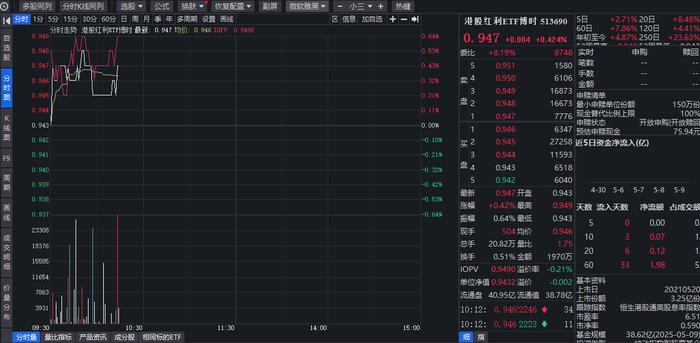
Group 1 - A-shares market sentiment is improving due to positive signals from US-China negotiations, with major indices opening higher and specific ETFs showing gains [1] - The power sector is performing strongly, driven by policy support and rising demand, particularly with recent reforms in Shandong province promoting market-based pricing for renewable energy [1][2] - Bank stocks are reaching new highs, supported by high dividend yields, low valuations, and favorable policies such as interest rate cuts and reserve requirement ratio reductions [2][3] Group 2 - The average dividend yield for the banking sector is approximately 6.5%, with a price-to-earnings ratio of 6.5, indicating historical low valuations that attract long-term capital [2] - The red-chip sector is benefiting from policy catalysts and defensive demand, with significant inflows expected from insurance funds into high-dividend assets [2][3] - The recent performance of the Hong Kong Dividend ETF and the Low Volatility 100 ETF reflects a positive market environment, with the former seeing a 2.13% increase over the past week [3][6] Group 3 - The Low Volatility 100 Index has shown stability with a current price-to-earnings ratio of 8.22 and strong earnings stability indicators, suggesting potential for further upward movement if trading volume increases [5] - The rise of high-dividend sectors is attributed to a combination of policy support, capital inflows, and favorable market conditions, with a focus on banks and power companies as key investment areas [5][6] - For ordinary investors, ETFs like the Hong Kong Dividend ETF and the Low Volatility 100 ETF provide a way to diversify risk while capturing beta returns in a volatile market [6][7]
量化策略护航 探寻“固收+”超额收益新路径
Zhong Guo Zheng Quan Bao· 2025-05-11 21:10
Core Viewpoint - The fixed income market is facing challenges due to compressed yields, prompting fund managers to adopt new strategies for stable returns, including enhanced trading capabilities and a focus on equity markets for additional gains [1][2][4]. Group 1: Trading Strategies - The importance of trading ability has increased for fund managers in the fixed income sector, as traditional "buy and hold" strategies yield lower returns [1][3]. - The team employs quantitative methods to monitor the duration of bond funds daily, allowing for dynamic adjustments to portfolio duration based on market conditions [2][3]. - The introduction of more trading tools, such as expanding the list of trading partners and integrating third-party trading software, is aimed at improving operational efficiency [3]. Group 2: Investment Focus - The new mixed bond fund, CITIC Prudential Hui Li Bond, aims to create a low-volatility "fixed income plus" product, with a portion of investments allocated to stable-performing equity funds [2][4]. - The fund manager has established strict operational rules for equity positions, including initial allocation ratios and thresholds for profit-taking and rebalancing [2][3]. - There is a growing emphasis on capturing opportunities in the equity market, particularly in stable and mature active equity funds that employ dividend and turnaround strategies [3][4]. Group 3: Market Outlook - The bond market is expected to remain volatile in the short term due to policy uncertainties, but recent interest rate cuts by the central bank may provide support for economic stability [4]. - The short to medium-term bonds are viewed as having higher certainty, while long-term rates are influenced by various factors, leading to greater uncertainty [4]. - The convertible bond market is currently at a neutral valuation, with potential upside due to lower implied volatility compared to underlying stocks, focusing on balanced convertible bonds in sectors like AI and robotics [4].
政策“组合拳”发力 银行股持续活跃
Shang Hai Zheng Quan Bao· 2025-05-08 18:45
Core Viewpoint - The recent surge in A-share bank stocks is attributed to a series of supportive financial policies, including interest rate cuts and reserve requirement ratio reductions, which enhance the stability and profitability of banks [1][2]. Group 1: Financial Policies Impact - On May 7, the People's Bank of China announced a package of financial measures, including a 0.1 percentage point reduction in policy interest rates and a 0.5 percentage point decrease in the reserve requirement ratio [2]. - The introduction of 500 billion yuan for consumer and pension re-loans is expected to further stimulate bank lending and improve asset quality [2]. - Analysts believe that these policies will lead to a stable credit supply and manageable asset quality pressures for banks [2]. Group 2: Market Performance - On May 8, bank stocks continued to perform strongly, with Shanghai Pudong Development Bank reaching a new high of 11.69 yuan per share, and Jiangsu Bank closing up 2.46% at 10.41 yuan per share, pushing its market capitalization above 191 billion yuan [1]. - Other banks, such as Qingnong Commercial Bank and Qingdao Bank, also saw significant gains, with increases exceeding 3% [1]. - Bank-related ETFs also performed well, with several ETFs showing gains of over 1% [1]. Group 3: Institutional Investment - Insurance funds have shown a strong preference for bank stocks, holding 27.82 billion shares valued at 265.78 billion yuan as of the end of the first quarter, making banks the top holdings [3]. - The trend of institutional investment in bank stocks is expected to accelerate, enhancing the dividend value of the banking sector [3]. - Analysts suggest that the high dividend yield characteristic of bank stocks makes them attractive for long-term investors, reinforcing their strategic value in both short and long-term portfolios [3].




麻绎文:为何巴菲特钟爱现金流?解锁现金流的慢富密码
Mei Ri Jing Ji Xin Wen· 2025-05-08 01:09
Group 1 - The concept of free cash flow is crucial in Buffett's value investment philosophy, reflecting a company's ability to return value to shareholders and creditors, as well as its capacity for future development [1] - Free cash flow has advantages over net profit as it is derived from the cash flow statement, which has higher transparency and is less susceptible to manipulation [1] - Recent market trends show an increase in cash flow ETFs, which primarily use free cash flow yield as a selection criterion, indicating a long-term effectiveness of cash flow strategies in the A-share large and mid-cap stock selection [1][2] Group 2 - Cash flow ETFs and strategies are considered to have advantages over dividend strategies, as they can better avoid value traps and provide timely insights into a company's cash flow [2] - The FTSE Free Cash Flow Index has shown a remarkable annualized return of over 20% from the end of 2013 to 2024, with a higher proportion of central state-owned enterprises and companies with high dividend yields and low valuations [2] - Recent policy changes, including the new "National Nine Articles" and market value management regulations, encourage companies with high free cash flow to convert it into dividends and buybacks, enhancing shareholder returns [3] Group 3 - The upcoming dividend season and potential easing of external trade tensions create an opportunity for cash flow ETFs to be a core asset allocation, suggesting a strategy of gradual accumulation during market dips [3]
国有大行又起舞,政策“十箭齐发”如何影响银行?
Sou Hu Cai Jing· 2025-05-07 10:30
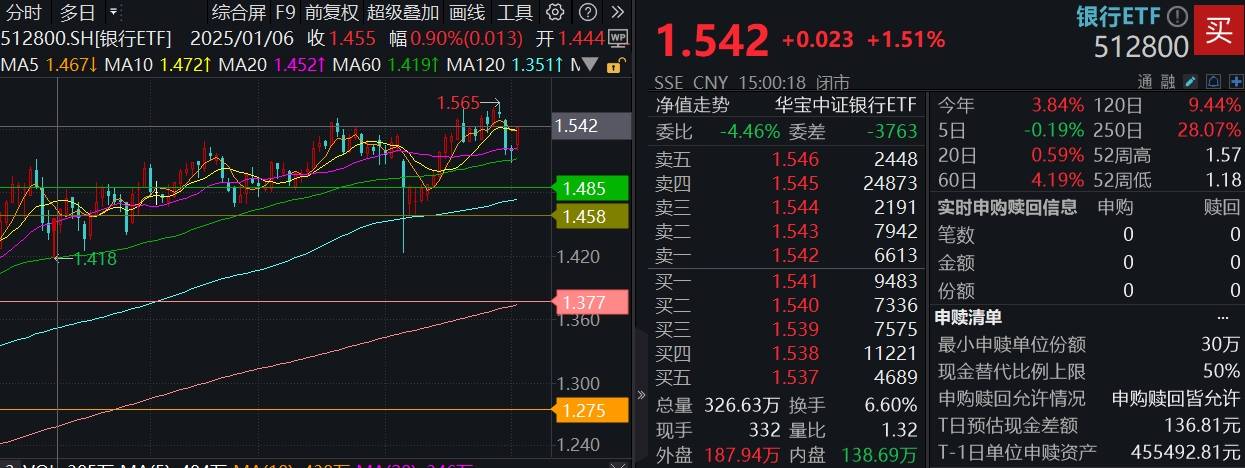
央行官宣降准又降息,银行全天走势较强。截至2025年5月7日收盘,A股顶流银行ETF(512800)高开高走,场内价格上涨1.51%,连收5日、10日线,重返 所有均线上方,全天成交额超5亿元,环比放量逾1亿。 | 分时 多日 = | 综合屏 F9 前复权 超级参加 画线 工具 ◇ ② » | | | | | | --- | --- | --- | --- | --- | --- | | 512800.SHI银行ETFI 2025/01/06 收 1.455 幅0.90%(0.013) 开 1.444 四 | | | 1 542 +0.023 +1.51% | | | | MA5 1.467 MA10 1.4721 MA20 1.4521 MA60 1.4191 MA120 1.3511 NY = 0 | | | | | | | | | | SSE CNY 15:00:18 闭市 | | | | | | | 净值走势 华宝中证银行ETF | | 文生 3.84% | | 1.542 | | 委比 | -4.46% 委差 | -3763 | 5 5 -0.19% | | | | 375 | 1.546 | 24 ...
首批五只自由现金流ETF上市,“山西煤老板”现身,“老熟人”私募、券商也都来了
Sou Hu Cai Jing· 2025-05-07 03:04
Group 1 - The first batch of 12 CSI All Share Free Cash Flow ETFs was approved in April, with five funds already established and listed by May 6 [2] - The ETFs aim to track the CSI All Share Free Cash Flow Index, focusing on listed companies with high cash flow characteristics [2] - Notable institutional investors in the ETFs include companies like Shanxi Changtai Energy Group and Datong Xingergou Coal Industry, indicating interest from corporate entities in these financial products [2][4] Group 2 - The Southern Free Cash Flow ETF raised a total of 1.909 billion yuan, with significant holdings from Sichuan Longmang Group [4] - The trend of private equity firms increasing their participation in the ETF market is evident, with several private institutions appearing among the top holders of newly established ETFs [6] - The investment strategy focusing on high dividend and free cash flow companies is seen as a key theme for equity markets this year, with regulatory support encouraging companies to enhance investor returns through dividends and buybacks [8]

险资一季度调仓路径曝光:加仓高股息资产
Zhong Guo Zheng Quan Bao· 2025-05-05 20:41
Group 1 - The core viewpoint of the articles indicates that insurance capital is increasingly favoring high-dividend assets, particularly in the banking sector, as they seek stable long-term returns [1][2][3] - As of the end of Q1 2025, insurance capital appeared in the top ten shareholders of 735 stocks, holding a total of 607.98 billion shares valued at 580.88 billion yuan [1] - The banking sector is the most favored by insurance capital, with an increase of 188 million shares in Q1 2025, bringing the total holdings to 27.82 billion shares valued at 265.78 billion yuan [1] Group 2 - Insurance capital has made 13 significant share acquisitions in 2025, with 6 of these involving bank stocks, indicating a strong preference for this sector [2] - The preference for bank stocks is attributed to the stable dividend cash flow they provide, which helps offset declining interest income [2] - In addition to banking stocks, insurance capital has also increased holdings in transportation, real estate, telecommunications, and public utilities, with notable investments in China Unicom, Beijing-Shanghai High-Speed Railway, and Gemdale Corporation [2][3] Group 3 - In Q1 2025, insurance capital increased its investment in the transportation sector, with significant movements in shares of Beijing-Shanghai High-Speed Railway and other companies [3] - Insurance capital has become a top ten shareholder in nearly 180 stocks, with substantial holdings in companies like China CITIC Bank, China State Construction, Weichai Power, and Suzhou Bank [3] - The trend towards high-dividend assets is expected to continue, as insurance capital prioritizes stability and safety in investment returns amid low interest rates and asset scarcity [3]
本周聚焦:3月重点省市信贷投放情况如何?
GOLDEN SUN SECURITIES· 2025-05-05 11:29
Investment Rating - The report does not explicitly provide an investment rating for the banking sector Core Insights - The banking sector is expected to benefit from expansionary policies aimed at stabilizing the economy, with a focus on real estate, consumer promotion, and increased social security [3] - Key banks to watch include Ningbo Bank, Postal Savings Bank, China Merchants Bank, and Changshu Bank under a pro-cyclical strategy, while Shanghai Bank, China Merchants Bank, Jiangsu Bank, and Chongqing Bank are highlighted under a dividend strategy [3] Summary by Sections Credit Growth - As of March 2025, the total loan balance reached 269.26 trillion yuan, with a year-on-year growth of 6.9%. The RMB loan balance was 265.41 trillion yuan, growing by 7.4% [1] - In March, Sichuan, Anhui, Shandong, and Jiangsu led in credit growth rates, all exceeding 10%, with growth rates of 11.6%, 10.2%, 10.2%, and 10.1% respectively [1] - For enterprise loans, Jiangsu, Sichuan, and Shandong had the highest growth rates at 14.3%, 14.1%, and 13.6% respectively [2] - In the residential loan segment, Shanghai and Shaanxi showed notable growth rates of 13.6% and 7.2% respectively [2] Market Data Tracking - The average daily trading volume in the stock market was 11,040.26 billion yuan, a decrease of 427.29 billion yuan from the previous week [4] - The balance of margin financing and securities lending was 1.80 trillion yuan, down by 0.33% from the previous week [4] - The issuance of non-monetary funds totaled 21.998 billion, a decrease of 2.582 billion from the previous week [4] Interest Rate Market Tracking - The issuance scale of interbank certificates of deposit was 249.34 billion yuan, a significant decrease of 718.44 billion yuan from the previous week [5] - The average interest rate for interbank certificates of deposit was 1.77%, unchanged from the previous week [8] Sector Performance - The banking sector is expected to show a positive trend due to policy catalysts, with a focus on cyclical stocks [3] - The report indicates that the banking sector's performance is closely tied to economic recovery, which may take time [3]





