反内卷政策

Search documents
氧化钇价格暴涨4400%,不是中国不卖,而是美国买不起了。
Sou Hu Cai Jing· 2025-12-01 04:37
Group 1 - The core viewpoint is that despite the perceived victory of the U.S. in the tariff agreement with China, underlying geopolitical tensions are being exacerbated, particularly regarding rare earth resources [1] - China is adhering to the bilateral agreement made in Kuala Lumpur, but the U.S. is still facing a rare earth crisis [1][5] - The price of rare earth elements, especially yttrium oxide, has surged dramatically, with a reported increase of 44 times, leading to significant cost pressures for U.S. companies [3][5] Group 2 - China has not violated any terms of the agreement, as there are no restrictions on price increases, which has led to a substantial rise in prices, particularly in yttrium oxide, which has increased by over 4400% [5] - The shift in pricing strategy by China is a response to Western criticism of low prices, indicating a potential end to the era of cheap Chinese goods [5][7] - The Chinese government is planning to enhance social welfare and change its economic development model, moving away from excessive competition, which may lead to a new era of increased export prices for Chinese goods [7]


重要政策时间窗口前的布局期
AVIC Securities· 2025-12-01 02:54
Core Insights - The A-share market is experiencing fluctuations primarily influenced by overseas factors, with expectations of a 25 basis point rate cut by the Federal Reserve in December due to dovish statements from multiple officials [3][8] - Improved Sino-U.S. relations are noted, with discussions on trade and economic cooperation, which may enhance global risk appetite [3][8] - The "anti-involution" policy is showing initial effects, but profit growth has slowed down, indicating a need for continued monitoring of domestic demand policies [11][13] Market Performance - The A-share market has shown a strong upward trend, with significant increases in major indices such as the Shanghai Composite Index (1.40%) and the ChiNext Index (4.54%) [7][8] - The market's trading volume has decreased to 1.6 trillion, reflecting lower investor participation [3][8] - The overall P/E ratio of A-shares stands at 21.74, indicating a slight increase from the previous week [7] Policy and Economic Outlook - The upcoming December political bureau meeting and the central economic work conference are expected to clarify policy directions for the coming year, potentially supporting market sentiment [5][16] - The "spring market" phenomenon is anticipated post-Spring Festival, with a generally optimistic market atmosphere and significant profit potential across various sectors [6][16] - The manufacturing sector is showing positive trends, particularly in high-tech industries, while traditional industries are also benefiting from upgrades [11][13] Investment Recommendations - Short-term focus is advised on dividend-paying sectors and technology stocks, as they may present good investment opportunities [5][6] - The commercial aerospace sector is highlighted for its growth potential, driven by satellite launch progress and favorable policies [6][8]
大越期货玻璃早报-20251201
Da Yue Qi Huo· 2025-12-01 02:24
1. Report Industry Investment Rating - Not provided in the report 2. Core View of the Report - The fundamentals of the glass industry are weak. With production profit repair being sluggish, supply contraction falling short of expectations, downstream deep - processing orders being weak due to the real estate drag, and inventory at a historically high level, the glass is expected to fluctuate weakly in the short term [2]. 3. Summary by Relevant Catalogs 3.1 Glass Futures Market - The closing price of the main glass futures contract is 1053 yuan/ton, up 1.15% from the previous value. The spot price of Shahe Safety large - size glass is 1004 yuan/ton, up 1.62%. The main basis is - 49 yuan/ton, down 7.55% [7]. 3.2 Glass Spot Market - The market price of 5mm white glass large - size boards in the spot benchmark area of Hebei Shahe is 1004 yuan/ton, up 16 yuan/ton from the previous day [14]. 3.3 Fundamentals - Cost Side - Not elaborated in detail in the report 3.4 Fundamentals - Supply - The number of operating national float glass production lines is 220, with an operating rate of 74.51%. The number of operating production lines is at a historically low level in the same period. The daily melting capacity of national float glass is 157,200 tons, and the production capacity is at a historically low level in the same period [25][27]. 3.5 Fundamentals - Demand - In September 2025, the apparent consumption of float glass was 4.7082 million tons. The real - estate terminal demand is still weak, and the number of orders from glass deep - processing enterprises is at a historically low level in the same period. The capital collection of the deep - processing industry is not optimistic, and traders and processors are cautious, mainly focusing on digesting the original glass inventory [5][30]. 3.6 Fundamentals - Inventory - The inventory of national float glass enterprises is 62.362 million weight boxes, a decrease of 1.49% from the previous week, and the inventory is running above the five - year average [43]. 3.7 Fundamentals - Supply - Demand Balance Sheet - The report provides the annual supply - demand balance sheet of float glass from 2017 to 2024E, including production, consumption, production growth rate, consumption growth rate, and net import ratio. For example, in 2024E, the production is expected to be 55.1 million tons, with a production growth rate of 3.94%, and the consumption is expected to be 53.1 million tons, with a consumption growth rate of - 1.15% [44]. 3.8 Influencing Factors - **Positive factors**: "Coal - to - gas" in the Shahe region and cold - repair in the industry have caused production losses [4]. - **Negative factors**: Weak real - estate terminal demand, low number of orders from glass deep - processing enterprises, and cautious attitudes of traders and processors [5]. 3.9 Main Logic - The glass supply has stabilized at a low level, the orders from downstream deep - processing factories are dismal, and the glass factory inventory has increased. It is expected that the glass will fluctuate weakly at a low level [6].
11月PMI数据点评:年末年初投资项目或在蓄力
Bank of China Securities· 2025-12-01 01:12
Group 1: Manufacturing Sector Insights - The manufacturing PMI index for November is 49.2%, a slight increase of 0.2 percentage points from the previous month, indicating a minor recovery within the contraction zone[3] - The new orders index for November is also at 49.2%, up 0.4 percentage points, with the new export orders index rising 1.7 percentage points to 47.6%, likely boosted by the upcoming holiday season[3] - The production index stands at 50.0%, reflecting a 0.3 percentage point increase, while the raw material inventory index is at 47.3%, unchanged from the previous month[3] Group 2: Investment and Demand Trends - Fixed asset investment projects, particularly in infrastructure and affordable housing, are expected to gain momentum towards the end of the year[1] - The major raw material purchase price index increased by 1.1 percentage points to 53.6%, indicating a high level of purchasing activity[9] - Demand in the raw materials and equipment manufacturing sectors shows signs of recovery, with the new orders index for non-metallic mineral products significantly above the threshold[10] Group 3: Non-Manufacturing Sector Performance - The non-manufacturing PMI index for November is 49.5%, down 0.6 percentage points, indicating a decline in business activity[4] - The new orders index for the non-manufacturing sector is at 45.7%, a decrease of 0.3 percentage points, while the new export orders index has improved to 47.9%, up 1.7 percentage points[12] - The construction sector's PMI is at 49.6%, with a new orders index of 46.1%, reflecting a slight recovery in demand despite remaining in contraction territory[16]
11月PMI:反弹的底色
Ge Long Hui· 2025-12-01 00:57
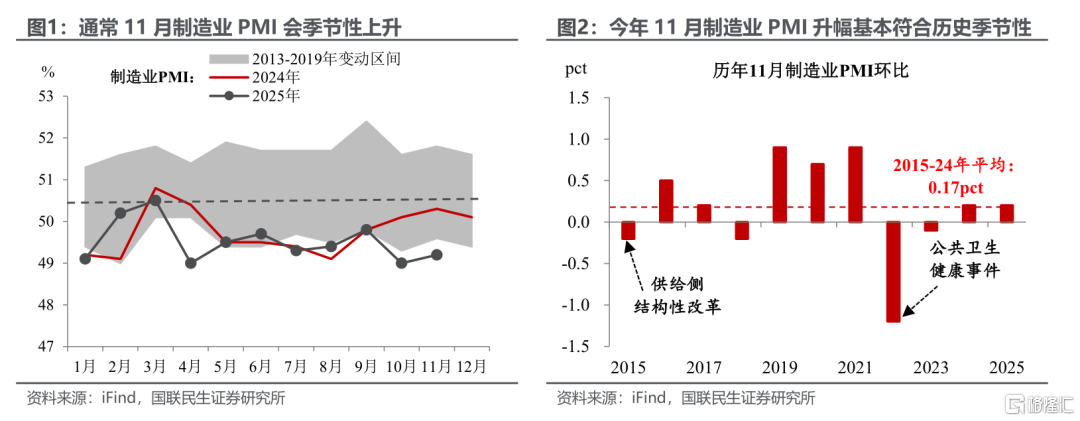
Core Viewpoint - The November manufacturing PMI shows a seasonal rebound post-holiday, but underlying signals indicate unusual trends that warrant deeper analysis [1]. Group 1: Manufacturing PMI Overview - The November manufacturing PMI typically rises due to increased working days compared to October's holiday month, with an average increase of 0.17 percentage points from 2015 to 2024; this year, it increased by 0.2 percentage points, aligning with seasonal trends [1]. - The main drivers of the PMI increase are the new orders index and production index, with the former rising by 0.4 percentage points to 49.2% and the latter by 0.3 percentage points to 50.0% [3]. Group 2: Demand and Supply Dynamics - Although the production index has reached the neutral line, the demand side shows stronger improvement, with the new orders index reflecting seasonal growth while the production index remains weak; this divergence suggests that "anti-involution" policies are facilitating orderly adjustments on the supply side, potentially leading to a balanced supply-demand landscape [4]. Group 3: Price Indicators - Price indicators are sending positive signals, with the raw materials purchasing price index rising by 1.1 percentage points to 53.6% and the factory price index increasing by 0.7 percentage points to 48.2%, indicating potential for continued improvement in overall PPI growth; however, the greater improvement in upstream prices compared to downstream suggests that corporate profit margins may be narrowing [7]. Group 4: Export and Sector Performance - The November export sector showed significant improvement, with the new export orders index rising by 1.7 percentage points, driven by two main factors: a phase one trade agreement between China and the U.S. and the upcoming overseas Christmas order season [9]. - The construction PMI has risen by 0.5 percentage points to 49.6%, marking the largest increase since June, reflecting the effectiveness of new policy financial tools; in contrast, the service sector PMI has decreased by 0.7 percentage points, indicating a need for stronger measures to enhance service consumption mechanisms [9].
谜题尽解,尚待新局 - 2026年债市年度策略展望
2025-12-01 00:49
Summary of Key Points from Conference Call Industry Overview - The conference call primarily discusses the **debt market** outlook for 2026, highlighting various strategies and market dynamics affecting bond yields and credit performance. Core Insights and Arguments - **Yield Predictions**: The mainstream view anticipates that the 10-year government bond yield will fluctuate between **1.7% and 2.0%** in 2026, with a cautious approach towards the **97 strategy** and a focus on institutional behavior [1][4] - **Market Dynamics**: The debt market is expected to experience a slight upward fluctuation, influenced by weak economic sentiment and insufficient social demand, with potential risks from equity market rallies and tightening monetary policy [1][6] - **Credit vs. Interest Rates**: Credit performance is currently superior to interest rates, with short-term credit bonds showing strong performance. The focus has shifted back to **yield strategies** rather than merely avoiding risks [3][12] - **Key Strategies**: The main strategies for 2026 include **low volatility**, **high yield strategies**, and a cautious approach to the **97 strategy**. Emphasis is placed on understanding institutional behaviors and market dynamics [5][8] Important but Overlooked Content - **Impact of Anti-Competition Policies**: The anti-competition policies have significantly reduced the leading indicators' effectiveness, particularly the PPI, which historically had a strong influence on the debt market [7] - **Financial Debt as Core Investment**: Financial bonds remain a core investment for non-bank institutions due to their safety, yield, and liquidity advantages, despite short-term impacts from redemption fee regulations [8][29] - **Sector-Specific Insights**: The real estate sector is under pressure due to demographic changes, with a declining number of new births affecting future housing demand. This demographic shift is expected to continue impacting the economy and real estate sector negatively [22][31] - **Credit Strategy Adjustments**: The strategy for credit bonds involves adjusting allocations based on yield levels, favoring high elasticity subjects during high yield periods and low elasticity subjects during low yield periods [28] Conclusion - The debt market outlook for 2026 is characterized by cautious optimism, with a focus on credit performance and strategic adjustments in response to evolving market conditions. The interplay between policy, economic indicators, and institutional behavior will be crucial in shaping investment strategies moving forward.
如何看大化工的投资机会?
2025-12-01 00:49
Summary of Conference Call on Chemical Industry Investment Opportunities Industry Overview - The chemical industry is currently experiencing historically low gross margins per ton due to rapid domestic capacity expansion leading to oversupply, while demand has not significantly decreased, indicating potential improvement in supply-demand dynamics in the future [1][2][3] - Companies are proactively reducing capital expenditures, with expectations of continued negative growth in capital expenditures for chemical listed companies from 2024 to 2026 [1][2] Supply and Demand Dynamics - Both domestic and international supply sides are showing signs of contraction. Domestically, companies are reducing capital expenditures due to poor profitability, while internationally, the Russia-Ukraine conflict has increased energy costs in Europe and led to operational difficulties for global chemical leaders, accelerating the shutdown of production lines [1][3] - The demand side is expected to recover, with the U.S. entering a rate-cutting cycle, followed by China and the UK, which may lead to a resonance in demand between China and the U.S. [1][3] Emerging Opportunities - New industries such as renewable energy, energy storage, photovoltaics, and AI are expected to drive incremental demand for chemical products, with the industry projected to enter an upward cycle from 2026 to 2027 [1][3] - Recommended sectors include: - **Bottom Elastic Products**: Organic silicon and industrial silicon benefiting from high energy consumption characteristics and energy-saving trends (e.g., Hengsheng Silicon, Xin'an Chemical, Xingfa Group) [1][4] - **Soda Ash**: Benefiting from anti-dumping policies despite expansion (e.g., Boyuan Chemical) [1][4] - **PTA and Polyester Filament**: Stable growth in end-user demand (e.g., Tongkun, Xinfengming) [1][4] Investment Recommendations - Focus on quality stocks with bottom valuations and potential volume growth, such as Wanhua Chemical, Hualu Hengsheng, Longbai Group, and Huahong New Materials [2][4][7] - Growth companies in tires and new materials are also worth attention, such as Sailun Tire, Xin Nuobang, and Shengquan Group, which benefit from AI, new energy development, and domestic substitution [5] Strategic Outlook for 2026 - The strategy for the petrochemical industry in 2026 will adopt a top-down framework due to prolonged low margins (10%-20%) and the completion of capital expenditures in 2023 and 2024 [6][7] - Anticipation of three rate cuts by the Federal Reserve in 2026, reducing rates to around 3%, is expected to support a soft landing for the global economy [6] Key Focus Areas in Petrochemical Sector - The PTA sector is highlighted as a key area of focus, with optimism regarding market corrections and support from national policies [7][8] - Attention should also be given to cyclical sectors, including private refining companies like Satellite Chemical, Baofeng Energy, and Hengli Petrochemical, which are expected to experience reversals [8] Additional Investment Opportunities - Other notable investment opportunities include the POE market and Xinjiang coal chemical stocks, which are expected to perform well due to stable operations and significant profit margin potential [11] - Companies like Aerospace Engineering and 3D Chemical are highlighted for their safety margins and potential valuation recovery due to supportive policies [11]
私募超44000次调研 去了哪些行业?
Zhong Guo Ji Jin Bao· 2025-11-30 15:14
Core Insights - Private equity firms have conducted over 44,000 research activities on A-share listed companies this year, with a focus on hard technology sectors such as electronics, biomedicine, and machinery [1][3] - Future investment focus will be on artificial intelligence, innovative pharmaceuticals, new consumption trends, and structural opportunities arising from "anti-involution" policies [2][6] Group 1: Research Activity Overview - A total of 2,579 private equity firms have participated in A-share research activities, covering 2,184 stocks across 30 primary industries, with a total of 44,702 research instances [3] - The top three industries by research frequency are electronics (8,732 times), biomedicine (6,341 times), and machinery (5,437 times) [3] - Notable stocks in the electronics sector include Luxshare Precision, which was researched 335 times, followed by Langchao Technology and Crystal Optoelectronics [3][4] Group 2: Key Private Equity Firms - Zhengyuan Investment has been the most active, conducting 1,002 research activities this year [3] - Other significant firms include Panjing Investment, Gao Yi Asset, and Danshui Spring, with research activities of 429, 389, and 319 times respectively [3][4] - Panjing Investment has shown particular interest in stocks with three or more research instances, including Luxshare Precision and Jiangbolong [4] Group 3: Sector Insights - The electronics industry is leading due to accelerated domestic substitution in semiconductors and the initiation of a consumer electronics innovation cycle [5] - The biomedicine sector is favored for its diverse stock options and the acceleration of innovative drug approvals, alongside a recovery in medical consumption [5] - The power equipment sector benefits from the continuous growth in new energy installations, attracting significant research interest from private equity firms [5] Group 4: Market Trends and Future Outlook - The market is transitioning from valuation-driven to earnings-driven, with a focus on high-growth sectors such as AI, innovative pharmaceuticals, and machinery [6][7] - Investment strategies are being adjusted to optimize portfolios in high-prosperity industries while preparing for potential style shifts [7] - There is an increasing emphasis on individual stock performance, with a focus on sectors that show structural growth potential without relying on overall economic recovery [7]
私募超44000次调研,去了哪些行业?
中国基金报· 2025-11-30 15:06
Core Insights - The article highlights that private equity firms have conducted over 44,000 research activities on A-share listed companies in China this year, with a strong focus on hard technology sectors such as electronics, biomedicine, and machinery [2][4]. Group 1: Research Activities - A total of 2,579 private equity firms participated in A-share research activities, covering 2,184 stocks across 30 primary industries, with 44,702 total research instances [4]. - The top three industries by research frequency are electronics (8,732 times), biomedicine (6,341 times), and machinery (5,437 times) [4]. - Notable stocks in the electronics sector include Luxshare Precision, which was researched 335 times, and other prominent companies in the biomedicine sector such as United Imaging Healthcare and Mindray Medical [4][5]. Group 2: Investment Focus - Private equity firms are increasingly interested in sectors like artificial intelligence, innovative pharmaceuticals, and new consumption trends, as well as structural opportunities arising from "anti-involution" policies [2][9]. - The electronics industry is leading due to accelerated domestic semiconductor replacement and the initiation of a consumer electronics innovation cycle [7]. - The biomedicine sector is favored for its diverse stock options and the rapid approval of innovative drugs, while the power equipment sector benefits from the continuous growth of new energy installations [7]. Group 3: Market Outlook - The article suggests that the market is transitioning from valuation-driven to performance-driven, with a focus on high-growth sectors such as AI, innovative pharmaceuticals, and machinery [9]. - There is an expectation that individual stock performance will become more significant than sector performance in the future, with a focus on areas that show structural growth potential [9]. - Investment strategies are being adjusted to account for market corrections and style rebalancing, with an emphasis on sectors that can maintain profitability without relying on overall economic recovery [9].

私募超44000次调研,去了哪些行业?
Zhong Guo Ji Jin Bao· 2025-11-30 15:06
Core Insights - Private equity firms have conducted over 44,000 research activities on A-share listed companies in 2023, with a focus on hard technology sectors such as electronics, biomedicine, and machinery [1][2] - The most researched industries include electronics, biomedicine, and machinery, with significant interest in artificial intelligence, innovative pharmaceuticals, and new consumption trends [1][4] Group 1: Research Activities - A total of 2,579 private equity firms participated in A-share research, covering 2,184 stocks across 30 primary industries, resulting in 44,702 research instances [2] - The electronics sector was the most researched, with 8,732 instances, followed by biomedicine with 6,341 and machinery with 5,437 [2][4] - Notable companies in the electronics sector include Luxshare Precision, which was researched 335 times, and other leading firms in biomedicine such as United Imaging Healthcare and Mindray Medical [2][3] Group 2: Private Equity Firm Activities - The most active private equity firm, Zhengyuan Investment, conducted 1,002 research activities, while other major firms like Panjing Investment and Gao Yi Asset also showed high engagement [2][3] - Panjing Investment focused on nearly 30 stocks with multiple research instances, including Luxshare Precision and Jiangbolong [3] - Gao Yi Asset showed a preference for biomedicine, electronics, and machinery, conducting six research activities on Zhongkong Technology [3] Group 3: Market Trends and Insights - The electronics industry is thriving due to accelerated domestic semiconductor replacement and the initiation of a consumer electronics innovation cycle [4] - The biomedicine sector is favored for its diverse stock options and the rapid approval of innovative drugs, alongside a recovery in medical consumption [4] - The power equipment sector benefits from the continuous growth of new energy installations, attracting significant research interest from private equity firms [4] Group 4: Future Outlook - The market is expected to shift from valuation-driven to performance-driven, with a focus on high-growth sectors such as artificial intelligence, innovative pharmaceuticals, and machinery [5][6] - Investment strategies will emphasize structural growth potential in emerging sectors and cyclical opportunities arising from "anti-involution" policies [6]